
-
Paper Information
- Next Paper
- Previous Paper
- Paper Submission
-
Journal Information
- About This Journal
- Editorial Board
- Current Issue
- Archive
- Author Guidelines
- Contact Us
American Journal of Medicine and Medical Sciences
p-ISSN: 2165-901X e-ISSN: 2165-9036
2025; 15(12): 4279-4282
doi:10.5923/j.ajmms.20251512.17
Received: Oct. 20, 2025; Accepted: Dec. 3, 2025; Published: Dec. 8, 2025

Assessment of the Diagnostic Value of Serum Cytokine Levels in HIV-Positive Children
 Abstract
 Reference
 Full-Text PDF
 Full-text HTML
Karimov D. A.1, Akhmedjanova Z. I.2, Urunova D. M.3, Raimkulova D. F.4, Ikramov U. E.5, Sunnatova N. M.6
1MSc, Lecturer, School of Medicine, Central Asian University, Tashkent, Uzbekistan
2DSc, Principal Research Scientist, Department of Immunity Physiology, Institute of Immunology and Human Genomics, Academy of Sciences of the Republic of Uzbekistan, Tashkent, Uzbekistan
3DSc, Associate Professor, Tashkent State Medical University, Head of the Laboratory of Epidemiology of Infectious Diseases, Republican Specialized Scientific and Practical Medical Center of Epidemiology, Microbiology, Infectious and Parasitic Diseases, Ministry of Health of the Republic of Uzbekistan, Tashkent, Uzbekistan
4PhD, Associate Professor, Department of Infectious and Children`s infectious diseases, Tashkent State Medical University, Tashkent, Uzbekistan
5Assistant, Department of Infectious and Children`s infectious diseases, Tashkent State Medical University, Tashkent, Uzbekistan
6Lecturer, Department of Global Education, Westminster International University in Tashkent, Tashkent, Uzbekistan
Correspondence to: Karimov D. A., MSc, Lecturer, School of Medicine, Central Asian University, Tashkent, Uzbekistan.
| Email: |  |
Copyright © 2025 The Author(s). Published by Scientific & Academic Publishing.
This work is licensed under the Creative Commons Attribution International License (CC BY).
http://creativecommons.org/licenses/by/4.0/

The study aimed to assess the diagnostic significance of serum cytokines (IL-4, IL-18, IFN-γ, and TNF-α) in children and adolescents with HIV infection, in relation to clinical and immunological parameters, including CD4⁺ T-lymphocyte count, viral load, and clinical stage of the disease, as well as in comparison with healthy controls. Serum cytokine concentrations (IL-4, IL-18, IFN-γ, TNF-α) were measured by ELISA (Vector-Best, Russian Federation), and CD4⁺ counts were determined by flow cytometry. HIV RNA viral load was quantified by PCR. Statistical analysis was performed using StatTech 4.8.11. Data were expressed as median (Me) and interquartile range (Q₁–Q₃); group differences were assessed using the Mann–Whitney U-test and Kruskal–Wallis test, with significance set at p<0.05. Compared with healthy controls, HIV-infected adolescents demonstrated significantly elevated serum levels of all studied cytokines (p<0.05). IFN-γ and TNF-α markedly exceeded both control values and reference upper limits, indicating persistent proinflammatory activation. IL-4 levels remained within the physiological range but were significantly higher than in controls (p=0.010), with individual elevations up to 12 pg/mL, reflecting Th2 immune imbalance. IL-18 levels were within the reference range but below the average normative value, suggesting a trend toward chronic low-grade inflammation. Among all cytokines, only IL-4 showed significant differences between clinical stages (p=0.041). ROC analysis confirmed its prognostic value (AUC=0.639, cut-off 1.2 pg/mL; sensitivity 69.0%, specificity 62.5%) for predicting transition to stage 4 HIV infection. These findings highlight the diagnostic and prognostic utility of cytokine profiling in comprehensive immunological monitoring of HIV-infected adolescents. Determination of IFN-γ and TNF-α may serve as indicators of systemic inflammation even with undetectable viral load, while IL-4 ≥1.2 pg/mL can predict progression to advanced clinical stages. Combined assessment of CD4⁺ count, viral load, and cytokine profile improves risk stratification and supports personalized management of adolescents living with HIV.
Keywords: HIV-infection, Cytokines, IL-4, IL-18, IFN-γ, TNF-α
Cite this paper: Karimov D. A., Akhmedjanova Z. I., Urunova D. M., Raimkulova D. F., Ikramov U. E., Sunnatova N. M., Assessment of the Diagnostic Value of Serum Cytokine Levels in HIV-Positive Children, American Journal of Medicine and Medical Sciences, Vol. 15 No. 12, 2025, pp. 4279-4282. doi: 10.5923/j.ajmms.20251512.17.
1. Introduction
- HIV infection is accompanied by pronounced dysregulation of the cytokine profile, which plays a key role in the pathogenesis of the disease. In patients not receiving antiretroviral therapy (ART), there is a significant increase in the levels of proinflammatory cytokines, including TNF-α, IL-1β, and IL-6. This imbalance leads to chronic immune activation, accelerated apoptosis, and depletion of CD4+ T lymphocytes, thereby contributing to the progression of HIV infection to the AIDS stage [1,2].Despite the effectiveness of ART, some patients experience incomplete recovery of CD4+ T cells. In such individuals, elevated expression of inflammatory cytokines persists, which hinders full immune reconstitution and is associated with a higher risk of non–AIDS-related comorbidities [6].Increased levels of TNF-α, IL-1β, and IL-6 indicate chronic immune activation and a risk of disease progression [2,3]. The dynamics of cytokines make it possible to assess the likelihood of CD4+ T-cell recovery. A decrease in TNF-α and IL-6 is associated with more pronounced regeneration of immune cells, whereas their persistent elevation indicates an unfavorable prognosis [6,4].Cytokine measurement may serve as an additional tool for monitoring ART effectiveness by identifying patients with persistent immune activation even when viral load is undetectable [7,8]. The cytokine profile provides opportunities for individualized patient management, including additional anti-inflammatory interventions to reduce the risk of complications [5].The aim of the present study was to determine the diagnostic significance of cytokines (IL-4, IL-18, IFN-γ, TNF-α) in the serum of HIV-infected children and adolescents, in comparison with clinical and immunological parameters, including CD4+ T-lymphocyte count, viral load, and clinical stage of the disease, as well as with the indicators of a control group of healthy individuals.
2. Materials and Methods
- The study included 84 children and adolescents with HIV infection who were under clinical follow-up at the Republican and City AIDS Centers and received treatment at a specialized infectious diseases hospital. The control group consisted of 24 conditionally healthy peers matched by sex and age. Participants were aged 10–18 years, with a median age of 17 years. The proportion of boys and girls was 55.6% and 44.4%, respectively. The most common clinical stage of HIV infection was stage 3 (62.5%). According to immunological classification, the majority had CD4+ counts >500 cells/µL; severe immunodeficiency (≤200 cells/µL) was observed in 11.2% of cases. An undetectable viral load was found in 71.8% of patients, while persistent viral replication was present in 28.2%.Immunological assessment: absolute CD4+ T-cell counts were determined by flow cytometry; serum cytokines (IL-4, IL-18, IFN-γ, TNF-α) were measured using enzyme-linked immunosorbent assay (ELISA).Virological testing: quantitative PCR was used to detect HIV RNA in plasma.Clinical stage, year of birth, age, duration of clinical follow-up, and number of hospital bed-days were also recorded.Statistical analysis: data were analyzed using StatTech 4.8.11 (LLC “Stattech”, Russia; registration No. 2020615715 dated 29.05.2020). Descriptive statistics included median (Me), interquartile range (Q1–Q3), mean (M), standard deviation (SD), and 95% confidence interval (CI). Intergroup comparisons were performed using the Mann–Whitney U test, and multiple-group comparisons using the Kruskal–Wallis test. Statistical significance was set at p<0.05.
3. Results and Discussion
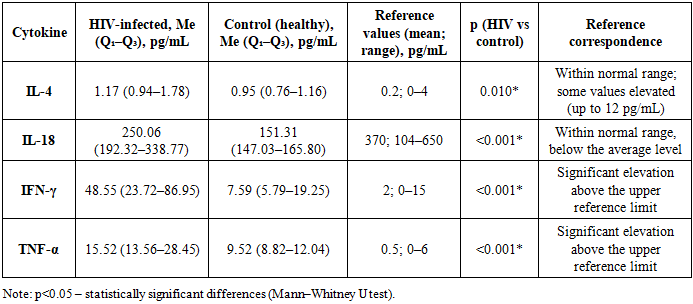
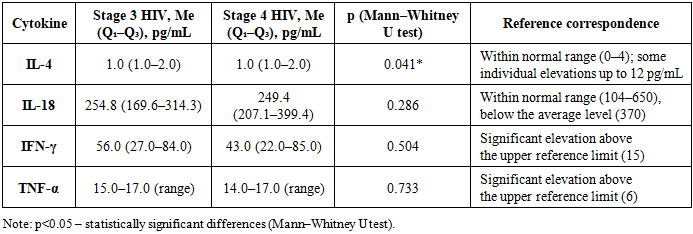
- Cytokine dysregulation is an important component of the pathogenesis of HIV infection, determining the features of inflammatory activation and immune reconstitution during antiretroviral therapy (ART). To assess the nature of these alterations, serum levels of IL-4, IL-18, IFN-γ, and TNF-α were analyzed in adolescents with HIV infection in comparison with a control group of healthy children and with reference values (Table 1).
|
|
4. Conclusions
- The conducted study demonstrated that adolescents with HIV infection receiving antiretroviral therapy exhibit a pronounced dysregulation of the cytokine profile, characterized by:1. A significant increase in IFN-γ and TNF-α levels compared with the control group and the upper limits of reference values;2. A relative elevation of IL-4, which has prognostic value in assessing the risk of disease progression to more advanced stages;3. Variability of IL-18, whose levels generally remain within the normal range but indicate the presence of residual inflammation.The obtained data make it possible to formulate several practical recommendations for implementation in healthcare practice. It is advisable to use the determination of serum IFN-γ and TNF-α levels as additional markers of chronic inflammatory activation in adolescents with HIV infection. Their persistent elevation, even in the presence of an undetectable viral load, reflects ongoing systemic inflammation and may serve as an indicator of the risk for non–AIDS-related complications.The prognostic value of IL-4 was established: a level of ≥1.2 pg/mL is associated with progression to stage 4 of HIV infection (sensitivity 69.0%, specificity 62.5%). This marker can be recommended for inclusion in the immunological monitoring algorithm for adolescents with HIV infection.The assessment of IL-18 levels in HIV-infected adolescents allows the identification of patients with persistent inflammatory activation, even under effective viral load control. This parameter should be considered an additional criterion for evaluating immune system status and planning follow-up strategies.The combined use of CD4+ T-lymphocyte counts, viral load, and cytokine profile data provides a more accurate stratification of patients by the risk of disease progression and complication development, thereby creating opportunities for individualized management of pediatric HIV patients.