
-
Paper Information
- Next Paper
- Previous Paper
- Paper Submission
-
Journal Information
- About This Journal
- Editorial Board
- Current Issue
- Archive
- Author Guidelines
- Contact Us
American Journal of Medicine and Medical Sciences
p-ISSN: 2165-901X e-ISSN: 2165-9036
2025; 15(12): 4698-4701
doi:10.5923/j.ajmms.20251512.111
Received: Nov. 22, 2025; Accepted: Dec. 19, 2025; Published: Dec. 29, 2025

Under the Age of 14 Children of Hospital Infections the Inside of the Incidence and Epidemiological Analysis
 Abstract
 Reference
 Full-Text PDF
 Full-text HTML
F. G. Xomidova1, B. M. Tadjiev2, F. X. Rasulov3
1PhD Student, Republican Specialized Scientific-Practical Medical Center of Epidemiology, Microbiology and Infectious Diseases, Uzbekistan
2Professor, Republican Specialized Scientific-Practical Medical Center of Epidemiology, Microbiology and Infectious Diseases, Uzbekistan
3Associate Professor, Fergana Public Health Medicine Institute, Uzbekistan
Copyright © 2025 The Author(s). Published by Scientific & Academic Publishing.
This work is licensed under the Creative Commons Attribution International License (CC BY).
http://creativecommons.org/licenses/by/4.0/

The coming of the main factors appear nozokomial infections in children: in children with weak immunity, the patient to remain in the long term, and different operating manipulyasiya are coming together other diseases ( hereditary and genetic). The incidence of hospital infections in the republic of 2021-2023 the condition of the inside of the epidemiological analysis is done when the 773 units in the year 2021, 2022-year units, 877, 896 units in the year 2023, while the incidence of the condition was recorded. Also as seen, incidence trends 2021-2023 compared to the year coming into the year, have increased dramatically. The inside of the incidence of hospital infections in children under the age of 14 indicators with absolute 333 units in the year 2021, 2022-year units 410, 431 continues up than while in the year 2023. Regional analysis carrying make the most high indicators 2021-year of Tashkent city (57,35%) and Andijan region (18,6%) was recorded. In the year 2022, while Tashkent, Samarkand and Andijan regions, respectively 51,5%, 15,6% and 8,8% was recorded with. According to the survey results, in the year of 2023 hospital infections in children under the age of 14 with the inside of the incidence of the condition has established the following: the city of tashkent, 57,3%, at Andijan region by 11.6% and Samarkand, the region Surhondaryo 5,8%.
Keywords: Nozokomial infections, Antibiotic-resistant bacteria, Risk factors, Preventive, Staphylococcus aureus, Coagulase-negative staphylococci, Epidemiological and statistical methods
Cite this paper: F. G. Xomidova, B. M. Tadjiev, F. X. Rasulov, Under the Age of 14 Children of Hospital Infections the Inside of the Incidence and Epidemiological Analysis, American Journal of Medicine and Medical Sciences, Vol. 15 No. 12, 2025, pp. 4698-4701. doi: 10.5923/j.ajmms.20251512.111.
1. Introduction
- Hospital-acquired infections (HAIs) are considered one of the most important global public health problems worldwide. Their socio-economic impact is extremely significant. Despite the development of modern diagnostic and therapeutic technologies, the problem of HAIs remains as relevant as ever, creating an urgent medical and social need. Nosocomial infections can lead to a significant increase in mortality rates, length of hospital stay, and healthcare costs, thereby posing a serious global health challenge [2,3]. According to data from foreign researchers, HAIs occur in 5–20% of hospitalized patients [4]. According to the World Health Organization (WHO), on average 8.7% of hospitalized patients may be carriers of nosocomial infection pathogens. Globally, 1.4 million people suffer from diseases acquired under hospital conditions. The current increase and spread of hospital-acquired infections (HAIs) are associated with the following factors: the establishment of large hospital complexes; close and continuous interactions among patients; and the formation of strong and artificial transmission mechanisms of infectious agents, which are related to invasive diagnostic and therapeutic procedures. In addition, the use of complex medical equipment that requires specialized sterilization methods for diagnostic and therapeutic purposes also contributes to this problem.In general, if an infectious disease is detected in a hospitalized patient 48 hours after admission, it is considered a hospital-acquired infection.The main bacterial pathogens associated with nosocomial infections include Staphylococcus aureus, coagulase-negative staphylococci (CoNS), Streptococcus pneumoniae, Escherichia coli, Pseudomonas aeruginosa, Haemophilus influenzae, Klebsiella pneumoniae, Acinetobacter, and Enterococci [4,5].Currently, antibiotics remain the leading method for the treatment of bacterial infections. However, the irrational use of antibiotics under selective pressure has led to the emergence of certain strains of multidrug-resistant (MDR) bacteria. As a result, bacteria that were once susceptible have re-emerged with resistance to various antibiotics, creating limited therapeutic options and increasing the risk of treatment failure and poor patient management [2,6]. In specific clinical settings, knowledge of appropriate antimicrobial prescribing policies, along with the study of pathogens and their antimicrobial susceptibility profiles, is crucial for improving infection control and reducing incidence rates [7]. The purpose of the research. Hospital infections in children under the age of 14 in the year epidemiological study of the condition of the inside of the 2021-2023.
2. Materials and Methods
- The study materials consisted of statistical data on nosocomial infections obtained from the State Sanitary and Epidemiological Service of the Republic of Uzbekistan for the years 2021–2023. Epidemiological and statistical methods were used in the study.
3. Results and Discussion
- The main factors contributing to the occurrence of nosocomial infections in children include:- weakened immune systems in children;- prolonged hospital stays;- various surgical and invasive procedures;the presence of concomitant diseases (hereditary and genetic conditions). Low body weight in children is also a significant risk factor for the development of hospital-acquired infections, with a higher incidence observed in underweight children compared to those with normal or higher body weight. In addition, frequent visits to hospitalized children—primarily by parents—and the co-hospitalization of mothers with breastfed infants during the hospital stay are considered risk factors for the development of HAIs.Despite the implementation of preventive measures in hospitals, the incidence rate remains high. However, the actual number of hospital-acquired infections is often underreported, which negatively affects the effectiveness of prevention and control measures aimed at reducing HAIs.According to the results of the conducted analysis, the incidence of hospital-acquired infections in the Republic showed the following intensive indicators: 2.2 in 2021, 2.5 in 2022, and 2.5 in 2023. By 2023, an upward trend in incidence can be observed.The incidence of nosocomial infections among children under 14 years of age was 333 cases in 2021, 410 cases in 2022, and 431 cases in 2023 (absolute numbers). In proportion to the overall increasing trend of hospital-acquired infections in the population of the Republic, the occurrence of nosocomial infections among children has also been rising (Figure 1,2).
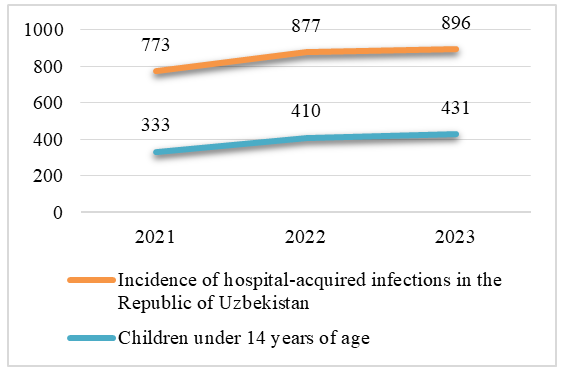 | Figure 1. Absolute numbers of hospital-acquired infections in the Republic of Uzbekistan in 2021–2023 (total population and children under 14 years of age) |
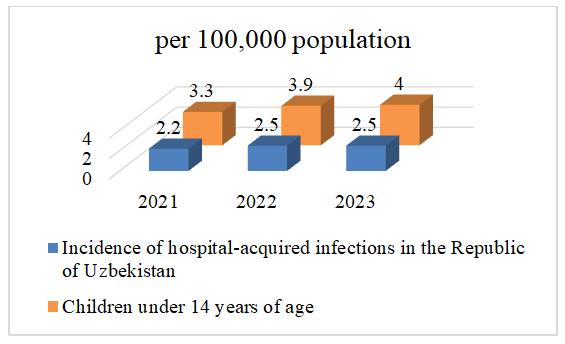 | Figure 2. Incidence rates of hospital-acquired infections in the Republic of Uzbekistan in 2021–2023 (total population and children under 14 years of age) |
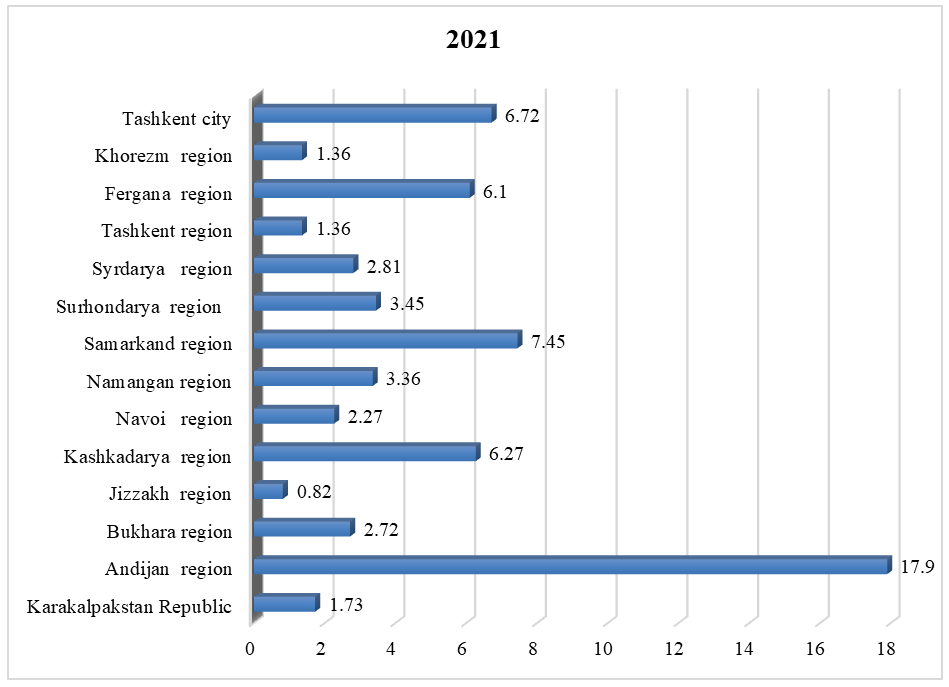 | Figure 3. Incidence of nosocomial infections among children under 14 years of age in 2021 by region |
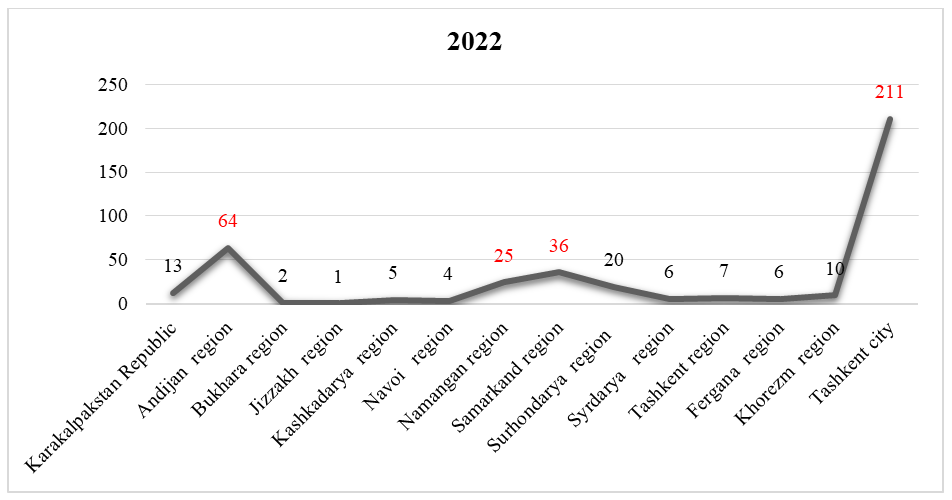 | Figure 4. Incidence of nosocomial infections among children under 14 years of age in 2022 by region |
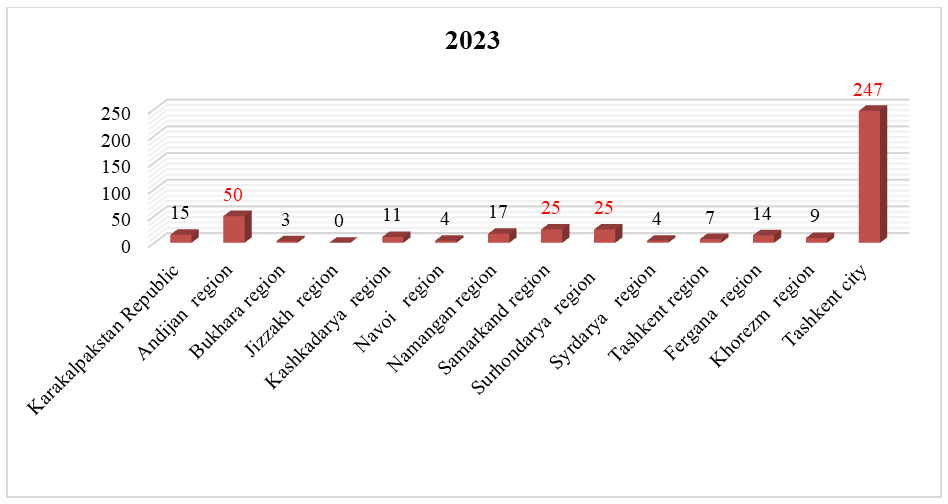 | Figure 5. Incidence of nosocomial infections among children under 14 years of age in 2023 by region |
4. Conclusions
- To implement measures aimed at neutralizing sources of hospital-acquired infections, it is necessary to establish wards for isolating patients with HAIs. Microbiological screening of patients admitted to pediatric surgical units is recommended. Key preventive measures include maintaining cleanliness in medical facilities, adhering strictly to aseptic rules during invasive procedures, and properly sterilizing medical instruments. Special attention should be paid to hand hygiene, including washing and rubbing hands with alcohol-based solutions before and after contact with patients.Nosocomial infections remain a serious threat to the health and lives of patients, especially those with risk factors. To reduce the incidence and mortality of hospital-acquired infections, it is essential to improve infection control and patient care practices, enhance diagnostic methods, and implement new antimicrobial agents in clinical practice.