
-
Paper Information
- Paper Submission
-
Journal Information
- About This Journal
- Editorial Board
- Current Issue
- Archive
- Author Guidelines
- Contact Us
American Journal of Medicine and Medical Sciences
p-ISSN: 2165-901X e-ISSN: 2165-9036
2025; 15(11): 4189-4191
doi:10.5923/j.ajmms.20251511.96
Received: Oct. 12, 2025; Accepted: Nov. 21, 2025; Published: Nov. 28, 2025

Study of the Nutritional Value and Effectiveness of Using the Biologically Active Food Supplement "Numa Vitamin D3" in Animals
 Abstract
 Reference
 Full-Text PDF
 Full-text HTML
Saribaeva G. K., Rustamova M. T., Shaykhova G. I., Khairullaeva S. S.
Tashkent State Medical University, Uzbekistan
Copyright © 2025 The Author(s). Published by Scientific & Academic Publishing.
This work is licensed under the Creative Commons Attribution International License (CC BY).
http://creativecommons.org/licenses/by/4.0/

This article presents the results of an animal study examining the nutritional and biological value of the dietary supplement Numa Vitamin D3 in soft gelatin capsules. Organoleptic, microbiological, and physicochemical methods were used. The study was conducted on male and female rats. Analysis of the results showed that the product is not harmful and does not exhibit cumulative, reactive, or sensitizing properties. The nutritional and biological value and efficacy meet the requirements of the State Department for Sanitary Supervision of Food and Drug Quality.
Keywords: «Numa vitamin D3» soft gelatin capsules, Animal studies, Nutritional value, Efficacy
Cite this paper: Saribaeva G. K., Rustamova M. T., Shaykhova G. I., Khairullaeva S. S., Study of the Nutritional Value and Effectiveness of Using the Biologically Active Food Supplement "Numa Vitamin D3" in Animals, American Journal of Medicine and Medical Sciences, Vol. 15 No. 11, 2025, pp. 4189-4191. doi: 10.5923/j.ajmms.20251511.96.
1. Introduction
- Vitamin D deficiency remains a widespread global health problem affecting both humans and animals. According to the World Health Organization, over 1 billion individuals worldwide suffer from inadequate vitamin D levels, while hypovitaminosis D is detected in more than 30–40% of domestic and agricultural animals in various climatic zones [1]. The prevalence is particularly high in regions with limited sunlight exposure, intensive indoor breeding systems, and imbalanced feeding programs, leading to metabolic disturbances, impaired growth, and weakened immune responses among livestock and laboratory animals [2]. In recent years, nutritional epidemiology has highlighted that vitamin D status is closely linked not only to skeletal health, but also to a wide range of physiological processes, including endocrine regulation, reproductive performance, inflammatory responses, and antioxidant protection [3].Vitamin D3 (cholecalciferol) plays a central role in calcium-phosphorus metabolism, ensuring proper mineralization of bone and cartilage tissues. Numerous studies demonstrate that deficiency of vitamin D3 contributes to rickets, osteomalacia, muscle weakness, and decreased adaptive capacity in animals [4]. Experimental data show that regular dietary supplementation with vitamin D3 leads to increased bone density, enhanced immune resistance, and improved feed utilization efficiency [5]. For example, Khan et al. reported that vitamin D3 supplementation in laboratory rats resulted in significantly higher serum calcium concentration and improved structural parameters of bone tissue compared to non-supplemented controls [6]. Similarly, Ivanova and colleagues demonstrated that livestock receiving vitamin D3-enriched rations exhibited accelerated weight gain, increased productivity, and reduced susceptibility to infectious diseases [7].In recent decades, biologically active dietary supplements (BADs) have become an important component of veterinary nutrition strategies. Their use is aimed at correcting micronutrient deficiencies, optimizing metabolic processes, and improving overall physiological performance. Modern preparations—such as the dietary supplement “NUMA Vitamin D3”—are formulated to ensure high bioavailability, stability, and accurate dosing of cholecalciferol, making them promising for controlled experimental and practical use in animal feeding programs [8]. Preliminary research suggests that technologically improved delivery systems may enhance intestinal absorption of vitamin D3 and prolong its biological activity, which is essential for achieving consistent physiological effects [9].Despite the growing availability of vitamin D3 supplements, there is still a need for comprehensive scientific evaluation of their nutritional value, safety, and biological effectiveness in animals. Understanding how “NUMA Vitamin D3” influences metabolic parameters, growth dynamics, immune function, and biochemical markers is critical for developing evidence-based recommendations for its inclusion in animal diets. Therefore, the present study aims to investigate the nutritional characteristics and functional efficacy of the dietary supplement “NUMA Vitamin D3,” providing a detailed assessment of its biological impact under controlled experimental conditions.Adequate vitamin D status is essential for maintaining the health of people of all ages. Recent studies have shown that vitamin D3 supplementation helps reduce the incidence of acute respiratory viral infections, including the novel coronavirus infection COVID-19. It has been shown that in countries where COVID-19 patients have higher vitamin D3 levels, the risk of complications is significantly lower. Vitamin D3 boosts the body's defenses, reduces the likelihood of a "cytokine storm," maintains lung function, and boosts the body's defenses. Weakness, muscle pain, fatigue, brittle bones, dental problems, and frequent colds are associated with vitamin D3 deficiency. In addition to the effects vitamin D has on the musculoskeletal system, it currently plays an important role in maintaining immunity, mental health, and overall life expectancy [2,4,7]. It helps with osteochondrosis and arthritis, and strengthens bones, joints, and teeth. Enhances calcium and phosphorus absorption, normalizes heart and vascular function [1,3,4,9]. It should be noted that in recent years there has been an increase in the incidence of gout and vitamin D deficiency associated with this pathology, with its worsening course, which determines the relevance of this study [5,6,7,8].Considering the above, research aimed at replenishing ingredients, including vitamin D3 deficiency, is a pressing issue.The aim of the study is to investigate the nutritional value of the dietary supplement "Numa Vitamin D3" and the effectiveness of this product in animals.
2. Material and Research Methods
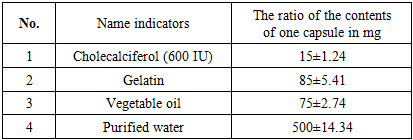
- To achieve this goal, we studied organoleptic, microbiological, and physicochemical studies on rats.Together with employees Nurti Makon Factori " Numa Vitamin D3" soft gelatin capsules were developed, obtained by pressing, with additives of minerals, vitamins, and plant extracts by mixing them, in the form of soft and hard encapsulated forms, intended as an additional source in case of insufficient intake of vitamin D3 from food and intended for sale in the retail and pharmacy network.The nutritional and biological value of the product were studied on male and female white rats in accordance with the purpose, obtained from the zoo section of the USEN GMU. with an initial body weight of 140-160 grams. The animals were kept under standard conditions on a general vivarium food ration, 6 individuals per group, the diet of the experimental groups was supplemented with the studied additives, which were administered through a tube after preliminary grinding of the candies and mixing with water to a suspension. Organoleptic indicators were determined by smell, color and transparency according to GOST 1198; O ' zDSt 950: 2011 - drinking water; O ' zDSt - 1197-2015 - vegetable oils; the content of cholecalciferol (vitamin D3) by high-performance liquid chromatography according to GOST EN 12821-2014. The control methods for physical and chemical indicators were carried out according to the organization standard Ts 309753282:001-2022.The statistical study was conducted using Microsoft Office Excel-2020 and SPSS 22 software packages.
3. Study Results
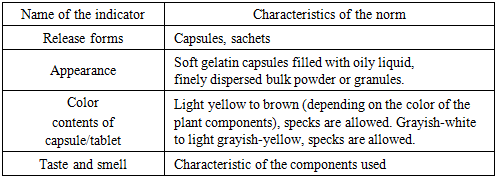
- Organoleptic properties of the dietary supplement "Numa Vitamin D3" soft gelatin capsules in terms of smell, color and transparency they corresponded to GOST 1198 (Table 1).
|
|
4. Conclusions
- Developed in collaboration with Nurti staff. Makon Factori "Numa Vitamin D3" soft gelatin capsules meet the requirements of the State Department for Sanitary Supervision of Food and Drug Quality. The results of the conducted studies of the nutritional and biological value, organoleptic and physicochemical indicators of the product on animals allow us to conclude that Numa Vitamin D3 capsules are not harmful and do not have cumulative, reactive or sensitizing properties. The product activates protein metabolism processes, improves energy supply for biochemical processes occurring in the rats' bodies, improves overall health, and maintains the body's physiological status in an optimal state.