
-
Paper Information
- Next Paper
- Previous Paper
- Paper Submission
-
Journal Information
- About This Journal
- Editorial Board
- Current Issue
- Archive
- Author Guidelines
- Contact Us
American Journal of Medicine and Medical Sciences
p-ISSN: 2165-901X e-ISSN: 2165-9036
2025; 15(11): 4081-4084
doi:10.5923/j.ajmms.20251511.73
Received: Sep. 28, 2025; Accepted: Oct. 22, 2025; Published: Nov. 19, 2025

The Role and Features of Information and Communication Technologies in Improving the Economic Efficiency and Quality of Medical Services Provided to Military Personnel in Medical Institutions
 Abstract
 Reference
 Full-Text PDF
 Full-text HTML
Nasirova Rano Raximovna
Nursing Academy Uzbekistan
Correspondence to: Nasirova Rano Raximovna, Nursing Academy Uzbekistan.
Copyright © 2025 The Author(s). Published by Scientific & Academic Publishing.
This work is licensed under the Creative Commons Attribution International License (CC BY).
http://creativecommons.org/licenses/by/4.0/

Introduction. Digitalization of healthcare is a key area for improving the efficiency of medical care. This process is particularly important in military medicine, where a combination of high efficiency and cost-effectiveness is required. Objective. To comprehensively assess the economic efficiency of implementing the electronic clinic module in military healthcare outpatient clinics. Materials and Methods. A comparative analysis of 201 medical services was conducted, using a before and after analysis. Costing took into account staff salaries, taxes, service time, and direct and indirect costs. Descriptive statistics, calculating mean values and relative changes, were used to assess the economic impact. Results. The implementation of digital technologies reduced the cost of services by an average of 17.7% to 89.7%. The greatest economic impact was achieved through the automation of registration and diagnostic processes (reductions to 77.9–89.7%). A moderate but stable reduction in costs was recorded for outpatient consultations with physicians of various specialties (17.7–32.2%). Discussion. The obtained results confirm that digitalization has a systemic impact on the organizational and economic indicators of medical care. The greatest efficiency is achieved in areas with a high proportion of administrative operations and paperwork, while clinical consultations demonstrate a moderate but stable effect. Conclusion. The study's objective has been achieved: the economic efficiency of implementing the electronic clinic module has been proven. Its use reduces costs while simultaneously improving the accessibility, quality, and timeliness of medical care for military personnel, making digitalization a strategically important area of development for military healthcare.
Keywords: Electronic clinic, Digitalization of healthcare, Economic efficiency, Military medicine, Medical services
Cite this paper: Nasirova Rano Raximovna, The Role and Features of Information and Communication Technologies in Improving the Economic Efficiency and Quality of Medical Services Provided to Military Personnel in Medical Institutions, American Journal of Medicine and Medical Sciences, Vol. 15 No. 11, 2025, pp. 4081-4084. doi: 10.5923/j.ajmms.20251511.73.
Article Outline
1. Introduction
- In recent years, healthcare in many countries has been undergoing a major digital transformation, driven by the active implementation of information and communication technologies (ICT). Their use not only improves diagnostics and treatment but also enhances the economic efficiency of medical institutions by streamlining document flow, reducing time costs, and utilizing resources more efficiently. Digitalization significantly increases the availability of specialized care, shortens wait times for doctor appointments, and enables a new level of interaction between patients and medical staff [1]. The implementation of ICT is particularly important in the military medical system. Military personnel must receive medical care within the shortest possible timeframe, be high-quality, and be cost-effective. The high workload of outpatient care, the need to strictly adhere to diagnostic and treatment standards, and the need for rapid data exchange create conditions in which traditional methods of organizing medical care become insufficient. In this regard, the introduction of an “electronic clinic” is considered a crucial step in optimizing treatment and diagnostic processes, allowing the functions of electronic recording, medical documentation and remote consultations to be combined into a single system [2].Domestic research confirms the high effectiveness of digital solutions in medical practice. For example, the implementation of lean technologies and electronic services is considered a key tool for improving the quality of medical care and process manageability [1]. For military healthcare, the use of ICT creates opportunities for systematic monitoring of personnel health and rationalization of economic costs [2]. The role of outpatient complementary technologies, which contribute to improving the effectiveness of primary health care and the development of integrated service models, is further emphasized [3]. In the social and medical sphere, digitalization demonstrates significant economic benefits, confirming the sustainable value of modern management and information solutions [4].The relevance of this study stems from the need to identify effective organizational and economic tools to improve the effectiveness and quality of medical care for military personnel. The implementation of an "e-clinic" module in military healthcare outpatient facilities appears to be a promising approach, capable of simultaneously optimizing resources and improving patient satisfaction. The objective of the study is to comprehensively assess the cost-effectiveness and impact of implementing the "e-clinic" module on the quality of medical care for military personnel in outpatient facilities.
2. Material and Methods of Research
- The study was conducted as a comparative "before-after" analysis aimed at assessing the economic efficiency of implementing the "electronic clinic" module in the outpatient system of military healthcare. This approach allows us to compare the cost price and cost structure of medical services in traditional and digital formats. The study included 201 types of medical services most frequently provided to military personnel in outpatient settings. The list covers key activities: registration services (initial patient registration, scheduling an appointment); pre-medical examination; consultations with specialist physicians (therapist, pediatrician, general practitioner, neurologist, endocrinologist, infectious disease specialist); diagnostic procedures (ultrasound examination of the pelvic organs, bladder, prostate gland, mammary glands, etc.). This choice of services is due to their high prevalence and significant share in the structure of outpatient clinic expenses.For each service, the full cost was determined, including: the official salary of medical personnel, taking into account vacation pay and mandatory accruals; actual working hours spent serving one patient; the cost of working time and social taxes; direct material costs (consumables, medications); indirect costs (utilities, equipment depreciation, etc.); and the total cost of providing the service. The calculation was conducted using a standardized scheme, which ensured data comparability.To assess the economic impact, the following were compared: the total cost of the service before the implementation of the electronic module; the total cost of the service after implementation, taking into account registration automation, reduction in paperwork, and optimization of staff working hours; the absolute difference in costs (in national currency); and the relative reduction in cost as a percentage.Statistical analysis. All results were summarized in tables and analyzed using descriptive statistics. Mean values and percentage changes were calculated, which allowed us to identify both overall trends and specific differences between service groups.
3. Results and Discussion
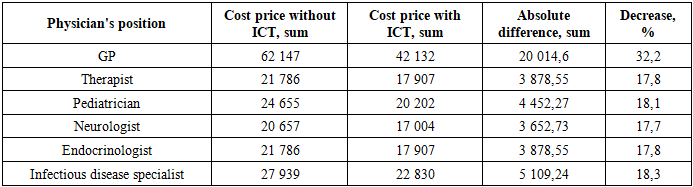
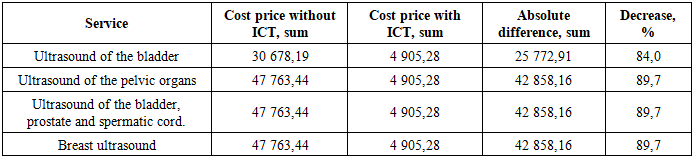
- The analysis showed that the implementation of the "Electronic Outpatient Clinic" module has had a significant impact on the cost and structure of medical services provided to military personnel in outpatient settings. Cost reductions were observed across virtually all service groups, but the degree of economic impact varied depending on the nature of the procedures performed. The greatest efficiency was achieved in automating registration processes. For example, the cost of "initial patient registration" decreased by 77.9%, and "appointment registration" by 61.1%. A more modest cost reduction was observed for pre-medical examinations—by 38.5% (Table 1).
|

|
|
4. Discussion
- The obtained results confirm that the implementation of the "e-clinic" module has a systemic impact on the organizational and economic indicators of medical care for military personnel. The identified reduction in the cost of medical services, ranging from 17.7% to 89.7%, reflects the significant potential of digital technologies as a tool for process optimization. The greatest effect was observed in registration and diagnostic procedures, where the share of administrative operations and document flow is highest. This is consistent with research data indicating the effectiveness of lean and digital technologies in reducing time and material costs in healthcare organizations [1].A moderate reduction in the cost of medical appointments (17.7–32.2%) demonstrates that digitalization cannot fully replace the direct involvement of a specialist; however, it can significantly reduce wasteful expenses. This primarily concerns the time spent on filling out documentation, maintaining medical records, and organizing consultations. These findings are consistent with the results of studies devoted to the role of information technology in monitoring the health of military personnel and optimizing outpatient care [2,3]. Of particular significance is the established reduction in the cost of ultrasound examinations (84–89.7%). This result is explained by the high automation of diagnostic processes, the standardization of protocols, and the reduction in the costs of presenting examination results. The literature emphasizes that the integration of ICT into the diagnostic segment of medical services not only improves the accuracy and reproducibility of data but also allows for a significant reduction in overall costs [3,4]. Our results confirm this thesis and demonstrate its practical significance in the context of military healthcare.At the same time, it's important to remember that the economic impact of digitalization goes beyond reducing direct costs. Improving the accessibility and timeliness of medical care helps reduce repeat visits, improve patient satisfaction, and strengthen trust in the healthcare system. This is especially important in military medicine, as improving the effectiveness of medical care for military personnel directly impacts the combat readiness of personnel and the overall resilience of the defense system.A number of limitations should also be noted. Implementation of the "e-clinic" module requires initial investments in infrastructure, staff training, and technical support. These factors may temporarily increase costs, as confirmed by international experience in healthcare digitalization [1,4]. However, the data obtained demonstrate that the long-term economic impact significantly outweighs the initial costs, and process optimization creates a sustainable model for improving the quality of medical care. A discussion of the results demonstrates that digitalization of the military medical outpatient unit is not only economically feasible but also strategically important. The "e-clinic" is an effective tool capable of combining the objectives of reducing costs, improving service quality, and increasing patient satisfaction.
5. Conclusions
- The obtained results convincingly demonstrate that the implementation of digital technologies leads to a significant reduction in the cost of medical services. The greatest economic impact was observed in registration and diagnostic processes, where cost reductions reached 77.9–89.7%. Doctor appointments also demonstrated a consistent cost reduction of 17.7–32.2%, demonstrating the real potential of digitalization for optimizing clinical practice. Implementation of the module ensures a combination of cost reduction and improved accessibility, quality, and timeliness of medical care. The obtained data confirm that digitalization of the outpatient component of military healthcare is not only rational but also strategically necessary for its development.