
-
Paper Information
- Next Paper
- Previous Paper
- Paper Submission
-
Journal Information
- About This Journal
- Editorial Board
- Current Issue
- Archive
- Author Guidelines
- Contact Us
American Journal of Medicine and Medical Sciences
p-ISSN: 2165-901X e-ISSN: 2165-9036
2025; 15(11): 4077-4080
doi:10.5923/j.ajmms.20251511.72
Received: Sep. 4, 2025; Accepted: Oct. 2, 2025; Published: Nov. 19, 2025

Clinical Features of Acute Intestinal Infections of Various Etiology
 Abstract
 Reference
 Full-Text PDF
 Full-text HTML
Tuychiev Laziz Nodirovich1, A‘zamov Otabek Fakhrutdinovich1, Akhmedova Khalida Yuldashevna2, Akhmedov Murod Rakhmonberdiyevich1
1Tashkent Medical University, Uzbekistan
2Republican Specialized Scientific and Practical Medical Centre of Epidemiology, Microbiology, Parasitology and Infectious Diseases Uzbekistan
Copyright © 2025 The Author(s). Published by Scientific & Academic Publishing.
This work is licensed under the Creative Commons Attribution International License (CC BY).
http://creativecommons.org/licenses/by/4.0/

The high incidence of illness among children, the risk of complications, and the need for differential diagnosis necessitate the study of the clinical features of various etiologies of acute intestinal infections (AII). Objective: to study clinical manifestations depending on the etiological factor. Materials and methods: The study was conducted on 103 children hospitalized with a confirmed diagnosis in 2023. Bacteriological culture and PCR analysis of feces were used to determine the etiology. Results: Viral and combined AII are characterized by a higher frequency of diarrhea and a lower frequency of vomiting compared to bacterial AII. Severe fever predicts the development of severe vomiting and diarrhea. Conclusions: Taking clinical features into account helps to avoid unnecessary medication, reduce hospitalization time, and adjust rehydration therapy in a timely manner.
Keywords: Acute intestinal infections, Etiology, Viral, Bacterial, Clinical features
Cite this paper: Tuychiev Laziz Nodirovich, A‘zamov Otabek Fakhrutdinovich, Akhmedova Khalida Yuldashevna, Akhmedov Murod Rakhmonberdiyevich, Clinical Features of Acute Intestinal Infections of Various Etiology, American Journal of Medicine and Medical Sciences, Vol. 15 No. 11, 2025, pp. 4077-4080. doi: 10.5923/j.ajmms.20251511.72.
Article Outline
1. Introduction
- The relevance of studying the clinical manifestations of acute intestinal infections (AII) depending on their etiology is due to the need to improve the accuracy of diagnosis, timely initiation of adequate treatment, and reduction of the risk of complications. Different pathogens (viruses, bacteria, parasites) cause symptoms and clinical syndromes characteristic of each type of infection, which allows them to be differentiated from each other and the optimal tactics for managing patients to be determined. Understanding the characteristics of clinical manifestations depending on the etiology contributes to a more accurate diagnosis in the early stages of the disease, which is especially important when laboratory diagnostic capabilities are limited or when quick decisions need to be made. For example, viral infections are more often accompanied by watery diarrhea without significant fever, while bacterial infections are accompanied by more severe symptoms, such as high fever, blood in the stool, or signs of intoxication. In addition, knowledge of characteristic symptoms helps to identify potentially dangerous forms of infection and take timely measures to prevent complications such as dehydration, toxic shock, or the development of chronic consequences [2,5,7,11].Thus, studying the clinical manifestations of acute intestinal infections depending on their etiology is an important aspect of modern clinical practice, improving the effectiveness of diagnosis and therapy, as well as contributing to better outcomes for patients [1,4,9].In most cases, it is impossible to determine the etiological nature of acute intestinal infections during the initial examination of a patient, so the diagnosis is carried out in two stages. Stage I is a preliminary diagnosis of acute intestinal infections (AII) . It is based on an assessment of clinical and epidemiological data and allows the etiology of the disease to be assumed before laboratory confirmation of the diagnosis is received. Stage II is the final diagnosis of acute intestinal infections, which becomes possible after receiving the results of laboratory tests (bacteriological, virological, serological, etc.). The outcome of acute diarrhea syndrome largely depends on the timeliness and adequacy of therapy. Before starting treatment, it is important to assess the child's general condition, the degree of dehydration, determine the extent of gastrointestinal tract damage (gastritis, gastroenteritis, enteritis, enterocolitis, colitis) and the nature of the diarrhea [3,8].The high incidence among children, the risk of severe complications, and the need for timely differential diagnosis determine the relevance of studies aimed at identifying the characteristics of the clinical course of AII of various etiologies.In this regard, the aim of our study was to investigate the clinical features of acute intestinal infections depending on the etiological factor [6,10].
2. Material and Methods of Research
- The study involved 103 children hospitalized at the Republican Specialized Scientific and Practical Medical Centre of Epidemiology, Microbiology, Parasitology and Infectious Diseases (RSSPMCEMIPD) clinic in 2023 with a diagnosis of AII. Etiological diagnosis was performed using bacteriological and PCR methods. In 33 patients, the diagnosis was confirmed bacteriologically, and in 70 — molecular genetically. Three groups were identified: AII of viral etiology (n=45; 43,69%), bacterial (26; 25,24%), and combined bacterial-viral intestinal infections (32; 31,07%).
3. Results and Discussion
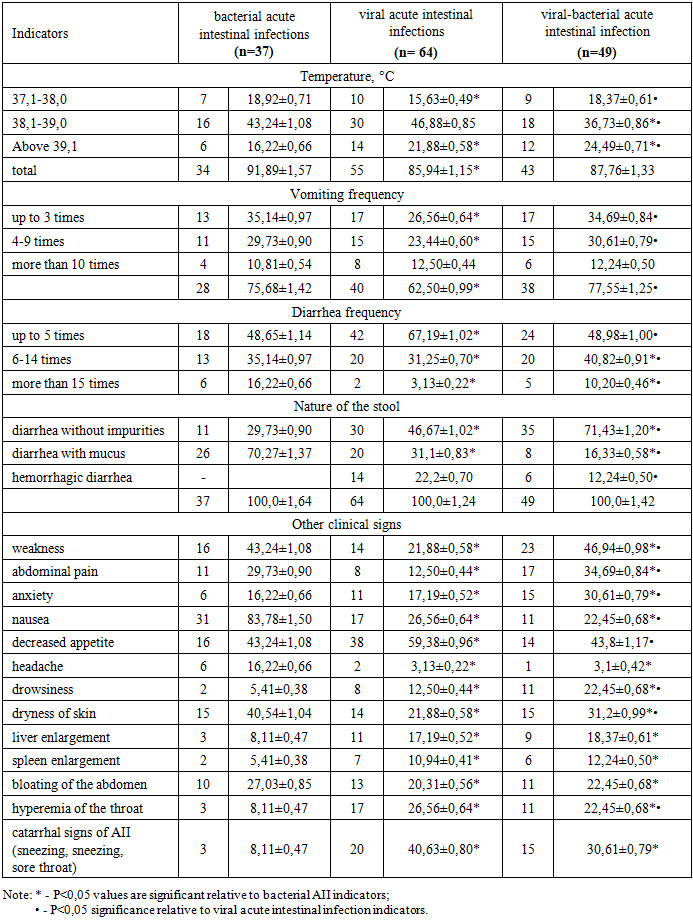
- The clinical manifestations of bacterial, viral, and combined AII were typical, and most children had characteristic symptoms (fever + vomiting + diarrhea), but there were significant differences in some manifestations of the disease.For example, fever was more common in BAII (91,89%) than in VAII (85,94%) and combined AII (87,76%). At the same time, subfebrile temperature was observed mainly only in patients with BAII (16,22%), significantly less in VAII (3,13%) and VBAII CI (6,12%). Hyperthermia (above 39°) was significantly more common in patients with combined viral-bacterial AII (24,49%), while in bacterial AII it was 16,22% and in viral AII it was 21,88%.Diarrhea was observed in all patients regardless of the etiological factor (100%), pathological impurities (mucus) were more often detected in patients with bacterial gastroenteritis (70,3%), less often in viral gastroenteritis (31,1%) and in viral-bacterial gastroenteritis (16,3%). Diarrhea with streaks of blood was significantly more common in patients with V AII (22,2%) than in those with combined AII (12,2%); there were no such patients with bacterial AII.
|
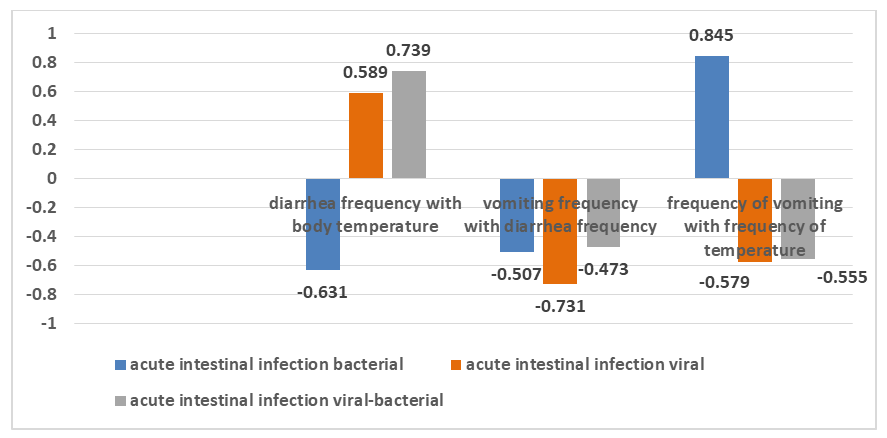 | Figure 1. Correlation coefficients of certain characteristics in acute intestinal infections of various etiologies |
4. Conclusions
- Thus, the data obtained have prognostic significance: the presence of a pronounced feverish reaction allows one to predict the development of severe vomiting, while in viral and viral-bacterial acute intestinal infections, the presence of a pronounced feverish reaction in a patient allows one to predict the development of severe diarrhea syndrome.The clinical manifestations of acute intestinal infections (AII) vary significantly depending on their etiology, which allows characteristic symptoms to be used for differential diagnosis and determining patient management tactics.Viral, bacterial, and combined AIDs have their own characteristics: for example, bacterial infections are more often accompanied by high fever, blood in the stool, and severe vomiting, while viral infections are characterized by less severe fever, a predominance of diarrhea, and less frequent blood in the stool.Correlation analysis showed that the severity of the feverish reaction is a prognostic sign for the development of more severe symptoms, such as vomiting and diarrhea, especially in bacterial and viral-bacterial infections.The data obtained emphasize the importance of comprehensive clinical analysis for timely diagnosis and selection of optimal therapy, and also allow predicting the clinical course of the disease based on the assessment of symptoms.Overall, studying clinical manifestations depending on the etiology of acute gastroenteritis contributes to improving the effectiveness of diagnosis, reducing the risk of complications, and improving outcomes in patients of all age groups.