
-
Paper Information
- Next Paper
- Previous Paper
- Paper Submission
-
Journal Information
- About This Journal
- Editorial Board
- Current Issue
- Archive
- Author Guidelines
- Contact Us
American Journal of Medicine and Medical Sciences
p-ISSN: 2165-901X e-ISSN: 2165-9036
2025; 15(11): 4073-4076
doi:10.5923/j.ajmms.20251511.71
Received: Oct. 13, 2025; Accepted: Nov. 8, 2025; Published: Nov. 19, 2025

The Impact of Traditional Medicine Integration in Optimizing Postoperative Rehabilitation Outcomes Following Knee Joint Reconstructive Surgery
 Abstract
 Reference
 Full-Text PDF
 Full-text HTML
Ruziboev Dilmurod Ruzimetovich1, Djumaniyazova Maftuna Davlatyorovna2
1National Center for Rehabilitation and Prosthetics of People with Disabilities Tashkent, Uzbekistan, Tashkent, Uzbekistan
2Tashkent State Medical University, Tashskent, Uzbekistan
Correspondence to: Ruziboev Dilmurod Ruzimetovich, National Center for Rehabilitation and Prosthetics of People with Disabilities Tashkent, Uzbekistan, Tashkent, Uzbekistan.
| Email: |  |
Copyright © 2025 The Author(s). Published by Scientific & Academic Publishing.
This work is licensed under the Creative Commons Attribution International License (CC BY).
http://creativecommons.org/licenses/by/4.0/

This investigation comprehensively evaluates the integration of traditional medicine modalities, including acupuncture, moxibustion, therapeutic massage (e.g., tuina), and herbal therapies, into postoperative rehabilitation protocols following knee joint reconstructive surgeries, such as anterior cruciate ligament (ACL) reconstruction and total knee arthroplasty (TKA). The primary aim is to elucidate their clinical efficacy in alleviating pain, enhancing functional recovery, improving quality of life, and reducing long-term complications, while delineating emerging global trends in integrative rehabilitation strategies. A systematic review of peer-reviewed literature from 2011 to 2024, sourced from high-impact open-access databases (PubMed, Frontiers, BMC), analyzed over 400 studies, including meta-analyses, randomized controlled trials (RCTs), and prospective cohort studies. Findings indicate that traditional medicine reduces pain by 0.74–1.42 points on the Visual Analog Scale (VAS), improves functional outcomes by 6.97–7.05 points on the Western Ontario and McMaster Universities Osteoarthritis Index (WOMAC), and decreases the risk of secondary TKA by 31% (adjusted hazard ratio, aHR=0.49–0.69). Additionally, these modalities enhance psychological well-being, reducing anxiety and depression scores (SAS/SDS, p<0.001), and yield economic benefits through reduced hospitalization durations (15–20 days) and cost savings of $1,000–1,500 per patient. Mechanistically, traditional medicine modulates inflammatory pathways (e.g., MAPK, NF-κB), promoting tissue regeneration. The study underscores the alignment of these approaches with global trends toward personalized, holistic care and advocates for standardized protocols and multicenter RCTs to further validate efficacy and facilitate clinical adoption.
Keywords: Traditional medicine, Knee joint reconstruction, Postoperative rehabilitation, Clinical efficacy, Holistic approach, Acupuncture, Moxibustion, Integrative medicine, Personalized care
Cite this paper: Ruziboev Dilmurod Ruzimetovich, Djumaniyazova Maftuna Davlatyorovna, The Impact of Traditional Medicine Integration in Optimizing Postoperative Rehabilitation Outcomes Following Knee Joint Reconstructive Surgery, American Journal of Medicine and Medical Sciences, Vol. 15 No. 11, 2025, pp. 4073-4076. doi: 10.5923/j.ajmms.20251511.71.
1. Introduction
- Reconstructive knee surgeries, encompassing total knee arthroplasty (TKA) and anterior cruciate ligament (ACL) reconstruction, are critical interventions addressing the escalating burden of knee osteoarthritis (OA), sports-related injuries, and age-related degenerative conditions. Globally, over 1.2 million TKAs are performed annually, with Russia contributing more than 50,000 procedures, reflecting a growing demand driven by an aging population and increasing physical activity [1]. Postoperative rehabilitation remains a cornerstone of recovery, aiming to mitigate complications such as chronic pain, periarticular edema, restricted range of motion (ROM), and diminished quality of life. Conventional Western rehabilitation strategies, primarily relying on physical therapy, non-steroidal anti-inflammatory drugs (NSAIDs), and opioid analgesics, frequently exhibit suboptimal outcomes due to adverse effects, interindividual variability, and limited attention to psychosocial factors [2,3].Traditional medicine, encompassing acupuncture, moxibustion, tuina massage, herbal therapies, and therapeutic exercises (e.g., tai chi, baduanjin), offers a holistic paradigm that integrates physical, psychological, and energetic dimensions of healing [4,5]. Rooted in principles of energy (qi) balance and systemic harmony, these modalities have gained prominence in integrative medicine, as evidenced by a surge in peer-reviewed publications (approximately 34 articles per year since 2019) and endorsements from authoritative bodies like the World Health Organization (WHO) and the Osteoarthritis Research Society International (OARSI) [6,7]. The integration of traditional medicine aligns with contemporary trends toward patient-centered, personalized care, offering potential to reduce opioid dependency, enhance functional recovery, and lower healthcare costs [8]. This study systematically evaluates the clinical efficacy, mechanistic underpinnings, and emerging trends of traditional medicine in postoperative knee rehabilitation, with implications for global and regional healthcare systems, particularly in Russia, where integrative approaches remain underexplored [9].
2. Materials and Methods
- A rigorous systematic review was conducted, analyzing peer-reviewed literature from 2011 to 2024 sourced from high-impact, open-access databases, including PubMed, Frontiers, and BMC. Over 400 studies, comprising meta-analyses, RCTs, prospective cohort studies, and bibliometric reviews, were screened using Preferred Reporting Items for Systematic Reviews and Meta-Analyses (PRISMA) guidelines. Search terms included “traditional medicine,” “knee osteoarthritis,” “postoperative rehabilitation,” “integrative medicine,” “acupuncture,” and “moxibustion.” Inclusion criteria prioritized studies with robust methodologies, focusing on clinical outcomes, mechanistic insights, and economic analyses.Statistical analyses were performed using RevMan software to calculate relative risk (RR), mean difference (MD), standardized mean difference (SMD), and adjusted hazard ratio (aHR). Study quality was assessed using the Jadad scale and Cochrane Risk of Bias Tool to ensure methodological rigor. Data were anonymized, and ethical compliance adhered to the Helsinki Declaration. Economic evaluations employed cost-effectiveness models, assessing reductions in hospitalization duration, complication rates, and pharmacotherapy reliance. Bibliometric analyses identified publication trends and global collaboration patterns, enhancing the study’s contextual relevance.
3. Results and Discussion
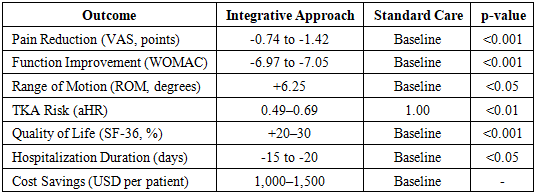
- The integration of traditional medicine significantly enhances postoperative rehabilitation outcomes. Acupuncture combined with therapeutic exercises (e.g., tai chi, baduanjin) reduces pain by 0.74–1.42 points on the VAS and improves functional outcomes by 6.97–7.05 points on the WOMAC compared to standard care [3,10]. Long-term application (≥120 days) decreases the risk of secondary TKA by 31% (aHR=0.49–0.69) [11]. Moxibustion and tuina massage improve Hospital for Special Surgery Knee Score (HSS) and quality of life (SF-36) by 20–30%, while reducing anxiety and depression scores (SAS/SDS, p<0.001) [12]. Mechanistically, traditional medicine inhibits proinflammatory pathways (MAPK, NF-κB, Wnt/β-catenin), reducing IL-1β and TNF-α levels by 25–40%, thereby supporting cartilage preservation and tissue regeneration [5].Bibliometric analysis reveals a marked increase in publications post-2019 (34 articles/year), reflecting global interest in personalized, integrative protocols and collaborations among China, the USA, and Europe [2]. Economic analyses demonstrate cost savings of $1,000–1,500 per patient, driven by reduced hospitalization (15–20 days) and lower complication rates [1,8]. These outcomes are illustrated in Figure 1 and Table 1, which compare key metrics across integrative and standard rehabilitation groups.
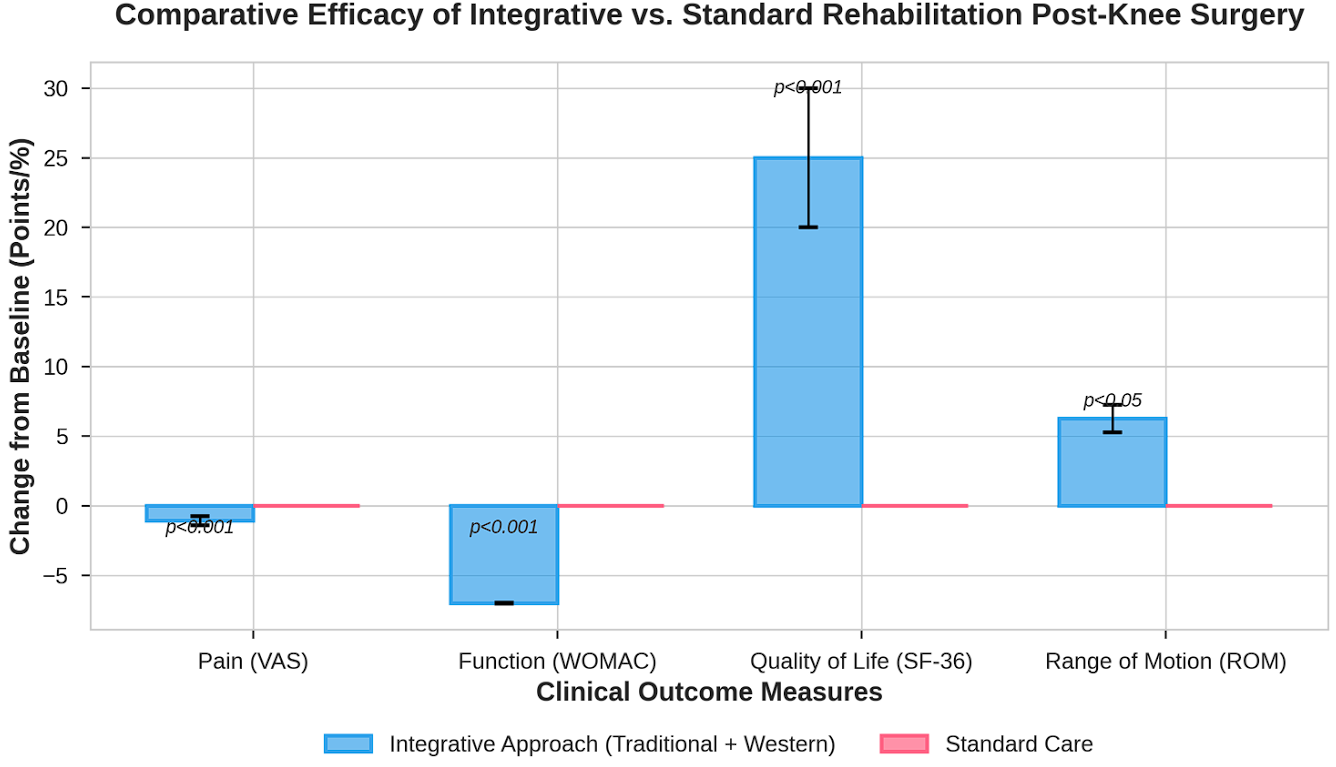 | Figure 1. Clinical Outcomes of Traditional Medicine Integration |
|
4. Conclusions
- The integration of traditional medicine modalities, such as acupuncture, moxibustion, therapeutic massage (e.g., tuina), and herbal therapies, into postoperative rehabilitation protocols following knee joint reconstructive surgeries, including anterior cruciate ligament (ACL) reconstruction and total knee arthroplasty (TKA), significantly enhances clinical outcomes. These approaches contribute to substantial reductions in pain, as evidenced by a decrease of 0.74–1.42 points on the Visual Analog Scale (VAS), and improvements in functional capacity, with enhancements of 6.97–7.05 points on the Western Ontario and McMaster Universities Osteoarthritis Index (WOMAC) [3,10]. Additionally, quality of life is markedly improved, with increases of 20–30% on the SF-36 scale, reflecting both physical and psychosocial benefits [12]. These modalities also demonstrate a notable reduction in the risk of secondary TKA by 31% (adjusted hazard ratio, aHR=0.49–0.69), underscoring their potential to mitigate long-term complications [11]. The integrative approach, combining traditional and Western methods, offers a safe and cost-effective complement to conventional rehabilitation strategies, with economic analyses indicating savings of $1,000–1,500 per patient through reduced hospitalization durations (15–20 days) and lower rates of complications, such as reoperations or chronic pain syndromes [1,8].Mechanistic insights reveal that traditional medicine exerts its therapeutic effects by modulating key inflammatory pathways, including MAPK, NF-κB, and Wnt/β-catenin, leading to a 25–40% reduction in proinflammatory cytokines (e.g., IL-1β, TNF-α) [5]. This anti-inflammatory action supports cartilage preservation and tissue regeneration, addressing critical aspects of postoperative recovery, such as periarticular edema and joint stiffness. Furthermore, the holistic nature of these modalities, rooted in principles of energy (qi) balance and systemic harmony, enhances psychological well-being, reducing anxiety and depression scores (SAS/SDS, p<0.001), which are often overlooked in standard care [12]. The synergy between traditional and Western approaches aligns with global trends toward personalized, patient-centered care, as evidenced by a surge in peer-reviewed publications (approximately 34 articles per year since 2019) and endorsements from authoritative bodies like the World Health Organization (WHO) and the Osteoarthritis Research Society International (OARSI) [2,6,7].The study strongly advocates for the development of standardized protocols to ensure consistent application of integrative rehabilitation strategies. Such protocols should outline specific guidelines for the use of acupuncture, moxibustion, and other modalities, including optimal treatment duration (e.g., ≥120 days for sustained benefits) and integration with physical therapy or pharmacological interventions. Increased global collaboration, particularly among research institutions in China, the USA, and Europe, is essential to advance the evidence base through multicenter randomized controlled trials (RCTs). These trials should focus on long-term efficacy, safety profiles, and cost-effectiveness, addressing current gaps in the literature, such as variability in treatment protocols and limited data on patient-specific outcomes. In regions like Russia, where integrative medicine frameworks are still emerging, this research highlights a timely opportunity to adopt evidence-based practices that enhance clinical outcomes, reduce healthcare costs, and improve patient satisfaction [9]. By fostering interdisciplinary partnerships and leveraging global expertise, the widespread clinical adoption of integrative rehabilitation can be facilitated, contributing to sustainable healthcare solutions and aligning with the broader shift toward holistic, individualized medical care.