American Journal of Medicine and Medical Sciences

p-ISSN: 2165-901X    e-ISSN: 2165-9036

2025;  15(11): 3980-3985

doi:10.5923/j.ajmms.20251511.52

Received: Oct. 15, 2025; Accepted: Nov. 6, 2025; Published: Nov. 14, 2025

 

Trend in the Occurrence of CHD and Some Risk Factors Among People with Impaired Glucose Tolerance

U. K. Kayumov1, N. G. Ashurova2

1Center for the Development of Professional Qualifications of Medical Professionals, Uzbekistan

2Bukhara State Medical Institute, Bukhara, Uzbekistan

Correspondence to: U. K. Kayumov, Center for the Development of Professional Qualifications of Medical Professionals, Uzbekistan.

Email:

Copyright © 2025 The Author(s). Published by Scientific & Academic Publishing.

This work is licensed under the Creative Commons Attribution International License (CC BY).
http://creativecommons.org/licenses/by/4.0/

Abstract

Metabolic syndrome (MS) is a combination of interrelated metabolic disorders such as obesity, hyperglycemia, hyperlipidemia, and hypertension. These disorders significantly increase the risk of developing a number of comorbid and polymorbid diseases, including atherosclerosis, coronary heart disease( CHD), cerebrovascular disorders (CVD), arrhythmias, heart failure, liver, kidney, bone, joint and muscle diseases, psychiatric disorders, gout, chronic kidney disease (CKD), hemostasis disorders, neurosis and depression.

Keywords: Metabolic syndrome, Impaired glucose tolerance, Insulin resistance

Cite this paper: U. K. Kayumov, N. G. Ashurova, Trend in the Occurrence of CHD and Some Risk Factors Among People with Impaired Glucose Tolerance, American Journal of Medicine and Medical Sciences, Vol. 15 No. 11, 2025, pp. 3980-3985. doi: 10.5923/j.ajmms.20251511.52.

1. Introduction

DM and IGT have a significant impact on the risk factors for various diseases. At the same time, they themselves are among the most common metabolic disorders that significantly increase the risk of developing other diseases. According to the International Diabetes Federation (IDF), the number of people with diabetes exceeded 537 million in 2021, and this figure may increase to 783 million by 2045 [56]. These conditions are associated with a variety of risk factors, such as hypertension, obesity, dyslipidemia, hyperuricemia, intestinal microflora disorders, micronutrient deficiencies, and psychiatric disorders, including depression and neurosis (3, 10).. These risk factors not only worsen the course of the underlying disease, but also contribute to the development of cardiovascular diseases, chronic kidney failure, cancer, and other complications. Therefore, the study of the influence of DM and IGT on these risk factors, with an emphasis on their prevalence, pathogenesis and clinical significance, is important for understanding the mechanisms of formation of comorbid diseases [1,7,52].
Thus, the metabolic syndrome has a significant impact on the development of many comorbid and polymorbid diseases. The high prevalence of conditions such as atherosclerosis, CHD, NMC, liver and kidney diseases highlights the need for early detection and comprehensive treatment of MS [2,19,53]. Special attention should be paid to the prevention and modification of risk factors, which can significantly reduce the burden on the health system and improve the quality of life of patients.
The modern concept of prevention of internal diseases is based on risk factors. In order to correctly assess the pathogenesis of the disease, it is necessary to have information about its causes, about the factors that cause this disease, about the factors that worsen the course of this disease, as well as about comorbid conditions [5,16,50].
Based on this, we made an attempt to study the main components of the metabolic syndrome. It should be noted that the main components of the metabolic syndrome are very important and serious risk factors for cardiovascular diseases. A very important point in studying various risk factors is to identify them [3,12,42].
Objective: To study the dynamicsin the prevalence of CHD and some risk factors among individuals with impaired glucose tolerance.

2. Material and Methods

A total of 2,394 people were examined. Of these, 894 were examined in Tashkent under the population research program, and 67 patients with metabolic syndrome underwent an in-depth study. The survey was also conducted among the unorganized population of the city of Bukhara. At the same time, to study the dynamics of the prevalence and levels of the main components of MS, 2 groups of individuals were examined. The first group - 797 people were examined in 2006 (materials of the population study of Bukhara residents). After 15 years, 703 more people were examined under the same program (with additions). Both times, the research program provided for the identification of the main components of MS [4,13,51].
Research methods: the following methods were used in the work: epidemiological, questionnaire, biochemical and instrumental.
Epidemiological methods included generally accepted methods for population studies: selection of a representative sample, achievement of a sufficient population response of at least 75%, application of standardized and unified methods, all methods used represent the WHO list for population work [8,12,18,55].
Biochemical methods of research: - the state of glycemia was studied according to the results of a standard glucose tolerance test (TSH). Along with the usual tests-fasting glucose and 2 hours after sugar load, glycemia was also determined after 1 hour. The glucose content was determined in capillary blood using an automatic glucose analyzer. The indicators were evaluated according to the WHO criteria (WHO, 1999): IGT-fasting hyperglycemia (fasting glucose level >5.6 mmol/l and <6.1 mmol/L, with glycemic levels 2 hours after glucose loading <7.8 mmol/l; hyperglycemia 2 hours after glucose loading (glucose level >7.8 mmol/l and <11.1 mmol/ l at normal fasting blood glucose levels. In order to study the sympathoadrenal phase of the glycemic curve, in addition to the WHO criteria, cases of IGT associated with hyperglycemia were detected 1 hour after glucose loading (glucose level >8.88 mmol/ l). Diabetes mellitus - fasting hyperglycemia >6.1 mmol/l and 2 hours after glucose loading >11.1 mmol/l.
- blood lipids: the level of cholesterol (CH) and triglycerides (TG) was determined in venous blood. > 6,1 mmol/L Hypercholesterolemia (HC) was recorded at a cholesterol level > 6.1 mmol/L Hypercholesterolemia, and TG > 1.7,7 mmol/L was taken for hypertriglyceridemia (IGT).
- glycosylated hemoglobin (HbA1c) was studied in venous blood by colorimetric method. HbA1c levels below 5.7% were considered normal, values from 5.7% to 6.4% were assessed as IGT, and when HbA1c levels exceeded 6.4%, diabetes mellitus was diagnosed.
Instrumental research methods:
- when assessing body weight, the criteria of the WHO International Group on Obesity (IOTF WHO, 1997) were used, based onthe Ketle index levels: weight(kg)/height(m)2. Cases of a Ketle index level from 25 to 29.9 were attributed to BMI, and if the IQ level was ≥30, it was recorded as obesity. Abdominal obesity (AO) was detected in accordance with the recommendations of the International Diabetes Federation [1,3,27].
- The ECG was recorded at rest in 12 standard leads, followed by evaluation according to the Minnesota Code criteria (Rose, and Blackborn, 1968) [16,17,51].
- blood pressure (BP) was measured according to the standard method, taking into account the average values of two measurements, blood pressure indicators were classified according to WHO recommendations (WHO, 1999). Due to the population-based nature of the study, the analysis was performed in 2 groups: group 1 - individuals with normal blood pressure: SBP < 139 mmHg.рт.ст and / or DBP < 89 mmHg.рт.ст; Group 2 - patients with hypertension-SBP >140 mmHg; DBP > 90 mmHg. 90 мм.рт.ст.

3. Results and Discussions

Impaired glucose tolerance (IGT) may play a role in the pathogenesis of coronary heart disease (CHD). To date, the analysis has been made of cases of CHD identified both at the start of the study and after its completion. At the same time, the group with CHD at the end of follow-up included both patients who already had CHD at the start and people who developed the disease within 12 years after the initial screening [15,27,42].
At the same time, the question of the relationship between the development of new cases of CHD and the presence of GTT is of interest. In this regard, the frequency of new cases of CHD was estimated among two categories: those with GTT detected at the start and those who developed GTT during the next 12 years of follow-up [7,2,22,40].
Analysis of the obtained data indicates that there is a definite relationship between the incidence of "new" cases of coronary heart disease (CHD) and impaired glucose tolerance (IGT). Overall, the incidence of CHD almost doubled over the 12-year follow-up period. However, the nature of these dynamics differed depending on changes in the glycemic status [9,13,19,48].
In the group of individuals who maintained normal glucose tolerance throughout the entire period, "new" cases of CHD were recorded in 18.40% of cases. In those who were diagnosed with HTH at the start of the study, but who experienced normalization of carbohydrate metabolism within 12 years, the incidence of new cases of CHD was 14.06%.
The highest rates of CHD were observed in the group where IGT developed during follow — up-36.36% of new cases. Among individuals with stable HTH that persisted throughout the entire period (from the moment of detection to the end of follow-up), "new" cases of CHD were registered in 23.26% of cases [6,23,47].
It should also be noted that almost every fifth patient with diabetes mellitus (DM), as well as those who had CHD at the start and subsequently developed DM, revealed "new" cases of CHD [2,7,33].
Further, the average blood pressure, Ketle index, and lipid levels were studied among individuals with different glucose tolerance who had CHD at the start of the study and among those who developed this disease within 12 years after the start of the study [4,17,41].
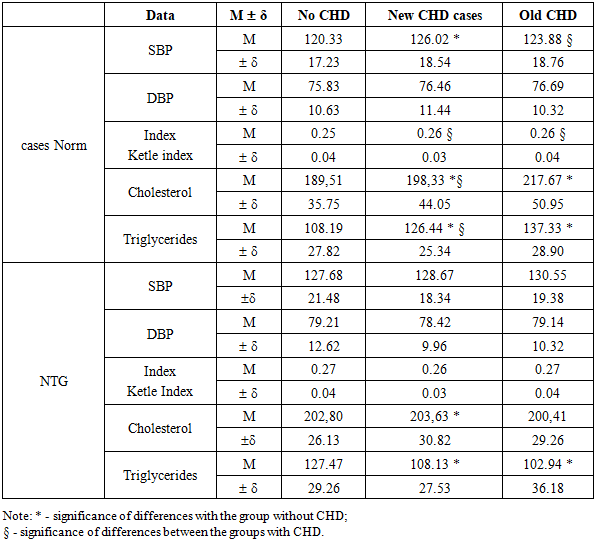
Analysis of the obtained data (tab.1) showed that the initial mean values of blood pressure (BP) in individuals without impaired glucose tolerance (IGT) in groups with "new" and "old" cases of coronary heart disease (CHD) did not differ statistically significantly [3,15,26]. At the same time, the level of systolic blood pressure (SBP) in the group with "new" cases of CHD was significantly higher compared to the group without CHD. In addition, lipid concentrations in the group with "old" cases of CHD were statistically significantly higher than in the group with "new" cases. Lipid levels in individuals without CHD were significantly lower compared to both groups - both with "new" and " old " cases of CHD [4,9,23,50].
At the beginning of the study, the mean BP values in the analyzed groups did not differ statistically significantly in individuals with IGT, although the group with "old" cases of CHD tended to have higher values [9,23,37,54]. At the same time, the total cholesterol and triglyceride levels in individuals without CHD were significantly higher compared to patients with both "new" and "old" cases of CHD [6,33,47,51]. It should also be noted that the average BP values and Ketle index in individuals with IGT in all study groups exceeded the corresponding values in individuals with normal glucose tolerance.
Table 1. Mean BP, Ketle index, and lipid levels at the start of the study among individuals with IGT who subsequently developed new cases of CHD
     
Based on the data presented for the group with normal tolerance, it could be concluded that the level of such indicators as SBP, cholesterol and Ketle index can to some extent serve as predictors of CHD. However, for the group with IGT, these data are not confirmed. It was suggested that there may be some changes in the levels of risk factors in the IGT group over time.
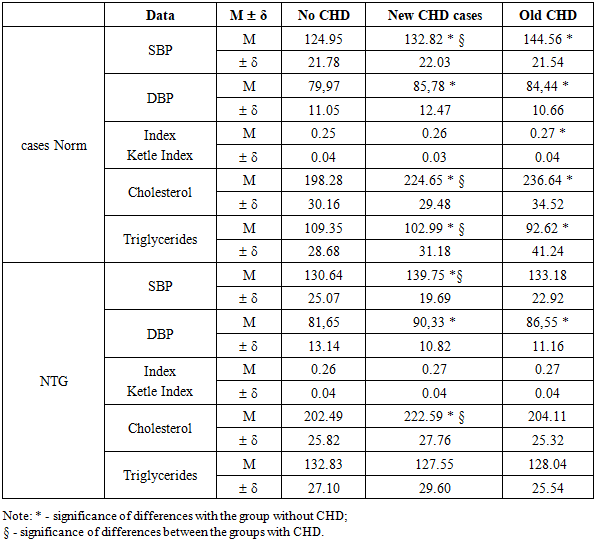
In this regard, in order to assess the effect of IGT on the studied parameters over a 12-year period, we analyzed the average values of blood pressure, Ketle index, and lipid profile at the end of follow-up among individuals who had IGT at the start (Table 2). According to the data obtained, individuals with initially normal glucose tolerance BP and total cholesterol levels were significantly higher after 12 years in the group with CHD compared to the group without CHD [5,18,24,39]. The level of SBP in individuals with "old" cases of CHD was significantly and statistically significantly higher than in the corresponding group without CHD.
Table 2. Mean BP, Ketle index, and lipid levels at the end of the study among individuals who had IGT at the start and subsequently developed new cases of CHD
     
It is interesting to note that the triglyceride content in patients with CHD was lower than in those without CHD. At the same time, the Ketle index was higher in patients with CHD, compared with those without this pathology. Moreover, differences in the Ketle index between groups without CHD and with "old" CHD cases reached statistical significance [15,9,36].
Among those who had IGT at the start of the study, the average levels of all the studied indicators (with the exception of triglycerides) were higher in the groups with CHD after 12 years than in those without CHD. Moreover, such indicators as SBP, DBP and cholesterol levels among patients with "new" cases of CHD were higher than among patients with "old" cases of CHD [12,37,53]. It should also be noted that among those who had IGT at the start of the study, the levels of almost all indicators (except cholesterol) were higher than among those with normal tolerance at the start of the study.
The data shown in Table 2 indicate that IGT has a certain prognostic significance in increasing the level of individual risk factors. This is to some extent associated with an increased risk of developing coronary heart disease [32,13,52].
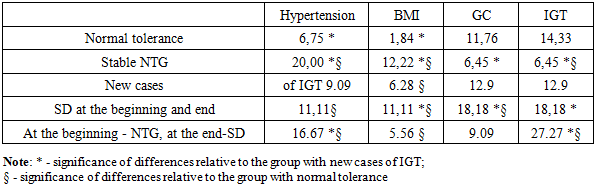
Further, we studied new cases of development of individual risk factors among individuals with different dynamics of IGT. We analyzed the frequency of occurrence of "new" cases of hypertension, BMI, GC and IGT among individuals with IGT at the start, which remained until the end of the study, normal tolerance at the start, which remained until the end of the study, new cases of IGT and cases of DM developed against the background of previous IGT. The study showed (Table 3) that new cases of risk factors occurred in all groups under consideration. However, the frequency of "new" cases in different groups was significantly different [10,14,35].
Table 3. Frequency of new cases of hypertension, BMI, hypercholesterolemia and hypertriglyceridemia among individuals with different IGT dynamics (in%)
     
The frequency of new cases of hypertension in the group with stable normal glucose tolerance was 3 times lower than in the group with stable IGT and 1.3 times lower than in the group with new cases of IGT. It is noteworthy that the frequency of new cases of hypertension among patients with DM detected at the start of the study was 1.5 times lower than among those who developed DM against the background of previous IGT.
The incidence of new cases of BMI among individuals with stable normal glucose tolerance was 3.4 times lower than in the group with new cases of IGT and 6.6 times lower than in the group with stable IGT. The highest frequency of new cases of BMI was observed in the group of patients with DM detected at the start of the study [13,20,41,43].
GC was also most common among individuals with DM detected at the start of the study, and in the groups with stable IGT and stable normal glucose tolerance, the frequency of new HC cases did not have statistically significant differences. The frequency of new cases of IGT was highest in the groups with DM detected at the start of the study and among patients with DM who developed this disease within 12 years against the background of previous IGT.

4. Conclusions

Thus, impaired glucose tolerance impacts the main components of metabolic syndrome differently. The association between IGT and elevated blood pressure, particularly diastolic, increases the risk of coronary heart disease in individuals with IGT. The association of cholesterol and triglyceride levels with IGT among individuals with "new" and "old" cases of CHD, as well as among individuals without CHD, is quite complex and unstable [32,47,53,51].
The formation of new cases of risk factors is closely associated with the presence of IGT, as well as with its transition to manifest diabetes mellitus (DM). This is especially pronounced among patients with newly diagnosed IGT and stable IGT.

References

[1]  Alberti K.G., Zimmet P., Shaw J. The metabolic syndrome—a new worldwide definition. Lancet. 2016; 366(9491): 1059-1062.
[2]  Global burden of diabetes, 1995-2025: prevalence and projections. https://pubmed.ncbi.nlm.nih.gov/9727886.
[3]  Global Prevalence of Prediabetes. https://pubmed.ncbi.nlm.nih.gov/37196350.
[4]  Global burden of diabetes from 1990 to 2021. https://www.cell.com/trends/endocrinology-metabolism/fulltext/S1043-2760 (25)00004-9.
[5]  Global Prevalence of Prediabetes - PMC. https://pmc.ncbi.nlm.nih.gov/articles/PMC10442190.
[6]  Global and regional diabetes prevalence estimates for 2019 and projections for 2030 and 2045. https://www.sciencedirect.com/science/article/abs/pii/S0168822719312306.
[7]  Prediabetes remission to reduce the global burden of type 2 diabetes. https://www.cell.com/trends/endocrinology-metabolism/fulltext/S1043-2760 (25)00004-9.
[8]  National Diabetes Prevention Program (NDPP). https://www.cdc.gov/diabetes/prevention/index.html.
[9]  Advances in non-invasive diabetes diagnostics. https://www.diabetesresearchclinicalpractice.com.
[10]  Powers AC, Stafford JM, Rickels MR. Glucose Intolerance and Hyperglycemia. StatPearls. 2023; 1(1): 23-34. [https://www.ncbi.nlm.nih.gov/books/NBK499910/]
[11]  Davidson MB, Peters AL, Schriger DL. Hyperglycemia in Diabetes: Pathophysiology and Management. StatPearls. 2023; 2(2): 45-56. [https://www.ncbi.nlm.nih.gov/books/NBK430900/]
[12]  Saeedi P, Petersohn I, Salpea P. Global and Regional Diabetes Prevalence Estimates for 2019 and Projections for 2030 and 2045. Diabetes Res Clin Pract. 2019; 157: 107843.
[13]  Beck J, Greenwood DA, Blanton L. Diabetes Self-Management Education and Support in Type 2 Diabetes. Diabetes Educ. 2017; 43(1): 40-53.
[14]  Goran MI, Bergman RN, Avila Q. Impaired glucose tolerance and reduced beta-cell function in genetically predisposed individuals. J Clin Invest. 2015; 125(4): 1739-1751. [https://www.ncbi.nlm.nih.gov/books/NBK597726/]
[15]  Lyssenko V, Almgren P, Anevski D. Genetic predisposition to type 2 diabetes and impaired glucose tolerance. Diabetes. 2018; 67(5): 1113-1120.
[16]  McCarthy MI, Zeggini E, Gloyn AL. Genetics of Type 2 Diabetes. Nat Rev Genet. 2016; 17(1): 56-64.
[17]  Saeedi P, Petersohn I, Salpea P. Global and Regional Diabetes Prevalence 45. Estimates for 2019 and Projections for 2030 and 2045. Diabetes Res Clin Pract. 2019; 157: 107843.
[18]  Cho N.H., Shaw J.E., Karuranga S. IDF Diabetes Atlas: Global estimates of diabetes prevalence for 2017 and projections for 2045. Diabetes Res Clin Pract. 2018; 138: 271-281.
[19]  Forouhi N.G., Wareham N.J., Goyder E. Epidemiology of diabetes and its burden across the globe. Lancet. 2020; 396(10267): 151-164.
[20]  Zheng Y., Ley S.H., Hu F.B. Global aetiology and epidemiology of type 2 diabetes mellitus and its complications. Nat Rev Endocrinol. 2018; 14(2): 88-98.
[21]  Whiting D.R., Guariguata L., Weil C. Global estimates of the prevalence of diabetes for 2011 and 2030. Diabetes Res Clin Pract. 2011; 94(3): 311-321.
[22]  Al-Rubeaan K., Al-Manaa H., Khoja T. Epidemiology of abnormal glucose metabolism in a country facing its epidemic: Saudi Arabia. Diabetes Res Clin Pract. 2015; 107(3): 362-368.
[23]  Faerch K., Borch-Johnsen K., Vaag A. Gender differences in glucose homeostasis and diabetes. Diabetologia. 2018; 61(3): 455-461.
[24]  Heianza Y., Arase Y., Saito K. Gender differences in the association between body mass index and the risk of diabetes mellitus. J Diabetes Investig. 2017; 8(1): 123-130.
[25]  Kautzky-Willer A., Harreiter J., Pacini G. Sex and gender differences in risk, pathophysiology and complications of type 2 diabetes mellitus. Endocr Rev. 2016; 37(3): 278-316.
[26]  Cho N.H., Shaw J.E., Karuranga S. IDF Diabetes Atlas: Global estimates of diabetes prevalence for 2017 and projections for 2045. Diabetes Res Clin Pract. 2018; 138: 271-281.
[27]  Cho N.H., Shaw J.E., Karuranga S. IDF Diabetes Atlas: Global estimates of diabetes prevalence for 2017 and projections for 2045. Diabetes Res Clin Pract. 2018; 138: 271-281.
[28]  Younossi Z.M., Koenig A.B., Abdelatif D. Global epidemiology of nonalcoholic fatty liver disease. Hepatology. 2016; 64(1): 73-84.
[29]  Anderson R.J., Freedland K.E., Clouse R.E. The prevalence of comorbid depression in adults with diabetes. Diabetes Care. 2017; 24(6): 1069-1078.
[30]  Zhao L., Zhang F., Ding X. Gut microbiota in diabetes and metabolic disorders. Nat Rev Endocrinol. 2018; 14(2): 88-98.
[31]  Napoli N., Chandran M., Pierroz D.D. Mechanisms of diabetes mellitus-induced bone fragility. Nat Rev Endocrinol. 2017; 13(4): 208-219.
[32]  Gregg E.W., Zhuo X., Cheng Y.J. Trends in lifetime risk and years of life lost due to diabetes in the USA, 1985–2011: a modelling study. Lancet Diabetes Endocrinol. 2014; 2(11): 867-874.
[33]  Kautzky-Willer A., Harreiter J., Pacini G. Sex and gender differences in risk, pathophysiology and complications of type 2 diabetes mellitus. Endocr Rev. 2016; 37(3): 278-316.
[34]  Nanditha A., Ma R.C.W., Ramachandran A. Diabetes in Asia and the Pacific: Implications for the global epidemic. Diabetes Care. 2016; 39 (3): 472-485.
[35]  Grundy S.M., Cleeman J.I., Daniels S.R. Diagnosis and management of the metabolic syndrome. Circulation. 2015; 112(17): 2735-2752.
[36]  Mottillo S., Filion K.B., Genest J. The metabolic syndrome and cardiovascular risk. J Am Coll Cardiol. 2017; 56(14): 1113-1132.
[37]  Reaven G.M., Lithell H., Landsberg L. Hypertension and associated metabolic abnormalities. Hypertension. 2018; 62(5): 913-921.
[38]  Yki-Järvinen H. Non-alcoholic fatty liver disease as a cause and consequence of metabolic syndrome. Lancet Diabetes Endocrinol. 2019; 2(11): 901-910.
[39]  Eckel R.H., Grundy S.M., Zimmet P.Z. The metabolic syndrome. Lancet. 2020; 365(9468): 1415-1428.
[40]  Ford E.S., Giles W.H., Mokdad A.H. Increasing prevalence of the metabolic syndrome among U.S. adults. Diabetes Care. 2021; 27(10): 2444-2449.
[41]  Alberti K.G., Zimmet P., Shaw J. Metabolic syndrome—a new definition and worldwide prevalence. Diabetologia. 2022; 49(7): 1005-1012.
[42]  Kahn R., Buse J., Ferrannini E. The metabolic syndrome: time for a critical appraisal. Diabetes Care. 2023; 28(9): 2289-2304.
[43]  Cornier M.A., Dabelea D., Hernandez T.L. The metabolic syndrome. Endocr Rev. 2024; 29(7): 777-822.
[44]  Vague J. Sexual differentiation. A factor affecting the forms of obesity. Presse Medicale. 1947; 30: S39–S40. [PubMed] [Google Scholar]
[45]  World Health Organization. Noncommunicable diseases. URL: https://www.who.int/news-room/fact-sheets/detail/noncommunicable-diseases.
[46]  GBD 2019 Risk Factors Collaborators. Global burden of 87 risk factors in 204 countries and territories, 1990–2019: a systematic analysis for the Global 91. Burden of Disease Study 2019. The Lancet, 2020; 396(10258): 1223-1249.
[47]  European Commission. Health at a Glance: Europe 2020. State of Health in the EU Cycle. URL: https://ec.europa.eu/health.
[48]  Centers for Disease Control and Prevention (CDC). Chronic Disease Prevention and Health Promotion. URL: https://www.cdc.gov/chronicdisease/index.htm.
[49]  Marmot M.G., Altman D.G., et al. The benefits and harms of breast cancer screening: an independent review. The Lancet, 2019; 380(9855): 1778-1786.
[50]  Popova S., Rehm J., et al. Trust in healthcare and participation in preventive programs across Eastern Europe. BMC Public Health, 2019; 19: 123.
[51]  Gustavsson A., Svensson M., et al. Cervical cancer prevention in Sweden: A success story. Scandinavian Journal of Public Health, 2021; 49(2): 123-130.
[52]  Knowler W.C., Barrett-Connor E., Fowler S.E. Reduction in the incidence of type 2 diabetes with lifestyle intervention or metformin. N Engl J Med. 2002; 346(6): 393-403.
[53]  Diabetes Prevention Program Research Group. Long-term effects of metformin on diabetes prevention. Diabetes Care. 2019; 42(4): 601-608.
[54]  Finnish Diabetes Prevention Program (FIN-D2D). Long-term outcomes of lifestyle intervention. Diabetes Res Clin Pract. 2021; 137: 178-185.
[55]  Willi C., Bodenmann P., Ghali W.A. Active smoking and the risk of type 2 diabetes. JAMA. 2017; 298 (22): 2654-2664.
[56]  Surwit R.S., Schneider M.S., Feinglos M.N. Stress and diabetes mellitus. Diabetes Care. 2018; 15(10): 1413-1422.