
-
Paper Information
- Next Paper
- Previous Paper
- Paper Submission
-
Journal Information
- About This Journal
- Editorial Board
- Current Issue
- Archive
- Author Guidelines
- Contact Us
American Journal of Medicine and Medical Sciences
p-ISSN: 2165-901X e-ISSN: 2165-9036
2025; 15(11): 3967-3968
doi:10.5923/j.ajmms.20251511.49
Received: Sep. 23, 2025; Accepted: Nov. 3, 2025; Published: Nov. 14, 2025

Gastrointestinal Dysfunction in Haemoblastoses: Focus on Dyspeptic Symptoms
 Abstract
 Reference
 Full-Text PDF
 Full-text HTML
Bekhruz Bakhriddinovich Nurov
Department of Hematology and Clinical Laboratory Diagnostics, Nephrology and Hemodialysis, Bukhara State Medical Institute named after Avicenna, Bukhara, Uzbekistan
Correspondence to: Bekhruz Bakhriddinovich Nurov, Department of Hematology and Clinical Laboratory Diagnostics, Nephrology and Hemodialysis, Bukhara State Medical Institute named after Avicenna, Bukhara, Uzbekistan.
| Email: |  |
Copyright © 2025 The Author(s). Published by Scientific & Academic Publishing.
This work is licensed under the Creative Commons Attribution International License (CC BY).
http://creativecommons.org/licenses/by/4.0/

Dyspeptic symptoms are among the most prevalent gastrointestinal (GI) disturbances in patients with haemoblastoses. These manifestations often arise as a result of chemotherapy-induced mucosal injury, alterations in intestinal microbiota, and systemic metabolic disorders. This study aimed to evaluate the frequency, structure, and clinical characteristics of dyspepsia in patients with haemoblastoses. Methods: A cross-sectional observational study was conducted at the Bukhara State Medical Institute. Clinical symptoms of dyspepsia were recorded and analysed in patients undergoing cytostatic therapy. The study included evaluation of nausea, epigastric pain, bloating, heartburn, and vomiting.
Keywords: Haemoblastoses, Dyspepsia, Chemotherapy, Gastrointestinal symptoms, Supportive therapy
Cite this paper: Bekhruz Bakhriddinovich Nurov, Gastrointestinal Dysfunction in Haemoblastoses: Focus on Dyspeptic Symptoms, American Journal of Medicine and Medical Sciences, Vol. 15 No. 11, 2025, pp. 3967-3968. doi: 10.5923/j.ajmms.20251511.49.
1. Introduction
- Haemoblastoses encompass a group of malignant disorders of the haematopoietic system, including acute and chronic leukaemias, lymphomas, and myelodysplastic syndromes. With advances in cytostatic and immunochemotherapy, survival outcomes have improved substantially. However, treatment-related complications, particularly those involving the gastrointestinal tract, remain a major clinical challenge [1].Dyspepsia, characterized by upper abdominal discomfort, nausea, bloating, and epigastric pain, frequently arises in patients undergoing chemotherapy. The pathophysiology is multifactorial, involving direct mucosal toxicity, neurohormonal alterations, impaired motility, and inflammatory cytokine release [2]. In addition, alterations in gut microbiota, nutritional deficiencies, and prolonged use of proton pump inhibitors may exacerbate symptoms [3].Despite the high prevalence of dyspeptic symptoms, their evaluation is often secondary to haematologic treatment goals. Limited regional data are available regarding the frequency and clinical presentation of dyspepsia among patients with haemoblastoses in Central Asia. The present study aims to assess the occurrence and spectrum of dyspeptic manifestations in this patient population.
2. Materials and Methods
- This observational study was performed at the Department of Internal Medicine, Bukhara State Medical Institute. A total of patients diagnosed with various forms of haemoblastoses were enrolled. Inclusion criteria comprised adults undergoing chemotherapy with no pre-existing gastrointestinal ulcerative or inflammatory disease. Patients with hepatic or renal failure were excluded.Clinical data were collected using structured interviews and physical examinations. Dyspeptic symptoms were classified as nausea, vomiting, bloating, epigastric pain, and heartburn. Symptom frequency and intensity were recorded during active chemotherapy and post-treatment recovery. Laboratory data were used to exclude infectious or metabolic causes of gastrointestinal discomfort. Descriptive statistics were applied for data summarisation, and results were expressed in percentages.
3. Results
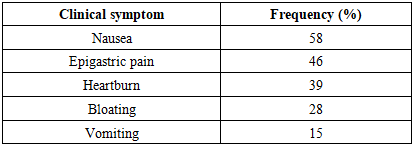
- Among the examined patients, dyspeptic manifestations were found in 72% of cases. Nausea (58%) and epigastric pain (46%) were predominant symptoms. Heartburn occurred in 39% of patients, whereas bloating and vomiting were reported in 28% and 15% respectively. The frequency and distribution of symptoms are shown in Table 1.
|
4. Discussion
- The present study demonstrates that dyspepsia represents one of the most prevalent gastrointestinal disorders in patients with haemoblastoses. Chemotherapy-related mucosal injury, impaired gastric motility, and disturbances in digestive enzyme secretion are considered primary mechanisms [4]. Cytotoxic agents such as anthracyclines and cytarabine have been linked to direct epithelial damage of the gastric mucosa, leading to chronic irritation and functional dyspepsia.The predominance of nausea and epigastric discomfort in this study is consistent with findings reported in other populations [5,6]. Furthermore, dyspepsia may be compounded by hepatotoxic effects of cytostatics, nutritional insufficiency, and psychological stress associated with prolonged treatment. Several studies have indicated a bidirectional relationship between systemic inflammation and gastrointestinal dysmotility, suggesting cytokine-mediated modulation of the enteric nervous system [7].In our cohort, the lower prevalence of vomiting and bloating may reflect effective use of antiemetic prophylaxis. However, persistent symptoms such as heartburn indicate the need for ongoing gastroprotective therapy. Proton pump inhibitors and prokinetics are commonly used; however, excessive suppression of gastric acid may further disrupt microbial balance. Thus, individualised management of dyspepsia in haemoblastoses is necessary.Future research should investigate the correlation between dyspepsia severity and chemotherapy regimens, nutritional intake, and microbiome alterations. Implementation of multidisciplinary care involving haematologists, gastroenterologists, and nutritionists is essential to mitigate gastrointestinal toxicity.
5. Conclusions
- Dyspepsia is a frequent and clinically significant complication in patients with haemoblastoses. The syndrome reflects a combination of mucosal injury, altered motility, and metabolic factors associated with chemotherapy. Recognition and systematic monitoring of dyspeptic symptoms are crucial for optimising patient management and improving quality of life. Further studies focusing on preventive and therapeutic strategies may contribute to enhanced supportive care in haematologic malignancies.