
-
Paper Information
- Next Paper
- Previous Paper
- Paper Submission
-
Journal Information
- About This Journal
- Editorial Board
- Current Issue
- Archive
- Author Guidelines
- Contact Us
American Journal of Medicine and Medical Sciences
p-ISSN: 2165-901X e-ISSN: 2165-9036
2025; 15(11): 3954-3955
doi:10.5923/j.ajmms.20251511.45
Received: Sep. 28, 2025; Accepted: Nov. 2, 2025; Published: Nov. 14, 2025

Diagnostic Significance of Anti-Sperm Antibodies in the Clinical Practice of Reproductive Immunology in Men and Women
 Abstract
 Reference
 Full-Text PDF
 Full-text HTML
Hikmatova N. I., Tosheva I. I.
Bukhara State Medical Institute named after Abu Ali ibn Sina, Bukhara, Uzbekistan
Copyright © 2025 The Author(s). Published by Scientific & Academic Publishing.
This work is licensed under the Creative Commons Attribution International License (CC BY).
http://creativecommons.org/licenses/by/4.0/

Immunological infertility is a significant cause of reduced reproductive function in both men and women. This study evaluated the effects of anti-sperm antibodies (ASA) and cytokines on sperm function in men and reproductive structures in women in 180 patients. Participants were divided into three groups: main (elevated ASA), comparison (increased cytokines), and control (healthy individuals). High ASA levels in men were associated with reduced sperm motility, viability, and normal morphology, with increased DNA fragmentation. In women, ASA and cytokine imbalances negatively affected endometrial function, implantation, and pregnancy outcomes. Correlation analysis showed an inverse relationship between immunological factors and reproductive function. Comprehensive assessment of ASA and cytokine profiles allows individualized prediction and management of infertility and has practical significance for personalized immunological diagnostics, immunomodulatory therapy, antioxidants, and ART.
Keywords: Immunological infertility, Anti-sperm antibodies, Cytokines, Male fertility, Female fertility, MAR test, Reproductive immunology
Cite this paper: Hikmatova N. I., Tosheva I. I., Diagnostic Significance of Anti-Sperm Antibodies in the Clinical Practice of Reproductive Immunology in Men and Women, American Journal of Medicine and Medical Sciences, Vol. 15 No. 11, 2025, pp. 3954-3955. doi: 10.5923/j.ajmms.20251511.45.
1. Introduction
- Immunological infertility is one of the significant causes of reduced reproductive function in both men and women [1,2,3]. In men, anti-sperm antibodies (ASA) and pro-inflammatory cytokines negatively affect sperm motility, viability, morphology, and DNA integrity [4,5,6]. In women, immunological factors include ASA, anti-phospholipid antibodies, autoantibodies to the ovaries and endometrium, and cytokine imbalances that influence implantation and pregnancy outcomes. Identifying immunological factors in infertility allows for accurate diagnosis, prognosis of assisted reproductive technology (ART) outcomes, and personalized treatment strategies [7,8,9,10,11,12,13].Am of the Study. The aim of this study was to investigate the mechanisms by which anti-sperm antibodies and cytokines affect sperm function in men and reproductive structures in women, as well as to develop effective diagnostic and therapeutic approaches for immunological infertility.
2. Materials and Methods
- The study included 180 patients with immunological infertility:• 90 men aged 22–37 years• 90 women aged 23–38 yearsPatients were divided into three groups:1. Main group — patients with high levels of ASA (men and women)2. Comparison group — patients with elevated levels of specific cytokines (IL-1β, IL-6, TNF-α, IFN-γ, IL-10)3. Control group — healthy men and women without immunological infertility factorsMethods:• ASA detection in blood serum and seminal plasma (men) and cervical mucus (women) using the MAR test• Cytokine profiling using ELISA• Assessment of sperm parameters according to WHO 2021 guidelines• Evaluation of female reproductive potential: endometrial quality, hormone levels, presence of autoantibodies, and implantation outcomes during ART
3. Results
|

|
4. Discussion
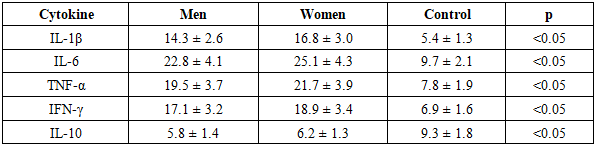
- High ASA levels and cytokine imbalances in women contribute to implantation failure and increased risk of miscarriage. In men, ASA and pro-inflammatory cytokines negatively impact sperm quality. Comprehensive evaluation of immunological factors in both partners allows for individualized diagnostics and therapy, including immunomodulators, antioxidants, and ART.
5. Conclusions
- 1. Immunological factors significantly influence fertility in both men and women.2. Combined assessment of ASA and cytokine profiles ensures high diagnostic accuracy.3. In women, immunological abnormalities are associated with reduced fertility and increased risk of miscarriage.4. Promising therapeutic approaches include immunomodulators, antioxidants, and assisted reproductive technologies.