
-
Paper Information
- Next Paper
- Previous Paper
- Paper Submission
-
Journal Information
- About This Journal
- Editorial Board
- Current Issue
- Archive
- Author Guidelines
- Contact Us
American Journal of Medicine and Medical Sciences
p-ISSN: 2165-901X e-ISSN: 2165-9036
2025; 15(11): 3854-3858
doi:10.5923/j.ajmms.20251511.21
Received: Oct. 8, 2025; Accepted: Oct. 25, 2025; Published: Nov. 7, 2025

Morphological Characteristics of Injuries in Individuals Ejected from the Passenger Compartments of Moving Modern Motor Vehicles
 Abstract
 Reference
 Full-Text PDF
 Full-text HTML
Sh. Sh. Kamalov1, S. I. Indiaminov2
1Tashkent Regional Branch of the Republican Scientific and Practical Center of Forensic Medical Examination, Ministry of Health of the Republic of Uzbekistan, Tashkent, Uzbekistan
2Doctor of Medical Sciences, Professor, ZarMed University, Samarkand, Uzbekistan
Correspondence to: Sh. Sh. Kamalov, Tashkent Regional Branch of the Republican Scientific and Practical Center of Forensic Medical Examination, Ministry of Health of the Republic of Uzbekistan, Tashkent, Uzbekistan.
| Email: |  |
Copyright © 2025 The Author(s). Published by Scientific & Academic Publishing.
This work is licensed under the Creative Commons Attribution International License (CC BY).
http://creativecommons.org/licenses/by/4.0/

An analysis of the results of forensic medical examinations of 164 individuals who sustained injuries as a result of being ejected from the passenger compartments of moving passenger cars was conducted. Among them, 10 individuals were drivers, while the remaining 154 were passengers: 53 of them are front seat passengers and 101 are rear seat passengers. The systematization of injuries to organs and tissues sustained in ejections from moving motor vehicles (in the first and second subgroups) was performed in accordance with the data of S. V. Leonov et al. [1]. It was noted that modifications in the design and structural parameters of vehicle bodies and interiors of modern cars, equipped with active and passive safety systems, together with the considerable increase in driving speeds of new vehicles, have influenced the nature, extent, and mechanisms of trauma resulting from ejections from modern vehicles. These changes have led to a decrease in the diagnostic value and in some cases led to the loss of significance of forensic diagnostic criteria for this type of trauma that had been developed in earlier times. The mechanism of injury formation from ejections from modern vehicles is mainly determined by impacts of body parts against the ground surface during landing (first phase) and only rarely associated with sliding of the body along the ground (second phase).
Keywords: Automobile injury, Modern passenger car, Ejection of individuals from the vehicle compartment, Morphology of injuries, Mechanism of trauma
Cite this paper: Sh. Sh. Kamalov, S. I. Indiaminov, Morphological Characteristics of Injuries in Individuals Ejected from the Passenger Compartments of Moving Modern Motor Vehicles, American Journal of Medicine and Medical Sciences, Vol. 15 No. 11, 2025, pp. 3854-3858. doi: 10.5923/j.ajmms.20251511.21.
Article Outline
1. Relevance
- Worldwide, against the backdrop of a continuous increase in the number of vehicles and their rapid movement, there is a persistent rise in injuries resulting from road traffic accidents, within which automobile trauma continues to occupy the leading position [2]. Ejection of individuals from the passenger compartment or body of a moving vehicle constitutes an independent type of automobile injury, which in the past occurred considerably more frequently, accounting for approximately 24.5% of all types of automobile trauma. In the majority of cases (84%), these were ejections from the bodies of moving trucks, more likely explained by the earlier practice of transporting people in various types of trucks with semi-enclosed or open bodies, and even in tractor trailer carts, most often during agricultural work [4].Nowadays, the designs of vehicle bodies and interiors of all type of cars have significantly changed after being equipped with active and passive safety systems, however their driving speeds have also substantially increased. These factors have contributed not only to a significant reduction in automobile-related injuries overall, and specifically in the incidence of ejections from moving vehicles, but also notably influenced the mechanisms of injury formation, as well as the nature and severity of injuries among individuals who sustain various forms of modern automobile trauma. These facts have prompted the continuation of research in this field.Objective of the study – improvement of forensic medical assessment of injuries resulting from ejection of individuals from the passenger compartments or bodies of moving modern vehicles, based on analysis of the morphological characteristics of trauma in organs and tissue.
2. Materials and Methods of the Study
- The study was conducted on the basis of forensic medical examinations of 164 individuals injured due to ejection from the passenger compartments of moving passenger cars. Of these, 10 were drivers, and 154 were passengers: 53 front seat passengers and 101 rear seat passengers as a majority. In 139 of the 164 observed cases, the vehicles from which drivers and passengers were ejected were modern passenger cars of the Uz-Daewoo brand, while only 23 cases involved older model passenger cars.Special attention was given to the nature of imprints and damage to clothing and footwear, as well as the character, localization, morphology, and extent of organ and tissue injuries during the retrospective analysis of the forensic medical examination reports. The systematization of combined and multiple injuries was carried out in accordance with well-known clinico-morphological classifications. Standardized clinico-morphological classifications of traumatic brain injuries, bone fractures, and internal organ injuries were also taken into account. Case materials were examined, including protocols of on-site inspection of the accident location and the body at the place of discovery, vehicle inspection protocols, and selected results of forensic automotive technical examinations. The systematization of injuries to organs and tissues sustained in ejections from moving motor vehicles (in the first and second subgroups) was carried out in accordance with the data of S. V. Leonov et al. [1]. A comparative analysis of the morphological data of these two subgroups was conducted with the study results. In determining the nature of complications and outcomes of injuries in living individuals who had been ejected in the above types of road traffic accidents, a detailed analysis of medical records and results of additional studies (radiographs, computed tomography, ultrasonography) was performed. The adequacy and validity of forensic medical conclusions regarding severity and mechanism of trauma were evaluated. The obtained data were recorded into coded registration forms for statistical analysis. Statistical analysis was conducted using methods of variation statistics, with determination of the reliability criterion (t), their minimal error (m), and statistical significance of differences (p).
3. Results of the Study
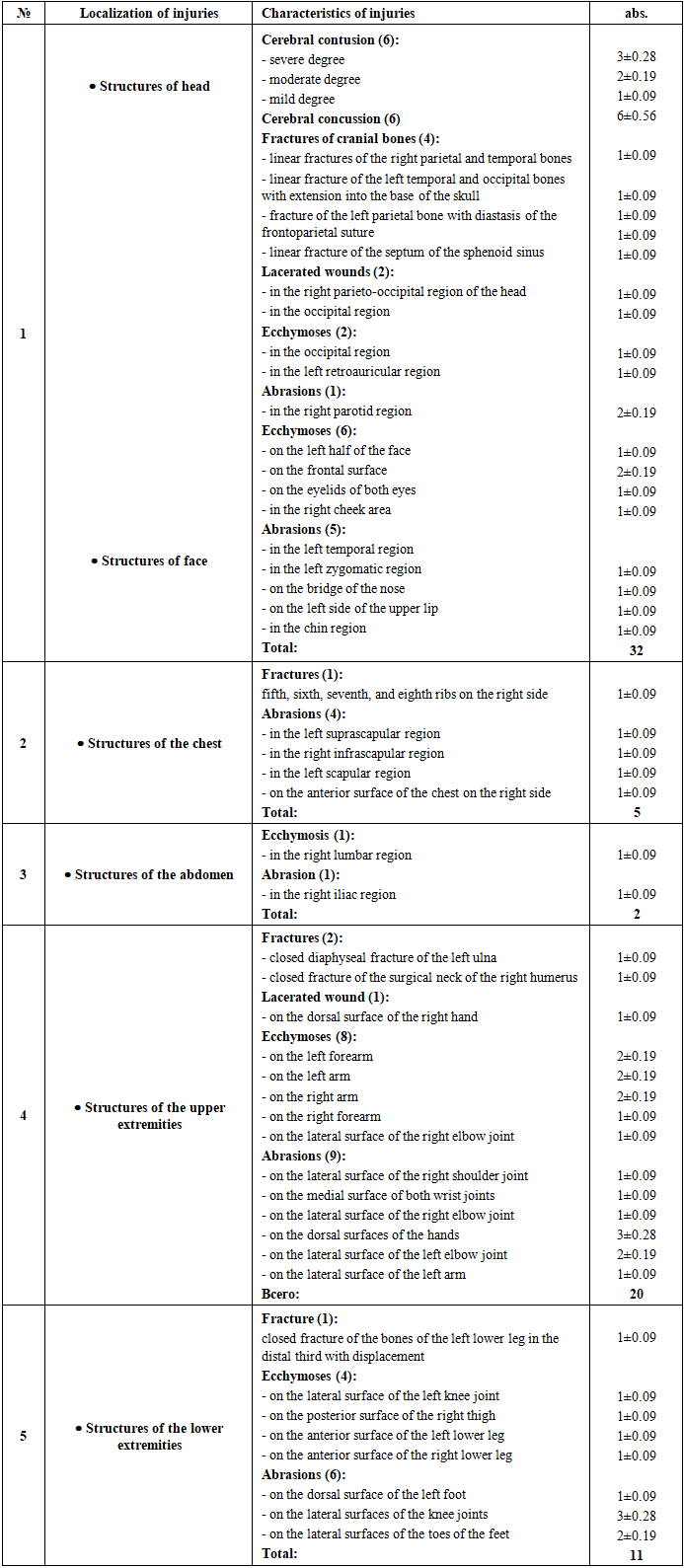
- In drivers injured as a result of ejection from the passenger compartments of moving modern vehicles, in all cases (7) injuries were limited to the external integument, presenting as abrasions and contusions with soft tissue bruising. The majority of these injuries were located on the external and posterior surfaces of the head, trunk, and extremities. Only in a few individuals abrasions were also found on the anteromedial surfaces of the knees and legs. These data indicate that ejections of drivers from the passenger compartments of moving cars are predominantly accompanied by impacts of the posterior-external body surfaces against the road surface.The localization, nature, extent, and frequency of injuries in front seat passengers ejected from moving modern vehicles are presented in Table 1.
|
4. Discussion
- Injuries sustained by individuals as a result of ejection from moving automobiles, despite a significant reduction in frequency under modern conditions compared with their occurrence in the past, remain to this day among the most diagnostically challenging types of trauma. This is due to the polymorphic nature of injuries in organs and tissues, as well as the dependence of trauma mechanisms on numerous conditions and factors. Nevertheless, as the review of the literature has shown, the medico-social and forensic medical aspects of this type of automobile trauma have been studied quite insufficiently. There is a practical absence of guidelines and methodological developments concerning the forensic medical diagnosis of injuries resulting from ejection of individuals from the cabins or bodies of modern automobiles, the structural design and interior components of which differ substantially from those of vehicles of previous decades. The structural features of modern automobiles, their equipment with active and passive safety systems, as well as their higher travel speeds, have significantly influenced the mechanisms of injury formation in individuals affected by any type of modern automobile trauma.According to the data available in the literature, in cases of ejection from the cabin of a passenger automobile, a single variant is observed, whereas in cases of ejection from the body of a truck, three variants occur (forward, lateral, and backward ejection). Each of these variants consists of three phases: collision of the body with the parts of the cabin or vehicle body, falling with impact against the road surface, and subsequent displacement of the body along the road surface. The nature of body injuries depends on the position of the body at the moment of impact. In most cases, during ejection, the injured person strikes the surface with the head, and the position of the body at the moment of impact may be either vertical or horizontal. Specifically, in falls with head landing, localized injuries of the soft tissues of the head, fractures of the cranial bones, and traumatic injuries of the brain are formed, as well as remote injuries of the cranial base, cervical vertebrae, chest, shoulder girdle, and upper extremities. As a result of the shaking of the body, injuries to internal organs are observed, mainly in the form of hemorrhages in the ligaments and suspensory structures, as well as ruptures and tears of organs. Injuries also include impacted fractures of the surgical neck of the humerus and dislocations of the joints of the upper extremities. In cases of falls with landing on the feet, localized fractures of the calcaneus, bones of the foot, and metatarsal bones occur, along with spiral fractures of the tibia and femur, and remote injuries in the form of fractures of the lower thoracic and lumbar vertebrae. Falls on the gluteal region result in localized injuries of the pelvic structures and remote injuries of the lumbar spine, ring-shaped fractures of the cranial base, and signs of internal organ concussion. Falls on the lateral side of the body lead to fractures of the ribs and clavicles, as well as combined injuries of internal organs [3]. We have established that in drivers who sustained injuries as a result of ejection from the cabins of moving modern automobiles, in all cases (7), the injuries consisted solely of damage to the external body covering in the form of abrasions and contusions with bruising of the soft tissues. Most of these injuries were located on the external and posterior surfaces of the head, trunk, and extremities, while in some individuals, in addition to this localization, abrasions were also observed on the anteromedial surfaces of the knees and legs. In front-seat passengers who sustained injuries as a result of ejection from the cabins of moving modern passenger automobiles, severe injuries were predominantly observed in the structures of the head (contusions and concussions of the brain, linear fractures of the parietotemporal and occipital bones), as well as closed injuries of the external body covering, mostly in the regions of the face and extremities. In a number of cases, ejection of front-seat passengers from the cabins of modern passenger automobiles was accompanied by fractures of the upper ribs along the anterior anatomical lines and by diaphyseal and intra-articular fractures of the long tubular bones of the upper extremities. The predominant localization of these injuries on the anterolateral surfaces of the body indicates that such ejections most frequently involve primary impacts of these zones with the road surface. In rear-seat passengers who sustained injuries as a result of ejection from the cabins of modern passenger automobiles, injuries of the head were detected in almost one-quarter of the victims, including brain contusions of severe (4) and moderate (3) degree, and concussions of the brain (14). Brain contusions in 5 cases were accompanied by fractures of the cranial bones in the form of linear fractures and subarachnoid hemorrhages. In the soft tissues of the head, lacerated wounds of the parietal, temporal, and frontal regions on both the right and left sides were noted, as well as hematomas (contusions) in these same areas (6) and in the occipital region (1). In the facial coverings of injured passengers, contusions (11) and abrasions (19) were identified in the orbital, zygomatic, cervicomental, labial, and nasal regions. In the tissues of the thoracic cage of 1 passenger, fractures of the third and fourth ribs along the left anterolateral line were observed. In 2 passengers, fractures of the body and acromial joint of the left clavicle were identified. In the soft tissues of the chest in some injured individuals, bruising of the soft tissues (5) and abrasions (2) were noted on the anterior and posterior surfaces.It should be noted that ejection of rear-seat passengers from the cabins of modern passenger automobiles in 4 cases was accompanied by compression fractures of the lumbar vertebrae: the first (1), the first to the fourth (1), the fourth (1), and the process of the first vertebra (1). In 4 passengers, abrasions in the iliac regions were observed, and in 1 passenger a contusion of this area was recorded. In 1 case, a fracture of the fourth sacral vertebra was identified. Pelvic injuries were detected in 2 passengers, including a fracture of the pubic bone (1) and sprain of the ligaments of the left hip joint. On the gluteal regions, in the sacral and hip joint areas, abrasions (4) and contusions (1) were recorded. The presence of compression fractures of the lumbosacral vertebrae and contusions of the gluteal regions, as well as pelvic injuries, indicate gluteal landing in passengers ejected from automobile cabins. In the structures of the upper extremities of rear-seat passengers, fractures of the bones of the upper (6) and lower (13) extremities were often identified. In particular, fractures included the diaphysis and styloid process of the right ulna, the neck and head of the right humerus, as well as the second metacarpal bone of the left hand. Along with fractures, a dislocation of the head of the right humerus (1) and sprain of the right radiocarpal joint (1) were also observed. Most commonly, abrasions (24) and contusions (10) were recorded on the upper extremities of injured passengers, predominantly on the external surfaces and, to a lesser degree, on the anterior surfaces of the extremities. With respect to the structures of the lower extremities, in 13 cases fractures of the bones were identified, including fractures of the neck of the right femur (1), diaphyseal fracture of the left femur (3), fractures of both bones of the left leg (1), fractures of the right lateral and medial malleolus (2), fracture of the navicular bone of the right foot (1), and fracture of the fourth metatarsal bone of the left foot (1). In addition, there were cases of contusion of the right ankle joint with ligament sprain (1) and hemarthrosis of the right knee joint (1). Abrasions and contusions of the lower extremities were detected in the majority of injured passengers (in more than 50), predominantly located on the anterior and external surfaces of the legs. In rear-seat passengers who sustained trauma as a result of ejection from the cabins of moving modern automobiles, more severe injuries were identified in the structures of the head, chest, spine, pelvis, and extremities, which indicate landings on the head, buttocks, and legs. Injuries of the body coverings were located predominantly on the external surfaces, followed by the anterior and posterior surfaces.
5. Conclusions
- 1. Changes in the design of the interior (cabin) and body structures, in particular the relative smoothness of internal components, as well as their lower elasticity and the reduction in cabin height from ground level, have led to either the absence or extreme rarity of body injuries during the first phase (impact against interior details and structures of the cabin or body) of ejection from modern automobiles. At the same time, the significantly increased speed of movement of modern automobiles has substantially influenced the frequent occurrence of brain contusions (concussions) and chest organ contusions, primarily on the side of body impact with the ground surface;2. The mechanism of trauma formation from ejection from modern automobiles is primarily determined by impact of body parts with the ground surface at landing (first phase) and is only rarely associated with the sliding of the body along the ground (second phase).