American Journal of Medicine and Medical Sciences

p-ISSN: 2165-901X    e-ISSN: 2165-9036

2025;  15(11): 3775-3778

doi:10.5923/j.ajmms.20251511.05

Received: Sep. 10, 2025; Accepted: Oct. 10, 2025; Published: Nov. 3, 2025

 

The Role of Biomarkers by Age and Sex in Acute Ischemic Stroke

Vakhabova N. M.1, Bokiyeva F. A.2, Abduvahobov A. A.2, Nuraliyeva A. Sh.3, Kodirova S. A.3

1Doctor of Medical Sciences, Tashkent State Medical University, Tashkent, Uzbekistan

2Neurologist of Department of Neurology and Medical Psychology, Tashkent State Medical University, Tashkent, Uzbekistan

3Master’s Student, Department of Neurology and Medical Psychology, Tashkent State Medical University, Tashkent, Uzbekistan

Correspondence to: Vakhabova N. M., Doctor of Medical Sciences, Tashkent State Medical University, Tashkent, Uzbekistan.

Email:

Copyright © 2025 The Author(s). Published by Scientific & Academic Publishing.

This work is licensed under the Creative Commons Attribution International License (CC BY).
http://creativecommons.org/licenses/by/4.0/

Abstract

In recent years, increasing attention has been paid to “novel” risk factors that promote the development of chronic dysmetabolic processes in the vascular walls and brain tissues. Among these, hyperhomocysteinemia (HHcy) holds a special place. According to several authors, HHcy is closely associated not only with damage to intracranial and visceral vessels but also plays a role in the pathogenesis of cerebral vascular accidents. HHcy adversely affects vascular autoregulation, lipid metabolism, and the blood's coagulation potential.

Keywords: Acute ischemic stroke, Hyperhomocysteinemia, Endothelial dysfunction, Homocysteine, Thrombomodulin, Endothelin-1

Cite this paper: Vakhabova N. M., Bokiyeva F. A., Abduvahobov A. A., Nuraliyeva A. Sh., Kodirova S. A., The Role of Biomarkers by Age and Sex in Acute Ischemic Stroke, American Journal of Medicine and Medical Sciences, Vol. 15 No. 11, 2025, pp. 3775-3778. doi: 10.5923/j.ajmms.20251511.05.

1. Introduction

One of the key objectives faced by angioneurologists is to provide effective and appropriate care not only in the acute phase of ischemic stroke (IS) but also during the early recovery phase. This necessitates an in-depth study of the pathogenesis of brain structural damage occurring in the early post-stroke period [1]. According to some researchers, there is a rapid increase in endothelial dysfunction markers following acute IS. Endothelial dysfunction is often associated with increased total plasma homocysteine levels and may be partially related to oxidative stress. Other authors suggest that thrombomodulin is associated with cerebrovascular ischemic conditions and may serve as an important biomarker for the early onset of ischemic stroke. Our findings confirmed that thrombomodulin levels in AIS patients were significantly higher than in both the control group and CCI patients (p<0.05), indicating severe endothelial dysfunction in the acute phase [2].

2. Materials and Methods

A study of biochemical markers of endothelial dysfunction (homocysteine, thrombomodulin, and endothelin-1) was conducted in 165 patients with acute ischemic stroke (AIS), of whom 29 had chronic cerebral ischemia (CCI). The control group consisted of 30 practically healthy individuals without clinical signs of chronic cerebrovascular disorders. Among the 136 patients with AIS in the acute phase, 26.5% (36 patients) were of young age, 40.4% (55 patients) of middle age, and 33.1% (45 patients) of elderly and senile age.

3. Results and Discussion

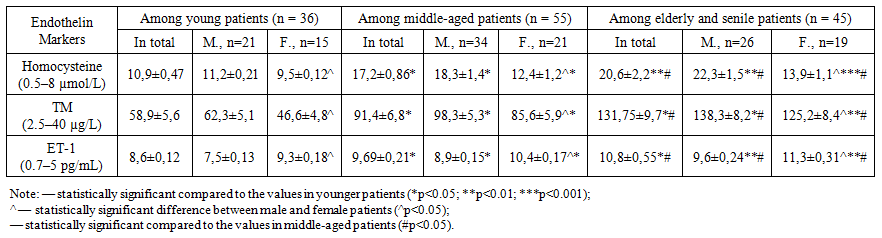
The analysis showed that thrombomodulin (TM) levels in AIS patients during the acute phase were significantly higher compared to those in the control group (p<0.05) and in patients with CCI (p<0.05), indicating a high degree of endothelial dysfunction. Moreover, an age-related increase in TM levels was observed. In young patients, TM levels averaged 58.9±5.6 µg/L, while in elderly and senile patients, the levels were 2.2 times higher (p<0.05).The level of endothelin-1 (ET-1) in AIS patients during the acute phase was on average 3.4 times higher than in the control group (p<0.01). In CCI patients, ET-1 levels were 1.7 times higher than in the control group (p<0.05). With advancing age, ET-1 levels increased from 8.6±0.12 pg/mL in young patients to 10.8±0.55 pg/mL in elderly and senile patients (p<0.001).Correlation analysis showed a moderate to strong direct correlation between age and levels of homocysteine (r=0.568; p=0.002), thrombomodulin (r=0.732; p=0.003), and endothelin-1 (r=0.668; p=0.003).
With aging, these indicators increased significantly: TM levels in elderly and senile patients were 2.2 times higher than in young individuals (p<0.05). Similarly, ET-1 levels were 3.4 times higher in AIS patients than in controls (p<0.01), and 1.7 times higher in CCI patients (p<0.05). In older patients, ET-1 levels reached up to 10.8±0.55 pg/mL, compared to 8.6±0.12 pg/mL in younger patients (p<0.001). Homocysteine levels also rose with age: 2.6-fold increase in younger patients (p<0.05) and 4.8-fold in elderly patients compared to controls (p<0.001).
Compared to the control group, patients with chronic cerebral ischemia (CCI) showed a statistically significant increase in homocysteine levels (p<0.05). In patients in the acute phase of ischemic stroke (IS), this marker was 1.9 times higher in younger individuals and 3.5 times higher in elderly and senile patients (p<0.001).
The study also identified certain patterns in the relationship between biochemical markers of endothelial dysfunction (homocysteine, thrombomodulin, endothelin-1) and sex-related characteristics of the patients [3]. These patterns are presented in Table 1 and illustrate that the severity of endothelial dysfunction and its association with specific biochemical markers vary depending on the patient's sex [4]. This information is of practical importance for the further development of more precise approaches to the prevention and treatment of endothelial dysfunction.As shown in the data, male patients exhibited higher levels of both thrombomodulin and homocysteine across all age groups compared to female patients [5].
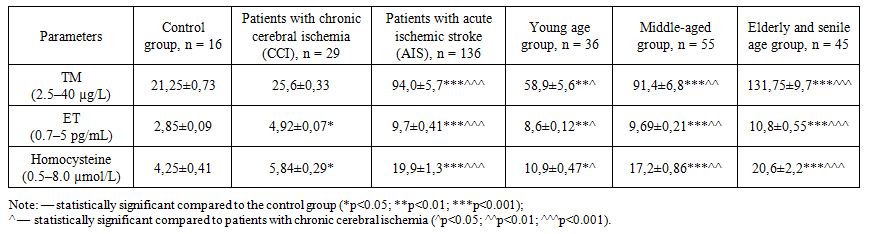
Table 1. Presents age-related quantitative changes in biochemical markers of endothelial dysfunction (homocysteine, thrombomodulin, endothelin-1) in the examined patients
Table 2. Sex- and age-related quantitative changes in biochemical markers of endothelial dysfunction (homocysteine, thrombomodulin, endothelin-1) in patients with acute ischemic stroke
ET-1 levels were significantly higher in female patients compared to males (p<0.01), and this trend was observed across all age groups. We also assessed the relationship between neurological deficit severity and the concentrations of biochemical markers of endothelial dysfunction (homocysteine, thrombomodulin, endothelin-1) during the acute phase of ischemic stroke (IS). It was found that in patients with severe neurological deficit, there was a marked increase in homocysteine (from 10.5±1.2 µmol/L to 21.3±3.1 µmol/L; p<0.001), thrombomodulin (from 65.6±3.2 µg/L to 140.3±6.3 µg/L; p<0.01), and endothelin-1 (from 8.9±0.21 pg/mL to 12.5±0.27 pg/mL; p<0.01) — representing an approximate twofold rise in each marker (Table 3).
Table 3. Changes in biochemical markers of endothelial dysfunction (homocysteine, thrombomodulin, endothelin-1) according to the severity of neurological deficit in patients during the acute phase of ischemic stroke
Furthermore, the predictive significance of elevated biomarker levels for the development of severe neurological deficit was identified. Specifically, a homocysteine level exceeding 16.59 µmol/L (AUC = 0.878, sensitivity – 77.3%, specificity – 89.2%; p<0.001), a thrombomodulin level above 70.0 µg/L (AUC = 0.869, sensitivity – 87%, specificity – 86.3%; p<0.001), and an endothelin-1 level greater than 9.2 pg/mL (AUC = 0.889, sensitivity – 86%, specificity – 84%; p<0.001) were identified as threshold values associated with poor neurological outcomes.

4. Conclusions

An age-dependent increase in the levels of homocysteine, thrombomodulin, and endothelin-1 was observed in patients during the acute phase of ischemic stroke, confirming the presence of pronounced endothelial dysfunction. These elevations, which intensified with age, reflect significant impairments in endothelial function and highlight its critical role in stroke pathogenesis.Sex-specific differences in the levels of endothelial dysfunction biomarkers were also observed: men exhibited higher levels of homocysteine and thrombomodulin, whereas women showed significantly elevated endothelin-1 levels.
The combined use of these biomarkers provides additional insight into the functional state of brain tissue during the hyperacute phase of ischemic stroke and may serve as an important tool for outcome prediction.

References

[1]  M. M. Asadullaev, F. S. Saidvaliev, F. K. Shermukhamedova, J.K. Rizvonov, N.M. Vakhabova (2012). Evaluation of the multimodal effect of cytoflavin in acute cerebral stroke that developed against the background of metabolic syndrome. Journal of Neurology and Psychiatry. SS Korsakov, 112(10), 24-27.
[2]  M.M. Asadullaev, G.S. Rakhimbayeva, N.M. Vakhabova, S.A. Zhangirov, (2021). The frequency of the main neurological symptoms in ischemic stroke among elderly patients. Zbirnik naukovih prats SCIENTIA.
[3]  M.M. Asadullaev, G.S. Rakhimbayeva, N.M. Vakhabova, Sh.A. Zhangirov, (2021). Shtkir ischemic stroke rivozhlanishdagi pathogenetic mechanism. Zbirnik naukovikh prats SCIENTIA.
[4]  N.M. Vakhabova, R. B. Azizova, N. N. Abdullayeva. (2019). Gender characteristics of risk factors and background diseases in different variants of ischemic stroke in elderly and senile people.
[5]  N.M. Vakhabova. (2021). The structure of clinical and neurological symptoms in acute cerebral strokes in men and women in the elderly and senile age. Journal of Neurology and Neurosurgical Research 2(3).
[6]  N.M. Vakhabova. (2021). The specific effect of hyperhomocysteinemia on the occurrence of ischemic stroke of the brain.Journal of Neurology and Neurosurgical Research. Topical issues of neurology. Bukhara, October 20-21, 2021.
[7]  N.V.Vereshchagin. Heterogeneity of stroke:a view from the position of a clinician. Neuropathol Journal. and a psychiatrist. - 2003. - No. 9 - pp. 23-26.
[8]  A.Umarov, N. Vakhabova, A.Prokhorova, , &M.Narzikulova. (2016). PS-82 GENDER FEATURES OF THE RENIN-ANGIOTENSIN-ALDOSTERONE SYSTEM (RAAS) IN PATIENTS WITH ARTERIAL HYPERTENSION IN UZBEKISTAN. Journal of Hypertension, 34, e497.
[9]  A. M. Makhmudovich, R. G. Sattarovna, V. N.Maksudovna, & A. K. Maksudovich. (2020). The Application Of Preparation Mavix In The Complex Treatment Of Ischemic Stroke In The Elderly Age. The American Journal of Medical Sciences and Pharmaceutical Research, 2(12), 55-63.
[10]  A.Umarov, A. Prokhorova, G. Rakhimbaeva, & N. Vakhabova. (2016, January). Stroke indidence and association with risk factors in women in Uzbekistan. In CEREBROVASCULAR DISEASES (Vol. 41, pp. 212-212). ALLSCHWILERSTRASSE 10, CH-4009 BASEL, SWITZERLAND: KARGER.
[11]  A. M. Makhmudovich, R. G. Sattarovna,V. N. Maksudovna, & J. S. Azamatovich,. (2021). Hyperhomocysteinemia And Pathogenetic Mechanisms Of Ischemic Stroke. The American Journal of Medical Sciences and Pharmaceutical Research, 3(02), 66-76.
[12]  A. Umarov, & N. Vakhabova,. (2017, January). Hormonal status in patients with acute ischemic stroke in uzbekistan-cortisol and insulin-like growth factor-1 igf. In CEREBROVASCULAR DISEASES (Vol. 43). ALLSCHWILERSTRASSE 10, CH-4009 BASEL, SWITZERLAND: KARGER.
[13]  A. Umarov, & N. Vakhabova. (2017, January). Hormonal status in patients with ischemic stroke in uzbekistan-cortisol, estradiol and testosteron. In CEREBROVASCULAR DISEASES (Vol. 43). ALLSCHWILERSTRASSE 10, CH-4009 BASEL, SWITZERLAND: KARGER.
[14]  A. Umarov, N. Vakhabova, M. Asadullaev. (2021). Gender characteristics of the main arteries of the head. Journal of the Neurological Sciences 429, 119645, 2021.
[15]  A. Umarov, N. Vakhabova, G.Rakhimbaeva, M. Asadullaev. (2021). The Gender.
[16]  featuresahd its frequency. Journal of the Neurological Sciences 429,119646, 2021.
[17]  D. Akramova, G. Rakhimbaeva, N. Vakhabova, M. Narzikulova. (2017, January). The frequency of ischemic stroke depending on the season and it's gender features. In CEREBROVASCULAR DISEASES (Vol. 43). ALLSCHWILERSTRASSE 10, CH-4009 BASEL, SWITZERLAND: KARGER.
[18]  M. M. Asadullaev, G. S. Rakhimbaeva, N. M. Vakhabova, H. M. Asadullaev, F. M. Mirzaakhmedov, O.Q.Saidnosirov. // Gender Features of Neurological Manifestations in Ischemic Stroke-International Journal Of Pharmaceutical Research.
[19]  M.M. Asadullaev, F.S.Saidvaliev, F.K., Shermukhamedova Zh.K. Rizvonov, N.M.Vakhabova. (2012). Assessment of multimodal effect of cytoflavin in the acute brain stroke in patients with metabolic syndrome.Zhurnal nevrologii i psikhiatrii imeni SS Korsakova, 112(10), 24-27.
[20]  M.M. Asadullaev, N.M. Vakhabova., & H.M. Asadullaev. (2020). Risk Factors and Background Diseases in Different Variants of Ischemic Stroke in the Elderly and Senile Age. International Journal on Orange Technologies, 2(10), 86-88.
[21]  M. Ergasheva, & N. Vakhabova, (2019). New gender-influenced stroke study: Cognitive manifestations in acute ischemic stroke in Uzbekistan. Journal of the Neurological Sciences, 405, 115.
[22]  M. Ergasheva, N. Vakhabova, & G. Rakhimbaeva. (2019). Gender, aging and background diseases influence on the new neuronosological structure of acute ischemic stroke in Uzbekistan. Journal of the Neurological Sciences, 405, 115.
[23]  N. Tolibova., N. Vakhabova., U. Shirasava. (2017). Gender differences in stroke subtypes, severity, risk factors, and outcomes amont elderly patients with acute ischemic stroke among Uzbek population. CEREBROVASCULAR DISEASES 43.
[24]  N.M. Vakhabova, G.S. Rakhimbaeva, M.M. Asadullaev. (2021). Clinical and Neurological Symptoms in Acute Brain Stroke from Gender Dymorphism and Age Features. International Journal of Multidisiplinary Research And Analysis. ISSN: 2643-9840, Volume 04 Issue 10 october. P. 1406-1410.
[25]  N. Tolibova, & N. Vakhabova. (2017). Gender differences in stroke subtypes, severity, risk factors, and outcomes among elderly patients with acute ischemic stroke in Uzbekistan. Journal of the Neurological Sciences, 381, 377.
[26]  N. Tolibova, & N. Vakhabova. (2017). Stroke incidence and association with risk factors in women in Uzbekistan. Journal of the Neurological Sciences, 381, 377.
[27]  N. Tolibova, & N. Vakhabova. (2017, January). Homocysteine levels and functional outcome in patients with ischemic stroke in Uzbekistan. In CEREBROVASCULAR DISEASES (Vol. 43). ALLSCHWILERSTRASSE 10, CH-4009 BASEL, SWITZERLAND.
[28]  Sundseth A., Faiz K.W., Ronning O.M. Factors Related to Knowledge of Stroke Symptoms and Risk Factors in a Norwegian Stroke Population. // J Stroke Cerebrovasc Dis. - 2014 May 6. – vol. 14. - S.1052-3057.
[29]  V. N. Maksudovna. (2016). Indirect influence of hormonal status on the development of ischemic insult and its gender peculiarities. European science review, (9-10).
[30]  U. Makhmudova, & N. Vakhabova, (2019). Gender dependent neuropsychological manifestations study in patients with acute ischemic stroke in Uzbekistan. Journal of the Neurological Sciences, 405, 118-119.
[31]  U. Makhmudova, G.Rakhimbaeva, & N. Vakhabova, (2019). New approach of risk factors and background diseases role in acute ischemic stroke in elderly and senile-aged patients in Uzbekistan. Journal of the Neurological Sciences, 405, 118.
[32]  Abdulle AM, Pathan JY, Moussa N, Gariballa S. Association between homocysteine and endothelial dysfunction markers in stroke disease. Nutr Neurosci. 2017 Feb; 13(1): 2-6. doi: 10.1179/147683010X12611460763562. PMID: 20132648.
[33]  Gimbrone MA Jr, Garcia-Cardena G. Endothelial Cell Dysfunction and the Pathobiology of Atherosclerosis. Circ Res. 2016; 118(4): 620-636. https://doi.org/10.1161/CIRCRESAHA.115.306301.
[34]  Godo S, Shimokawa H. Endothelial Functions. Arterioscler Throtnb Vase Biol. 2017; 37(9): 108-114. https://doi.org/10.1080/14779072.2016.1207527.
[35]  Gattringer T., Posekany A., Niederkorn K., et al. Predicting early mortality of acute ischemic stroke. Stroke. 2018; 50(2): 349–356. DOI: 10.1161/strokeaha.118.022863. PMID: 30580732.
[36]  Girijala RL, Sohrabji F, Bush RL. Sex differences in stroke: Review of current knowledge and evidence. Vase Med 2017; 22 (2): 135-45. DOI: 10.1177/1358863X16668263.
[37]  Dcanfield J.E., Halcox J.P., Rabclink T.J. Endothelial function and dysfunction: testing and clinical relevance. Circulation. 2017; 115(10): 1285-1295. https://doi.org/10.1161.
[38]  Jensen HA, Mehta JL. Endothelial cell dysfunction as a novel therapeutic target in atherosclerosis. Expert Rev Cardiovasc Ther. 2016; 14(9): 1021-1033. https://doi.org/10.1080/14779072.2016.1207527.
[39]  Lyros E, Bakogiannis C, Liu Y, Fassbender K. Molecular links between endothelial dysfunction and neurodegencration in Alzheimer’s disease. Curr Alzheimer Res. 2014; 11 (1): 18-26.