
-
Paper Information
- Next Paper
- Previous Paper
- Paper Submission
-
Journal Information
- About This Journal
- Editorial Board
- Current Issue
- Archive
- Author Guidelines
- Contact Us
American Journal of Medicine and Medical Sciences
p-ISSN: 2165-901X e-ISSN: 2165-9036
2025; 15(11): 3760-3763
doi:10.5923/j.ajmms.20251511.02
Received: Oct. 2, 2025; Accepted: Oct. 27, 2025; Published: Nov. 3, 2025

Specificity of the Positive Features of the Use of "Sensistab" Gel With Individual Cappas in the Process of Orthodontic Treatment of Tooth Row Anomalies and Deformities in Children with Hypersensitivity of Teeth
 Abstract
 Reference
 Full-Text PDF
 Full-text HTML
Bobodustov Ulugbek Kenja Ugli, Saidov Akbar Axadovich
Bukhara State Medical Institute named after Abu Ali Ibn Sino, Bukhara, Uzbekistan
Correspondence to: Saidov Akbar Axadovich, Bukhara State Medical Institute named after Abu Ali Ibn Sino, Bukhara, Uzbekistan.
| Email: |  |
Copyright © 2025 The Author(s). Published by Scientific & Academic Publishing.
This work is licensed under the Creative Commons Attribution International License (CC BY).
http://creativecommons.org/licenses/by/4.0/

Tooth-jawomalias are polyethiological diseases that are congenital or acquired with a developmental disorder of the tooth-jaw system. These anomalies occupied a series of diseases that are most common among diseases of the face-jaw. Tooth-jaw disorders lead to a violation of the aesthetic appearance and functions of the tooth-jaw joint (chewing, breathing, loss and swallowing). In the treatment of tooth-jawomalia, orthodontic constructions are used that are removable and not removable.
Keywords: Dental row abnormalities and deformities in children, Orthodontic treatment, Hypersensitivity of teeth, Sensistab gel, Individual Cappas
Cite this paper: Bobodustov Ulugbek Kenja Ugli, Saidov Akbar Axadovich, Specificity of the Positive Features of the Use of "Sensistab" Gel With Individual Cappas in the Process of Orthodontic Treatment of Tooth Row Anomalies and Deformities in Children with Hypersensitivity of Teeth, American Journal of Medicine and Medical Sciences, Vol. 15 No. 11, 2025, pp. 3760-3763. doi: 10.5923/j.ajmms.20251511.02.
1. Introduction
- During orthodontic treatment, the contents of the oral microflora are altered to include Streptococcus mutans, Candida albicans, Lactobacillus spp., Increased amounts of Enterobacteriaceae have been found to cause inflammatory diseases of dental caries and periodont tissue. Tooth-jaw bite deformities are the second largest prevalence of dental diseases among children. Their diagnosis and treatment are considered one of the urgent tasks in orthodontics, as long as they affect the functions of chewing, causing speech disorders, aesthetic defects and significantly reducing the quality of life, limiting the manifestation of human potential. In addition to the change in the microflora of the oral cavity which with an increase in pathogenic and conditionally pathogenic microorganisms, dysbacteriosis can be observed. During orthodontic treatment, the contents of the oral microflora are altered to include Streptococcus mutans, Candida albicans, Lactobacillus spp., Increased amounts of Enterobacteriaceae have been found to cause inflammatory diseases of dental caries and periodont tissue [2,4,6,8,10,12,14,16]. Several factors are responsible for the course of periodont diseases, which reduce the reactivity of the body and lead to a decrease in secondary immunity. Modern views have shown that the main place in the etiopathogenesis of parodont diseases is caused by a decrease in the resistance of the immune system and parodont tissue to bacteria.The purpose of the study. Complex treatment of dental –jaw abnormalities and defformasias in children.The object of the study is children with dental row anomalies and deformities of 152 people aged 10 to 18 living in the Bukhara region. The main criteria for the selection of children to the group under study were clinical – laboratory confirmations and their age served. As the subject of the study, data was obtained on clinical cases of children with dental row anomalies and deformities, dental-gum pocket fluid, mixed saliva, functional state of the oral cavity. The methods of the study used clinical-dental, microbiological, biochemical, and statistical methods.
2. Results and Analyzes
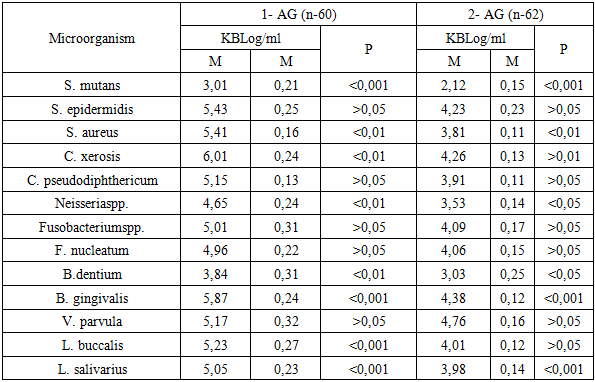
- Dental examinations were carried out among 152 children aged 10-18 who applied to the dentist for treatment at the Bukhara State Medical Institute "dental center", of which 122 dental rows are children with gingivitis caused by orthodontic treatment of anomalies and deformities, and 30 healthy children. Of the children examined, 76 were girls and 76 were boys. All checked D. According to a Calvelis, young groups are formed depending on the periods of formation of the bite. The 1stGuruh is the night exchange period (10-13 years old) with 44 children (boys 24 and girls 20); the 2nd Guruh is the permanent bite period (14-18 years old) with 78 children (boys 38 and girls 40). Local and general etiological as well as pathogenetic factors have been identified that lead to inflammation of the parodont tissue in Primary Children. All patients who met the criteria for inclusion in the study were invited for a dental examination and were examined, the indices were evaluated and an exudate was obtained from the periodontal pocket for microbiological and biochemical study. Selected according to the criteria for inclusion in the study and passed a dental examination at the first stage, hygiene products were selected and the first stage of professional Hygiene applied dental rows children with gingivitis caused by orthodontic treatment of anomalies and deformities the main Group (AG) patients numbered -122 people. It is classified into 2 subgroups according to treatment procedures performed in the main group of patients. AG-1 (n=60) had conventional treatment. In the case of AG-2 (n=62), however, complex therapy was performed using "pomegranate bean oil" and "aseptaprapolis" gel with individually transported Cappas in additional gum pockets to the traditional cure [1,3,5,7,9,11,13,15]. The research materials were conducted from statistical processing using parametric and non-symmetric analysis methods. The first data collection, correction, systematization and visualization of the results obtained were carried out in the Microsoft Office Excel 2016 spreadsheets. In our scientific study, we conducted dental examinations among 152 children aged 10-18, of which 122 were children with gingivitis caused by orthodontic treatment of tooth row anomalies and deformities, and 30 were healthy children. They applied to the "dental center" of the Bukhara State Medical Institute for treatment to the dentist. The complex treatment performed is inflammation in the parodont tissues there is a tooth row anomaly and deformity in patients of the 1st main group who received traditional treatment treatments of the main guru S. mutans 3.01±0.21; S. epidermidis 5.43±0.25; S. aureus 5.41±0.16; C. xerosis 6.21±0.24; C. with pseudodiphthericum being 5.15±0.13 KHQB Log/ml, Major Group 2 patients who received complex treatment had S. mutans 2.12±0.15; S. epidermidis 4.23±0.23; S. aureus 3.89±0.11; C. xerosis 4.26±0.13; C. pseudodiphthericum has been found to be 3.91±0.11 KHQB Log/ml (Table 1).
|
|
|
3. Conclusions
- In the complex treatment of gingivitis caused by the orthodontic treatment of tooth row anomalies and deformities, the effectiveness of treatment with individually prepared Cappas from the gel "pomegranate danagi oil" and "aseptaprapolis" was 92.5 percent in the 2nd main group compared to the 1st main group. For the purpose of prophylaxis of gingivitis caused by orthodontic treatment of tooth row anomalies and deformities, the application of local "pomegranate bean oil" with individually prepared Cappas to the tooth-gum pocket "Colgate Plax" for mouth rinsing effectively helped.