
-
Paper Information
- Next Paper
- Previous Paper
- Paper Submission
-
Journal Information
- About This Journal
- Editorial Board
- Current Issue
- Archive
- Author Guidelines
- Contact Us
American Journal of Medicine and Medical Sciences
p-ISSN: 2165-901X e-ISSN: 2165-9036
2025; 15(10): 3706-3707
doi:10.5923/j.ajmms.20251510.91
Received: Sep. 25, 2025; Accepted: Oct. 21, 2025; Published: Oct. 31, 2025

Prognostic Significance of MMP-9 Level in the Clinical Course of Acute Hemorrhagic Stroke
 Abstract
 Reference
 Full-Text PDF
 Full-text HTML
Musaev S. M.1, Rakhimbaeva G. S.2
1Doctor of Medical Sciences, Professor, Tashkent State Medical Univercity, Tashkent, Uzbekistan
2Researcher, Tashkent State Medical Univercity, Tashkent, Uzbekistan
Correspondence to: Musaev S. M., Doctor of Medical Sciences, Professor, Tashkent State Medical Univercity, Tashkent, Uzbekistan.
| Email: |  |
Copyright © 2025 The Author(s). Published by Scientific & Academic Publishing.
This work is licensed under the Creative Commons Attribution International License (CC BY).
http://creativecommons.org/licenses/by/4.0/

Acute hemorrhagic stroke stands out among neurological diseases due to its high mortality and disability rates. this study investigated the prognostic significance of matrix metalloproteinase-9 (MMP-9) levels in assessing the clinical course of stroke. a strong positive correlation between MMP-9 levels and clinical severity according to the NIHSS scale (r ≈ 0.99; p<0.001) was found, showing that MMP-9 concentration significantly increases as stroke severity worsens. these results suggest that MMP-9 can be used as a biochemical biomarker in acute hemorrhagic stroke for early diagnosis, prognosis, and as an additional criterion in selecting individualized treatment strategies.
Keywords: Hemorrhagic stroke, MMP-9, NIHSS
Cite this paper: Musaev S. M., Rakhimbaeva G. S., Prognostic Significance of MMP-9 Level in the Clinical Course of Acute Hemorrhagic Stroke, American Journal of Medicine and Medical Sciences, Vol. 15 No. 10, 2025, pp. 3706-3707. doi: 10.5923/j.ajmms.20251510.91.
1. Introduction
- Approximately 20 million stroke cases are reported worldwide each year, of which only 25–30% retain their ability to work, while the rest result in disability or death (Johnson et al., 2019) [4]. In 2019, hemorrhagic stroke accounted for 22–39% of the 12.2 million recorded stroke cases and ranked as the second leading cause of death after cardiovascular diseases (Feigin et al., 2021). Acute hemorrhagic stroke is characterized by a severe clinical course, high rates of disability, and mortality. Despite recent advances in neuroimaging and intensive therapy methods, the prognosis of hemorrhagic stroke remains unsatisfactory (van Asch et al., 2010). Therefore, identifying molecular and biochemical markers of stroke and evaluating their correlation with clinical severity is both scientifically and practically important. Matrix metalloproteinases, particularly MMP-9, play a crucial role in blood-brain barrier disruption, hematoma expansion, and secondary neuronal injury. Hence, studying MMP-9 levels is of significant value in predicting the clinical course of stroke and individualizing treatment strategies (Kelly et al., 2008; Chauhan et al., 2017 [1,3].Purpose of study. To identify the main factors influencing the clinical course of acute hemorrhagic stroke and to determine the disease prognosis by assessing MMP-9 levels.
2. Materials and Methods
- Within the scope of the study, clinical indicators of 50 patients suffering from acute hemorrhagic stroke were evaluated. These patients were treated at the multidisciplinary clinic of Tashkent Medical Academy from 2023 to 2025 years. Clinical neurological examinations were performed using the NIHSS scale, and MMP-9 levels were measured in their blood plasma.
3. Results and Discussion
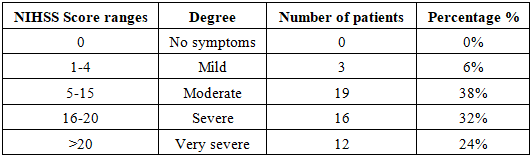
- The severity of the disease was determined using the NIHSS scale. According to the NIHSS scores, patients were divided into five categories: no symptoms (0 points), mild (1–4 points), moderate (5–15 points), severe (16–20 points), and very severe (>20 points). In this study, 50 patients were analyzed. Among them, 3 patients (6%) had mild neurological deficits, while the largest group 19 patients (38%) had moderate deficits. The number of patients with severe and very severe conditions was also significant, accounting for 16 (32%) and 12 (24%) patients, respectively. (Table 1).
|
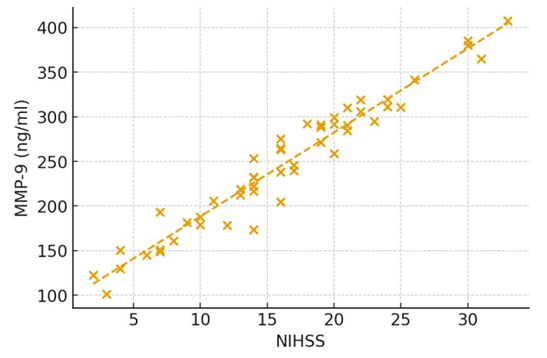 | Figure 1. Correlation analysis of MMP-9 levels with the NIHSS scale |
4. Conclusions
- Thus, obtained results indicate the potential use of the MMP-9 biomarker for predicting hemorrhagic stroke and selecting individualized treatment strategies.