
-
Paper Information
- Next Paper
- Previous Paper
- Paper Submission
-
Journal Information
- About This Journal
- Editorial Board
- Current Issue
- Archive
- Author Guidelines
- Contact Us
American Journal of Medicine and Medical Sciences
p-ISSN: 2165-901X e-ISSN: 2165-9036
2025; 15(10): 3562-3564
doi:10.5923/j.ajmms.20251510.59
Received: Sep. 27, 2025; Accepted: Oct. 23, 2025; Published: Oct. 28, 2025

The State of the Emotional And Volitional Sphere in Patients with Chronic Alcoholism of Young and Middle Age
 Abstract
 Reference
 Full-Text PDF
 Full-text HTML
Kamalova N. L.1, Rakhimbayeva G. S.2, Urinova G. G.3, Allayarov A. U.4, Nishonov Sh. Yu.5
1Assistant, Department of Neurology, Andijan State Medical Institute, Andijan, Uzbekistan
2Doctor of Medical Sciences, Professor, Head of the Department of Neurology, Tashkent State Medical University, Tashkent, Uzbekistan
3Candidate of Medical Sciences, Associate Professor of the Department of Neurology, Andijan State Medical Institute, Andijan, Uzbekistan
4Assistant of the Department of Dentistry, Andijan State Medical Institute, Andijan, Uzbekistan
5PhD, Associate Professor, Dean of the Faculty of Medicine, Alfraganus University, Tashkent, Uzbekistan
Copyright © 2025 The Author(s). Published by Scientific & Academic Publishing.
This work is licensed under the Creative Commons Attribution International License (CC BY).
http://creativecommons.org/licenses/by/4.0/

The article presents a study of the emotional and volitional sphere in young and middle-aged patients suffering from chronic alcoholism. A total of 151 patients were examined and divided according to age and the stage of the disease. Emotional and volitional disturbances were assessed using the Hamilton Depression Rating Scale (HDRS) [4] and the Hamilton Anxiety Rating Scale (HARS) [5]. The results demonstrated that the severity of depressive and anxiety symptoms increased with the progression of alcoholism and the duration of the disease. In young patients, emotional lability and moderate depressive-anxiety symptoms predominated, whereas middle-aged individuals exhibited persistent depression and pronounced anxiety. A significant positive correlation was found between the duration of alcohol dependence and the severity of psychoemotional disturbances (r = 0.68 for depression, r = 0.64 for anxiety; p < 0.01). Nootropic therapy revealed that oxiracetam was more effective than piracetam in reducing HDRS and HARS scores. The obtained results confirm the necessity of early diagnosis and an individualized therapeutic approach for correcting emotional and volitional disorders in patients with chronic alcoholism.
Keywords: Chronic alcoholism, Emotional and volitional sphere, Depression, Anxiety, HDRS, HARS, Oxiracetam, Piracetam, Psychoemotional disorders
Cite this paper: Kamalova N. L., Rakhimbayeva G. S., Urinova G. G., Allayarov A. U., Nishonov Sh. Yu., The State of the Emotional And Volitional Sphere in Patients with Chronic Alcoholism of Young and Middle Age, American Journal of Medicine and Medical Sciences, Vol. 15 No. 10, 2025, pp. 3562-3564. doi: 10.5923/j.ajmms.20251510.59.
Article Outline
1. Introduction
- Chronic alcoholism is one of the most common forms of psychoactive substance dependence [1], exerting a significant influence on the emotional and volitional sphere of an individual’s personality. Impairments in emotional regulation and volitional activity lead to deterioration in social adaptation, reduced motivation for treatment, and the development of chronic psychoemotional disorders. The emotional and volitional sphere encompasses the ability to control emotions, resilience to stress, initiative, goal-directed behavior, and self-regulation. Patients with alcohol dependence exhibit pronounced disturbances in these functions, manifested as depression, anxiety, emotional lability, and apathy. The relevance of this study lies in the need to identify age-related characteristics of emotional and volitional disorders in order to optimize therapeutic approaches [2].
2. Objective of the Study
- To assess the state of the emotional and volitional sphere in young and middle-aged patients with chronic alcoholism and to determine the influence of disease duration and therapy on the severity of psychoemotional disorders.Research Tasks:1. To compare the levels of depressive and anxiety manifestations depending on age and the stage of alcoholism.2. To identify the correlation between the duration of alcohol dependence and the severity of emotional and volitional disorders.3. To evaluate the effectiveness of nootropic therapy (piracetam and oxiracetam) on the psychoemotional state of patients.
3. Materials and Methods
- The study was conducted at the Andijan Regional Narcological Dispensary with the participation of 151 patients suffering from chronic alcoholism. The patients were divided into age groups:• Young (18–44 years)• Middle-aged (45–59 years)The stages of alcoholism were determined according to clinical criteria [1,3]:• Group 1 — first stage (average disease duration: 5 years)• Group 2 — second stage (average disease duration: 15 years)• Group 3 — third stage (average disease duration: 25 years or more)Methods for assessing the emotional and volitional sphere:• Hamilton Depression Rating Scale (HDRS)• Hamilton Anxiety Rating Scale (HARS)Patients received nootropic therapy with piracetam or oxiracetam. The effectiveness of therapy was evaluated based on changes in HDRS [4] and HARS scores [5].For statistical analysis, mean values, standard deviations, tests for the significance of differences between groups, and correlation analysis were used to determine the relationship between the duration of alcoholism and the severity of depressive and anxiety symptoms.
4. Results
- Depressive manifestations (HDRS)• Control group: mean HDRS score — 0• Group 1: young — 4.06; middle-aged — 5.23• Group 2: young — 20.63; middle-aged — 23.5• Group 3: young — 27.53; middle-aged — 27.93Comparison of indicators:• The mean HDRS score in Group 1 (4.65) was statistically significantly lower than in Group 2 (22.07) and Group 3 (27.73) (p < 0.001).• A consistent trend toward an increase in depressive manifestations was observed with the progression of alcoholism.• In Group 3, the scores reached the threshold of severe depression, indicating pronounced psychoemotional maladaptation.The findings demonstrate that the severity of depressive disorders increases with both the progression of alcohol dependence and the age of patients [1,2,6]]. The use of nootropic agents, particularly oxiracetam, contributed to a significant reduction in depressive symptoms and an improvement in patients’ psychoemotional state (Fig. 1).
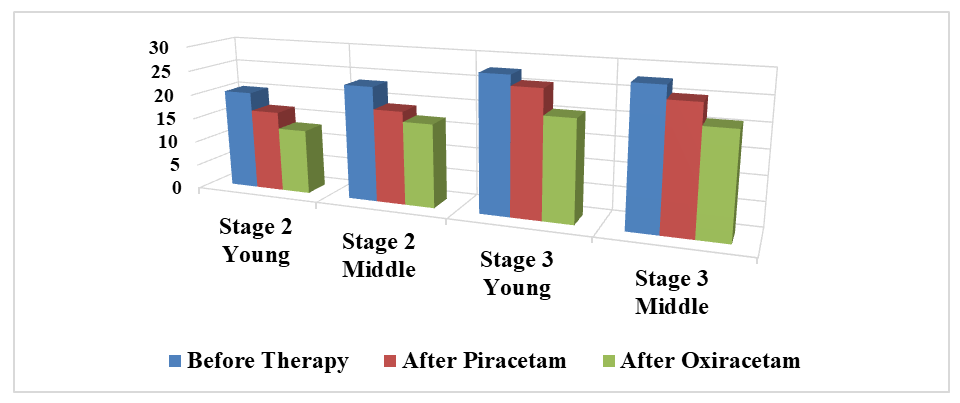 | Figure 1. HDRS Scores by Group, Stage, and Age |
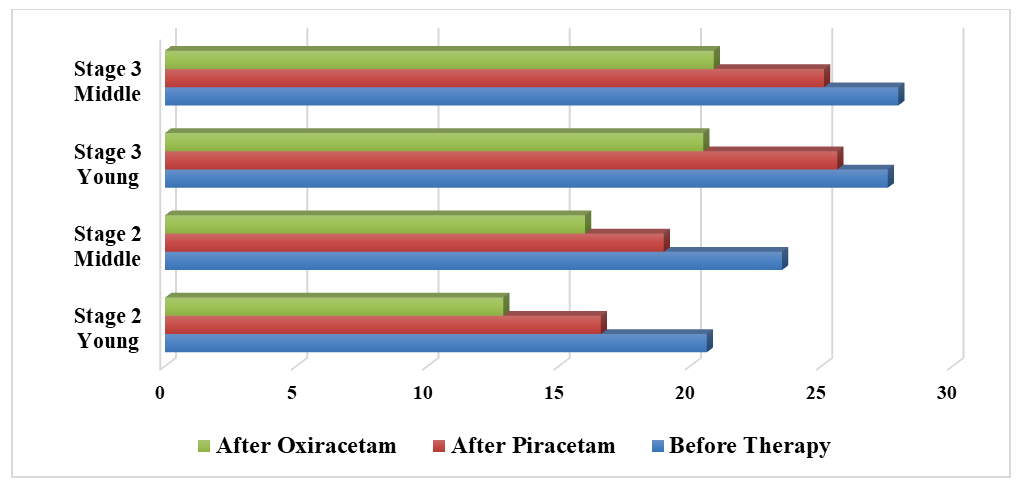 | Figure 2. HARS Scores by Group, Stage, and Age |
5. Discussion
- The results confirm that chronic alcoholism exerts a progressively negative effect on the emotional and volitional sphere of personality [1,2,6]. Young patients primarily exhibit emotional lability and moderate depressive-anxiety symptoms. In middle-aged individuals with long-term dependence, there is pronounced apathy, persistent depression, and high levels of anxiety, consistent with neuropsychological findings on the degradation of fronto-limbic structures.The increase in depressive and anxiety symptoms with advancing disease stage and longer alcohol history highlights the necessity of early diagnosis of psychoemotional disorders. The superior effectiveness of oxiracetam compared to piracetam supports the use of more modern nootropics in comprehensive therapy.These findings have practical significance: identifying age- and stage-specific characteristics of the emotional and volitional sphere allows for optimization of treatment and rehabilitation programs and improves the likelihood of patients’ social adaptation [4,5].
6. Conclusions
- 1. Chronic alcoholism leads to pronounced disturbances in the emotional and volitional sphere, which intensify with age and disease stage.2. Young patients exhibit emotional lability and moderate depressive-anxiety symptoms, whereas middle-aged patients show persistent depression and high anxiety.3. The duration of alcohol dependence is directly correlated with the severity of emotional and volitional disturbances.4. Nootropic therapy, particularly with oxiracetam, improves patients’ psychoemotional state and reduces depressive and anxiety symptoms.5. A comprehensive therapeutic approach should include early diagnosis, psychotherapeutic support, and individualized pharmacotherapy selection.