
-
Paper Information
- Next Paper
- Previous Paper
- Paper Submission
-
Journal Information
- About This Journal
- Editorial Board
- Current Issue
- Archive
- Author Guidelines
- Contact Us
American Journal of Medicine and Medical Sciences
p-ISSN: 2165-901X e-ISSN: 2165-9036
2025; 15(10): 3532-3534
doi:10.5923/j.ajmms.20251510.53
Received: Oct. 5, 2025; Accepted: Oct. 26, 2025; Published: Oct. 28, 2025

Correlation Between Vitamin D Deficiency and Subclinical Hypothyroidism
 Abstract
 Reference
 Full-Text PDF
 Full-text HTML
Marupov Abrorjon Toshturgun ugli1, Muradimova Alfiya Rashidovna2
1Phd Student, Fergana Medical Institute of Public Health, Fergana, Uzbekistan
2PhD., Associate Professor, Head of the Department of Neurology and Psychiatry, Fergana Medical Institute of Public Health, Fergana, Uzbekistan
Copyright © 2025 The Author(s). Published by Scientific & Academic Publishing.
This work is licensed under the Creative Commons Attribution International License (CC BY).
http://creativecommons.org/licenses/by/4.0/

Vitamin D deficiency is one of the global health problems today. In recent years, the direct effect of this vitamin not only on the musculoskeletal system, but also on the work of the endocrine and immune systems has been studied on a large scale. However, the role of vitamin D in the course of subclinical hypothyroidism is not fully understood. Subclinical hypothyroidism is a disease accompanied by borderline changes in thyroid hormones, but not manifested by obvious clinical signs, its prevalence has been increasing in recent years. Studies suggest that vitamin D deficiency may be directly related to subclinical hypothyroidism. At the same time, a decrease in the level of vitamin D is observed, a violation of thyroid gland, an increase in autoimmune processes and a combination with hypocalcemia. Also, vitamin D deficiency is inversely correlated with TSH levels, which may determine the severity of hypothyroidism compensation. Thus, in patients with subclinical hypothyroidism, it is recommended to regularly monitor the level of vitamin D and correct it if insufficiency is detected. This is of great importance for the early detection of the disease, the prevention of severe clinical forms, and the improvement of patients’ quality of life. Vitamin D deficiency is a global public health problem. Vitamin D's role as an immunomodulator is highlighted. Today, the effect of vitamin D on the course of autoimmune diseases is actively studied. Vitamin D deficiency is a global health problem.
Keywords: Vitamin D deficiency, Subclinical hypothyroidism, Thyroid gland, TSG, fT4
Cite this paper: Marupov Abrorjon Toshturgun ugli, Muradimova Alfiya Rashidovna, Correlation Between Vitamin D Deficiency and Subclinical Hypothyroidism, American Journal of Medicine and Medical Sciences, Vol. 15 No. 10, 2025, pp. 3532-3534. doi: 10.5923/j.ajmms.20251510.53.
1. Introduction
- More than 1 billion people worldwide are deficient or deficient in vitamin D [1]. Even today, the medical community is not sufficiently aware of the negative impact of this deficiency on human health and the need to achieve adequate levels of vitamin D in the blood [2]. The study of the role of vitamin D has been ongoing since its discovery as a simple vitamin at the beginning of the 20th century to the present day [3]. It has been found that in addition to its prominent role in calcium homeostasis and the development of the musculoskeletal system, vitamin D also influences the functioning of the immune system [3]. It has also been found that vitamin D deficiency is associated with autoimmune diseases such as rheumatoid arthritis, systemic red sclerosis disease, Crohn's disease, multiple sclerosis, and type 1 diabetes, while supplemental vitamin D intake has been proven to prevent their occurrence or development [4]. In addition, decreased levels of vitamin D in the blood have been noted in patients with Hashimoto's thyroiditis, an autoimmune thyroid disease [5].Vitamin D enters the bloodstream in the form of an attachment to the vitamin D-binding protein, is hydroxylated through the liver to 25(OH)D, and then converted to the active metabolite in the kidneys – 1,25-dihydroxyvitamin D, that is, calcitirol [6]. The most reliable indicator for assessing the status of vitamin D intake is the amount of 25(OH)D in the blood serum [7]. According to modern recommendation [8]:• Vitamin D deficiency – if the level of 25(OH)D is below 20 ng/ml (50 nmol/l),• Vitamin D deficiency – when the level of 25(OH)D is 21–29 ng/ml (50.1–74.9 nmol/l),• Normal level – 25(OH)D when above 75.0 nmol/l,• Severe deficiency, on the other hand, is detected at readings below 25 nmol/l [8].It is worth noting that both vitamin D and thyroid hormones bind to steroid hormone receptors. The presence of certain vitamin D receptor genes leads to a susceptibility to autoimmune thyroid diseases (diffuse toxic bull, autoimmune thyroiditis). Therefore, the role of the vitamin D system in this pathology is great [9]. Vitamin D exerts its action by binding to the vitamin D receptor (VDR) and activating VDR-sensitive genes. Polymorphism of the VDR gene has been found to be associated with autoimmune thyroid gland disease [9].Key Section The purpose of the study was to determine the relationship between subclinical hypothyroidism and vitamin D deficiency.
2. Materials and Styles
- During the study, 80 permanent residents (in the Fergana region) with their written consent were observed in conditions of iodine deficiency. The study was conducted during 2023-2025.Participants were divided into two main groups:Group I – 60 patients with primary subclinical hypothyroidism (24 males – 40% and 36 women – 60%), mean age 48.8±5.4 years. The diagnosis of hypothyroidism is confirmed by their medical records.Group II (control group) – 20 practically healthy individuals (8 males – 40% and 12 females – 60%), average age 45.2±6.7 years. They were not under dispensary supervision due to any chronic diseases, have no history of thyroid disease, and were not taking vitamin D drugs.In study participants, the following were studied: complaints, history data, clinical trial results, thyrotropic hormone (TSH), free thyroxine (fT4) levels, and levels of 25(OH)D in the blood serum.
3. Research Findings
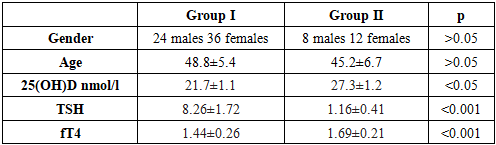
- The average values of the indicators of 25(OH)D, ionized calcium, thyroid gland functional status in blood serum in the participants of the two groups are shown in Table 1. No reliable differences were found between the age and sex content groups.
|
|

4. Conclusions
- In patients with subclinical hypothyroidism, it is recommended to screen for vitamin D levels and additionally prescribe vitamin D drugs.Vitamin D levels are reliably low (21.7±1.1 nmol/l) in patients with subclinical hypothyroidism, significantly differing compared to healthy individuals (27.3±1.2 nmol/l; p<0.05).Vitamin D has been found to have a positive reliable correlation with thyroid hormone levels, as well as a negative reliable correlation with TSH levels.Vitamin D deficiency is confidently correlated with the severity of subclinical hypothyroidism, which makes it necessary to prescribe vitamin D supplementally. Vitamin D deficiency screening is recommended for all patients with hypothyroidism.