
-
Paper Information
- Next Paper
- Previous Paper
- Paper Submission
-
Journal Information
- About This Journal
- Editorial Board
- Current Issue
- Archive
- Author Guidelines
- Contact Us
American Journal of Medicine and Medical Sciences
p-ISSN: 2165-901X e-ISSN: 2165-9036
2025; 15(10): 3513-3516
doi:10.5923/j.ajmms.20251510.50
Received: Sep. 28, 2025; Accepted: Oct. 25, 2025; Published: Oct. 28, 2025

The Effect of Bilateral Adhesive Splinting on Microcirculation and Functional Parameters of the Periodontium
 Abstract
 Reference
 Full-Text PDF
 Full-text HTML
Yusupova Manzurakhon Kobuljon kizi1, Solijonov Sardor Shukhratovich2
1Independent Researcher at the Department of Pediatric Dentistry, Andijan State Medical Institute, Andijan, Uzbekistan
2Student of the Faculty of Dentistry, Bukhara State Medical Institute, Bukhara, Uzbekistan
Copyright © 2025 The Author(s). Published by Scientific & Academic Publishing.
This work is licensed under the Creative Commons Attribution International License (CC BY).
http://creativecommons.org/licenses/by/4.0/

The article presents the results of a study of the effectiveness of adhesive splinting in the complex treatment of chronic generalized periodontitis. The aim of the work was to evaluate the effect of bilateral adhesive splinting on clinical and functional parameters, microcirculation and oral microbiocenosis in patients with chronic periodontitis. The study used modern diagnostic methods - laser Doppler flowmetry, gnathodynamometry, X-ray examinations (radiovisiography, CBCT), as well as microbiological analysis and determination of the main hygiene indices (OHI-S, PBI, etc.). The results obtained showed that the use of bilateral adhesive splinting contributes to a significant improvement in clinical parameters, stabilization of microcirculation and a decrease in pathogenic periodontal microflora. The introduction of the drug Tivorel into the complex therapy enhanced the restoration of capillary blood flow and improved metabolic processes in periodontal tissues.
Keywords: Chronic generalized periodontitis, Adhesive splinting, Microcirculation, Gnathodynamometry, Microbiocenosis, Tivorel
Cite this paper: Yusupova Manzurakhon Kobuljon kizi, Solijonov Sardor Shukhratovich, The Effect of Bilateral Adhesive Splinting on Microcirculation and Functional Parameters of the Periodontium, American Journal of Medicine and Medical Sciences, Vol. 15 No. 10, 2025, pp. 3513-3516. doi: 10.5923/j.ajmms.20251510.50.
Article Outline
1. Introduction
- Chronic generalized periodontitis is one of the most common periodontal diseases, characterized by progressive inflammation and destruction of the tissues surrounding the teeth. Impaired microcirculation, activation of pathogenic microflora, and functional overload of the teeth are key pathogenetic factors in disease progression [1,3,4].Modern comprehensive treatment methods are aimed not only at eliminating inflammatory manifestations but also at restoring the functional stability of the dentition. One effective approach is adhesive splinting, which helps stabilize loose teeth, redistribute chewing forces, and create favorable conditions for periodontal tissue restoration [2,3].However, to date, issues related to the objective assessment of microcirculation and functional indicators after the use of various splinting options have remained insufficiently studied.In this regard, the aim of the study was to evaluate the clinical, functional, radiological and microbiological parameters when using bilateral adhesive splinting as part of complex therapy for chronic generalized periodontitis.
2. Materials and Methods of Research
- The study was conducted at the Clinical Orthopedic Dentistry Department of the Andijan State Medical Institute. The study included 40 patients with partial edentulism (Kennedy Class IV), complicated by moderate chronic generalized periodontitis. The patients required orthopedic splinting or prosthetics for the anterior dentition.All patients underwent adhesive splinting using F&A FiberRope fiberglass-reinforced cords and F&A FiberTape tapes. This method was chosen due to its minimally invasive nature and lightweight construction, which ensures gentle pressure on the periodontium.Study design. Patients were randomly assigned to two comparison groups and a control group of 20 each:• Group I – adhesive splinting from the vestibular and oral sides and the introduction of the drug Tivorel ®;• Group II – splinting only from the oral side without medication;• The control group consisted of healthy individuals without signs of periodontal pathology.The subjects ranged in age from 25 to 55 years. Men and women were evenly distributed. Inclusion criteria included signs of moderate periodontitis and the absence of more than one or two teeth in the anterior region. Exclusion criteria included severe somatic and infectious diseases, pregnancy, unhealthy habits, and poor oral hygiene.In the study group (I), Tivorel®, a combination of L-arginine and L-carnitine, which provides substrates for nitric oxide (NO) synthesis, was used to correct microcirculation. The solution was administered intravenously by drip, 100 ml once daily for 10 days, at a rate of 10–30 drops/min, ensuring a stable concentration of the active ingredients and improving capillary blood flow.Clinical and hygienic methods Patients underwent a standard dental examination, including assessment of complaints, medical history, dental arches, and oral mucosa. Following a visual examination, a dental chart was compiled, and dental formula and occlusion characteristics were recorded.For oral care, patients in Group I were recommended Elgydium products: the Perio brush (the first 2 weeks), then Inter-Active Medium”, Elgydium paste Anti-Plaque with chlorhexidine and Elugel gel. Patients in the II and control groups used standard medium- hardness toothbrushes and toothpaste of their choice. Professional cleaning was performed every 4–6 months.The condition of the tissues was assessed using the OHI-S (Green - Vermillion) and PBI (Saxer - Muhlemann) indices, the depth of periodontal pockets and the degree of gum recession.Functional methodsX-ray examination. We used targeted radiovisiography and cone-beam computed tomography (CBCT) on the following devices: Rotograph -D (Italy) and GALILEOS (Germany). Images were taken before treatment and after 1, 3, 6, and 12 months. The height of the interalveolar septa, the thickness of the cortical plate, and the condition of the alveolar bone tissue were assessed.Gnathodynamometry. The chewing force of the anterior teeth was assessed using the Vizir device (Central Research Institute Elektropribor). Patients compressed the sensor between their central incisors, and the maximum force (Fmax, N) was recorded. Measurements were taken before treatment and after 3, 6, and 12 months. The results were analyzed statistically using the Student's t-test.Laser Doppler flowmetry. The LAKK-M system (Russia) was used to assess microcirculation. The fiber-optic probe was fixed in a silicone positioner, ensuring reproducible measurements. Perfusion parameters (PM) and flow variability (σ) were recorded. Measurements were performed after 14, 30, and 90 days, and the data were analyzed using LAKK software version 3.0.2.384.Laboratory and statistical methodsMicrobiological examination of oral fluid included culture on endo, blood agar, Sabouraud, MPC-4, and anaerobic agar media. Colonies were incubated at 37°C for 18–24 hours; anaerobes were cultured in sealed bags containing natural gas. Identification was performed by Gram staining and culture properties.Statistical processing of the results was carried out in the programs STATPLUS (2009) and Microsoft Excel. M ± SD, standard error (m) and Student's t-test were used, differences were considered significant at p < 0.05.
3. Study Results
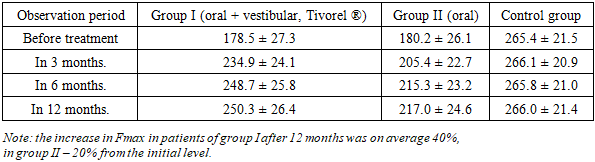
- Before treatment, the average chewing force in patients with chronic generalized periodontitis was 186 ± 31.2 N in men and 171 ± 19.8 N in women. Three months after adhesive splinting, an increase of 31.7% in men and 32.7% in women was observed. By the end of the twelfth month, the indicators increased by 40.3% and 40.9%, respectively, compared to baseline values (p < 0.001).
|
|

4. Discussion of Results
- The obtained data convincingly demonstrate the advantages of bilateral adhesive splinting using Tivorel® in the comprehensive treatment of patients with chronic generalized periodontitis. A comparison of functional, radiographic, and microbiological indicators suggests that this technique provides more stable restoration of the structural and functional state of the periodontium and alveolar bone tissue.The dynamics of chewing force (Fmax) reflect a significant improvement in periodontal endurance in patients in the study group. Just three months after the start of treatment, Fmax values in patients with bilateral splinting increased by an average of 30–32%, and by more than 40% of baseline values after twelve months (p < 0.001). In the unilateral splinting group, the increase in compressive force was less pronounced and did not exceed 20%. This indicates that the use of bilateral fixation creates a more uniform distribution of chewing loads, reduces trauma to periodontal tissues, and promotes functional adaptation of the masticatory apparatus.Radiographic analysis confirmed a slowdown in alveolar bone resorption with bilateral splinting. After six months, the average cortical plate thickness was 0.43 ± 0.06 mm in the study group versus 0.25 ± 0.07 mm in the second group. After twelve months, Group I showed a thickness reduction of only 18.9% in the middle and 14.0% in the apical portion, while in Group II, similar indicators decreased by 60.6%, indicating critical bone atrophy with the unilateral technique.Thus, bilateral splinting prevents overloading of individual teeth, stabilizes bone support and slows down destructive processes in the periodontium.Flowmetry study of microcirculation revealed that patients in the study group exhibited a significant increase in the perfusion index (PI) and a decrease in the amplitude of flow oscillations (σ), reflecting normalization of vascular tone. This improvement in microcirculation is associated with the action of Tivorel®, which, through the use of L-arginine, enhances nitric oxide (NO) synthesis and dilates microvascular vessels. These effects lead to improved blood flow to periodontal tissues and accelerated reparative processes.Before treatment, anaerobic pathogenic flora, Staphylococcus, was predominant in all groups. aureus, Prevotella intermedia, Peptostreptococcus spp. After complex therapy in group I, a sharp decrease in the number of pathogenic microorganisms (2.5 times) and an increase in the proportion of normal flora (Lactobacillus sp., Streptococcus spp.). In group II, the reduction in pathogenic flora was less pronounced, which correlated with the persistent signs of inflammation of the gum tissue.The indicators between the groups demonstrates that bilateral splinting with Tivorel® affects the main pathogenetic mechanisms of the disease:• reduces inflammation and swelling of the mucous membrane;• stabilizes dental arches and distributes the load;• reduces bone resorption;• normalizes microcirculation and microflora of the oral cavity.Thus, the proposed technique has a pronounced pathogenetic effect, helps preserve supporting teeth and improves the quality of life of patients.
5. Conclusions
- 1. Bilateral adhesive splinting for chronic generalized periodontitis provides a more significant reduction in inflammatory and destructive processes compared to unilateral splinting. This is demonstrated by a sustained reduction in clinical signs of inflammation, a decrease in the oral hygiene index (OHI-S) and inflammation index (PMA), and an increase in the functional stability of teeth.2. Gnathodynamometry data, in the main group there was an increase in maximum chewing force (Fmax) by 40.3% in men and 40.9% in women 12 months after treatment (p < 0.001), which indicates the restoration of the functional activity of the periodontium and an increase in its endurance.3. Radiographic studies showed that in patients with bilateral splinting, the loss of alveolar cortical bone thickness in the middle portion did not exceed 18.9%, while with unilateral fixation, it reached 60.6%. This confirms the stabilizing effect of this method on the bone support of the teeth and the effectiveness of uniform load distribution.4. Laser Doppler flowmetry revealed improved microcirculation and normalization of vascular tone in patients receiving Tivorel®. The perfusion index (PI) increased by 35–38% after 90 days, indicating restoration of tissue trophism and activation of reparative processes.5. Microbiological research showed a decrease in the proportion of pathogenic flora by more than 2.5 times and an increase in the content of Lactobacillus spp. and Streptococcus spp., which reflects the restoration of the oral microbiocenosis and a decrease in inflammatory potential.6. The combined use of bilateral adhesive splinting with Tivorel® provides a pathogenetically based approach to the treatment of periodontitis, aimed at preserving bone tissue, stabilizing dental arches and improving microcirculation.