Butaboyev Jasurbek Mahmudjonovich1, Shaykhova Guli Islamovna2, Kasimov Adham Lutfullaevich3, Otakuziev Ahmadillo Zakirjanovich4
1Associate Professor, Department of General Surgery and Transplantology, Andijan State Medical Institute, Uzbekistan
2Professor, Department of Children, Adolescents and Nutritional Hygiene, Tashkent State Medical University, Uzbekistan
3Professor, Department of General Surgery and Transplantology, Andijan State Medical Institute, Uzbekistan
4Associate Professor, Department of Surgical Diseases, Andijan State Medical Institute, Uzbekistan
Correspondence to: Butaboyev Jasurbek Mahmudjonovich, Associate Professor, Department of General Surgery and Transplantology, Andijan State Medical Institute, Uzbekistan.
| Email: |  |
Copyright © 2025 The Author(s). Published by Scientific & Academic Publishing.
This work is licensed under the Creative Commons Attribution International License (CC BY).
http://creativecommons.org/licenses/by/4.0/

Abstract
The authors assessed the incidence of echinococcosis among the population of the Fergana region, taking into account age and ethnic factors. The data obtained revealed a correlation between age and gender and the prevalence of echinococcosis. The prevalence of echinococcosis in men was 1,416 (21.2%), and in women, 366 (5.5%). This figure was 12.2% higher than that of the European population, 1.4% higher than that of the Andijan region, and 4.8% higher than that of the Namangan region.
Keywords:
Echinococcosis, Echinococcosis prevalence, Age and gender factors
Cite this paper: Butaboyev Jasurbek Mahmudjonovich, Shaykhova Guli Islamovna, Kasimov Adham Lutfullaevich, Otakuziev Ahmadillo Zakirjanovich, Epidemiological Aspects of Echinococcal Disease Using the Example of the Fergana Region, American Journal of Medicine and Medical Sciences, Vol. 15 No. 10, 2025, pp. 3499-3505. doi: 10.5923/j.ajmms.20251510.47.
1. Introduction
In recent years, there has been a trend toward an increase in the incidence of echinococcosis in Uzbekistan, among both rural and urban populations [3,6,7,8,9]. This is due to a number of factors, including inadequate sanitary services and healthcare authorities, low or no systematic medical examination of the population, and unresolved sanitary-epidemiological and socioeconomic issues [2,5,10].The problem of echinococcosis is also relevant due to the fact that current preventive measures, which include only the identification and treatment of infected individuals and public health education, do not ensure high and sustainable results [1,4,5,11].Study Objective: To study and evaluate the epidemiological, clinical, and preventive properties of echinococcosis in the population of the Fergana region.
2. Materials and Methods
Statistical data on 6,666 patients diagnosed and treated with echinococcosis in various locations (chest and abdominal organs) were analyzed for the period from 2000 to 2024, determining the proportion of cases in the Fergana region.In the Fergana region, an analysis of long-term dynamics of human echinococcosis incidence over a 20-year period (2000-2024) revealed the highest rates were recorded in 2022, 2019, 2017, 2015, 2013, 2008, 2007, 2006, 2003, 2001, and 2000 (Table 1).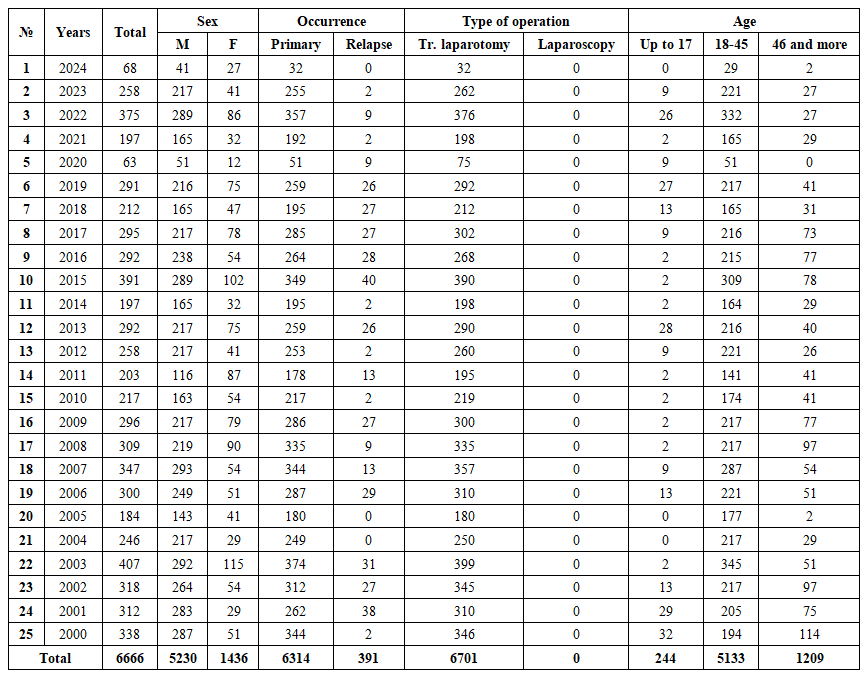 | Table 1. Prevalence of EB from 2000 to 2024 in the Fergana Region |
The prevalence of echinococcosis in the Fergana region was examined using five districts with high incidence rates as examples. The most affected area was the city of Fergana (zone 1 with a high incidence rate of 7.1%), followed by the Besharik district (zone 2 with a high incidence rate of 5.4%), the Uchkuprik district (zone 3 with a high incidence rate of 4.9%), and the city of Kokand and the Kuva districts (zones 4 and 5 with a high incidence rate of 4.7% and 4.0%) of the total number of EB patients (6,666).In this case, when distributed by gender, men accounted for 5,230 (78.5%), and women accounted for 1,436 (21.5%).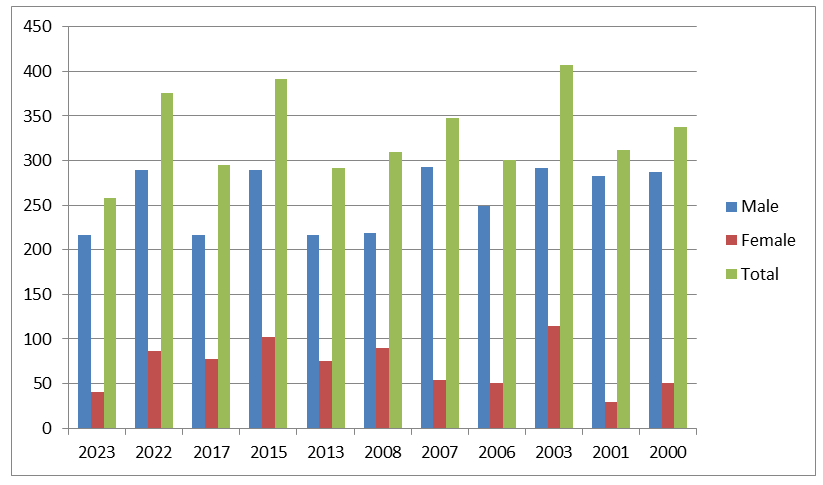 | Figure 1. Highest rates of EB from 2000 to 2024 in the Fergana Region |
3. Results and Discussion
When analyzing prevalence, the city of Fergana emerged as the first zone with a high incidence rate in the Fergana Region (7.1%).In Fergana, 476 patients with EB were recorded over a 20-year period (2000-2024). Of these, 375 (78.8%) were men and 101 (21.2%) were women, which significantly differs from other regions of the Fergana Valley.When analyzing by incidence and disease type, the highest frequency of primary echinococcosis was noted – 448 (94.2%), and recurrent – 28 (5.8%). Traditional surgeries accounted for 476 patients (100%), despite the widespread adoption of modern instrumentation (laparoscopic stand), including laparoscopic techniques.The largest number were patients of working age 18-45 years old – 372 (78.1%), patients under 17 years old accounted for 18 (3.8%), and patients aged 46 years and older were diagnosed with ED in 86 (18.1%), highlighting a medical and social problem. All patients with ED were urban residents, of whom 15.3% had migrated from rural areas (Table 2).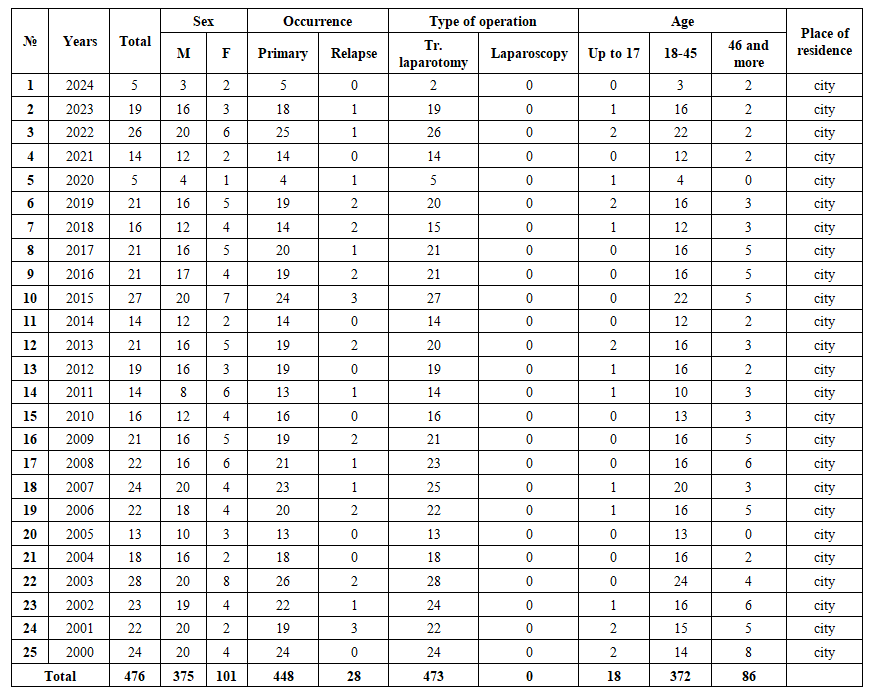 | Table 2. Prevalence of ED from 2000 to 2024 in Fergana |
The next district of regional significance is Besharik (zone 2) with a high incidence rate of 363 (5.4%) (Table 3).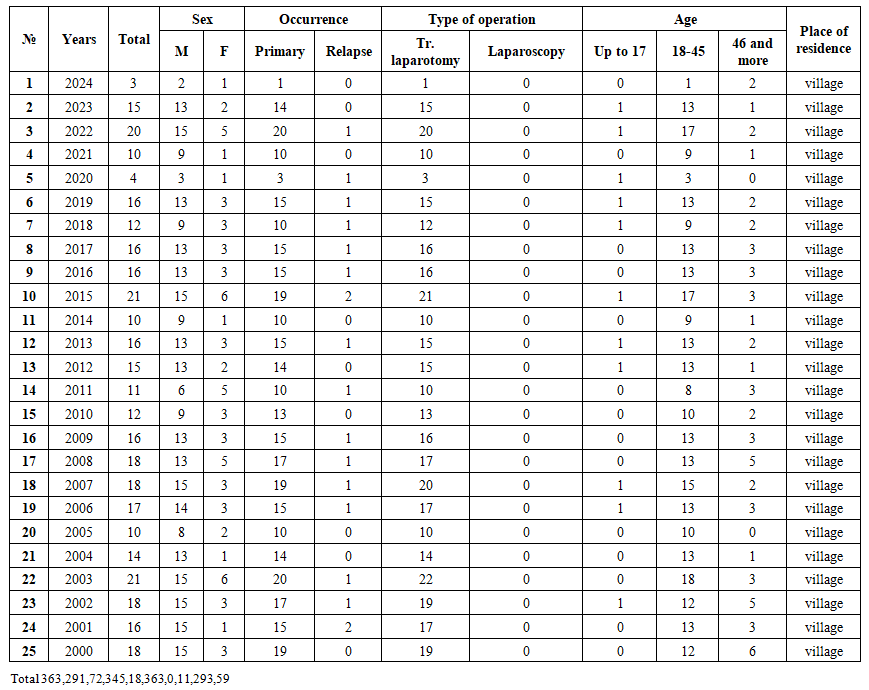 | Table 3. Prevalence of EB from 2000 to 2024 in Besharik district |
In Besharik district, 363 patients with EB were recorded over a 20-year period (2000-2024). Of these, 291 (80.2%) were men and 72 (19.8%) were women, which differs significantly from other districts of the Fergana Valley.When analyzing the incidence and type of disease, the highest frequency was observed for primary echinococcosis – 345 (95.0%), followed by recurrent echinococcosis – 18 (5.0%). Traditional surgeries accounted for 363 (100%) patients, with no laparoscopic surgeries.The largest number of patients were of working age (18-45 years) – 293 (80.7%), patients under 17 years of age accounted for 11 (3.0%), and 59 (16.2%) were diagnosed in those aged 46 and older, highlighting both a medical and social problem. A predominance of patients in rural areas was also noted – 326 (89.8%). The next district of regional significance is Uchkuprik District (zone 3 with a high incidence rate of 327 (4.9%) (Table 4).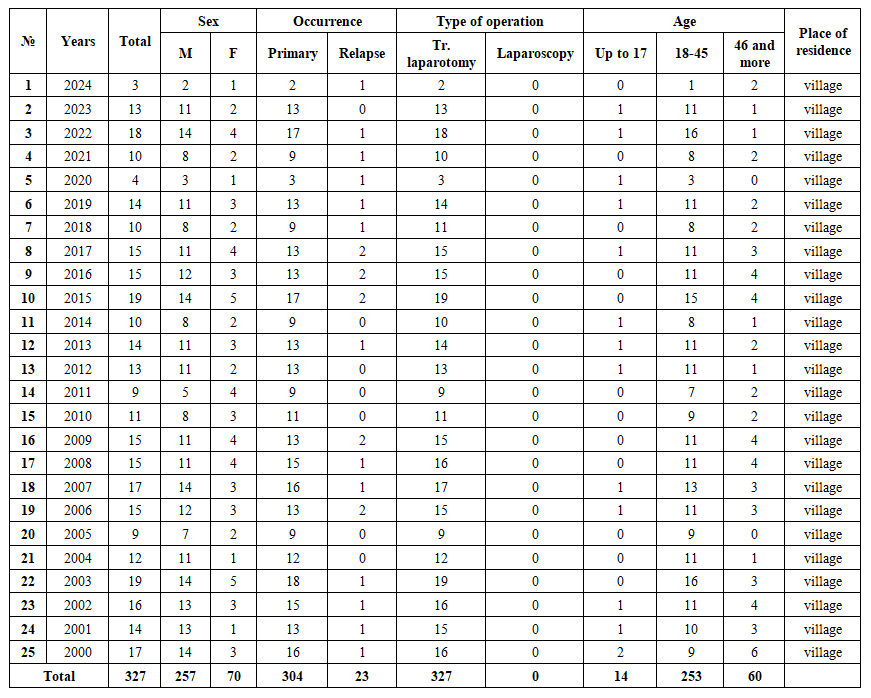 | Table 4. Prevalence of EB from 2000 to 2024 in Uchkuprik District |
In the Uchkuprik district, 327 patients with echinococcosis were diagnosed over a 20-year period (2000-2024). Of these, 257 (78.6%) were men and 70 (21.4%) were women.When analyzing the incidence and type of disease, the highest incidence was primary echinococcosis – 304 (93.0%), followed by recurrent echinococcosis – 17 (7.0%). Traditional surgeries accounted for 327 (100%) patients, and not a single laparoscopic procedure was performed, despite the widespread adoption of modern instrumentation (laparoscopic stand), including laparoscopic techniques.The largest number of patients were of working age (18-45 years) – 253 (77.3%), patients under 17 years of age accounted for 14 (4.3%), and those aged 46 and older accounted for 60 (18.4%), highlighting both a medical and social problem. A predominance of patients in rural areas was also noted – 327 (100%). The next district of regional significance is the city of Kokand (zone 4) with a high incidence rate of 318 (4.7%) (Table 5).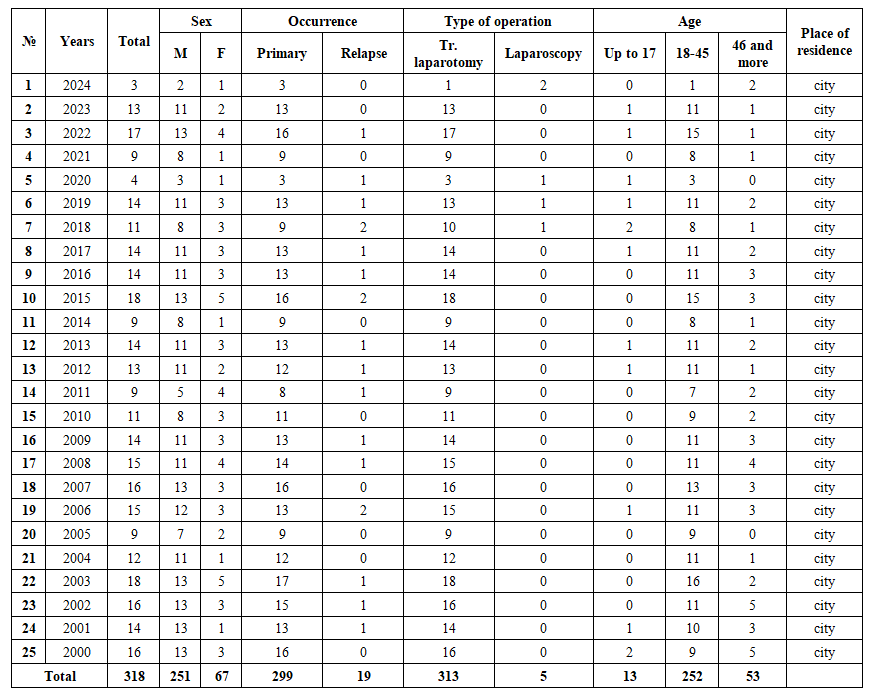 | Table 5. Prevalence of EB from 2000 to 2024 in Kokand |
In Kokand, over a 20-year period (2000-2024), 318 patients with EB were recorded. Of these, 251 (78.9%) were men and 67 (21.1%) were women.When analyzing the incidence and type of disease, the highest frequency of primary echinococcosis was noted – 299 (94.1%), and recurrent – 19 (5.9%). Traditional surgeries accounted for 327 patients (100%), and in no cases were laparoscopic surgeries, despite the widespread introduction of modern instrumentation (laparoscopic stand), including laparoscopic techniques.The largest number of patients were of working age 18-45 years – 252 (79.3%), patients under 17 years of age accounted for 13 (4.1%), and those aged 46 and older were diagnosed with EB in 53 (16.6%), highlighting a medical and social problem.A predominance of patients in urban areas was also noted (81.5%). Those who moved from rural areas to the city accounted for 18.5%.The next district of regional significance is the Kuvinsky District (zone 5) with a high incidence rate of 268 (4.0%) (Table 6).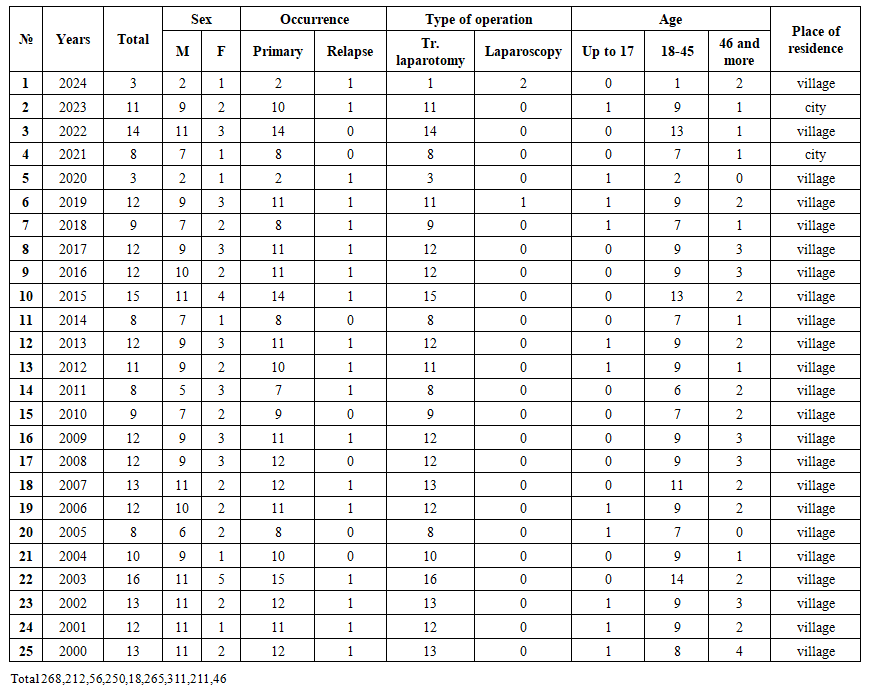 | Table 6. Prevalence of EB from 2000 to 2024 in the Kuvinsky District |
In the Kuvinsky District, over a 20-year period (2000-2024), 268 patients with EB were recorded. Of these, 212 (79.2%) were men and 56 (20.8%) were women.When analyzing the incidence and type of disease, the highest frequency was observed for primary echinococcosis – 250 (93.3%), followed by recurrent echinococcosis – 18 (6.7%). Traditional surgeries accounted for 265 patients (98.8%), while laparoscopic surgeries accounted for 3 (1.2%), despite the widespread introduction of modern instrumentation (laparoscopic stand), including laparoscopic techniques.The largest number of patients were of working age 18-45 years – 211 (78.7%), patients under 17 years of age accounted for 11 (4.2%), and patients aged 46 and older were diagnosed with EB in 46 (17.1%), highlighting both a medical and social problem.A predominance of patients in rural areas was also noted (86.9%). Those who moved from rural areas to the city accounted for 13.1%.
4. Conclusions
Thus, based on the study results, the EB population in the Fergana region was identified, studied, and assessed. Epidemiological indicators and a 20-year trend were determined, which differ sharply from international results, with a high rate. According to the data: in an analysis of the long-term dynamics of human echinococcosis incidence over a 20-year period (2000-2024), the highest rates were recorded in 2022, 2019, 2017, 2015, 2013, 2008, 2007, 2006, 2003, 2001, and 2000.The most affected area was the city of Fergana (zone 1 with a high incidence rate of -7.1%), followed by the Beshariq district (zone 2 with a high incidence rate of 5.4%), the Uchkuprik district (zone 3 with a high incidence rate of 4.9%), and the city of Kokand and the Kuva districts (zones 4 and 5 with a high incidence rate of 4.7% and 4.0%). The prevalence among men was 1,416 (21.2%), while among women it was 366 (5.5%). This figure was 12.2% higher than that of the European population, 1.4% higher than that of the Andijan region, and 4.8% higher than that of the Namangan region.
References
| [1] | Abilbek A.A., Iriskulova D.T., Kaulybekova A.E., Kurbanova M.I., Paizova M.K., et al. Prevalence of cystic echinococcosis among patients with the Altai Krai Clinical Hospital in 2019-2021: an original study with a literature review. Bulletin of the Kazakh National Medical University named after S.D. Asfendiyarov. 2021; (4): 104-109. |
| [2] | Akhina, D. A. Endemicity of territories for echinococcosis in countries of the world and in Russia / D. A. Akhina, A. M. Okunev // Actual issues of science and economy: new challenges and solutions: Collection of materials of the LIV student scientific and practical conference dedicated to the memory of the 75th anniversary of Victory in the Great Patriotic War, Tyumen, March 19-20, 2020. – Tyumen: State Agrarian University of the Northern Trans-Urals, 2020. – P. 229-237. – EDN ZBQKWO. |
| [3] | Bakhritdinov Sh.S., Akhmadaliev R.U., Normatova Sh.A., Ermatova G.A., Ashurova M.D. Actual problems of environmental and industrial hygiene in the Fergana Valley of Uzbekistan // collection of scientific papers "Fundamental Sciences and Practice" - Vol. 1. -No. 3. – Tomsk. – 2010. – P. 6-7. |
| [4] | Dragomeretskaya A.G., Trotsenko O.E., Logvin F.V., Tverdokhlebova T.I., Romanova2 E.B., Ishchenkova I.V., Moskvina Yu.I., Dimidova L.L., Chernikova M.P. Current epidemic situation of echinococcosis in the Far East and South of Russia // Medical Bulletin of the South of Russia. 2024; 15(1). - P.27-35. |
| [5] | Kuttubaev O.T., Kulzhabaeva K.S., Abdyzhaparov T.A. et al. Brief historical review of scientific research on echinococcosis in the Kyrgyz Republic (review) // Bulletin of the KSMA named after I.K. Akhunbaev. - 2010. - No. 10. - P. 27-31. |
| [6] | Normatova Sh.A., Ashurova M.D., Ermatova G.A., Khozhimatov Kh.O., Sultonov G.N., Boltaboev U.A. Actual problems of ecology and public health in Uzbekistan // Scientific and practical journal Science and Health. - 2014. - P. 1-4. |
| [7] | Rakhmanov K.E. Modern views on the pathology of liver echinococcosis // Problems of biology and medicine. - Samarkand. - 2018. - No. 3 (102). - P. 178 - 181. (14.00.00, No. 19) |
| [8] | Safoev B.B., Bakhmatov Sh.Sh., Ikromov T.E. Modern views on the etiopathogenesis, epidemiology, diagnosis and treatment of echinococcal disease // Scientific and practical journal Novy Den v Meditsiny. 2019. - No. 4 (28). P. 294-299. |
| [9] | Raimkulov K.M. Prevalence of echinococcosis in Central Asia // Economy and Society. - No. 4 (107) -1. - 2023. - DOI 10.5281/zenodo.7916445. |
| [10] | Sharipov AM, Shamszoda HA, Akbarov YuA, Mazabshoev SA, Zoirov AR. Surgical treatment tactics for an echinococcal pulmonary cyst that has ruptured into the bronchus // Pediatric Surgery. 2020; 24(6). National Medical Center "Shifobakhsh", 734026, Dushanbe, Republic of Tajikistan. P. 409-412. |
| [11] | Greco S, Cannella R, Giambelluca D, Pecoraro G, Battaglia E, et al. Complications of hepatic echinococcosis: multimodality imaging approach. Insights Imaging. 2019; 10(1): 113. https://doi.org/10.1186/s13244-019-0805-8. |


 Abstract
 Reference
 Full-Text PDF
 Full-text HTML