
-
Paper Information
- Next Paper
- Previous Paper
- Paper Submission
-
Journal Information
- About This Journal
- Editorial Board
- Current Issue
- Archive
- Author Guidelines
- Contact Us
American Journal of Medicine and Medical Sciences
p-ISSN: 2165-901X e-ISSN: 2165-9036
2025; 15(10): 3453-3455
doi:10.5923/j.ajmms.20251510.36
Received: Sep. 22, 2025; Accepted: Oct. 12, 2025; Published: Oct. 16, 2025

Environmental Health and Safety in Small Businesses: A Risk Assessment and Management Framework
 Abstract
 Reference
 Full-Text PDF
 Full-text HTML
Iskandarova Guzal Tulkinovna1, Ubbiniazova Aysulu Makhsetbaevna2
1Head of the Department of Communal and Occupational Hygiene, Doctor of Philosophy in Medicine (DSc), Professor, Tashkent Medical Academy, Uzbekistan
2Assistant of the Department of Communal and Occupational Hygiene, Tashkent Medical Academy, Uzbekistan
Copyright © 2025 The Author(s). Published by Scientific & Academic Publishing.
This work is licensed under the Creative Commons Attribution International License (CC BY).
http://creativecommons.org/licenses/by/4.0/

Small businesses often face unique challenges in maintaining adequate environmental health and safety (EHS) standards due to limited resources, expertise, and awareness. This paper presents a comprehensive framework for risk assessment and management tailored to the specific needs of small businesses. The framework encompasses a systematic approach to identifying potential EHS hazards, evaluating the associated risks, and implementing effective control measures. The proposed framework includes practical tools and techniques for conducting risk assessments, developing EHS management plans, providing employee training, and monitoring performance. The paper also examines the role of regulatory compliance, best practices, and stakeholder engagement in promoting a culture of EHS within small businesses. Case studies of successful EHS programs in small businesses are presented to illustrate the practical application of the framework. The research concludes by highlighting the benefits of implementing a proactive EHS management system, including reduced accidents and injuries, improved employee morale, enhanced productivity, and a stronger reputation.
Keywords: Environmental Health and Safety (EHS), Risk Assessment, Risk Management, Small Businesses, Occupational Safety, Environmental Compliance, Safety Management Systems, Hazard Identification, Control Measures, Workplace Safety, Preventive Measures
Cite this paper: Iskandarova Guzal Tulkinovna, Ubbiniazova Aysulu Makhsetbaevna, Environmental Health and Safety in Small Businesses: A Risk Assessment and Management Framework, American Journal of Medicine and Medical Sciences, Vol. 15 No. 10, 2025, pp. 3453-3455. doi: 10.5923/j.ajmms.20251510.36.
1. Introduction
- In the dynamic landscape of the modern economy, small businesses (SBs) stand as vital engines of growth, innovation, and employment. Defined variously across nations, these enterprises are characterized by their lean structures, entrepreneurial spirit, and close ties to local communities. However, the very attributes that enable their agility and responsiveness often contribute to vulnerabilities in critical areas such as environmental health and safety (EHS). The intersection of small business operations and EHS concerns presents a complex and often overlooked challenge with far-reaching implications for worker well-being, environmental sustainability, and long-term economic viability. [1]Environmental health and safety, encompassing both occupational safety and environmental protection, are paramount concerns in any business operation. These principles dictate the responsibility of employers to provide a safe and healthy working environment, minimize pollution and waste, and adhere to all relevant regulations and standards. While large corporations typically possess dedicated EHS departments, specialized staff, and robust management systems, small businesses frequently operate with limited resources, technical expertise, and formal procedures. This disparity creates a significant gap in EHS performance, exposing small business employees to elevated risks of accidents, injuries, and illnesses, while also contributing disproportionately to environmental degradation.The significance of addressing EHS challenges in small businesses cannot be overstated. Workplace accidents and injuries not only inflict immediate suffering on affected individuals and their families but also impose substantial economic burdens on businesses, communities, and healthcare systems. These costs encompass direct expenses such as medical treatment, workers' compensation, and legal fees, as well as indirect costs such as lost productivity, equipment damage, and reputational harm. Furthermore, environmental violations can lead to hefty fines, legal sanctions, and long-term damage to natural resources and ecosystems. Ignoring EHS concerns is not merely a matter of ethical negligence; it is a financially imprudent practice that undermines the sustainability and competitiveness of small businesses.
2. Materials and Methods
- Despite the compelling need for effective EHS management, many small businesses struggle to implement comprehensive programs due to a confluence of factors. Financial constraints, limited access to information and training, and a lack of perceived relevance often hinder the adoption of proactive EHS measures. In some cases, small business owners may view EHS compliance as a burdensome regulatory requirement rather than a strategic investment in their workforce and the environment. Moreover, the diverse nature of small businesses, spanning a wide range of industries, sizes, and organizational structures, necessitates a tailored approach to EHS management that accounts for the specific hazards and risks associated with each sector.Against this backdrop, the central objective of this paper is to present a comprehensive framework for risk assessment and management that is specifically designed to address the unique needs and challenges of small businesses in the context of EHS. This framework seeks to provide a practical, systematic, and adaptable approach to identifying, evaluating, and controlling EHS hazards, thereby empowering small businesses to create safer, healthier, and more sustainable workplaces. The framework is grounded in established principles of risk management, occupational safety, and environmental stewardship, while also incorporating innovative tools and techniques that are accessible and affordable for small businesses. [2]
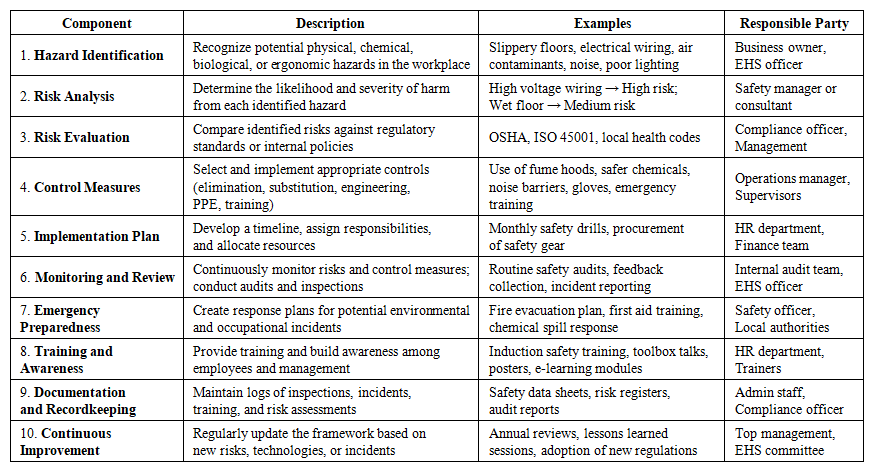 | Table 1. Environmental Health and Safety Risk Assessment and Management Framework for Small Businesses |
3. Results and Discussions
- Management Review and Improvement: Regular review of the EHS management system by senior management to identify areas for improvement and ensure ongoing commitment to EHS principles. This includes setting EHS objectives, allocating resources, and fostering a culture of safety and environmental responsibility throughout the organization.To illustrate the practical application of the proposed framework, this paper will present case studies of successful EHS programs in small businesses across various sectors. These case studies will showcase how small businesses have effectively implemented the framework to reduce accidents and injuries, minimize environmental impacts, and improve overall business performance. The paper will also address the role of regulatory compliance, best practices, and stakeholder engagement in promoting a culture of EHS within small businesses.This paper aims to contribute to the existing body of knowledge on EHS management by providing a practical, adaptable, and evidence-based framework for small businesses. By empowering small businesses to proactively manage EHS risks, this paper seeks to promote safer, healthier, and more sustainable workplaces, ultimately benefiting workers, communities, and the economy as a whole.The structure of this paper is as follows: Section 2 will provide a detailed review of the existing literature on EHS management in small businesses. Section 3 will outline the proposed risk assessment and management framework. Section 4 will present case studies of successful EHS programs in small businesses. Section 5 will discuss the role of regulatory compliance, best practices, and stakeholder engagement. Finally, Section 6 will offer concluding remarks and recommendations for future research. It is hoped that this work will provide practical guidance to small businesses and policy makers alike. [3]This paper has presented a comprehensive framework for environmental health and safety (EHS) risk assessment and management tailored to the unique challenges and constraints faced by small businesses. Recognizing the vital role small businesses play in the economy and the often-overlooked EHS vulnerabilities within these enterprises, the research aimed to provide a practical, systematic, and adaptable approach to fostering safer, healthier, and more sustainable workplaces.The proposed framework, encompassing hazard identification, risk assessment, control measure implementation, monitoring and evaluation, and management review, provides a structured pathway for small businesses to proactively manage EHS risks. By adopting this framework, small businesses can move beyond reactive compliance towards a proactive and preventative culture of safety and environmental responsibility. [4]The case studies presented throughout this paper demonstrated the practical applicability and effectiveness of the framework in diverse small business settings. These examples highlighted how targeted interventions, driven by a thorough understanding of specific risks and tailored to available resources, can lead to significant reductions in accidents, injuries, and environmental impacts. Moreover, the findings underscored the positive correlation between robust EHS management and improved employee morale, enhanced productivity, and a stronger business reputation. [5]
4. Conclusions
- This research has also emphasized the importance of regulatory compliance, best practices, and stakeholder engagement in creating a supportive ecosystem for EHS in small businesses. Governments, industry associations, and community organizations all have a crucial role to play in providing resources, training, and incentives to encourage small businesses to prioritize EHS. Simplification of regulations, provision of accessible training programs, and recognition of EHS achievements can all contribute to a more level playing field and a greater commitment to EHS principles across the small business sector.Despite the contributions of this research, several avenues for future investigation remain. Further studies are needed to:Evaluate the long-term impact of the proposed framework on EHS performance in small businesses. Longitudinal studies that track EHS outcomes over extended periods would provide valuable insights into the sustainability of implemented interventions. Develop industry-specific adaptations of the framework. While the general framework is designed to be adaptable, more tailored versions that address the unique hazards and risks of specific sectors would enhance its practicality and effectiveness. Explore the role of technology in EHS management for small businesses. Innovative technologies such as mobile apps, wearable sensors, and data analytics platforms have the potential to streamline EHS processes and improve risk monitoring in resource-constrained settings.Investigate the behavioral factors that influence EHS compliance in small businesses. Understanding the attitudes, beliefs, and motivations of small business owners and employees is crucial for designing effective behavior change interventions. Quantify the Economic benefits Further research should quantify the monetary and non-monetary benefits of EHS investment for small businesses.In conclusion, the Environmental health and safety must be elevated as both a core business value and a fundamental responsibility. By embracing a proactive and systematic approach to EHS risk management, small businesses can not only protect their workers and the environment but also enhance their long-term sustainability and competitiveness.