Jamshid Kutliev1, Jamshid Nishonov2, Uktamjon Davronov3
1Head of the Department of Military Hygiene, Epidemiology and Biosafety, Military Medical Institute, Tashkent, Uzbekistan
2Independent Researcher of the Military Medical Institute, Tashkent, Uzbekistan
3Senior Lecturer of the Department of Military Hygiene, Epidemiology and Biosafety, Military Medical Institute, Tashkent, Uzbekistan
Correspondence to: Jamshid Kutliev, Head of the Department of Military Hygiene, Epidemiology and Biosafety, Military Medical Institute, Tashkent, Uzbekistan.
| Email: |  |
Copyright © 2025 The Author(s). Published by Scientific & Academic Publishing.
This work is licensed under the Creative Commons Attribution International License (CC BY).
http://creativecommons.org/licenses/by/4.0/

Abstract
This study presents the results of assessing the quality of life of border guards serving in mountainous conditions. According to the survey conducted during our research, 72,0% of the total respondents indicated that their health was very good, reporting feeling full of strength and energy 25,0% reported good health, noting that they occasionally fall ill. Only 1,4% of border guards were found to have poor health, experiencing frequent illnesses and constant fatigue, which negatively affects their mood. In light of these findings, we decided to assess the impact of mountainous conditions on the quality of life and physical-mental state of border guards using the specially standardized “SF-36” quality of life assessment questionnaire.
Keywords:
Quality of life,Mountain conditions, Oxygen deficiency, Relief, Radiation, Temperature
Cite this paper: Jamshid Kutliev, Jamshid Nishonov, Uktamjon Davronov, Results of the Quality of Life Assessment of Border Guards Serving in Mountainous Conditions, American Journal of Medicine and Medical Sciences, Vol. 15 No. 10, 2025, pp. 3417-3420. doi: 10.5923/j.ajmms.20251510.29.
1. Introduction
In the context of increasing traditional and emerging threats to the security of individuals, society, and the state worldwide, particularly in our region, a socio-medical reassessment of the border troops' role, significance, and development prospects in ensuring the security of the Republic of Uzbekistan's state borders, as well as the specific characteristics of border guards' activities, is one of the crucial tasks facing military preventive medicine specialists today. Serving in remote and hard-to-reach border areas in mountainous regions requires border guards to perform training and combat missions in extreme conditions promptly and effectively [2,3,4].In this regard, the modern approach to protecting the health of border guards should significantly expand beyond the treatment of ordinary diseases and, based on the latest achievements of science and practice, along with comprehensive organizational measures, be aimed at carefully planned medical and preventive measures, in particular, ensuring the accessibility of medical care, researching rapid evacuation routes, increasing the resilience of border guards, adapting to mountain conditions, and effectively overcoming the influence of unfavorable factors characteristic of mountainous areas [1,5,6]. According to researchers, 2438 meters above sea level is considered a high mountain. However, some scientists note that even a level above 1500 meters above sea level can be recorded as a high mountain sign. At such altitudes, it is typically cooler, characterized by lower humidity, increased ultraviolet radiation, and lower atmospheric pressure. All these factors are related to human health [7,9].Mountain and high-altitude climate zones are typically characterized by a decrease in atmospheric pressure and, correspondingly, a reduction in the partial pressure of oxygen, leading to varying degrees of hypoxia. These zones also experience significant daily temperature fluctuations, including overheating during the day and hypothermia at night, intense solar radiation, and steep ascents and descents that demand considerable physical exertion. Additionally, there are limited suitable routes and areas for establishing food supply points, as well as challenges in providing personnel with high-quality and safe drinking water [8,10].
2. Purpose of the Research
The purpose of this study is to evaluate the quality of life of border guards serving in mountainous conditions.
3. Materials and Method
The study employed analytical and statistical methods, utilizing a specialized standardized SF-36 quality of life assessment questionnaire to evaluate the impact of mountainous conditions on the quality of life and physical-psychological state of border guards.
4. Results and Discussion
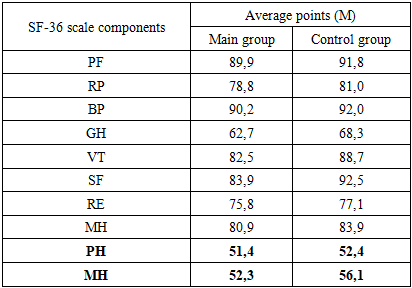
A number of scientific studies conducted worldwide show that in border guards serving at an altitude of 2500 m, VO2 max decreases by an average of 10-15%, tachycardia increases significantly, and the feeling of subjective fatigue increases by 1,5-2 times.According to the results of the survey conducted during our study, 72,0% of the total number of respondents involved in the study indicated that their health is very good, full of strength and energy, 25,0% - good, sometimes they get sick, only 1,4% of border guards were found to have poor health, get sick often, feel constant fatigue, and this negatively affects their mood.Of course, although most of the subjects considered themselves to have no health problems, it was found that 26,4% of border guards had health problems related to their service in mountainous conditions.In this regard, we decided to assess the impact of mountain conditions on the quality of life and physical and mental state of border guards using a specially standardized quality of life assessment questionnaire “SF-36”.In the survey conducted to assess the quality of life of border guards, various categories of border guards participated, first of all, we assessed the quality of life of border guards serving in different mountainous areas that participated in the study (Table 1), and at the next stage, based on the conditions of service of these border guards, we considered it necessary to assess them separately in the context of all subdivisions under study (Table 2).Table 1. Results of the quality of life assessment of border guards serving in mountainous areas
 |
| |
|
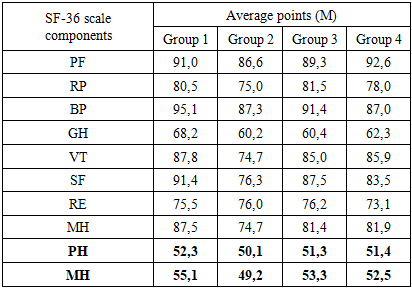
The scale indicators range from 0 to 100, and the 100 indicator represents a state of complete health. These scales form mental and physical well-being, and the results of the survey were calculated in points on 8 scales. The higher the total number of points collected based on the questionnaire, the higher the quality of a person's life. As can be seen from the table above, the data obtained on the quality of life indicators of all border guards participating in the survey include the average scores obtained on various scales of the SF-36 questionnaire. In particular, the indicator of physical activity (PF) averaged 89,9 points, which indicates a high level of physical activity of border guards, their ability to perform basic movements and tasks well. These indicators in the control group were 91,8, which is 1,9 points higher than in the main group. The indicator of the role of problems related to physical activity (RP) in the life activity of border guards averaged 78,8 points, which indicates that there are few limitations in the body of border guards arising from the state of physical health - physical barriers to the performance of official duties by them are insignificant, while in the control group these indicators were 81,0, which is 2,2 points higher.The indicators of the analysis of the influence of pain intensity on the normal life of border guards on the pain scale (PA) averaged 90,2 points, which indicates a minimal level of physical pain in the body of border guards and does not have a significant impact on their physical activity and daily activities. In the control group, these indicators were 1,8 points higher and amounted to 92,0 points.The indicators of the general health status (General Health) of border guards serving in the mountainous region averaged 62,7 points, which indicates that their general health indicators are at an average level, but it should not be overlooked that there are risks associated with unfavorable factors of the mountainous region. In the control group, these indicators were 68,3 points, and the difference was 5,6 points.The vitality scale (VT Vitality), i.e., how much the border guards feel or are satisfied with their activities and quality of life, averaged 82,5 points, and in addition to the high level of energy and activity in their body, it was found to be 6,2 points lower than the indicators of the control group (88,7 points), which showed that there may also be a tendency to fatigue in the health of border guards serving in mountainous areas.Social Functioning (SF) indicators, which determine the level of satisfaction with the social activity of border guards, averaged 83,9 points, indicating that they have good social relations and no problems working in a team. In the control group, these indicators were 92,5 points.The Role of Emotional Activity in the Life of Border Guards The average score on the Role Emotional (RE) indicator was 75,8 points, and it was found that their mental state over the past 14 days did not significantly affect their daily activities and performance of official duties.The results of the Mental Health (MH) assessment of the mental health status, mood, and emotional state of border guards averaged 80,9 points, indicating that mental health is stable, and stress and anxiety are minimal.Of the quality of life indicators of border guards, the integral score for the physical (PH) and mental (MH) components was 51,4 points for the physical component (PH) (52,4 in the control group), indicating that their physical condition is relatively better than the general condition, however, taking into account the fact that border guards belong to a practically healthy contingent of the population, these indicators need to be somewhat improved. Also, the average score for the mental component (MP) was 25,3 (56,1 points in the control group), which indicates that the mental state of border guards in the general group is close to the general state and there are fewer problems.Analyzing the results of assessing the quality of life of the groups of border guards, presented in Table 2, it was established that in group 1, the indicators of quality of life and health were the highest compared to other groups, high indicators of PF (91,0), BP (95,1), SF (91,4) were noted, which indicates that the physical abilities, the level of pain in the body, and social activity of the border guards were higher compared to other groups. It can be concluded that the fact that border guards in the 1st study group are physically healthy, have strong social connections, and are mentally stable is related to local conditions, lifestyle, environment, and the level of physical activity.Table 2. Results of quality of life assessment in different groups of border guards
 |
| |
|
On the contrary, based on the results of the analysis, it was found that the quality of life of border guards in the 2nd group was at a lower level compared to other groups and recorded the lowest indicators among the groups. In particular, GH (60,2 points), VT (74,7 points), MH (74,7 points), along with the presence of a decrease in general health, life activity, and mental state, the indicator of social activity also showed low results compared to other groups with 76.6 points. Of course, the fact that health and quality of life indicators in group 2 are significantly lower than in other groups may be related to the quality of service conditions, the nature of service, or preventive measures in the field of medicine, as well as measures for psychological and social support among border guards serving in this mountainous area.In group 4, border guards have high indicators of physical abilities, but there are some limitations in general health and emotional stability, which may be associated with a high level of stress, loneliness, climatic conditions at an altitude, or working conditions.At the same time, our main focus is on those serving in mountainous areas and those with various diseases throughout the year. Due to the fact that it is aimed at assessing the state of health and quality of life of border guards who have applied to medical services 1-2 times, studying not only their physical, but also mental state as a result of various diseases, the SF-36 questionnaire of 18,8% of the examined border guards was analyzed separately (Figure 1.).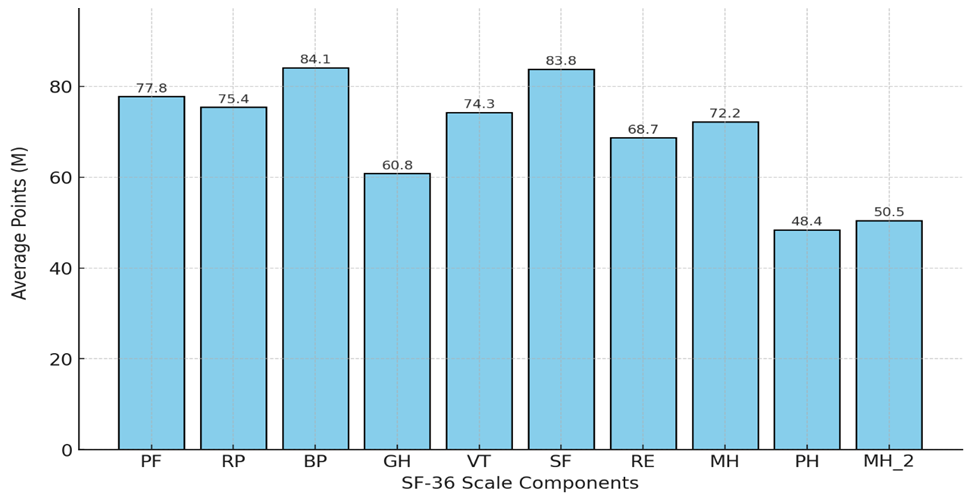 | Figure 1. Results of the quality of life assessment of border guards who applied for various illnesses |
As can be seen from Figure 1, a number of risk factors among border guards serving in mountainous areas negatively affect the quality of life. In particular, if the low oxygen content in the air causes disruption of respiration, muscle activity, and energy metabolism in the body, which is directly reflected in the indicators of GH, VT, and PF, then in mountainous areas, the need for border guards to walk long distances in full gear and lift heavy loads led to the accumulation of low scores for PF and RP indicators.
5. Conclusions
If we pay attention to the specifics of the factors influencing the body of border guards serving in mountainous areas, then in mountainous conditions, depending on the relief, season, and weather, various factors influence. Thus, if the presence of limitations in social contacts in mountainous conditions, in turn, affects the indicators of SF and MH, then RE and MH indicators are also significantly lower than those of healthy people due to the environment of high-altitude risk, long service, and mental problems associated with the health of border guards.
References
| [1] | Al Amer R, Al Khalifa K, Alajlan SA, Al Ansari A. Analyzing the Psychometric Properties of the Short Form-36 Quality of Life Questionnaire in Patients with Obesity. Obes Surg. 2018 Aug; 28(8): 2521-2527. |
| [2] | Azizova F. L., Ermatov N. J., Kutliev J. A. Hygienic recommendations for organizing a healthy diet to increase the physical activity of military athletes // Art of Medicine. International Medical Scientific Journal. – 2022. – Т. 2. – №. 1. |
| [3] | Kutliev J. A. et al. Modern approaches to service conditions factors affecting the health of military servicemen and prevention problems // Web of Medicine: Journal of Medicine, Practice and Nursing. – 2024. – Т. 2. – №. 3. – P. 104-109. |
| [4] | Kutliev J. A. et al. THE DIET OF MILITARY PERSONNEL AND ITS IMPACT ON THEIR FUNCTIONAL CAPABILITIES // Web of Medicine: Journal of Medicine, Practice and Nursing. – 2024. – Т. 2. – №. 10. – P. 81-83. |
| [5] | Kutliev J., Ermatov N. The Effectiveness of Assessing the Quality of Life of Obese Military Personnel Using the SF-36 Questionnaire. – 2025. |
| [6] | Lins L, Carvalho FM. SF-36 total score as a single measure of health-related quality of life: Scoping review. SAGE Open Med. 2016 Oct 4; 4: 2050312116671725. |
| [7] | Mathew TM, Sharma S. High Altitude Oxygenation. [Updated 2023 Apr 10]. In: StatPearls [Internet]. Treasure Island (FL): StatPearls Publishing; 2025 Jan-. Available from: https://www.ncbi.nlm.nih.gov/books/NBK539701/, 2023. |
| [8] | Ministry of Ecology, Environmental Protection and Climate Change of the Republic of Uzbekistan. (2023). National state of the environment report: Uzbekistan. International Institute for Sustainable Development. |
| [9] | Schneider M, Bernasch D, Weymann J, et al. Acute mountain sickness: Influence of susceptibility, preexposure, and ascent rate. Med Sci Sports Exerc 2022; 34: 1886–91. |
| [10] | Simonson TS, Yang Y, Huff CD, et al. Genetic evidence for highaltitude adaptation in Tibet. Science. 2010; 329(5987): 72-5. doi:10.1126/science.1189406. |


 Abstract
 Reference
 Full-Text PDF
 Full-text HTML