
-
Paper Information
- Next Paper
- Previous Paper
- Paper Submission
-
Journal Information
- About This Journal
- Editorial Board
- Current Issue
- Archive
- Author Guidelines
- Contact Us
American Journal of Medicine and Medical Sciences
p-ISSN: 2165-901X e-ISSN: 2165-9036
2025; 15(10): 3397-3401
doi:10.5923/j.ajmms.20251510.25
Received: Sep. 11, 2025; Accepted: Oct. 5, 2025; Published: Oct. 15, 2025

Comparative Characteristics of Studies of the Uterus of White Outbred Female Rats Before and After Long-Term Energy Drink Intake
 Abstract
 Reference
 Full-Text PDF
 Full-text HTML
Ishankulova Dildora Khabibullaevna
Bukhara State Medical Institute named after Abu Ali ibn Sina, Bukhara, Uzbekistan
Correspondence to: Ishankulova Dildora Khabibullaevna, Bukhara State Medical Institute named after Abu Ali ibn Sina, Bukhara, Uzbekistan.
| Email: |  |
Copyright © 2025 The Author(s). Published by Scientific & Academic Publishing.
This work is licensed under the Creative Commons Attribution International License (CC BY).
http://creativecommons.org/licenses/by/4.0/

This work is devoted to the study of the effect of energy drinks on the histochemical structure of the uterus using female white outbred rats as an example. The methods of study were staining with Schiff reagent and positive PAS reaction of the uterine structure after long-term intake of energy drink. As a result of the study, it was revealed that there is proliferation and increase in the amount of collagen type III. (Reticular fibers) in the uterine tissue of white outbred rats.
Keywords: PAS reaction, Schiff reagent, Histochemical study, Uterus, White outbred rats, Collagen type III
Cite this paper: Ishankulova Dildora Khabibullaevna, Comparative Characteristics of Studies of the Uterus of White Outbred Female Rats Before and After Long-Term Energy Drink Intake, American Journal of Medicine and Medical Sciences, Vol. 15 No. 10, 2025, pp. 3397-3401. doi: 10.5923/j.ajmms.20251510.25.
1. Introduction
- Energy drinks are a special type of carbonated beverages that are positioned by their manufacturers as those that increase physical activity and improve productivity when consumed. Energy drinks first appeared on the market in the 80s of the 20th century. Drinks of this class gained particular popularity in the 2000s of the 21st century, as evidenced by the increased sales volumes [1].Energy drinks consist of components that have long been known to medicine. Thus, all "energy drinks" without exception contain caffeine. In industry, it is obtained in three ways: by isolating it from roasted coffee beans, which contain 0.75 - 1.5% caffeine; by extracting it from tea dust, ground tea leaves, containing 1.5 - 3.5% caffeine; by extracting it from cola nuts, which contain about 2% caffeine. In addition, it can be obtained chemically from uric acid or by methylation of theobromine. It is synthetic, cheaper caffeine that manufacturers include in energy drinks. Another component of energy cocktails is taurine. Some manufacturers add extract of mate leaves, damiana, Far Eastern magnolia vine, ginseng.There are also vitamins in the "energy" that are directly related to the body's energy metabolism: ascorbic acid, B1, B2, B3, B5, B6, B12, niacin. Moreover, some vitamins are introduced in the amount of the required daily dose of an adult, which is not bad at all. In general, the purpose of these drinks is to increase the same energy metabolism, the vitality of the body.Addiction to energy drinks lies in the properties of their main component - caffeine:- Large doses of caffeine can lead to depletion of nerve cells.- The effect of caffeine (like other psychostimulants) largely depends on the type of higher nervous activity.- Caffeine weakens the effect of sleeping pills and narcotics, increases the reflex excitability of the spinal cord, and excites the respiratory and vasomotor centers.- Cardiac activity increases under the influence of caffeine, myocardial contractions become more intense and frequent.In the amount contained in 2-3 cans of energy drinks, drunk over a short period of time, caffeine causes anxiety, insomnia, irritability, and headaches. At the same time, although this has not yet been fully proven, consuming caffeine in high doses over a long period of time can cause coronary heart disease, high blood pressure, and some birth defects in offspring [2,3].Acute caffeine poisoning produces early symptoms of anorexia, tremors, and confusion. Severe intoxication can cause delirium, seizures, supraventricular and ventricular tacharrhythmias, hypokalemia and hyperglycemia. Chronic intake of large doses of caffeine can lead to nervousness, irritability, anger, constant tremors, muscle twitching, insomnia and hyperreflexia. Taurine is a synthetic analogue of caffeine, which is cheaper and is added to energy drinks in huge quantities: Like caffeine, taurine helps improve energy processes, but the safety of taurine for patients under 18 has not been established, that is, the likelihood of adverse reactions and its effect on metabolism are unpredictable. Most expert opinions of medical specialists unequivocally state the detrimental effect of such drinks on human health. However, the only thing that specialists and society have managed to achieve to date is the mandatory application of warning labels on cans. A number of studies also clearly indicate a link between the consumption of energy drinks and weak alcoholic beverages and future addiction to strong alcoholic beverages and so-called “hard” drugs.Numerous cases of exacerbation of psychiatric disorders have been documented in individuals who abused energy drinks [4]. In a number of cases, their use by patients suffering from epilepsy provoked the development of seizures [5], including, in one case, against the background of their two-year absence. Machado-Vieira R. et al. described a case of the development of a manic episode in a 36-year-old patient suffering from bipolar disorder after consuming three cans of Red Bull per night [6]. Cerimele J.M. et al. noted the development of acute psychosis in a patient with schizophrenia [7,8]. The danger of consuming excessive amounts of energy drinks by healthy people in the context of psychiatric pathology is confirmed by the following facts. Iyadurai S.J., Chung S.S. documented an episode with the appearance of seizures without a history of epilepsy [9]. And Goruglu Y. et al. described a case of acute psychosis in a young man who had no previous psychiatric history [10]. Thus, Vivekanandarajah A. et al. [11] described a case of acute hepatitis in a 22-year-old girl who consumed about 10 cans of the drink per day for two weeks (brand name not specified). In the same year, Apestegui C.A. et al. [12] described a case of cholestatic hepatitis in a patient with a liver transplant who drank 15 cans of Red Bull over three days. In both cases, the authors of the cited publications associated the hepatotoxicity of drinks with a high content of vitamin B3.Objective of the study is to determine the effect of long-term consumption of energy drinks on the histochemical structure of the uterus in female white outbred rats using the methods of staining with the Schiff reagent and a positive PAS reaction.
2. Materials and Methods
- For the study, white nulliparous female rats aged 5-6 months weighing 130-140 g were selected. 5-6-month-old white outbred rats were kept in standard vivarium conditions with relative humidity (50-60%), temperature (19-22°C) and light regime (12 hours of darkness and 12 hours of light).In order to prevent infectious diseases in the vivarium and ensure the absence of infectious diseases, the laboratory animals were quarantined for 21 days and observed during these days, their temperature was measured and their weight was checked several times during these days. The increase was monitored. During this period, they did not show any symptoms of the disease, the temperature was within the normal range (38.5-39.5°C), appetite disorders and other external changes were not detected. On the 10th day, the animals were taken out of the experiment under ether anesthesia in compliance with the rules of euthanasia and autopsy material was collected for subsequent histological examination (small intestine). The autopsy material was labeled, fixed in 10% buffered formalin and subjected to histological examination using generally accepted histological techniques. To study the morphological parameters of the organs of laboratory animals, research methods widely used in experimental studies (anatomical dissection) were used. All histological preparations were examined using a trinocular microscope HL-19 (China) with software. Sections were stained with Schiff reagent.
3. Result and Discussion
- The rat uterus has paired horns, a double body and neck. The uterine horns fuse caudally to form the body and neck, but their cavities remain separated from each other by a septum and open into the vagina with two independent openings. It should be noted that in the main textbooks on veterinary science and monographs on developmental biology in rats, according to the main classification of uteruses, the latter is described as bipartite, which means the fusion of bodies with the formation of one cervical opening. Upon comprehensive study of this issue, it becomes clear that the rat uterus should be classified as double. The body of the uterus is an undivided area between the horns and the cervix. It is located in the abdominal cavity dorsal to the bladder and ventral to the rectum. The cervix is a small thick-walled area between the body of the uterus and the vagina. It is divided into vaginal and supravaginal parts. Histological examination revealed that the wall of the horns, body and cervix of the uterus consists of three membranes: the endometrium (mucous), myometrium (muscular) and perimetrium (serous) (Fig. 1).
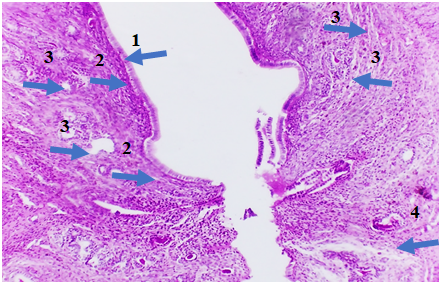 | Figure 1. Morphological structure of the uterus of a white mongrel rat before long-term use of energy drinks (normal) Stained with Schiff reagent and hematoxylin. Magnification 10x20. 1- endometrium; 2- proper plate of the mucous membrane (endometrial stroma); 3- uterine glands; 4- muscular layer |
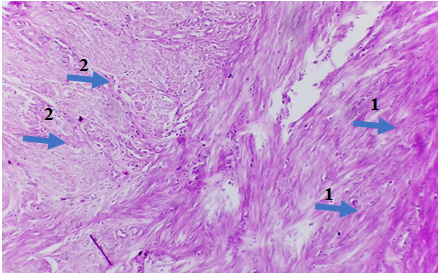 | Figure 2. Morphological structure of the uterus (myometrium) of a white mongrel rat before long-term use of energy drinks (normal) Stained with Schiff reagent and hematoxylin. Magnification 10x20. 1 - smooth muscles; 2 - circular muscles |
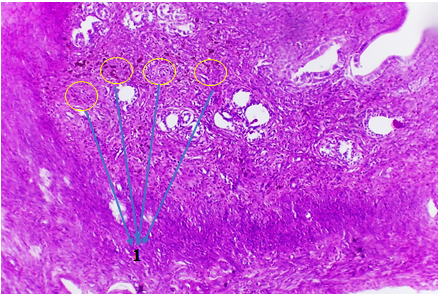 | Figure 3. Morphological structure of the uterus of a white mongrel rat after long-term consumption of energy drinks. Staining with Schiff reagent and hematoxylin. Positive PAS reaction for uterine tissue. Magnification 10x20. 1- proliferation and increase in the amount of type III collagen. (Reticular fibers) |
|
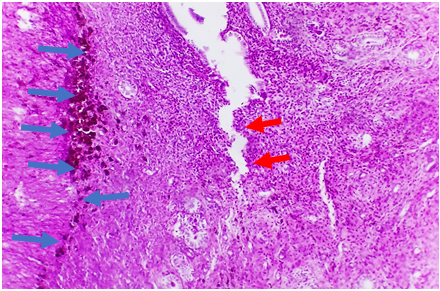 | Figure 4. Morphological structure of the uterus of a white mongrel rat after long-term consumption of energy drinks. Staining with Schiff reagent and hematoxylin. Positive PAS reaction for uterine tissue. Magnification 10x20. proliferation and increase in the amount of type III collagen. (Reticular fibers). metaplasia of the epithelium of the endothelial layer |
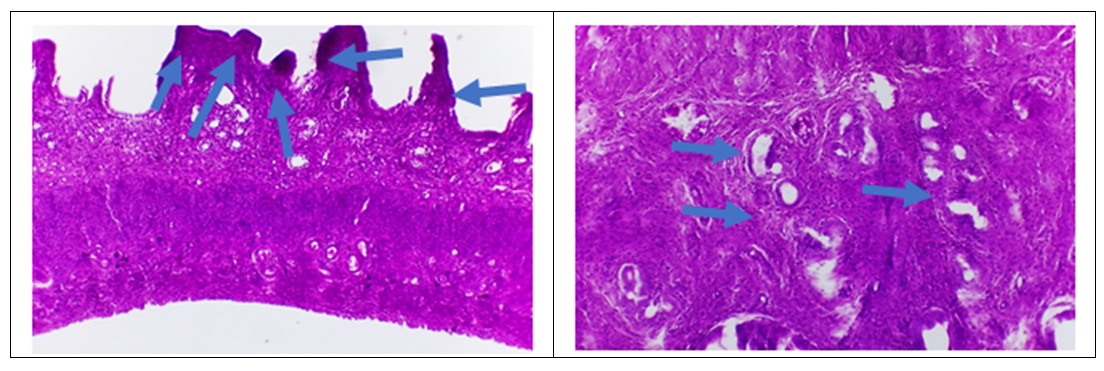 | Figure 5. Morphological structure of the uterus of a white mongrel rat after long-term consumption of energy drinks. Staining with Schiff reagent and hematoxylin. Positive PAS reaction on uterine tissue. Magnification 10x20. Proliferation and increase in the amount of type III collagen. (Reticular fibers) |
4. Conclusions
- Conclusion is that long-term energy drink consumption can cause pathological changes in uterine morphology, such as fibrosis and metaplasia. These results emphasize the need for further study and attention to the side effects of energy drink consumption on the body of the female reproductive system.