American Journal of Medicine and Medical Sciences

p-ISSN: 2165-901X    e-ISSN: 2165-9036

2025;  15(10): 3372-3376

doi:10.5923/j.ajmms.20251510.19

Received: Aug. 25, 2025; Accepted: Sep. 16, 2025; Published: Oct. 15, 2025

 

Clinical and Genetic Characteristics of Patients with Gout and Kidney and Liver Damage

Shodikulova Gulandom Zikriyayevna, Pulatov Ulugbek Sunatovich, Karimov Aziz Khamrokulovich

Samarkand State Medical University, Samarkand, Uzbekistan

Correspondence to: Shodikulova Gulandom Zikriyayevna, Samarkand State Medical University, Samarkand, Uzbekistan.

Email:

Copyright © 2025 The Author(s). Published by Scientific & Academic Publishing.

This work is licensed under the Creative Commons Attribution International License (CC BY).
http://creativecommons.org/licenses/by/4.0/

Abstract

Introduction. Gout is a condition that involves inflammation in the joints and the build-up of uric acid crystals in different tissues, which causes serious pain, swelling, and inflammation. Gout is one of the oldest conditions known to humans. Among rheumatic diseases, gout is considered the most studied, understood, and well-controlled nosologically entity. Research materials and methods. The research work was carried out at the central hospital of the Samarkand City Medical Association. For the dissertation work, a comprehensive approach was used, including clinical, laboratory, biochemical, immunological, ultrasound, radiological, CT, and statistical research methods. The study examined 111 patients with primary gout, who were divided into 3 groups: 1st group (n=34), patients diagnosed with primary gout without damage to internal organs. 2nd group (n=39), patients with primary gout with kidney damage and patients with primary gout with liver and kidney damage 3rd group (n=38). Research results. The average age of the patients was 55.9±8 years (from 29 to 65 years). Patients aged up to 43 years - 21.33%, from 44 to 58 years - 52%, from 59 to 65 years - 26.67%. The average age of patients at the onset of the disease was 44.8±8 years. In most patients (71.1%) the onset of the disease was observed on average at the age of 35-52 years. The average duration of the disease upon admission was 5.2 (1.0;10.0 years). Conclusions. Thus, our results showed no association between the Ala22Val polymorphism in the MTHFR gene and the development of gout in our patients, which contradicts the data of some scientific studies, where a predisposing effect of the mutant Val allele on the development of GU and gout in the adult population was found.

Keywords: Gout, Liver pathology, Chronic kidney disease, Clinical course, Genetic predisposition

Cite this paper: Shodikulova Gulandom Zikriyayevna, Pulatov Ulugbek Sunatovich, Karimov Aziz Khamrokulovich, Clinical and Genetic Characteristics of Patients with Gout and Kidney and Liver Damage, American Journal of Medicine and Medical Sciences, Vol. 15 No. 10, 2025, pp. 3372-3376. doi: 10.5923/j.ajmms.20251510.19.

1. Introduction

Gout is a condition that involves inflammation in the joints and the build-up of uric acid crystals in different tissues, which causes serious pain, swelling, and inflammation. Gout is one of the oldest conditions known to humans. Among rheumatic diseases, gout is considered the most studied, understood, and well-controlled nosologically entity [19]. The epidemiology of gout varies depending on the region and the population studied. According to Dehlin, M et al. (2020), various factors influence the prevalence and incidence of gout (location of the study group, genetics, research methodology, etc.), but it is known that the indicators vary in the range of <1% to 6.8% and 0.58-2.89 per 1,000 person-years, respectively. Gout is more common in men than in women, with increasing age and in some ethnic groups [20].
In recent decades, there has been an active search for candidate genes associated with the development of hyperuricaemia (GU) and gout, and the influence of genetic factors on the regulation of uric acid (UA) synthesis and excretion has been studied [2]. Polymorphic loci encoding folate metabolism can be considered as candidate genes predisposing to the development of HU and gout [4,8]. Folate metabolism disorders are associated with an increased risk of cardiovascular diseases (coronary heart disease, atherosclerosis, stroke), haemostasis system pathologies, pregnancy complications, osteoporosis, and rheumatoid arthritis [11,14]. On the other hand, the participation of folates in the biosynthesis of purine nucleotides suggests a possible role for the folate cycle in the pathogenesis of GU and gout.

2. Research Materials and Methods

The research work was carried out at the central hospital of the Samarkand City Medical Association. For the dissertation work, a comprehensive approach was used, including clinical, laboratory, biochemical, immunological, ultrasound, radiological, CT (computer tomography), and statistical research methods. The study examined 111 patients with primary gout, who were divided into 3 groups: 1st group (n=34), patients diagnosed with primary gout without damage to internal organs. 2nd group (n=39), patients with primary gout with kidney damage and patients with primary gout with liver and kidney damage 3rd group (n=38). Biochemical research methods (renal and hepatic parameters, lipid profile, rheumatic trials, uric acid level, IL6, IL10, TNF-α levels).
Assessment of the functional state of the joints was carried out according to a special questionnaire; the functional index of the foot, the American Orthopedic Foot and Ankle Joint Society (AOFAS) scale [9,12]. The AOFAS scale assesses parameters: pain, functional limitations, mobility, and some aspects of quality of life [11,13,14]. Assessment of the quality of life was carried out using the European Quality of Life Questionnaire (EQ-5D), since this questionnaire is universal and allows for a real assessment of the patient's psychometric state (reliability, validity, sensitivity) [6-8]. The Gout Impact Scale (GIS) was also used - a method specific to gout for assessing not only the quality of life, but also the impact of gout at the time of the attack and in general. The questionnaire was included in the form of five scales.
Statistical processing of the results was carried out on a personal computer using the "Statistica 6.0" software package with the calculation of the arithmetic mean (M), the error of the arithmetic mean (m), Student's t-test (t), and the equality of total variances (F - Fisher's criterion). A significance level of R=0.05 was taken as statistically significant changes. For statistical analysis of the obtained research results, statistical packages Statistica 12.0, Microsoft Excel 2010 were used.

3. Research Results

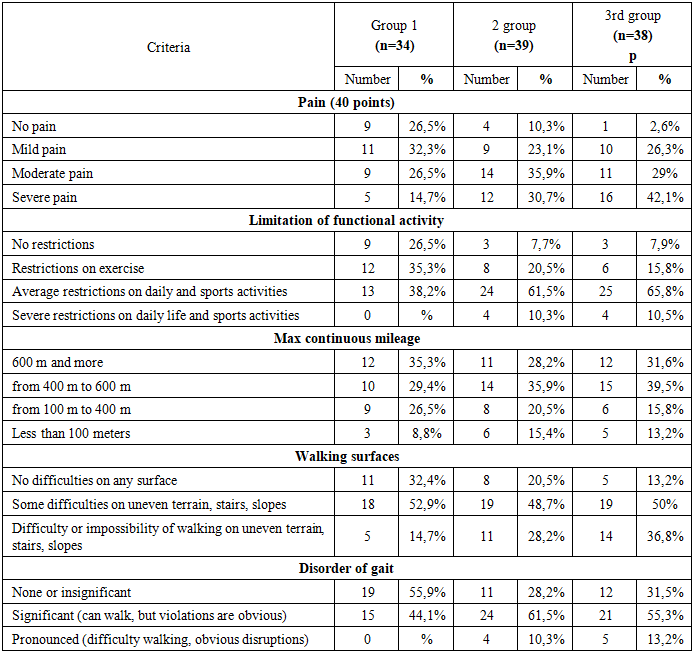
The average age of the patients was 55.9±8 years (from 29 to 65 years). Patients aged up to 43 years - 21.33%, from 44 to 58 years - 52%, from 59 to 65 years - 26.67%. The average age of patients at the onset of the disease was 44.8±8 years. In most patients (71.1%) the onset of the disease was observed on average at the age of 35-52 years. The average duration of the disease upon admission was 5.2 (1.0;10.0 years). The general characteristics of patients by age and duration of the disease are presented in Table 1.
Table 1. Criteria for assessing the limitation of the functional state of patients in groups
     
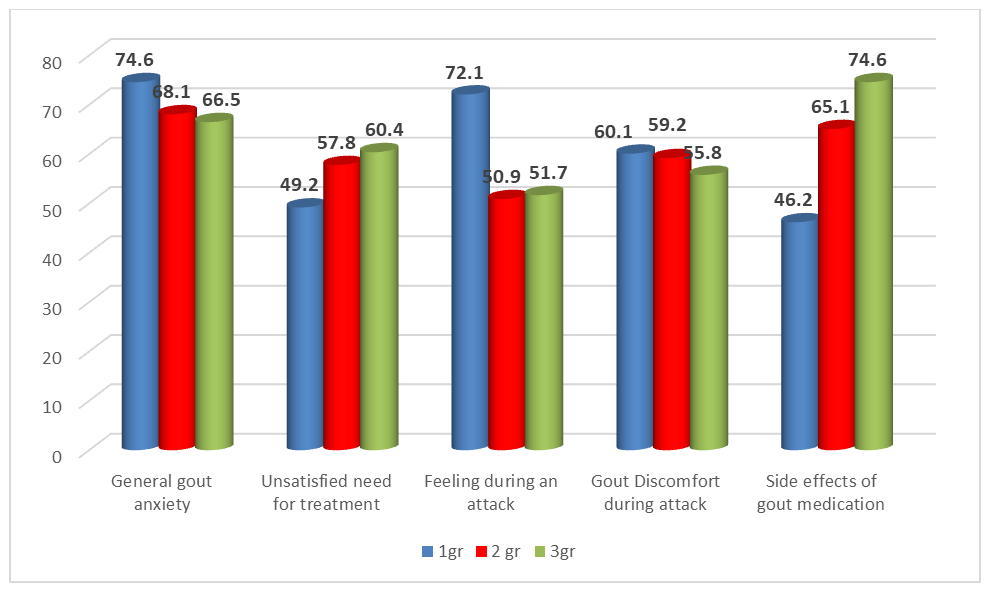
The Gout Impact Scale (GIS) was also used - a method specific to gout for assessing not only the quality of life, but also the impact of gout during an attack and in general. The questionnaire is included in the form of five scales, from 0 to 100, where 100 indicates the worst-case scenario.
Analysis of the indicators of the Gout Impact Scale (GIS) revealed a number of patterns in the perception of the disease among patients of different clinical groups (Fig. 1). The greatest general tendency towards anxiety for gout symptoms was noted in the first group (individual gout patients), and no statistically significant differences in this parameter were observed between the second (gout + kidney pathology) and third (gout + kidney + liver pathology) groups (p=0.076).
Figure 1. Gout Impact Scale (GIS) indicators
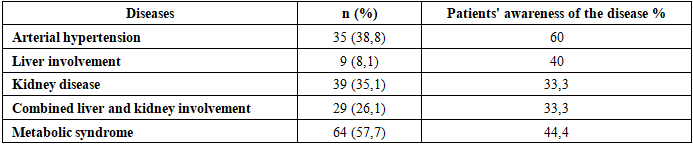
During the examination of patients, it was established that they repeatedly registered comorbidities, especially cardiovascular, kidney, and liver diseases. Among patients, kidney diseases were found in 35.1%, combined liver and kidney damage in 26.1%, and isolated liver damage in 8.1% of cases. Analysis of the conducted studies showed that 61.2% of patients had isolated or combined kidney damage, 16.1% had nephrolithiasis, 57.3% had uric acid diathesis, and 17.6% had renal cysts (Table 2).
Table 2. Complementary diseases of patients with gout and their level of awareness of these diseases
     
It is known that an increase in the level of uric acid in the blood is a predictor of the development of non-alcoholic fatty liver disease, that is, uric acid and its metabolites cause inflammation in the liver tissue and endothelial dysfunction, insulin resistance.
For an in-depth analysis of the above-mentioned pathologies, laboratory and instrumental methods of examination of patients were evaluated. In patients with gout with kidney and liver damage, the disease began at almost the same age (55±14 and 55±18 years, respectively, p<0.001). In these patients, the onset of gout was significantly earlier, and the number of affected joints was greater (p<0.001 and p<0.05, respectively). It was established that the frequency of attacks of gouty arthritis in them was observed more often in the last year (p<0.01). When analyzing patients depending on the clinical course of the disease, it was found that among patients with gout and kidney damage, 26 patients had a recurrent course of the underlying disease, and 13 patients had a chronic course. Among the examined patients, among the symptoms characteristic of kidney damage, urolithiasis, dysuric symptoms, pain in the lumbar region, macrohematuria, and hypertension were most common.
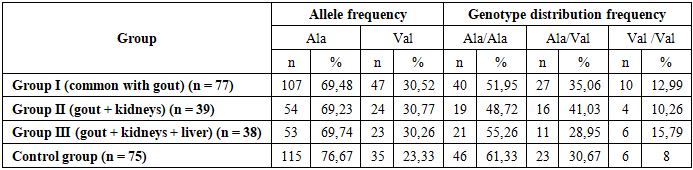
The next stage of the study was to investigate the prevalence of the methylene tetrahydrofolate reductase (MTHFR) folate cycle gene in groups of patients with kidney and liver damage. Genotyping of the Ala22Val polymorphism of the MTHFR folate cycle gene in 77 patients in the main group suffering from gout and having complications in the form of kidney and liver damage, as well as 75 healthy people who made up the control group (i.e., individuals without GU and manifestations of gout), can be seen in Table 3.
Table 3. Frequency of Ala22Val alleles and genotypes in the MTHFR gene in the comparison groups
     
The results showed that the distribution of allele and genotype frequencies corresponded to the expected Hardy-Weinberg equilibrium law. The expected and observed frequencies of the Ala22Val polymorphism of the MTHFR folate cycle gene did not differ statistically, p>0.05, both in the group of patients suffering from gout (p=0.13) and in the group of healthy people who made up the control group (p=0.29). This fact indicates the absence of pronounced dynamic factors in the population.
Genetic predisposition plays a key role in the development of gout, especially its complicated forms, such as kidney damage. Heredity affects the synthesis of uric acid and its subsequent excretion by the kidneys, which is a key factor in the development of gout. In turn, genetic predisposition to GU, by triggering a cascade of metabolic disorders, leads to liver damage, which is most affected by such disorders.
In connection with the above, we attempted to find a correlation between the carriage of alleles and genotypes of the Ala22Val polymorphism of the MTHFR gene with kidney and liver damage against the background of gout, for which a comparison was made with the study groups: Group II with gout and kidney pathology and Group III with kidney and liver damage against a background of gout. The results showed that there were no differences in the frequency of alleles and genotypes of the Ala22Val polymorphism of the MTHFR gene between Groups II and III (Table 3). There was an excess frequency of the heterozygous Ala/Val allele in patients with gout and kidney damage (41%) compared to patients with a combination of kidney and liver damage (28.9%) without any confidence intervals (χ2=1.2, p=0.30, RR=1.4, 95%CI=0.61-3.31, OR=1.7, 95%CI=0.66-4.39).

4. Conclusions

Thus, our results showed no association between the Ala22Val polymorphism in the MTHFR gene and the development of gout in our patients, which contradicts the data of some scientific studies, where a predisposing effect of the mutant Val allele on the development of GU and gout in the adult population was found. In our scientific work, despite the prevalence of the mutant Val allele and the Val/Val genotype of the MTHFR gene in the group of patients with gout, we did not find any significant genetic associations with gout.
Information about the source of support in the form of grants, equipment, and drugs. The authors did not receive financial support from manufacturers of medicines and medical equipment.
Conflicts of interest. The authors have no conflicts of interest.

References

[1]  Abhishek A, Valdes AM, Jenkins W, Zhang W, Doherty M. Triggers of acute attacks of gout, does age of gout onset matter? A primary care based cross-sectional study. PLoS One. 2017 Oct 12; 12(10): e0186096. doi: 10.1371/journal.pone.0186096. PMID: 29023487; PMCID: PMC5638318.
[2]  Adashek ML, Bourji KI. Pegloticase Induced Hemolytic Anemia in a Patient With G6PD Deficiency. J Hematol. 2018 May; 7(2): 83-85. doi: 10.14740/jh402w. Epub 2018 May 10. PMID: 32300419; PMCID: PMC7155862.
[3]  Alghubayshi A, Edelman A, Alrajeh K, Roman Y. Genetic assessment of hyperuricemia and gout in Asian, Native Hawaiian, and Pacific Islander subgroups of pregnant women: biospecimens repository cross-sectional study. BMC Rheumatol. 2022 Jan 6; 6(1): 1. doi: 10.1186/s41927-021-00239-7. PMID: 34986901; PMCID: PMC8734301.
[4]  Alrajeh, K.Y.; Roman, Y.M. Pharmacogenetic Perspective for Optimal Gout Management. Future Pharmacol. 2022, 2, 135-152. https://doi.org/10.3390/futurepharmacol2020011
[5]  Amatucci AJ, Padnick-Silver L, LaMoreaux B, Bulbin DH. Comparison Between Early-Onset and Common Gout: A Systematic Literature Review. Rheumatol Ther. 2023 Aug; 10(4): 809-823. doi: 10.1007/s40744-023-00565-x. Epub 2023 Jun 19. PMID: 37335432; PMCID: PMC10326179.
[6]  Beringer PM, Kriengkauykiat J, Zhang X, Hidayat L, Liu S, Louie S, Synold T, Burckart GJ, Rao PA, Shapiro B, Gill M. Lack of effect of P-glycoprotein inhibition on renal clearance of dicloxacillin in patients with cystic fibrosis. Pharmacotherapy. 2008 Jul; 28(7): 883-94. doi: 10.1592/phco.28.7.883. PMID: 18576903.
[7]  Bezalel Y, Gershoni-Baruch R, Dagan E, Lidar M, Livneh A. The 3435T polymorphism in the ABCB1 gene and colchicine unresponsiveness in familial Mediterranean fever. Clin Exp Rheumatol. 2009 Mar-Apr; 27(2 Suppl 53): S103-4. PMID: 19796545.
[8]  Borić-Bilušić AA, Božina N, Lalić Z, Lovrić M, Nađ-Škegro S, Penezić L, Barišić K, Trkulja V. Loss of Function ABCG2 c.421C>A (rs2231142) Polymorphism Increases Steady-State Exposure to Mycophenolic Acid in Stable Renal Transplant Recipients: An Exploratory Matched Cohort Study. Adv Ther. 2023 Feb; 40(2): 601-618. doi: 10.1007/s12325-022-02378-w. Epub 2022 Nov 25. PMID: 36434147.
[9]  Bortolotti M, Polito L, Battelli MG, Bolognesi A. Xanthine oxidoreductase: One enzyme for multiple physiological tasks. Redox Biol. 2021 May; 41: 101882. doi: 10.1016/j.redox.2021.101882. Epub 2021 Jan 27. PMID: 33578127; PMCID: PMC7879036.
[10]  Bowden RG, Richardson KA, Richardson LT. Uric acid and metabolic syndrome: Findings from national health and nutrition examination survey. Front Med (Lausanne). 2022 Dec 14; 9: 1039230. doi: 10.3389/fmed.2022.1039230. PMID: 36590930; PMCID: PMC9795410.
[11]  Brigham MD, Milgroom A, Lenco MO, Wang Z, Kent JD, LaMoreaux B, Johnson RJ, Mandell BF, Hadker N, Sanchez H, Francis K, Radeck LP, Miyasato G, Li JW. Immunosuppressant Use and Gout in the Prevalent Solid Organ Transplantation Population. Prog Transplant. 2020 Jun; 30(2): 103-110. doi: 10.1177/1526924820913514. Epub 2020 Mar 25. PMID: 32208882.
[12]  Cai N, Chen M, Feng P, Zheng Q, Zhu X, Yang S, Zhang Z, Wang Y. Relationships between obesity and prevalence of gout in patients with type 2 diabetes mellitus: a cross-sectional population-based study. BMC Endocr Disord. 2024 Aug 2; 24(1): 137. doi: 10.1186/s12902-024-01672-8. PMID: 39090627; PMCID: PMC11295670.
[13]  Cai N, Chen M, Wu L, Feng P, Ye X, Liu Q, Zhu X, Lu C, Zheng Q, Wang Y. Association between physical activity and the prevalence of gout among patients with type 2 diabetes mellitus and hyperuricemia: a two-center population-based cross-sectional study. Clin Rheumatol. 2024 Sep; 43(9): 2955-2961. doi: 10.1007/s10067-024-07081-5. Epub 2024 Jul 26. PMID: 39060811; PMCID: PMC11330382.
[14]  Cao L, Zhao T, Xie C, Zheng S, Wan W, Zou H, Zhu X. Performance of Ultrasound in the Clinical Evaluation of Gout and Hyperuricemia. J Immunol Res. 2021 Apr 5; 2021: 5550626. doi: 10.1155/2021/5550626. PMID: 33884273; PMCID: PMC8041551.
[15]  Card-Gowers J, Retat L, Kumar A, Marder BA, Padnick-Silver L, LaMoreaux B, Webber L. Projected Health and Economic Burden of Comorbid Gout and Chronic Kidney Disease in a Virtual US Population: A Microsimulation Study. Rheumatol Ther. 2024 Aug; 11(4): 913-926. doi: 10.1007/s40744-024-00681-2. Epub 2024 Jun 5. PMID: 38836994; PMCID: PMC11264668.
[16]  Carroll MB, Smith DM, Shaak TL. Genomic sequencing of uric acid metabolizing and clearing genes in relationship to xanthine oxidase inhibitor dose. Rheumatol Int. 2017 Mar; 37(3): 445-453. doi: 10.1007/s00296-016-3592-2. Epub 2016 Oct 31. PMID: 27798726.
[17]  Cho C, Kim B, Kim DS, Hwang MY, Shim I, Song M, Lee YC, Jung SH, Cho SK, Park WY, Myung W, Kim BJ, Do R, Choi HK, Merriman TR, Kim YJ, Won HH. Large-scale cross-ancestry genome-wide meta-analysis of serum urate. Nat Commun. 2024 Apr 24; 15(1): 3441. doi: 10.1038/s41467-024-47805-4. PMID: 38658550; PMCID: PMC11043400.
[18]  Choi HG, Kwon BC, Kwon MJ, Kim JH, Kim JH, Park B, Lee JW. Association between Gout and Dyslipidemia: A Nested Case-Control Study Using a National Health Screening Cohort. J Pers Med. 2022 Apr 8; 12(4): 605. doi: 10.3390/jpm12040605. PMID: 35455721; PMCID: PMC9032264.
[19]  Dehlin, M., Jacobsson, L. & Roddy, E. Global epidemiology of gout: prevalence, incidence, treatment patterns and risk factors. Nat Rev Rheumatol 16, 380–390 (2020). https://doi.org/10.1038/s41584-020-0441-1
[20]  Fenando A, Rednam M, Gujarathi R, et al. Gout. [Updated 2024 Feb 12]. In: StatPearls [Internet]. Treasure Island (FL): StatPearls Publishing; 2024 Jan-. Available from: https://www.ncbi.nlm.nih.gov/books/NBK546606/.