Akhmedova Nilufar Mamujanovna, Mukhitdinova Tukhtakhon Kadyrovna
Andijan State Medical Institute, Andijan, Uzbekistan
Copyright © 2025 The Author(s). Published by Scientific & Academic Publishing.
This work is licensed under the Creative Commons Attribution International License (CC BY).
http://creativecommons.org/licenses/by/4.0/

Abstract
With submucous myoma, the probability of infertility reaches 30-35%. But when pregnancy occurs, there is a risk of complications during and after childbirth. The combination of uterine myoma with endometrial hyperplasia may indicate systemic damage to the uterus associated with hyperplastic processes in both the endometrium and myometrium.
Keywords:
Submucous uterine myoma, Reproductive function, Infertility
Cite this paper: Akhmedova Nilufar Mamujanovna, Mukhitdinova Tukhtakhon Kadyrovna, Peculiarities of the Clinical Course of Submucous Uterine Myoma in Women of Fertile Age, American Journal of Medicine and Medical Sciences, Vol. 15 No. 9, 2025, pp. 3258-3260. doi: 10.5923/j.ajmms.20251509.92.
1. Introduction
Clinical manifestations of submucous uterine myoma depend on several key factors, including the time elapsed since the appearance of the neoplasm, its size and growth rate. In the early stages of the disease, symptoms are often absent, and the presence of myoma is detected by chance during a gynecological examination or ultrasound [1,2,3,4]. With an increase in the size of the submucous node, a number of clinical manifestations are observed [5,6,7]. One of the first signs of its growth is menorrhagia - abnormally heavy menstrual bleeding, accompanied by the presence of blood clots and a duration exceeding the physiological norm. It is also possible for bloody discharge to appear in the intermenstrual period, which indicates a violation of the menstrual cycle [8,9,10,11,12].As a result of frequent and significant blood loss, patients develop anemia, which is manifested by a complex of symptoms, including general malaise, pale skin, dizziness, headaches and decreased performance. These manifestations are a consequence of tissue hypoxia caused by iron deficiency in the body.Objective. To identify the features of the clinical course of submucous uterine myoma in women of fertile age.
2. Material and Methods
The study is based on a clinical and laboratory examination of 200 women with submucous uterine fibroids who were hospitalized in the gynecological department of the Andijan Regional Perinatal Center from 2019 to 2024.All patients were divided into 2 groups depending on the size, location, and number of myomatous nodes.: Group 1 consisted of 160 (69.6%) patients with nodules up to 5 cm in size who underwent resectoscopy, the main group consisted of 40 (17.4%) women with sizes over 5 cm who had laparoscopic myomectomy. For an adequate assessment of laboratory data, a control group consisting of 30 practically healthy people was formed.
3. The Results and Their Discussion
The study of genetic predisposition to diseases of the reproductive system is an important aspect of modern medicine aimed at the prevention and treatment of reproductive pathologies in women of childbearing age (Figure 1).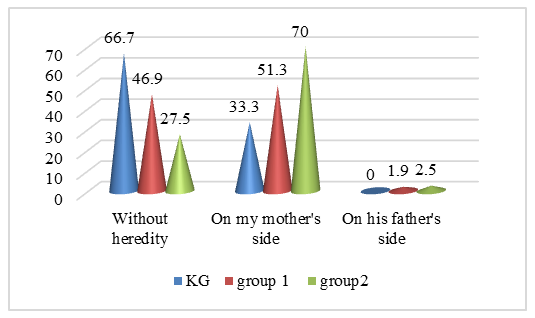 | Figure 1 |
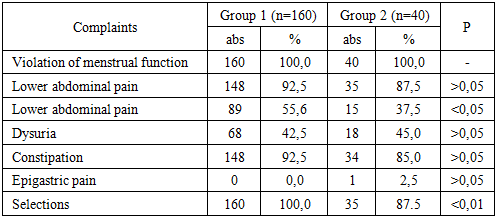
The medical history data showed that 20 (66.7%) of the control group, 75 (46.9%) of the 1st group and 11 (27.5%) of the 2nd group. In group 1, maternal heredity was present in 82 (51.3%), and paternal inheritance in 3 (1.9%). In group 2, burdened heredity was observed in 11 (%) of cases, and on the maternal side – in 28 (%), on the paternal side - 1 (%).Pain syndrome with submucous location of myomatous nodes is observed in 20-50% of patients. The pain is cramping, localized in the lower abdomen and can radiate into the lumbar region, especially during menstruation. These pains are caused by the contractile activity of the myometrium in response to mechanical irritation of the endometrium by a growing node.Unlike subserous fibroids, submucous tumors, as a rule, do not significantly affect the surrounding organs. However, in 10-40% of cases, there is a violation of reproductive function, manifested in the form of infertility or spontaneous abortions. This is due to changes in the uterine cavity, impaired implantation of the fetal egg and increased myometrial tone.NMF was observed in all women with submucous uterine fibroids. 148 (92.5%) patients of group 1 and 35 (87.5%) patients of group 2 complained of abdominal pain (Table 1).Table 1. Complaints presented by examined patients with submucous uterine fibroids
 |
| |
|
Objectively, when examined in mirrors, hyperemic cervix was observed in 33 (20.6%) patients of group 1, in group 2 in 8 (20.0%), hypertrophied in 26 (16.3%) and 6 (15.0%) cases, unchanged in 45 (28.1%) and 14 (35.0%) and erosive in 56 (35.0%) and 12 (30.0%) cases, respectively.During bimanual examinations, we found that the tumor consistency is dense in all the studied cases, but in 16 (10.0%) cases with a bumpy surface, and 2 (5.0%) - in patients of group 1, in group 2. As well as a dense consistency, 45 (28.1%) in patients of group 1, 28 (70.0%) in group 2, 114 (90.0%) and 38 (95.0%) with a smooth surface.In 128 (80.03%) cases, painlessness was observed in patients of group 1 and 12 (30.0%) in group 2, in all other cases it was painful. The vast majority of patients: 133 (83.1%) and 34 (85.0%), respectively, showed tumor mobility, while in all other cases it was immobile.Appendages are mostly unchanged (91 (56.9%) and 30 (75.0%), respectively), enlarged – 38 (23.8%) and 5 (12.5%), painful – 26 (16.3%) and 4 (10.0%), fused – 5 (3.1%) and 1 (2.5%). Parametriosis was free in 138 (86.3%) patients of group 1 and painless in 22 (13.8%) cases of group 1 and 9 (22.5%).Hyperlipidemia, characterized by elevated serum lipids, is one of the fundamental factors that significantly affect the pathogenesis, clinical manifestation, and effectiveness of therapeutic strategies for uterine fibroids. This pathophysiological phenomenon plays an important role in the pathogenesis of uterine fibroids, modulating metabolic processes and contributing to the development of vascular disorders in the myometrium.Hyperlipidemia, in particular dyslipidemia, is associated with an increased risk of developing uterine fibroids, which is confirmed by numerous clinical and experimental studies. Lipid metabolites such as cholesterol, triglycerides and free fatty acids, penetrating into the myometrium, can have a direct effect on the proliferation and differentiation of smooth muscle cells, contributing to the growth of myomatous nodes.The mechanisms by which hyperlipidemia affects the pathogenesis of uterine fibroids are not fully understood. Nevertheless, there are hypotheses suggesting that lipids may function as signaling molecules interacting with various receptor systems and signaling pathways, including insulin receptors and the MAPK/ERK cascade.These signaling molecules can modulate the expression of genes involved in cell proliferation and apoptosis, which, in turn, can stimulate the growth and development of myomatous nodes. Thus, hyperlipidemia can be considered as a potential factor contributing to pathophysiological changes underlying the formation of uterine fibroids.
4. Conclusions
Elevated blood lipids are an important pathogenetic factor affecting the clinical picture of uterine fibroids and the effectiveness of therapeutic approaches. Taking this factor into account in clinical practice and developing personalized therapeutic strategies aimed at correcting hyperlipidemia can significantly improve treatment outcomes in patients with uterine fibroids.
References
| [1] | Bandarian M. Submucosal lipoleiomyoma mimicking uterine rupture during hysteroscopic resection // J Obstet Gynaecol Can. – 2024. - Vol. 46(4). – Р. 102-216. |
| [2] | Bantscheff M. Proteomics in Medicine and Pharmacy // Conference Book. – 2019. – С. 60. Yang Y. et al. Single-cell analysis by ambient mass spectrometry // TrAC Trends in 119 Analytical Chemistry. – 2017. – Т. 90. – С. 14-26. |
| [3] | Baranowski W. Ulipristal acetate before high complexity endoscopic (hysteroscopic, laparoscopic) myomectomy - a mini-review // Prz Menopauzalny. – 2016. - Vol. 15(4). – P. 202-204. doi: 10.5114/pm.2016.65664. |
| [4] | Bitzer J. et al. Medical management of heavy menstrual bleeding: a comprehensive review of the literature // Obstetrical & gynecological survey. – 2015. – Vol.70. – №. 2. – С. 115130. |
| [5] | Bofill M. R. et al. Cyclical progestogens for heavy menstrual bleeding // The Cochrane database of systematic reviews. – 2019. – Vol. 8. – P 343-387. |
| [6] | Carey-Love A, Bradley L, Kho RM. Diagnostic considerations and surgical techniques for a large prolapsing submucosal myoma. Fertil Steril. 2023 Oct; 120(4): 920-921. |
| [7] | Carranza-Mamane B. et al. The management of uterine fibroids in women with otherwise unexplained infertility // Journal of Obstetrics and Gynaecology Canada. – 2015. – Vol. 37. – №3. – P. 277-285. |
| [8] | Carranza-Mamane B., Havelock J., Hemmings R. Reproductive endocrinology and infertility committee 77. Chai XS, Tao GS, Ding H, Zhou P, Mei XL, Li XX. Case Report: Low-grade endometrial stromal sarcoma with intravenous and intracardiac extension: a case after misdiagnosis of endometrial stromal nodule as submucosal fibroid. Front Oncol. 2023 Oct 16; 13: 1205783. |
| [9] | Carranza-Mamane B., Havelock J., Hemmings R. Reproductive endocrinology and infertility committee special contributor. The management of uterine fibroids in women with otherwise unexplained infertility // J Obstet Gynaecol Can. 2015; Vol. 37(3): 277-285. doi: 10.1016/S1701-2163(15)30318-2. |
| [10] | Chase T, Estes SJ. Hysteroscopic myomectomy of a large submucosal leiomyoma with novel use of fluid warming. J Minim Invasive Gynecol. 2018/ -- Vol. 25(7). – P. 1289-1294. doi: 10.1016/j.jmig.2018.05.002. Epub 2018 May 14. |
| [11] | Chen Y. J. et al. Medical treatment for heavy menstrual bleeding // Taiwanese Journal of Obstetrics and Gynecology. – 2015. – Т. 54. – №. 5. – С. 483-488. |
| [12] | Genazzani A. D. et al. Medical Treatment of Myomas // Frontiers in Gynecological Endocrinology. – Springer, Cham, 2016. – С. 141-149. |


 Abstract
 Reference
 Full-Text PDF
 Full-text HTML