
-
Paper Information
- Next Paper
- Previous Paper
- Paper Submission
-
Journal Information
- About This Journal
- Editorial Board
- Current Issue
- Archive
- Author Guidelines
- Contact Us
American Journal of Medicine and Medical Sciences
p-ISSN: 2165-901X e-ISSN: 2165-9036
2025; 15(9): 3254-3257
doi:10.5923/j.ajmms.20251509.91
Received: Sep. 3, 2025; Accepted: Sep. 26, 2025; Published: Sep. 29, 2025

The Impact of Cationic Trypsinogen (PRSS1) Gene Polymorphism on the Prognosis of Acute Pancreatitis
 Abstract
 Reference
 Full-Text PDF
 Full-text HTML
Madatov Kurbonboy Aminboyevich1, Ismailov Uktam Safayevich2, Sharopov Asliddin Nasriddinovich3, Matmuratov Seyilkhon Kuronboyevich4, Tursunov Firdavs Nuriddinovich5
1PhD, Senior Lecturer, Department of Surgical Diseases No. 1, International Faculty, Tashkent State Medical University, Tashkent, Uzbekistan
2Doctor of Medical Sciences, Professor, Head of the Department of Surgical Diseases No. 1, International Faculty, Tashkent State Medical University, Tashkent, Uzbekistan
3Doctoral 上ent in the Basic Doctoral Program, Department of Surgical Diseases No. 1, International Faculty, Tashkent State Medical University, Tashkent, Uzbekistan
4Candidate of Medical Sciences, Senior Lecturer, Department of Surgical Diseases No. 1, International Faculty, Tashkent State Medical University, Tashkent, Uzbekistan
5PhD, Assistant, Department of Surgical Diseases, Termiz Branch of the Tashkent State Medical University, Termiz, Uzbekistan
Correspondence to: Madatov Kurbonboy Aminboyevich, PhD, Senior Lecturer, Department of Surgical Diseases No. 1, International Faculty, Tashkent State Medical University, Tashkent, Uzbekistan.
| Email: |  |
Copyright © 2025 The Author(s). Published by Scientific & Academic Publishing.
This work is licensed under the Creative Commons Attribution International License (CC BY).
http://creativecommons.org/licenses/by/4.0/

This article examines the impact of the Arg122His polymorphism in the PRSS1 gene on the incidence of acute pancreatitis. In the mechanism of acute pancreatitis development, environmental factors play an important role alongside genetic factors. Ethnic differences in the frequency distribution of alleles and genotypes of this gene's polymorphic variant were identified. Further advancement of molecular genetic research through studying the genetic basis of pancreatitis is crucial for developing new diagnostic methods and determining treatment strategies with an individualized approach to each patient.
Keywords: Cationic trypsinogen (PRSS1), Gene polymorphism, Emergency abdominal conditions, Pathological reactions
Cite this paper: Madatov Kurbonboy Aminboyevich, Ismailov Uktam Safayevich, Sharopov Asliddin Nasriddinovich, Matmuratov Seyilkhon Kuronboyevich, Tursunov Firdavs Nuriddinovich, The Impact of Cationic Trypsinogen (PRSS1) Gene Polymorphism on the Prognosis of Acute Pancreatitis, American Journal of Medicine and Medical Sciences, Vol. 15 No. 9, 2025, pp. 3254-3257. doi: 10.5923/j.ajmms.20251509.91.
Article Outline
1. Introduction
- Acute pancreatitis is one of the most pressing issues in modern medicine. For several years, it has ranked second, and in some regions even first, among urgent surgical diseases. In terms of growth rate, acute pancreatitis surpasses all other emergency abdominal conditions [1,4,5]. Along with the increasing number of patients with acute pancreatitis, there is a trend towards a higher proportion of fatal cases. The persistently high mortality rate in acute pancreatitis is associated with the complex, multi-level pathogenesis of the disease, and some mechanisms of pathological reactions remain unclear to this day [2,4,6,8].One of the most advanced areas in the study of acute pancreatitis is the investigation of genetic predisposition factors for severe forms of the disease. Currently, several mutations have been identified that are considered the main factors of hereditary predisposition to pancreatitis. For instance, due to a mutation in the cationic trypsinogen gene (PRSS1), trypsinogen becomes resistant to autolysis and prone to mild autoactivation, which can lead to the development of genetically determined acute pancreatitis. A mutation in the pancreatic secretory trypsin inhibitor gene (SPINK1) disrupts trypsin inactivation in pancreatic tissues, resulting in the activation of pancreatic enzymes, proteolytic necrosis of pancreatic tissues, and lysis of venule walls [3,7,9].At present, numerous studies are dedicated to the genetic aspects of pancreatitis; however, in clinical practice, a spectrum of genetic polymorphisms suitable for comprehensive diagnosis of pancreatitis has not been established. The literature often contains conflicting information about the role of specific polymorphisms in the pathogenesis of pancreatitis and the importance of their detection. There are also discrepancies between the research findings of European and Asian scientific centers. Therefore, determining the optimal diagnostic spectrum of genetic polymorphisms allows for timely prediction of acute pancreatitis development.The aim of our study was to predict and improve treatment outcomes for acute pancreatitis by evaluating the clinical significance of cationic trypsinogen (PRSS1) gene polymorphisms.
2. Materials and Methods
- This study was conducted in the surgical department of Republican Clinical Hospital No. 1 and in the molecular genetics department of RGIAM. To address these issues, we analyzed diagnostic and treatment measures in 68 patients hospitalized with acute pancreatitis of various etiologies.To conduct the study, we formed standardized groups based on age and gender, depending on the diagnostic and treatment methods used. Patients were divided into two groups: - main group (n=68), patients with clinical signs of acute pancreatitis; - control group (n=70), healthy individuals, in whom the Arg122His polymorphism in the PRSS1 gene was studied.The control group consisted of 38 healthy men (n=38) and 32 women (n=32) aged 25 to 66 years (mean age 56.7±8.4). The age of patients in the main group ranged from 29 to 75 years (mean age 57.3±9.3 years). Of these, 37 (52.2%) were women and 31 (47.8%) were men. Thus, the compared groups of patients were similar in sex distribution (main group: 37 men, 31 women; control group: 38 men, 32 women; χ2= 0.018, p=0.89) and age (56.7±8.4 and 57.3±9.3; t=0.048, df=146, p=24.17), and these compared groups did not differ significantly from each other in the aforementioned parameters (p<0.05).The diagnosis of acute pancreatitis is established based on the presence of at least two of the following signs, excluding other surgical pathologies: typical clinical presentation (severe belt-like pain unrelieved by antispasmodics, uncontrolled vomiting, history of alcohol consumption, spicy food intake, or cholelithiasis, etc.); characteristic ultrasound findings: enlargement, decreased echogenicity, and blurred contours of the pancreas; presence of free fluid in the abdominal cavity; hyperenzymeemia (hyperamylasemia or hyperlipasemia) exceeding the upper limit of normal by three times or more. Samples used for genetic typing were obtained from whole peripheral venous blood. Materials were collected using vacuum tubes with EDTA-K3 anticoagulant applied to the wall. DNA extraction for the analysis of whole blood leukocytes was performed using the "DNA-express-blood" reagent of Russian manufacture (LLC "NPF "Litex," Moscow).Data analysis was conducted using the "STATISTICA" version 6.0 statistical package, adhering to the principles and requirements of statistical processing of material in biological and medical research.
3. Research Results and Discussion
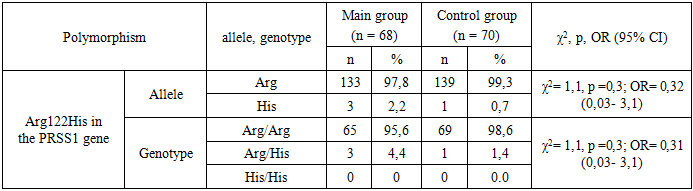
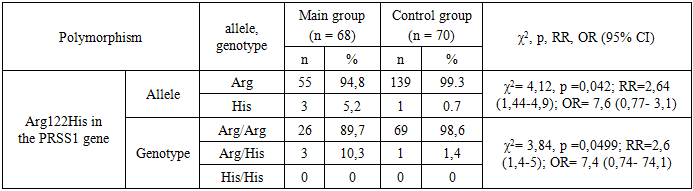
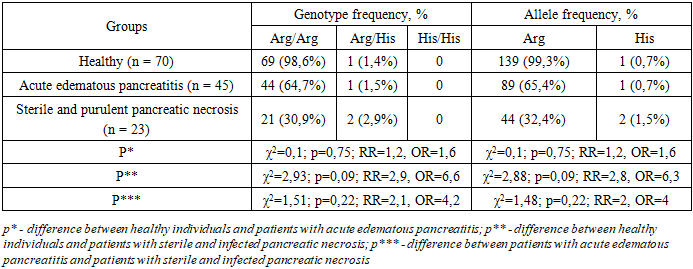
- The PRSS1 gene is located on the long arm of chromosome 7 (location 7q34) and consists of 5 exons encoding cationic trypsinogen (or trypsinogen 1). Cationic trypsinogen comprises 2/3 of the total pancreatic trypsinogen. To date, more than 20 different mutations in the PRSS1 gene have been described, most of which in heterozygous form lead to the development of an autosomal dominant variant of pancreatitis. In this section, we studied the Arg122His polymorphism of the PRSS1 gene.The study began by examining whether the molecular-genetically studied groups conformed to Hardy-Weinberg equilibrium. The frequency distribution of gene polymorphism genotypes in patients with acute pancreatitis and in the general sample of the Uzbek population corresponded to Hardy-Weinberg equilibrium (p > 0.05).Analysis of the distribution of genotype and allele frequencies in the control group showed that the frequency of the Arg allele was 99.3%, and the frequency of the His allele was 0.7%. Homozygotes for the Arg allele (genotype Arg/Arg) constituted 98.6% (n=69) of patients, while heterozygotes (genotype Arg/His) accounted for 1.4% (n=1) of patients. The homozygous genotype His/His was not observed in either the patient group or the control group (Table 1).
|
|
|
4. Conclusions
- Thus, in the mechanism of acute pancreatitis development, environmental factors play an important role alongside genetic factors. To date, the role of the PRSS1 gene polymorphism (Arg122His), which is involved in the mechanism of pancreatitis development, has been determined. Ethnic differences have been identified in the distribution of allele and genotype frequencies of this gene's polymorphic variant. Further development of molecular genetic research through studying the genetic basis of pancreatitis is crucial for developing new diagnostic methods and determining treatment strategies with an individualized approach to each patient. The PRSS1 gene polymorphisms (Arg122His) we studied have varying effects on the development of acute pancreatitis, its contributing factors (alcohol), and the course of the disease. Notably, the PRSS1 (Arg122His) gene polymorphism plays a significant role in the development of acute pancreatitis in cases of alcoholic pancreatitis.