
-
Paper Information
- Next Paper
- Previous Paper
- Paper Submission
-
Journal Information
- About This Journal
- Editorial Board
- Current Issue
- Archive
- Author Guidelines
- Contact Us
American Journal of Medicine and Medical Sciences
p-ISSN: 2165-901X e-ISSN: 2165-9036
2025; 15(9): 3249-3253
doi:10.5923/j.ajmms.20251509.90
Received: Aug. 22, 2025; Accepted: Sep. 13, 2025; Published: Sep. 29, 2025

Prevalence of Stroke in Ecologically Unfavorable Regions of the Republic of Karakalpakstan
 Abstract
 Reference
 Full-Text PDF
 Full-text HTML
Tleubergenova Azima Baltabaevna1, Matmurodov Rustambek Jumanazarovich2, Muminov Bekzod Askarovich2, Jumanazarova Shahzoda Rustambekovna2
1Karakalpakstan Medicine Institute, Uzbekistan
2Tashkent State Medical University, Uzbekistan
Copyright © 2025 The Author(s). Published by Scientific & Academic Publishing.
This work is licensed under the Creative Commons Attribution International License (CC BY).
http://creativecommons.org/licenses/by/4.0/

Stroke is a leading cause of long-term disability, mortality, and healthcare costs among adults worldwide. This is a major challenge for healthcare systems that requires continuous improvement in stroke care. According to the World Health Organization, “... the global incidence of stroke is projected to increase to 7.8 million by 2030 unless aggressive global action is taken to address this epidemic.” Purpose. To study the prevalence of stroke in different ecologically disadvantaged areas of the Republic of Qaraqalpakistan. Material and methods. In order to determine the prevalence of cerebral stroke in the island region of the Republic of Karakalpakstan, diseases leading to stroke, risk factors, clinical course, near-term prognosis, and preventive measures, a “Brain Stroke Registry” was conducted in the Kegeili, Amudarya, Muynak districts of the Republic of Karakalpakstan and the city of Nukus in 2021-2023. An in-depth study was conducted in accordance with a specially developed program to study the general patterns of the development and spread of cerebral strokes, and various research databases and data sources were used. Results. The study compared districts with unfavorable ecological conditions and different climatic conditions, as well as the capital of the republic, Nukus. In Nukus, 985 patients were diagnosed over 3 years, of which 506 (51.4%) were men and 479 (48.6%) were women, respectively, in Kegeili district there were a total of 166 patients, including 100 (60.3%) men and 66 (39.7%) women, in Amudarya district there were a total of 113 patients, including 79 (69.9%) men and 34 (30.1%) women, and in Muynak district there were a total of 65 patients, including 40 (61.5%) men and 25 (38.5%) women. Conclusion. The prevalence of stroke in different ecologically unfavorable areas of the Republic of Qaraqalpakistan depends on the geographical location, and the patients have different indicators by gender.
Keywords: Republic of Karakalpakstan, Ecological zone, Stroke
Cite this paper: Tleubergenova Azima Baltabaevna, Matmurodov Rustambek Jumanazarovich, Muminov Bekzod Askarovich, Jumanazarova Shahzoda Rustambekovna, Prevalence of Stroke in Ecologically Unfavorable Regions of the Republic of Karakalpakstan, American Journal of Medicine and Medical Sciences, Vol. 15 No. 9, 2025, pp. 3249-3253. doi: 10.5923/j.ajmms.20251509.90.
1. Introduction
- Stroke is an acute disruption of blood circulation in the brain, often leading to disability. If not treated promptly, the pathology can significantly impair brain function and lead to death [1,4,5,16].Acute cerebrovascular accidents are a major medical and social problem, which is associated with their high share in the structure of morbidity and mortality of the population, as well as significant indicators of temporary loss of work and primary disability (Gafurov B.G., 2010; Karimov S.I., Rakhimbayeva G.S., Ataniyazov M.K., Mirdzhuraev et al., 2011). Every year, about 9 million people in the world suffer from cerebrovascular diseases, among which ischemic stroke occupies the main place, the mortality rate in the acute period of stroke is 39%. In the Republic of Uzbekistan, 46,000-48,000 cases of the disease are observed annually, at least a third of which lead to death in the acute period (42.4%) (Asadullaev M.M., Ilhomov F.O., Dzhakhongirov A.Kh., 2002).Stroke is a leading cause of long-term disability, mortality, and healthcare costs among adults worldwide. This is a major challenge for healthcare systems that requires continuous improvement in stroke care. According to the World Health Organization, “... the global incidence of stroke is projected to increase to 7.8 million by 2030 unless aggressive global action is taken to address this epidemic” [8].In Uzbekistan, the number of patients with cerebral stroke is also quite high, with 40-45 thousand strokes recorded per year. More than 80% of stroke patients permanently lose their ability to work, and only 10.2% return to work [4,5,9,10,13]. The urgency of stroke problems is also associated with the aging of the patient population (Gusev E.I., 2001; Umarova Kh.Ya., 2004; Sodikova G.K. 2009; Williams LS 2002). Strokes among young people account for 2.5 to 14% of the total stroke population. The structure of strokes is up to 44 years old. was hemorrhagic in 55% of patients, ischemic in 45% to stroke correct comes [8].People brain in between stroke with illness laws to install attempt quite a bit before started, but different from sources used be and diagnose not standardized from the criteria used . This and own next various authors by cited information from each other sharp difference so that they of coordination opportunity was not Real illness, death indicators, as well as to the hospital was, and this of indicators dynamics only far time during population known group between just getting used to it reliable information to take possible gives For this purpose Whole world health to keep organization by standardized inspection methods and diagnosis criteria " Acute Stroke Registry " was developed with It was released . from the program use sharp brain stroke with of illness real indicators and of treatment various in stages for the sick help to show efficiency assessment possible gives.Purpose. Study of the prevalence of stroke in different ecologically disadvantaged areas of the Republic of Karakalpakstan.
2. Material and Methods
- In order to determine the prevalence of cerebral stroke in the island region of the Republic of Karakalpakstan, diseases leading to stroke, risk factors, clinical course, near-term prognosis, and preventive measures, a “Brain Stroke Registry” was conducted in the Kegeili, Amudarya, Muynak districts of the Republic of Karakalpakstan and the city of Nukus in 2021-2023. An in-depth study was conducted in accordance with a specially developed program to study the general patterns of the development and spread of cerebral strokes, and various research databases and data sources were used. The research was conducted in a general manner. All cases of first-time and recurrent stroke, as well as deaths from stroke, that occurred during the observation period among the population of the Republic of Karakalpakstan were recorded.
3. Results
- In the initial stages of the study, we analyzed the gender distribution and percentage of patients who had a first stroke in the ecologically unfavorable regions of the Republic of Karakalpakstan - Kegeyli, Muynak, Amu Darya districts and the city of Nukus during 2021-2023. The results show that, of the 1,329 stroke patients registered over the 3-year period, 725 (54.6%) were men and 604 (45.4%) were women. When compared between 2021 and 2023, a total of 399 patients had a stroke in 2021, of which 215 (61.4%) were men and 184 (46.2%) were women. In 2022, a total of 430 patients were diagnosed with diabetes, of which 232 (53.9%) were men and 198 (46.1%) were women. In 2023, a total of 500 patients were diagnosed, of which 278 (55.6%) were men and 222 (44.4%) were women. Over the years, the incidence of the disease in men and women had almost the same indicators, in men - 53.4% - 53.9% - 55.6% and in women - 46.2% - 46.1% - 44.4%.The study compared districts with unfavorable ecological conditions and different climatic conditions, as well as the capital of the republic, Nukus. In Nukus, 985 patients were diagnosed over 3 years, of which 506 (51.4%) were men and 479 (48.6%) were women, respectively, in Kegeili district there were a total of 166 patients, including 100 (60.3%) men and 66 (39.7%) women, in Amudarya district there were a total of 113 patients, including 79 (69.9%) men and 34 (30.1%) women, and in Muynak district there were a total of 65 patients, including 40 (61.5%) men and 25 (38.5%) women. The results show that while the incidence of men and women in Nukus is relatively close to each other, the incidence of the disease in the more environmentally unfavorable districts was higher, 60.3%, 69.9% and 61.5%, with a significant difference of p≤0.001 for women, all data are presented in Table 1.
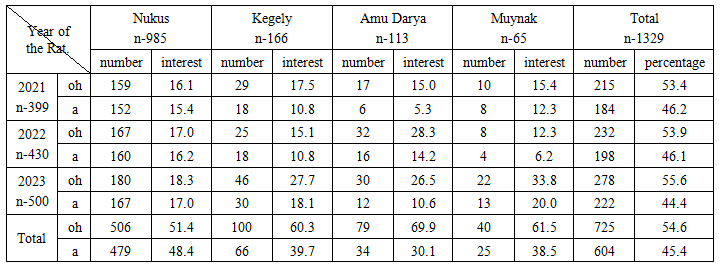 | Table 1. Distribution by gender and percentage of patients who had their first stroke in 2021-2023 |
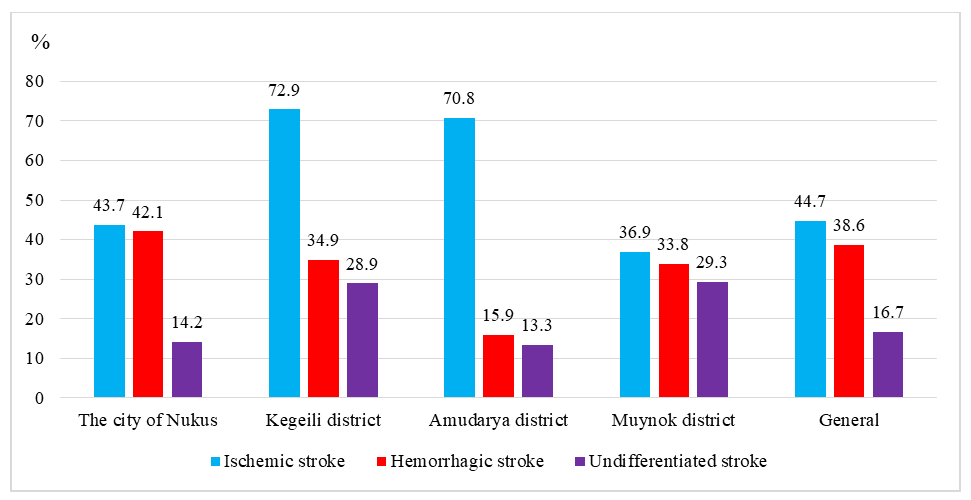 | Figure 1. Frequency of meeting by type of stroke (%) |
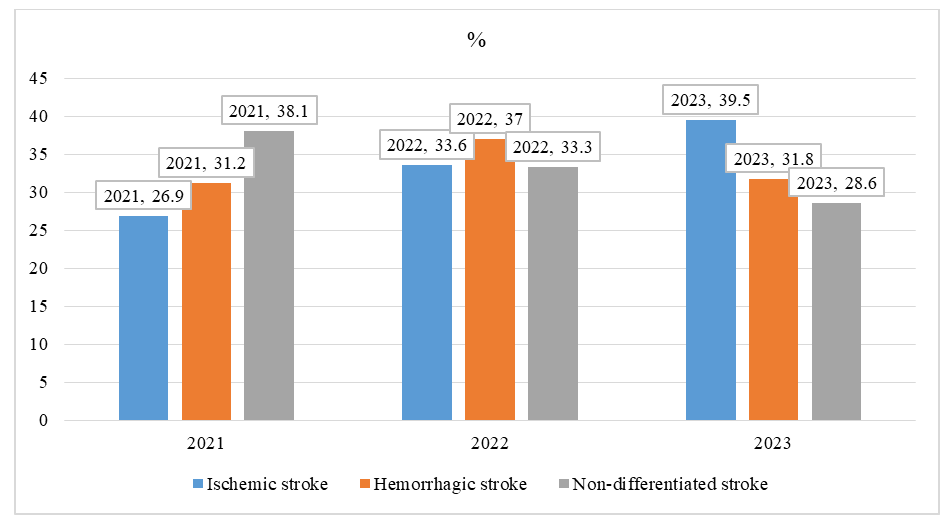 | Figure 2. Distribution of stroke types in 2021-2023 |
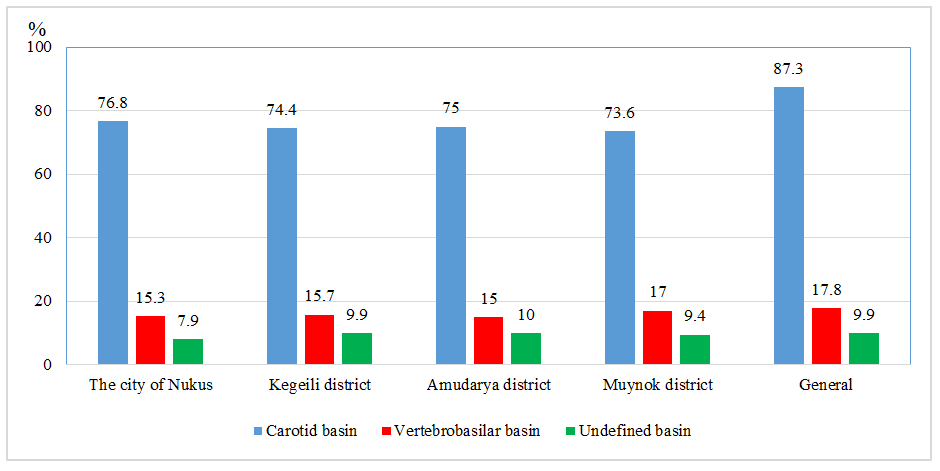 | Figure 3. Comparative analysis (%) of the regional cross-section of ischemic stroke localization |
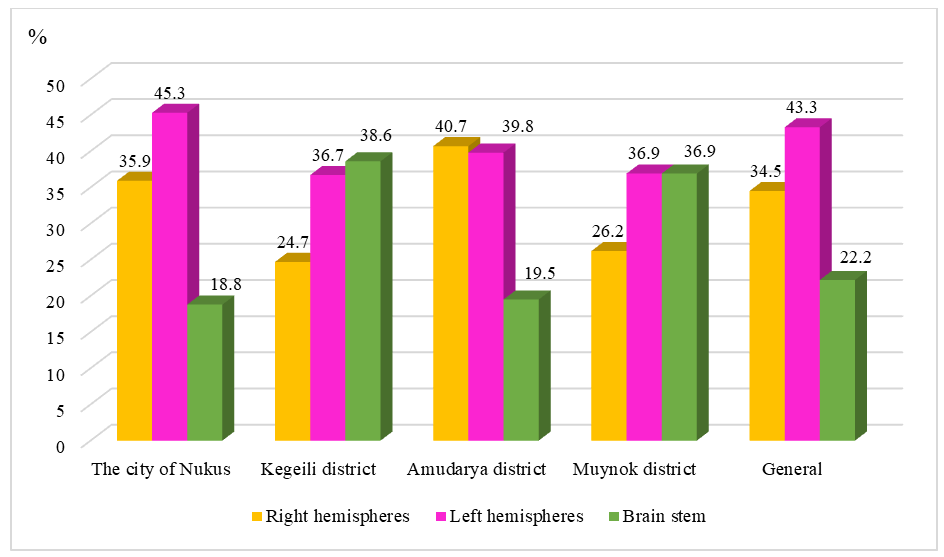 | Figure 4. Frequency of stroke according to damage of cerebral hemispheres (%) |
4. Conclusions
- The prevalence of stroke in different ecologically unfavorable regions of the Republic of Karakalpakstan is intrinsically dependent on the geographical location and patients have different indicators by gender. In sandy-desert zones, the prevalence of stroke is more observed and has seasonality.