
-
Paper Information
- Next Paper
- Previous Paper
- Paper Submission
-
Journal Information
- About This Journal
- Editorial Board
- Current Issue
- Archive
- Author Guidelines
- Contact Us
American Journal of Medicine and Medical Sciences
p-ISSN: 2165-901X e-ISSN: 2165-9036
2025; 15(9): 3239-3241
doi:10.5923/j.ajmms.20251509.87
Received: Sep. 2, 2025; Accepted: Sep. 23, 2025; Published: Sep. 29, 2025

Biochemical Biomarkers of Oxidative Stress in Patients with Hypothyroidism and Chronic Migrenia
 Abstract
 Reference
 Full-Text PDF
 Full-text HTML
D. N. Kambarova
Andijan State Medical Institute, Uzbekistan
Correspondence to: D. N. Kambarova, Andijan State Medical Institute, Uzbekistan.
Copyright © 2025 The Author(s). Published by Scientific & Academic Publishing.
This work is licensed under the Creative Commons Attribution International License (CC BY).
http://creativecommons.org/licenses/by/4.0/

In the membranes of erythrocytes in patients with hypothyroidism against the background of chronic migraine, a significant violation of pro- and antioxidant homeostasis is revealed. When studying the indicators of antioxidant protection, their decrease was revealed. At the same time, the content of AOS parameters in the blood plasma in patients with CM and hypothyroidism was noted to decrease in indicators as the duration of headache increased for more than 5 years.
Keywords: Peroxide-antioxidant system, Chronic migraine, Hypothyroidism
Cite this paper: D. N. Kambarova, Biochemical Biomarkers of Oxidative Stress in Patients with Hypothyroidism and Chronic Migrenia, American Journal of Medicine and Medical Sciences, Vol. 15 No. 9, 2025, pp. 3239-3241. doi: 10.5923/j.ajmms.20251509.87.
Article Outline
1. Introduction
- The relevance of the problem of patients with hypothyroidism against the background of chronic migraine is determined by the significant frequency of occurrence. It has been proven that hypothyroidism has an adverse effect on the body's systems and is a powerful factor in the activation of oxidative processes, the main manifestation of which is endothelial dysfunction.The main mechanism of antioxidant protection under natural conditions is the superoxide dismutase (SOD) enzyme, the oxidation capacity of which allows for the inactivation of free radicals at the site of formation, preventing their diffusion. Indeed, the vast number of data shows that SODs are important components of human antioxidant defense. SODs contain metals necessary for their catalytic function - copper and zinc.Purpose of the research. Identification of the role of biochemical biomarkers of oxidative stress in patients with hypothyroidism and chronic migraine.
2. Materials and Methods of Research
- The study included 118 patients with chronic migraine (CM). The diagnosis of migraine was made according to the International Classification of Headaches (ICHD-III).The patients were divided into 3 groups. The 1st group consisted of 38 patients with chronic headache lasting up to 5 years and hypothyroidism. The 2nd group included 41 patients with CM with a headache duration of more than 5 years and hypothyroidism. The 3rd group consisted of 39 patients with CM without hypothyroidism. A control group was also created, which included 20 practically healthy individuals.Assessment of the peroxide-antioxidant system in blood serum was carried out by the level of malondialdehyde (MDA), diene conjugates (DK), the activity of superoxide dismutase (SOD), glutathione peroxidase, glutathione reductase, catalase, cytochrome C, and nitrogen oxide (NO), determined by the spectrophotometric method (L.P. Andreeva et al., 1988; Dubinin B.B. et al., 1983).
3. Results and Their Discussion
- The results of the study of lipid peroxidation processes (LPO) in blood plasma in the examined patients showed that MDA indicators in patients of the 1st group were 3.12±0.4 nmol/ml, in patients of the 2nd group 4.18±0.8 nmol/ml, in the 3rd group - 2.87±0.6 nmol/ml, i.e., MDA indicators exceeded the values of the control group in the 1st group by 2.6 times, in the 2nd group by 3.5 times, and in the 3rd group by 2.4 times. Diene conjugates (DCs) were 1.89±0.21 μmol/l in the 1st group, 2.15±0.01 μmol/l in the 2nd group, and 1.55±0.1 μmol/l in the 3rd group. DK was 1.45 times higher in the 1st group, 1.65 times higher in the 2nd group, and 1.2 times higher in the 3rd group compared to the control group (Table 1).
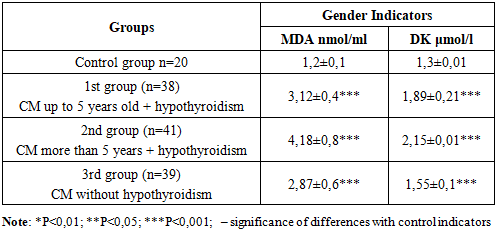 | Table 1. Comparative indicators of LPO in blood plasma in the examined patients |
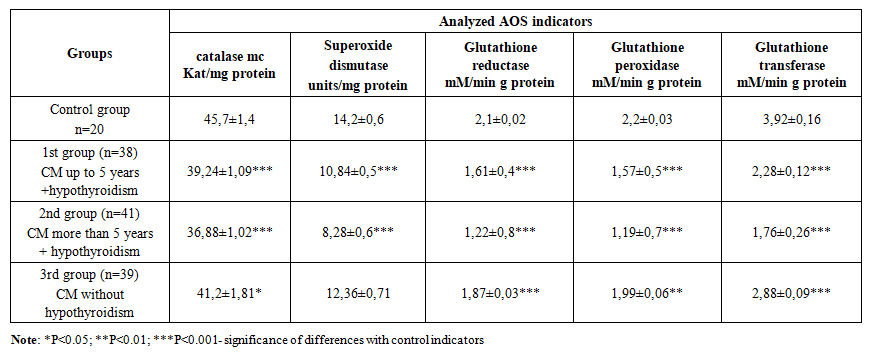 | Table 2. Comparative indicators of AOS in patients with CM and hypothyroidism |
4. Conclusions
- Our results indicate that a decrease in the activity and level of SOD in patients with CM and hypothyroidism makes them more susceptible to oxidative damage caused by active forms of oxygen.