
-
Paper Information
- Next Paper
- Previous Paper
- Paper Submission
-
Journal Information
- About This Journal
- Editorial Board
- Current Issue
- Archive
- Author Guidelines
- Contact Us
American Journal of Medicine and Medical Sciences
p-ISSN: 2165-901X e-ISSN: 2165-9036
2025; 15(9): 3175-3177
doi:10.5923/j.ajmms.20251509.74
Received: Sep. 7, 2025; Accepted: Sep. 23, 2025; Published: Sep. 29, 2025

The Role of Interleukin-6 (IL-6) in Trigeminal Neuralgia
 Abstract
 Reference
 Full-Text PDF
 Full-text HTML
Juraeva Dilsora Nuriddinovna
Bukhara Region of Jondor District Medical Association, Bukhara, Uzbekistan
Correspondence to: Juraeva Dilsora Nuriddinovna, Bukhara Region of Jondor District Medical Association, Bukhara, Uzbekistan.
Copyright © 2025 The Author(s). Published by Scientific & Academic Publishing.
This work is licensed under the Creative Commons Attribution International License (CC BY).
http://creativecommons.org/licenses/by/4.0/

We visited Bukhara region, Jondor District Medical Association, Central Polyclinic, where 92 patients with trigeminal neuralgia aged 17 to 70 years and 30 patients in the control group were prescribed interleukin -6 (IL-6) in blood serum. 53 of the patients involved in the study were 1 group of patients with very strong pain intensity and 39 patients with moderate intensity pain.
Keywords: Trigeminal neuralgia, Pain syndrome, Interleukin -6 (IL6)
Cite this paper: Juraeva Dilsora Nuriddinovna, The Role of Interleukin-6 (IL-6) in Trigeminal Neuralgia, American Journal of Medicine and Medical Sciences, Vol. 15 No. 9, 2025, pp. 3175-3177. doi: 10.5923/j.ajmms.20251509.74.
1. Introduction
- The trigeminal nerve consists of 12 pairs of cranial nerves. In the presence of symptoms and sensations, it acts on mixed nerves. It's a nervous shock. Thus, three Ukrainians were killed. Trigeminal neuralgia occurs simultaneously with trigeminal neuralgia. Trigeminal neuralgia is trigeminal neuralgia that occurs with trigeminal neuralgia. Seizures can reach 200 times a day [2,3]. There are several versions of the syndrome. It has been suggested that this is due to the branching of the trigeminal nerve. But experiments have shown that this is not the case. In the neurologist's chamber, aneurysms, arteriovenous malformations, abrasions, cysts, bruises, and injuries are diagnosed. The nervous breakdown was caused by a nervous breakdown. This leads to demyelination of the nerves. Subsequently, axonal degeneration may occur [1,2]. With trigeminal double neuralgia, trigeminal neuralgia is observed in 15% of cases, trigeminal sclerosis in 2%, and idiopathic neuralgia in 10%. Tachycardia is observed in 60% of cases. In 1.7-5% of cases, bilateral trigeminal neuralgia is observed. In both cases, trigeminal neuralgia is accompanied by hallucinations [2]. With trigeminal neuralgia, the duration of the attack ranges from 2% to 75 seconds, with 70% -from 2-10 to 1 hour, with the duration of the attack – from 2 to 3 minutes. Huruli are followed several times a day. In 40% of patients, a dose reduction to 10 mg per day is observed on one day. In patients with a long period of remission. In 37% of cases, remission can last longer, in 63% - longer. 68% - 98% of patients have spontaneous seizures. Diseases caused by the disease include such diseases as cough, nausea, vomiting, nausea, nausea, vomiting, vomiting, nausea, and vomiting. Patients with trigeminal nerve cephalopathy may have cephaloarthritis. In trigeminal neuralgia, sensory hypesthesia is observed in 30% of cases. In modern research based on the fundamental mechanisms of immunopathogenesis of hereditary immunodeficiency diseases, autoimmune and autoimmune diseases are distinguished. However, it is possible that other factors may be involved in the pathogenesis of autoimmune diseases. Thus, the mechanisms of autosomal recessive regulation can be associated with both mutations and the polymorphism of their clinical manifestations. This, in turn, may be due to the fact that individualized therapy aimed at preventing and preventing diseases provides greater self-regulation [3,4]. Scientists have found that trigeminal neuralgia can be caused by pneumonia, and studies show that nerve fibers may be involved in its pathogenesis. Interleukin-6 (IL – 6) is one of the cytokines involved in the regulation of inflammation and immune response in the body. IL-6 is aimed at fighting lung cancer and, possibly, its pathogenesis. In response, the excitatory signal stimulates the expression of excitatory mediators, which, in turn, affects the marker and peripheral nervous systems, increasing the sensitivity of neurons. According to him, IL-6 will play an important role in the development of chronic diseases [4,5]. In addition, it can be used as an offshoot of the immune response to certain diseases and acts on several immunological mechanisms. In this regard, interleukin-6 is prescribed to patients suffering from trigeminal neuralgia.Research objective: determination of the role of the immune system in patients with trigeminal neuralgia.
2. Materials and Results
- We examined 92 patients from Bukhara region, Jondor district, Central polyclinic aged 17 to 70 years suffering from trigeminal neuralgia, and 30 patients from Nazran who were found to have interleukin-6 (IL-6). Tadeusz Tadeusz's work was carried out in the Laboratory of Bacteriology at the Department of Microbiology, Immunology and Virology of the Bucharest State Medical Institute. A test drived by Vector Best LLC (Novosibirsk, Russia). They determined the concentration of interleukin-6 (IL-6, series A-8768) in the blood serum. ELISA was based on the "sandwich version", in which yeast was used as the fermentation phase. Specific reagents for 96 plague tablets are monoclonal antibodies conjugated to interleukins, 96 plague tablets, biotic antibodies to interleukins, hummingbirds to interleukins. In patients who complained of nausea, 53 people within 10 days after taking the drug, the pain intensity was 8-9-10 points, in 39 people during the day, the pain intensity decreased. it is estimated at 6-7 points.
3. Results and Analysis
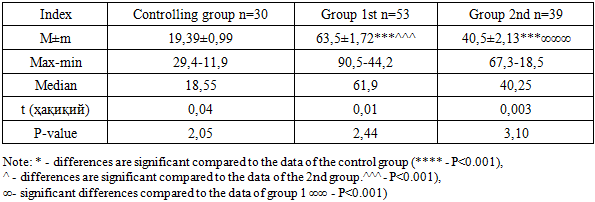
- The results were also obtained in patients with trigeminal neuralgia, who had an increased concentration of interleukin-6 (IL-6), that is, cytokinin, which was found in patients with trigeminal neuralgia. We studied how cytokinin IL-6 interacts with cytokines in patients with acute respiratory diseases and to what extent it affects their activity (see Table 1). From the data presented in Table 1, it follows that the concentration of cytokines in blood plasma in patients with Down syndrome is 63.5±1.72 pg/ml [90.5-44.2 pg/ml], in patients with 2-GUR, that is, in patients suffering from acute withdrawal syndrome, the dose is 40.5±2.13 pg/ml [67.3-18.5 pg/ml]. The human dose of gurtamine is 19.39±0.99 pg/ml [29.4-11.9]. The results of the study showed that patients suffering from trigeminal neuralgia have an increased degree of sensitivity to interleukin-6 (IL-6), and increased sensitivity to interleukin may occur.
|
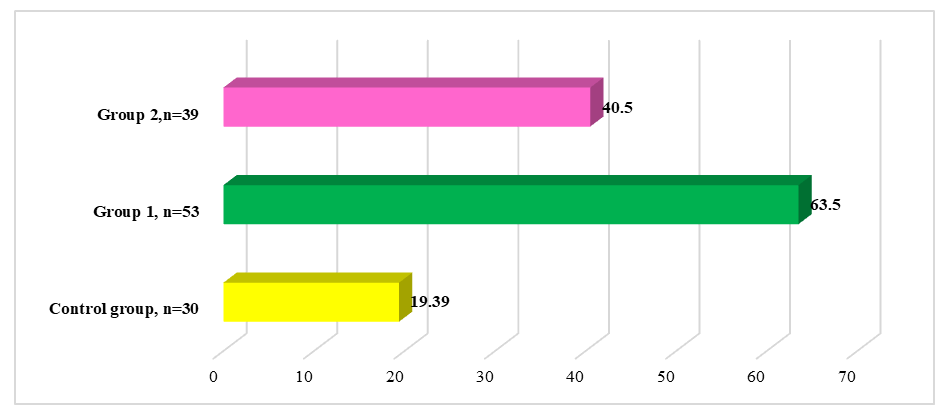 | Figure 1. IL-6 concentration in patients with mild and severe pain syndrome |
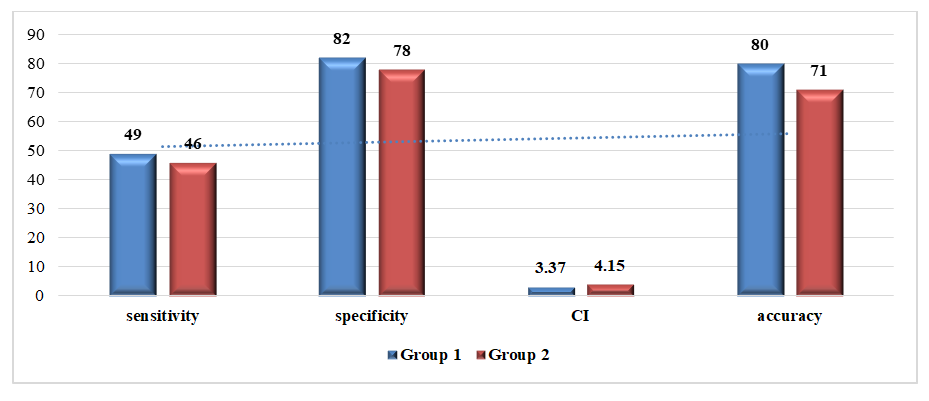 | Figure 2. Indicators of the specificity, sensitivity, accuracy, and confidence interval of the cytokine Interleukin-6 (IL-6) |
4. Сonclusions
- This may be a sign of trigeminal neuralgia caused by elevated cytokine levels in the brain, which may be a sign of trigeminal neuralgia. Nevertheless, the research results show that IL-6 cytokines can be used as a biomarker for the treatment of trigeminal neuralgia. In this regard, the study revealed that the results obtained during the study require significant attention to the factors affecting their effectiveness and reliability. According to Jumblatt, Tehran has repeatedly asked Russia to assist in clinical trials of neuralgia and hearing loss, as well as other pathologies.