
-
Paper Information
- Next Paper
- Previous Paper
- Paper Submission
-
Journal Information
- About This Journal
- Editorial Board
- Current Issue
- Archive
- Author Guidelines
- Contact Us
American Journal of Medicine and Medical Sciences
p-ISSN: 2165-901X e-ISSN: 2165-9036
2025; 15(9): 3140-3142
doi:10.5923/j.ajmms.20251509.65
Received: Jun. 5, 2025; Accepted: Jul. 2, 2025; Published: Sep. 29, 2025

Course of Chickenpox in Pregnant Women
 Abstract
 Reference
 Full-Text PDF
 Full-text HTML
Mubarakhon J. Akhmedova1, Fotimakhon A. Ibragimova2
1Doctor of Medical Sciences, Professor of the Department of Infectious and Pediatric Infectious Diseases of the Tashkent Medical Academy, Tashkent, Uzbekistan
2Independent Researcher at the Republican Specialized Scientific and Practical Medical Center of Epidemiology, Microbiology, Infectious and Parasitic Diseases, Tashkent, Uzbekistan
Copyright © 2025 The Author(s). Published by Scientific & Academic Publishing.
This work is licensed under the Creative Commons Attribution International License (CC BY).
http://creativecommons.org/licenses/by/4.0/

This article presents the results of a study conducted using retrospective and prospective methods. The aim of the research was to assess the incidence of chickenpox in recent years in the Republic of Uzbekistan, study the clinical course of the disease in pregnant women, and evaluate changes in coagulation parameters. A retrospective analysis of chickenpox incidence over the past ten years in Uzbekistan was carried out. According to the results, the incidence increased 1.9 times from 2012 to 2018, but sharply declined in subsequent years. In 2020, due to the COVID-19 pandemic and the resulting lockdown, the average incidence dropped to 7.4 cases per 100,000 population. However, in 2021, the incidence increased 2.5 times again and remains relevant to this day. Based on the prospective case-to-case study of 117 pregnant women treated with a confirmed diagnosis of chickenpox at the City Clinical Infectious Diseases Hospital No. 1 in Tashkent during 2021–2024, it was found that in 17.9% of cases, the disease took a severe course. In these cases, symptoms such as headache, sleep disturbances, nausea, and vomiting were more common. It was also revealed that severe chickenpox in pregnant women is associated with a tendency toward hypercoagulation.
Keywords: Republic of Uzbekistan, Pregnant women, Chickenpox, Coagulation profile
Cite this paper: Mubarakhon J. Akhmedova, Fotimakhon A. Ibragimova, Course of Chickenpox in Pregnant Women, American Journal of Medicine and Medical Sciences, Vol. 15 No. 9, 2025, pp. 3140-3142. doi: 10.5923/j.ajmms.20251509.65.
Article Outline
1. Introduction
- At the modern stage, the incidence of chickenpox among adults ranges from 300 to 800 or more cases per 100,000 people, while among children it reaches up to 7,000 cases per 100,000 children. Typically, chickenpox follows a mild course; however, in certain risk groups — including pregnant women — it can be severe and complicated. The risk of a pregnant woman becoming infected through contact with a patient with chickenpox is estimated at 12–24%. Nevertheless, considering the high level of seropositivity in the general population, the incidence of chickenpox among pregnant women is approximately 0.1–3 cases per 1,000 pregnancies [1,2,3,4]. Data in the literature regarding the course of chickenpox during pregnancy are limited.Our study aimed to evaluate the recent trends in chickenpox incidence in the Republic of Uzbekistan (RU), investigate the clinical course of the disease in pregnant women, and analyze changes in coagulation parameters.
2. Material and Methods of Research
- A retrospective analysis was conducted using official data on chickenpox incidence from the Republican Service for Sanitary-Epidemiological Wellbeing and Public Health for the period 2012–2021. Additionally, a prospective study was carried out involving 117 pregnant women diagnosed with chickenpox and treated at Tashkent City Infectious Diseases Hospital No. 1 between 2021 and 2024. The mean age of participants was 32.2±1.3 years.The etiological confirmation of chickenpox was performed using the immunofluorescence test (IFT) for the detection of anti-Varicella-zoster virus IgM antibodies in blood serum. Blood samples were collected in the morning on an empty stomach the day following hospital admission.Laboratory investigations included complete blood count, stool and urine analysis, and a comprehensive evaluation of coagulation parameters: prothrombin index (PTI), activated partial thromboplastin time (APTT), fibrinogen level, D-dimer, thrombin time (TT), antithrombin III, hematocrit, and platelet count.Statistical analysis was conducted using MedStatistical software (medstatistic.ru/calculators). Odds ratios (OR) with a 95% confidence interval (CI) were calculated. Statistical significance was assessed using Fisher’s exact test (for expected counts ≤5), Yates’ correction (for counts between 5.1 and 10), and the Chi-square test (for counts >10). Differences between groups were analyzed using the Student’s t-test, with p-values considered statistically significant at p<0.05.
3. Results and Discussion
- Analysis of official data revealed that the highest chickenpox incidence in Uzbekistan occurred in 2018, reaching 27.8 cases per 100,000 population. Between 2012 and 2018, there was a steady increase in incidence, with a 1.9-fold rise compared to 2012 levels (14.5 cases per 100,000 population).In 2019, a sharp 1.6-fold decrease in incidence was observed compared to the previous year.In 2020, the incidence further declined to 7.4 cases per 100,000 population, marking the lowest level during the study period.However, by 2021, the incidence rate increased again by 2.5-fold, reaching 18.4 cases per 100,000 population (Figure 1).
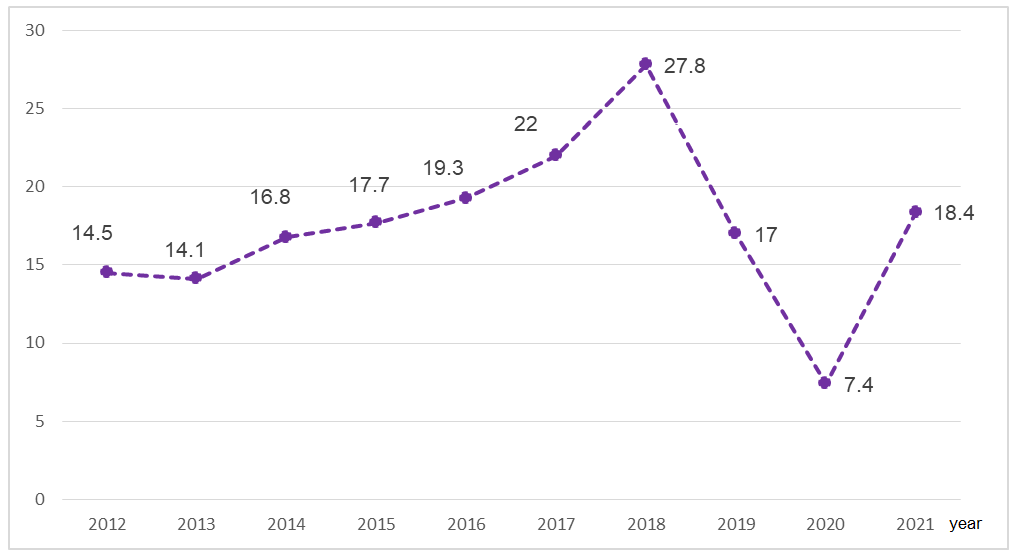 | Figure 1. Incidence rate of chickenpox in the Republic of Uzbekistan from 2012 to 2021 (intensive indicator per 100,000 population) |
4. Conclusions
- 1. The incidence of chickenpox in the Republic of Uzbekistan increased by 1.9 times from 2012 to 2018. However, in recent years, it sharply decreased, and in 2020, due to the COVID-19 pandemic and the lockdown, the average incidence per 100,000 population was 7.4 cases. In 2021, the incidence increased by 2.5 times and has remained elevated to this day.2. In pregnant women, 17.9% of cases of chickenpox develop in a severe form. In severe cases of chickenpox, there is a higher likelihood of symptoms such as headaches, sleep disturbances, nausea, and vomiting. This can lead to a tendency for hypercoagulability in pregnant women with severe chickenpox.