
-
Paper Information
- Next Paper
- Previous Paper
- Paper Submission
-
Journal Information
- About This Journal
- Editorial Board
- Current Issue
- Archive
- Author Guidelines
- Contact Us
American Journal of Medicine and Medical Sciences
p-ISSN: 2165-901X e-ISSN: 2165-9036
2025; 15(9): 3135-3139
doi:10.5923/j.ajmms.20251509.64
Received: Sep. 12, 2025; Accepted: Sep. 27, 2025; Published: Sep. 29, 2025

Use and Effectiveness of Ozone in the Complex Treatment of Chronic Recurrent Aphthous Stomatitis in Patients with Chronic Gastroduodenitis
 Abstract
 Reference
 Full-Text PDF
 Full-text HTML
Zoyirov Tulkin Elnazarovich1, Allazarov Kuvondik Azadovich2
1Doctor of Medical Sciences (DSc), Professor, Samarkand State Medical University, Samarkand, Uzbekistan
2Independent Applicant for the Department of Therapeutic Dentistry, Samarkand State Medical University, Samarkand, Uzbekistan
Copyright © 2025 The Author(s). Published by Scientific & Academic Publishing.
This work is licensed under the Creative Commons Attribution International License (CC BY).
http://creativecommons.org/licenses/by/4.0/

Objective: to increase the effectiveness of treatment of chronic recurrent aphthous stomatitis of the oral mucosa against the background of chronic gastroduodenitis by correcting dysbiotic disorders and enhancing antioxidant protection through pathogenetic therapy. Methods: general clinical, laboratory, biochemical, functional, instrumental and statistical methods were used in the course of the study. Results obtained: Clinical studies in patients with chronic recurrent aphthous stomatitis of the oral mucosa against the background of chronic gastroduodenitis have shown: a decrease in the following indicators by 1.24 times, a deterioration in hygiene by 1.92 times, an increase in the Schiller-Pisarev test by 2.06 times, an increase in stimulated salivation by 1.84 times and the absence of stimulated salivation by 2.09 times, a shift in The pH is in the acidic side. Conclusions: The results of clinical and laboratory studies during operative and long-term follow-up showed that the therapeutic and prophylactic complex developed by us for the treatment of oral mucosal diseases in chronic gastroduodenitis has a long-term bactericidal effect against pathological microbes. The local immune status of the oral cavity was observed to approach the norm.
Keywords: Chronic recurrent aphthous stomatitis, Dental caries, Periodontal diseases, Epidemiological study, Chronic aphthous stomatitis, Oral mucosa
Cite this paper: Zoyirov Tulkin Elnazarovich, Allazarov Kuvondik Azadovich, Use and Effectiveness of Ozone in the Complex Treatment of Chronic Recurrent Aphthous Stomatitis in Patients with Chronic Gastroduodenitis, American Journal of Medicine and Medical Sciences, Vol. 15 No. 9, 2025, pp. 3135-3139. doi: 10.5923/j.ajmms.20251509.64.
1. Introduction
- It has been proven that in patients with chronic gastroduodenitis, the composition of the microflora changes and the activity of intestinal enzymes is altered. As a result of the disruption of normomicrobiosis, intestinal dysbiosis develops in the body, accompanied by both qualitative and quantitative changes in the permanent representatives of the oral microflora and a restructuring of the oral biocenosis. This leads to a decrease in the body’s nonspecific resistance and antioxidant protection, causes infectious and inflammatory processes in the oral mucosa, and increases the progression of diseases in it.Many authors note that dysbiotic diseases occur along with suppression of the obligatory normal flora, creating conditions for the growth and colonization of coagulase-negative staphylococci, non-hemolytic streptococci, lactobacilli, corynebacteria, aerobic gram-negative bacilli (non-pathogenic fungi), and neisseriae. The prolonged persistence of the above-mentioned pathogenic microflora in the oral mucosa leads to the development of chronic recurrent aphthous stomatitis (CRAS).In the last decade, the incidence of oral mucosal diseases has increased by more than 30%, and the incidence of chronic stomatitis has risen to 60%. Due to the high variability and constant adaptation of microflora, the irrational selection of antibacterial therapy, and the high level of adaptation to the components of antifungal drugs, there has been an increase in the number of relapses of lesions that are difficult to treat with traditional methods, which significantly worsens patients’ quality of life.The above indicates the need to improve diagnostic methods, search for new means for the treatment and prevention of chronic recurrent aphthous stomatitis of the oral mucosa, and apply modern treatment methods based on the pathogenetic mechanisms of such lesions.The various exogenous and endogenous causative factors of different diseases of the oral mucosa act as chronic, long-term stress agents that lead to disturbances in cellular adaptation ("distress") through a nonspecific reaction of inhibiting biologically active substrates, in particular respiratory enzymes and functionally related ultrastructures.Recent scientific studies have shown that damage to teeth and oral mucosal tissues occurs alongside inflammatory diseases characteristic of the gastrointestinal tract. This suggests that the pathology of the dentoalveolar system is not only of local nature but is also associated with a significant systemic response of the whole body.At present, one of the main directions of research in dentistry is to establish possible relationships between oral pathologies and systemic diseases, as well as between regional homeostasis of the oral cavity and the general homeostasis of the body. Therefore, a comprehensive approach to the medical treatment of periodontal diseases is increasingly being recognized.Despite the achievements of modern dentistry, the issue of developing an effective and widely applicable method for treating oral mucosal diseases, including chronic recurrent aphthous stomatitis, has not been fully resolved and continues to remain relevant and socially significant.Taking into account modern concepts about the etiology of oral mucosal lesions, the main directions of therapy should include: local anti-inflammatory therapy; general and local therapy considering the presence of chronic gastroduodenitis; and a pathogenetically oriented approach.Research aim: To increase the effectiveness of treatment for chronic recurrent aphthous stomatitis in patients with chronic gastroduodenitis by improving dysbiotic conditions of the oral cavity and enhancing antioxidant protection through pathogenetic therapy.
2. Research Materials and Methods
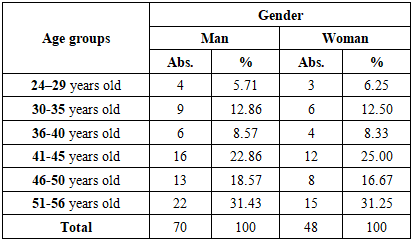
- To accomplish the tasks, we used comprehensive research methods. The object of the study was the clinical features of the disease course in patients with chronic gastroduodenitis, biochemical indicators of unstimulated oral fluid, and microbiological changes in CRAS. To achieve the set goal, 118 patients aged 24 to 56 years were examined: 70 men and 48 women. The clinical study involved 118 individuals (Table 1). Among them, 34 were practically healthy without somatic pathology, and 84 were patients with chronic gastroduodenitis. In accordance with ICD-10, the diagnosis of “gastritis and duodenitis” (code K29) and unspecified gastroduodenitis (code K29.9) was made by gastroenterologists of the gastroenterology department.
|
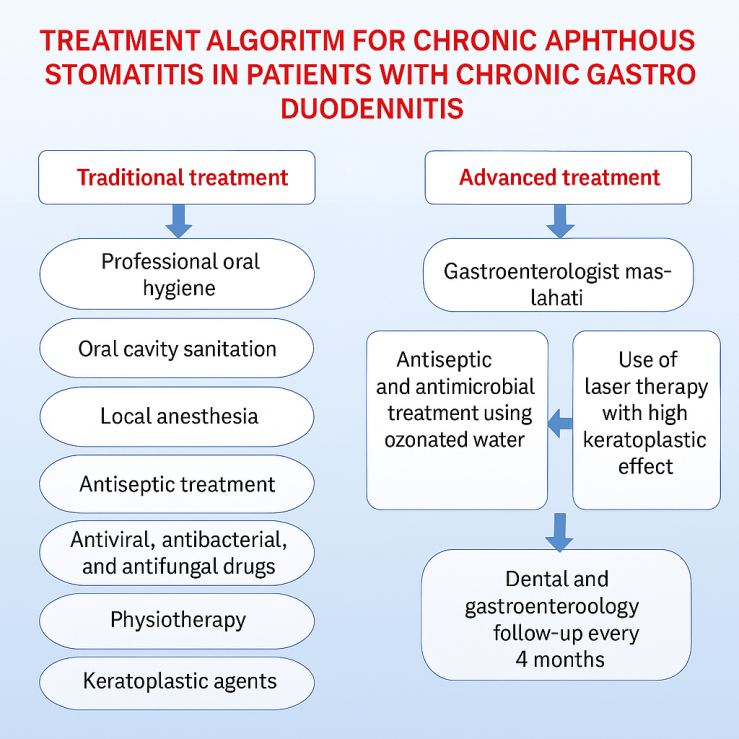 | Figure 1. Structure of the Special Treatment Algorithm for Chronic Recurrent Aphthous Stomatitis in Patients with Chronic Gastroduodenitis |
3. Results
- The findings of the clinical examination were confirmed by biochemical studies. Fourteen days after the application of the therapeutic–preventive complex in the main group, analysis of the changes in indicators showed a 1.81-fold decrease in elastase activity (p < 0.05) and a 1.56-fold decrease in MDA concentration. Ozonated water and Imunal, which have anti-inflammatory effects, prevent the accumulation of lipid peroxidation products in the oral cavity.A marked increase in MDA concentration, which is an indicator of lipid peroxidation processes, completely disappeared in the main group 30 days after the comprehensive treatment. A significant reduction in the severity of inflammatory signs was observed: the content of the proteolytic enzyme elastase decreased 2.53-fold (p < 0.02) and MDA decreased 2.15-fold (p < 0.05), almost reaching normal values.Long-term results after one year of follow-up in the main group showed that elastase activity decreased 2.0-fold (p < 0.02) and MDA levels decreased 1.87-fold (p < 0.05), which corresponded to normal values.In the comparison group, after 14 days, elastase activity and MDA concentration decreased 1.17-fold, remaining at a high level. A significant reduction in the severity of inflammatory signs was observed after 30 days — elastase decreased 1.94-fold and MDA decreased 2.0-fold (p < 0.05).The results of studies conducted after one year in the comparison group showed only a short-term effect of treatment using the standard method. The LPO indicator did not reach normal levels: MDA levels changed insignificantly — a 1.12-fold decrease, remaining significantly higher than in the main group, and elastase activity decreased only slightly — 1.21-fold.
|

4. Conclusions
- Clinical studies in patients with chronic recurrent aphthous stomatitis (CRAS) on the background of chronic gastroduodenitis showed the following changes: a 1.24-fold decrease in certain clinical parameters, a 1.92-fold worsening of oral hygiene, a 2.06-fold increase in the Schiller–Pisariev test results, a 1.84-fold reduction in stimulated salivary flow, a 2.09-fold reduction in unstimulated salivary flow, and a shift of pH toward acidity.Biochemical examination of stimulated oral fluid in patients with chronic gastroduodenitis revealed a marked increase in the activity of inflammatory markers: elastase increased 3.45-fold and malondialdehyde (MDA) 1.87-fold. At the same time, the activity of the antioxidant enzyme catalase decreased 3.5-fold, and the reduction of the Antioxidant–Prooxidant Index (API) by 6.25-fold reflected significant changes in the antioxidant–prooxidant balance.The therapeutic measures we propose normalize MDA, elastase, and catalase activity, restore antioxidant defense, significantly reduce urease levels, increase lysozyme secretion, and contribute to the normalization of the oral microbiocenosis.