Artikova Mavluda Abdurakhmanovna, Mamasoliev Shokhrukhbek Mamarasul ugli
Bukhara State Medical Institute, Uzbekistan
Copyright © 2025 The Author(s). Published by Scientific & Academic Publishing.
This work is licensed under the Creative Commons Attribution International License (CC BY).
http://creativecommons.org/licenses/by/4.0/

Abstract
The article presents the results of a study of hormonal and metabolic parameters in young patients with metabolic syndrome depending on gender and the presence of sleep disorders. A comparative analysis of the levels of cortisol, melatonin, leptin, adiponectin, insulin resistance and lipid profile in men and women was performed. It was revealed that patients with sleep disorders have more pronounced endocrine imbalances and metabolic shifts, and the nature of the changes has gender differences. In men, changes associated with carbohydrate metabolism and insulin resistance predominated, while in women, lipid metabolism disorders and decreased melatonin levels were more often observed. The data obtained emphasize the need to take into account gender characteristics in the diagnosis and correction of metabolic syndrome complicated by sleep disorders.
Keywords:
Metabolic syndrome, Sleep disorders, Hormonal-metabolic indices, Cortisol, Melatonin, Insulin resistance, Gender differences
Cite this paper: Artikova Mavluda Abdurakhmanovna, Mamasoliev Shokhrukhbek Mamarasul ugli, Hormonal and Metabolic Indices of Sleep Disorders in Young Patients with Metabolic Syndrome Depending on Gender, American Journal of Medicine and Medical Sciences, Vol. 15 No. 9, 2025, pp. 3114-3116. doi: 10.5923/j.ajmms.20251509.58.
1. Introduction
In recent decades, there has been a rapid increase in the prevalence of metabolic syndrome (MS) among young people, which is a serious medical and social problem. According to modern epidemiological studies, up to 20-25% of the adult population aged 20-40 years have signs of MS [2,5,7].The formation of MS components at a young age significantly increases the risk of developing cardiovascular and cerebrovascular diseases (CVD), type 2 diabetes mellitus, chronic kidney diseases and leads to a decrease in the duration and quality of life.One of the factors that aggravate the course of MS is sleep disorders, which, according to various authors, are detected in 30-50% of patients with MS [1,3,4].Sleep plays a critical role in the regulation of energy metabolism, hormonal balance and immune function, and its deficiency or disruption of structure can initiate a cascade of adverse metabolic changes, including increased insulin resistance, activation of the sympathetic nervous system and the development of chronic inflammation [6,7].Sleep disturbances increase the components of MS due to activation of the hypothalamic-pituitary-adrenal system, increased levels of cortisol and proinflammatory cytokines, and the development of insulin resistance.The aim of the study is to examine the clinical and hormonal relationships between sleep disorders in young people with metabolic syndrome depending on gender.
2. Materials and Methods of the Study
The object of the study was 124 young patients with MS with sleep disorders according to the selection criteria, the average age was 34.2 ± 7.1 years. The studies were conducted in the clinic of the Andijan State Medical Institute in the period from 2022 to 2024. The subject of the study was the features of the clinical and neurological status of patients and their laboratory and instrumental indicators. The diagnosis of MS was established according to the IDF/NCEP-ATP III criteria, where abdominal obesity was a mandatory component.We identified two main groups:• Group I: women with MS and sleep disorders (n=73)• Group II: men with MS and sleep disorders (n=51) (Fig. 1).• Control group (CG): 20 healthy young people; 10 men and 10 women, average age 33.1±5.4 years.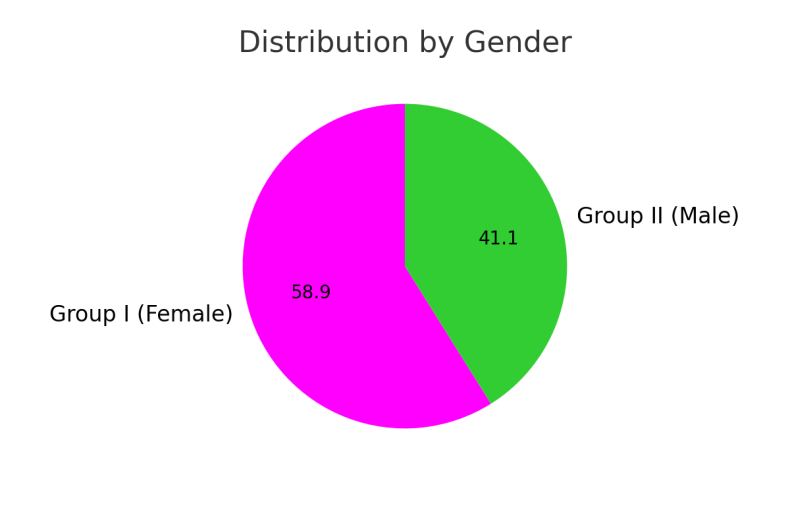 | Figure 1. Distribution of patients with MS and sleep disorders by groups |
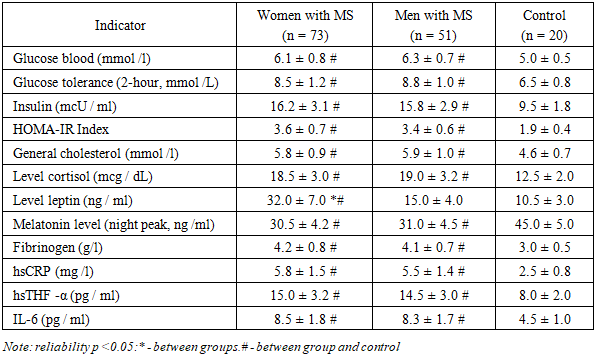
We conducted laboratory tests of blood of patients with MS and CG. Table 1 presents blood glucose levels, glucose tolerance test results, insulin levels, HOMA-IR index, total cholesterol as a representative of the lipid profile, cortisol, leptin, melatonin levels, as well as inflammation markers: fibrinogen, hs CRP, h sTNF -α and IL-6 (Table 1).Table 1. Laboratory parameters in groups
 |
| |
|
• Metabolic parameters. Blood glucose and glucose tolerance: In patients with MS, blood glucose levels (6.1–6.3 mmol /L) and 2-hour glucose tolerance test (8.5–8.8 mmol /L) are significantly higher than in the CG participants (5.0 mmol /L and 6.5 mmol /L, respectively). This indicates a disorder of carbohydrate metabolism in patients with MS.Insulin and HOMA-IR index: Elevated insulin levels (15.8–16.2 μU /ml) and HOMA-IR index (3.4–3.6) in the MS groups compared to the controls (9.5 μU /ml and 1.9, respectively) indicate the presence of insulin resistance in patients.Lipid profile: Total cholesterol in patients with MS (5.8–5.9 mmol /l) is also higher than in the CG (4.6 mmol /l), which reflects typical changes in lipid metabolism in MS.• Hormonal indicators and inflammation markersMS manifests itself in men and women with different clinical features. In men, such components of MS as abdominal obesity and dyslipidemia are more often dominant, while in women - hyperglycemia and hypertension.Despite objectively better sleep indicators, women more often complain of sleep disorders, insomnia, and fragmentation of night rest. This contradiction between the subjective assessment of sleep and objective characteristics may be associated with the peculiarities of emotional processing and hormonal fluctuations.We tested hormones in all patients with MS stress and energy metabolism - cortisol, leptin, melatonin and inflammatory markers fibrinogen, CRP, hsTHF -α, IL-6.Hormones: The level of cortisol in patients with MS (18.5–19.0 μg/ dL) significantly exceeds the values in the CG (12.5 μg/ dL), which may indicate hypercortisolemia and increased stress background. In addition,Melatonin levels in patients with MS (about 30.5-31.0 ng /ml) are lower than in healthy participants (45.0 ng /ml), indicating a disturbance in the rhythms of melatonin secretion and, as a consequence, a deterioration in sleep regulation.Inflammatory markers: Increased fibrinogen (4.1-4.2 g/l), CRP (5.5-5.8 mg/l), THF-α (14.5-15.0 pg /ml) and IL-6 (8.3-8.5 pg /ml) in patients with MS compared to CG (with values of 3.0 g/l, 2.5 mg/l, 8.0 pg /ml and 4.5 pg /ml, respectively) indicate the presence of chronic low-intensity inflammation, which is a characteristic pathological mechanism of MS.The data demonstrate that laboratory parameters in patients with MS are characterized by multiple disorders: elevated levels of glucose, insulin and the HOMA-IR index indicate a disorder of carbohydrate metabolism and insulin resistance. Changes in the lipid profile confirm the presence of dyslipidemia, characteristic of MS.Hormonal imbalances, manifested in elevated cortisol and leptin levels, combined with reduced melatonin levels, reflect endocrine dysregulation and, as a consequence, worsening sleep disorders. Elevated levels of inflammatory markers (fibrinogen, hs CRP, hsTHF -α, IL-6) indicate a chronic inflammatory process that can contribute to the development of MS complications.Figure 2 shows that both sexes with MS showed a more than twofold increase in hsTNF -α and IL-6 compared to controls, indicating a systemic proinflammatory state. No gender differences were found in cytokine levels, despite a statistically significant increase relative to CG.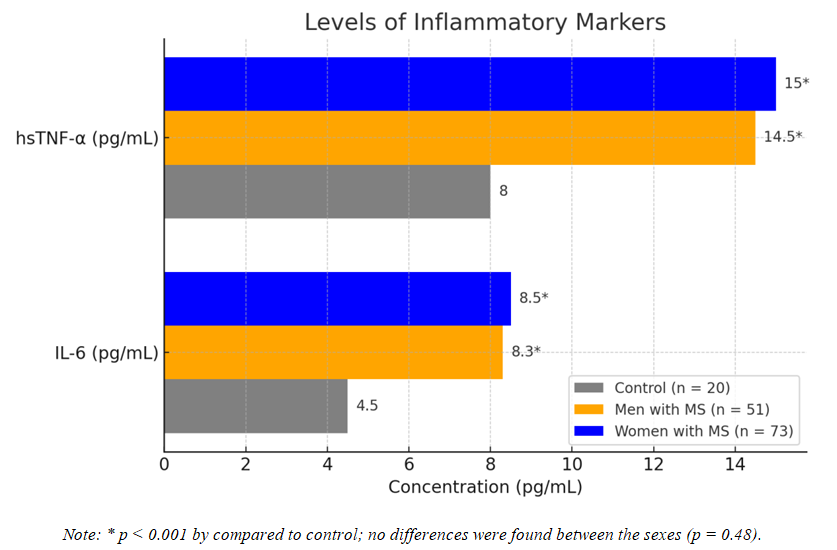 | Figure 2. Levels of proinflammatory markers |
Analysis of sleep phenotypes showed a predominance of the insomnic variant in women (43.8%), while in men the mixed phenotype was more common (37.3%). The hypersomnic type had a low prevalence in both groups (≤12%).Hormonal and metabolic differences in parameters between sleep phenotypes were established: in women with insomnic phenotype, elevated levels of cortisol, HOMA-IR index>3.6 and significant excess of leptin (p <0.05) were detected; in men with mixed phenotype, the following were recorded: increased HOMA-IR index>3.4, cortisol and decreased melatonin levels (p <0.05). More than twofold increase in hsCRP, hsFN O - α and IL-6 was detected in both sexes compared to the control, which indicates a systemic proinflammatory state in MS.Thus, the obtained data confirm the role of subclinical inflammation in MS and sleep disorders: high levels of hsTNF -α and IL-6 are associated with increased sleep latency and fragmentation of the N2 stage of slow sleep.
References
| [1] | Lok R., Qian J., Chellappa SL Sex differences in sleep, circadian rhythms, and metabolism: Implications for precision medicine. Sleep Med Rev. 2024; 75: 101926. |
| [2] | Kasurak E., Hawken E., Kolar D. et al. Gender differences in obstructive sleep apnea with comorbid treatment-resistant depression. Sleep Science Pract. 2023. |
| [3] | Kabir-Mokamelkhah E., Asghari O., Safaei N. Impact of insomnia and night sleep < 7 h on metabolic syndrome and its components: a cross-sectional study in health-care workers. Endocrinol Res Pract. 2024; 28 (2): 107-112. |
| [4] | Chaudhry BA et al. The relationship between sleep duration and metabolic syndrome severity scores in emerging adults. Nutrients. 2023; 15 (4): 1046. |
| [5] | Songern YM et al. Understanding the impact of night-to-night sleep variations on glucose handling. Sleep. 2024; 48 (2): zsae253. |
| [6] | Sun Y. et al. Causal effects of sleep traits on metabolic syndrome: a Mendelian randomization study. Sleep Breath. 2024; 28: e-pub ahead of print. |
| [7] | Songern YM et al. Understanding the impact of night-to-night sleep variations on glucose handling // Sleep. – 2024. – Vol. 48, N2. – P. 253. |


 Abstract
 Reference
 Full-Text PDF
 Full-text HTML