
-
Paper Information
- Next Paper
- Paper Submission
-
Journal Information
- About This Journal
- Editorial Board
- Current Issue
- Archive
- Author Guidelines
- Contact Us
American Journal of Medicine and Medical Sciences
p-ISSN: 2165-901X e-ISSN: 2165-9036
2025; 15(9): 3076-3079
doi:10.5923/j.ajmms.20251509.49
Received: Aug. 23, 2025; Accepted: Sep. 19, 2025; Published: Sep. 29, 2025

Clinical and Radiological Characteristics of Nasal Septum Deviation in Adolescents with a Premorbid Background
 Abstract
 Reference
 Full-Text PDF
 Full-text HTML
Nurov U. I., Ruzikulova Yu. B., Raupov F. S.
Bukhara State Medical Institute, Bukhara, Uzbekistan
Copyright © 2025 The Author(s). Published by Scientific & Academic Publishing.
This work is licensed under the Creative Commons Attribution International License (CC BY).
http://creativecommons.org/licenses/by/4.0/

The basis of this scientific work is the examination data of 121 adolescent patients, aged 10 to 17 years, with nasal septum deviation and a premorbid background. The inclusion criteria for patients in the group were the presence of a deviated nasal septum, complaints of difficulty with nasal breathing, frequent headaches, and an impaired sense of smell.
Keywords: Nasal septum deviation, Children, Rhinoseptoplasty
Cite this paper: Nurov U. I., Ruzikulova Yu. B., Raupov F. S., Clinical and Radiological Characteristics of Nasal Septum Deviation in Adolescents with a Premorbid Background, American Journal of Medicine and Medical Sciences, Vol. 15 No. 9, 2025, pp. 3076-3079. doi: 10.5923/j.ajmms.20251509.49.
1. Introduction
- The functional and aesthetic role of the nasal septum is undeniable. Normally, as the main supporting structure of the nose, the nasal septum provides support and stability to the structures of the external nose and its position relative to the central vertical axis of the face [1].Nasal septum deviation is a rather common phenomenon among the population. According to the literature, up to 96.5% of the population has some degree of nasal septum deviation. The normal position of the nasal septum is considered to be when it is located along the midline, corresponding to the sagittal line of the body. Deviation of the nasal septum as a pathology is widespread throughout the world. Septal deviation means its deflection to one side or the other from the median position, which is most often observed in traumatic injuries. Deformations refer to a change in one or more sections of the septum while it maintains a median position [2]. Nasal septum deviation (NSD) is one of the most common deformities of the facial skeleton. Impaired nasal breathing due to NSD leads to the development of oxygen deficiency, which clinically manifests as neurotic conditions, headaches, decreased memory, reduced concentration, sleep disturbances, and also leads to the development of cardiovascular diseases, which justifies the high rate of surgical activity for this pathology [3]. Deformation of the nasal septum disrupts the natural and rational architecture of the intranasal structures, which leads to a disturbance of the natural airflow through the nose. There are many classifications of nasal septum deviation, in which the main attention is paid to the characteristic shape of the nasal septum [4]. Currently, patients with complaints of difficulty in nasal breathing constitute one of the main categories of patients seeking an otolaryngologist's consultation. A standard ENT examination in an outpatient setting allows for the detection of anatomical defects in the external nose and various deformities of intranasal structures, such as a deviated nasal septum, hypertrophy of the inferior or middle nasal turbinates, the presence of synechiae in the nasal cavity, polypoid processes, etc.. However, an important aspect in the examination and subsequent choice of the optimal management strategy for these patients is an objective assessment of the nasal respiratory function [5].Strict recommendations for surgical treatment of children with a deviated nasal septum remain controversial, and at the core of this discussion lies the fact that the formation process of the nasal anatomical structures is not complete in certain age periods. In children aged 14-15, nasal septum deformation is more common in the cartilaginous and osteocartilaginous parts [6]. In modern rhinoplasty, there is still no consensus regarding the timing of surgical treatment for nasal septum deformation in children. Most otolaryngologists are in no hurry to perform surgical interventions on the nasal septum in children under 15-16 years of age, while others believe that rhinoseptoplasty can be performed between the ages of 6 and 14 [7]. According to most authors, the earlier the surgical intervention for a deviated nasal septum is performed in adolescents, the faster the function of the nasal cavity will be restored [8].However, it should be noted that the surgical correction of the deviation should not only restore the anatomical proportions in the nasal cavity but also consider the functional results after the operation. [9].Thus, the treatment of adolescent children with a deviated nasal septum is a complex problem. Some questions related to the pathogenesis of nasal septum deviation, morphological changes, and diagnostic and surgical treatment tactics remain open and require solutions [10]. Aim of the study: to study the clinical features of nasal septum deviation in adolescent children.
2. Material and Methods
- An analysis of the treatment and examination results of 121 patients who were treated in the otolaryngology department of the Bukhara Regional Children's Multidisciplinary Medical Center for the period 2020-2024 was conducted. All pediatric patients underwent a comprehensive examination, including a detailed study of their complaints and medical history, a clinical examination of ENT organs, radiological examination of the paranasal sinuses, endoscopy of the nasal cavity and nasopharynx, and an assessment of the olfactory, secretory, and transport functions of the nose. A set of laboratory tests was also performed, including a complete blood count and biochemical parameters, and, if necessary, a bacterial culture for pathogenic flora and pH-metry of nasal mucosal secretions.
3. Results and Discussion
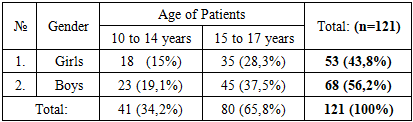
- The analysis of the obtained data by age and gender revealed the following: younger adolescents (from 10 to 14 years old) accounted for 41 (34.2%) cases, of which girls were 18 (15%) and boys were 23 (19.1%) of the total number of subjects (Table 1).
|
|

|
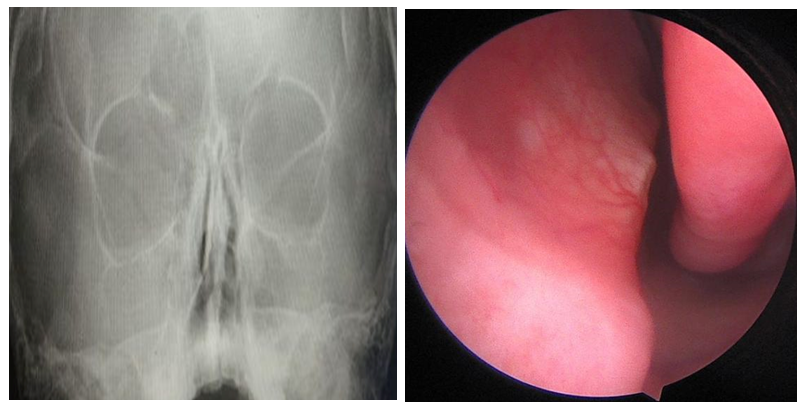 | Figure 1. "crest" shaped deviation |
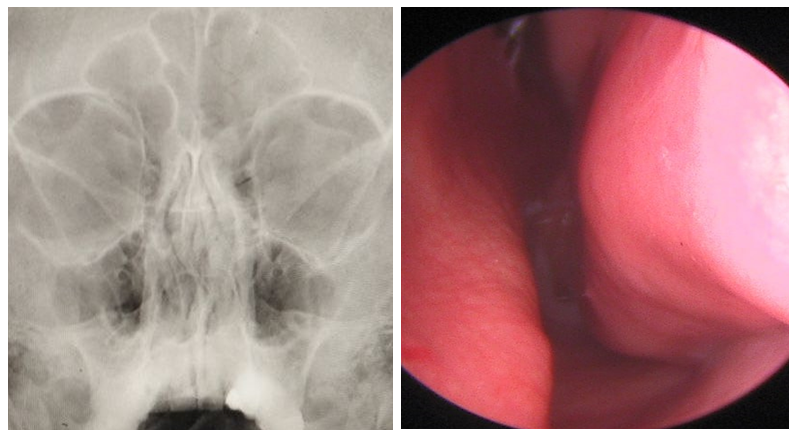 | Figure 2. S-shaped nasal septum deviation |
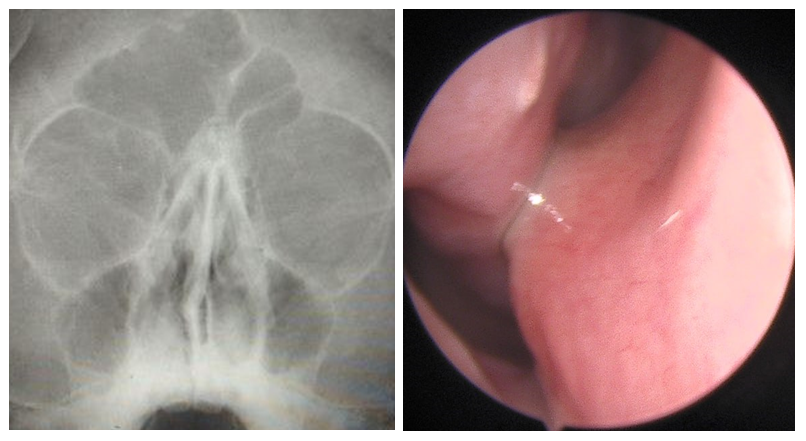 | Figure 3. Spur-shaped deviation of the nasal septum |
4. Conclusions
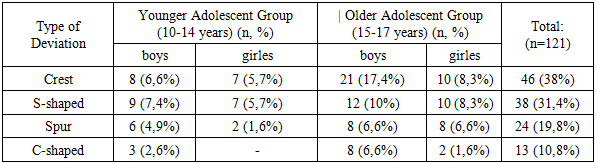
- In adolescents, deformations of the osteocartilaginous and cartilaginous parts of the nasal septum are predominant. In our opinion, the prevalence of deformations in the osteocartilaginous part of the nasal septum is related to differences in the growth and formation rates of bone and cartilage structures. According to our data, "crest" and S-shaped deviations of the nasal septum are frequently diagnosed in children, which confirms the uneven growth of individual septal structures, leading to its various deformations in the form of deviations, spurs, and crests.