
-
Paper Information
- Next Paper
- Previous Paper
- Paper Submission
-
Journal Information
- About This Journal
- Editorial Board
- Current Issue
- Archive
- Author Guidelines
- Contact Us
American Journal of Medicine and Medical Sciences
p-ISSN: 2165-901X e-ISSN: 2165-9036
2025; 15(9): 2996-2998
doi:10.5923/j.ajmms.20251509.32
Received: Aug. 12, 2025; Accepted: Sep. 7, 2025; Published: Sep. 23, 2025

Immobilization Stress as a Hormonal Model of Metabolic Disadaptation
 Abstract
 Reference
 Full-Text PDF
 Full-text HTML
Yusupova Iroda Akhmadzhanovna, Azimova Sevara Bakhadirovna, Akhmedova Dilafruz Bakhadirovna
Tashkent State Medical University, Tashkent, Uzbekistan
Correspondence to: Yusupova Iroda Akhmadzhanovna, Tashkent State Medical University, Tashkent, Uzbekistan.
| Email: |  |
Copyright © 2025 The Author(s). Published by Scientific & Academic Publishing.
This work is licensed under the Creative Commons Attribution International License (CC BY).
http://creativecommons.org/licenses/by/4.0/

Immobilization stress is a widely used experimental model for studying the body's neuroendocrine and metabolic responses to external stimuli. This study investigates the temporal dynamics of serum adrenaline and cortisol levels in laboratory rats subjected to immobilization stress for varying durations (1, 3, 7, 10, 14, and 28 days). The results demonstrate a sharp increase in adrenaline and cortisol concentrations during the acute phase of stress, followed by a gradual decline, although hormone levels remained elevated compared to the control group even after 28 days. These findings suggest that prolonged stress leads to persistent neuroendocrine activation and may contribute to metabolic dysregulation, including insulin resistance and hyperglycemia. The study provides important insights into the mechanisms of adaptation and maladaptation under chronic stress conditions.
Keywords: Immobilization stress, Adrenaline, Cortisol, Neuroendocrine response, Metabolic dysregulation, Adaptation, Laboratory rats
Cite this paper: Yusupova Iroda Akhmadzhanovna, Azimova Sevara Bakhadirovna, Akhmedova Dilafruz Bakhadirovna, Immobilization Stress as a Hormonal Model of Metabolic Disadaptation, American Journal of Medicine and Medical Sciences, Vol. 15 No. 9, 2025, pp. 2996-2998. doi: 10.5923/j.ajmms.20251509.32.
Article Outline
1. Introduction
- In the context of the modern pace of life, stress has become an integral part of both human existence and a range of experimental models used in biomedical research. Among various forms of stress exposure, immobilization stress is widely used as a universal model to study neuroendocrine and metabolic responses of the organism. This type of stress is characterized by the absence of physical activity and forced restriction of mobility, which causes pronounced changes in the body’s regulatory systems, especially the hypothalamic-pituitary-adrenal (HPA) and sympathoadrenal axes [1-3].The main role in implementing the stress response is played by the hormones cortisol and adrenaline, which are key mediators of adaptive processes. Adrenaline, as the primary hormone of the sympathoadrenal system, ensures the mobilization of energy resources, while cortisol, a glucocorticoid hormone, regulates carbohydrate, protein, and lipid metabolism, suppresses immune activity, and participates in maintaining homeostasis [4,5]. However, prolonged or excessive elevation of these hormones can disrupt physiological balance and contribute to the development of insulin resistance, hyperglycemia, and other metabolic disorders.Scientific interest in studying the dynamics of cortisol and adrenaline under various durations of stress exposure is driven by the need for a deeper understanding of adaptation and maladaptation mechanisms, as well as the search for early markers of metabolic and neuroendocrine destabilization [6-8].In this regard, the present study aims to investigate the chronological dynamics of adrenaline and cortisol concentrations in the blood serum of experimental animals under immobilization stress, with the goal of assessing the intensity and effectiveness of the organism’s adaptive mechanisms.
2. Purpose of the Research
- To determine the characteristics of changes in the concentrations of stress hormones—adrenaline and cortisol—under conditions of immobilization stress, as well as to characterize the stages and effectiveness of the organism’s adaptive mechanisms over different durations of stress exposure.
3. Materials and Methods
- Study Subjects:The experiment was conducted on white outbred male rats weighing 180–220 g, kept under standard housing conditions (free access to food and water, natural light cycle).Animal Grouping:Animals were divided into the following groups (12 animals per group):Control group - intact rats without stress exposure;Experimental groups - subjected to immobilization stress for:1 day,3 days,7 days,10 days,14 days,28 days.Immobilization Stress Model:Immobilization was performed daily for 6 hours during the designated period to reproduce acute and chronic stress exposure.Determination of Hormonal Parameters:Adrenaline and cortisol were measured in blood serum using enzyme-linked immunosorbent assay (ELISA) with certified kits (specify manufacturer if data is available, e.g., DRG, Elabscience, etc.).Blood sampling was performed the morning after the last stress exposure by decapitation under light ether anesthesia.Statistical Analysis:Results are presented as mean ± standard error (M±m). Comparative analysis between groups was performed using Student’s t-test. The level of statistical significance was set at p<0.05.Response of the Hypothalamic-Pituitary-Adrenal and Sympathoadrenal Systems to Stress: Dynamics of Cortisol and Adrenaline.The physiological response of the organism to stress is accompanied by complex neuroendocrine rearrangements, where cortisol and adrenaline play key roles. These biologically active substances regulate metabolic processes and adaptation to extreme influences by activating mechanisms that maintain homeostasis.
4. Results and Discussion
- Adrenaline: Secretion Dynamics and Metabolic ConsequencesIn the initial phase of immobilization stress, adrenaline concentration rapidly increases, reflecting immediate activation of the sympathoadrenal system. Within the first day, its level exceeds control values by more than 18 times, reaching peak values by the third day. This indicates a pronounced stress response and enhanced catabolic processes.High adrenaline levels affect glucose metabolism through dual action:Suppressing insulin secretion from pancreatic β-cells,Simultaneously stimulating glucagon production.This combination contributes to hyperglycemia, reduced tissue sensitivity to insulin, and the development of insulin resistance. Additionally, prolonged adrenaline exposure may suppress β-cell secretory activity, worsening endocrine dysfunction.From the seventh day, a decrease in adrenaline concentration is observed, possibly indicating partial adaptation. However, even after 28 days, its level remains significantly above baseline, indicating persistent sympathoadrenal system activation (Figure 1).
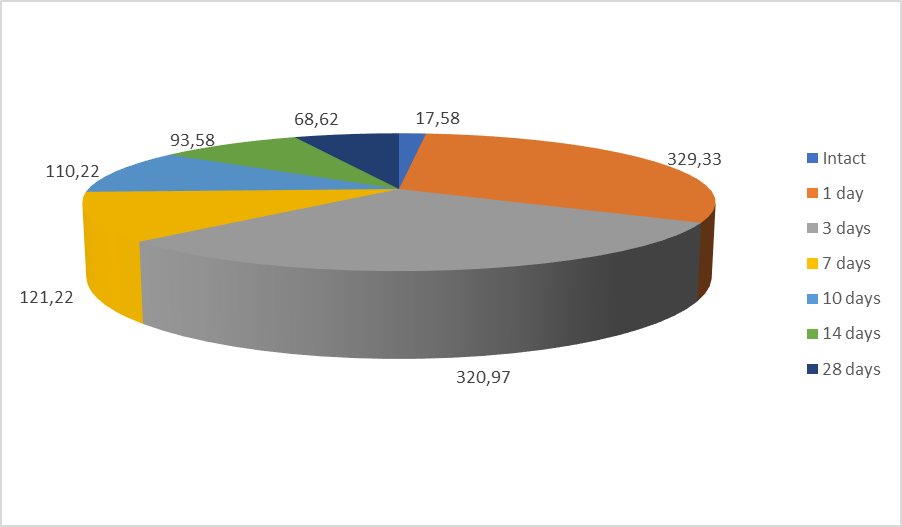 | Figure 1. Changes in Adrenaline Concentration Depending on the Duration of Immobilization Stress in Laboratory Rats |
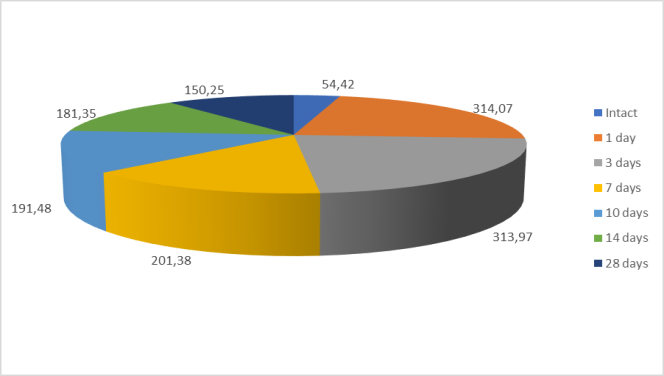 | Figure 2. Changes in Cortisol Concentration Depending on the Duration of Immobilization Stress in Laboratory Rats |
5. Conclusions
- Thus, the observed dynamics of cortisol and adrenaline under immobilization stress demonstrate a phased activation of the stress response with pronounced metabolic consequences. Despite partial adaptation at later stages, hormone levels do not return to physiological norms, indicating a prolonged endocrine overload and potential long-term risks to metabolic health.