
-
Paper Information
- Previous Paper
- Paper Submission
-
Journal Information
- About This Journal
- Editorial Board
- Current Issue
- Archive
- Author Guidelines
- Contact Us
American Journal of Medicine and Medical Sciences
p-ISSN: 2165-901X e-ISSN: 2165-9036
2025; 15(9): 2914-2916
doi:10.5923/j.ajmms.20251509.14
Received: Jul. 25, 2025; Accepted: Aug. 12, 2025; Published: Sep. 8, 2025

Features of the Course of Bronchial Asthma in the Conditions of the Aral Sea Zone
 Abstract
 Reference
 Full-Text PDF
 Full-text HTML
Baltabaeva Z. A., Narmukhamedova N. A., Rustamova H. E.
Center for Development of Professional Qualifications of Medical Workers, Tashkent, Uzbekistan
Copyright © 2025 The Author(s). Published by Scientific & Academic Publishing.
This work is licensed under the Creative Commons Attribution International License (CC BY).
http://creativecommons.org/licenses/by/4.0/

According to WHO, about 399 million patients with bronchial asthma (BA) are registered in the world. The prevalence of bronchial asthma in many countries ranges from 10 to 18%. Epidemiological studies of recent years show that almost all countries have seen an increase in the incidence of bronchial asthma, especially its severe form. The development of the disease is caused by triggers that cause inflammation of the respiratory tract or acute bronchospasm. Among them, allergens, meteorological factors, physical activity, and taking certain medications most often cause exacerbations. In recent years, the influence of respiratory viral infections, in particular the effect of the SARS-CoV-2 virus, has been highlighted in the development of exacerbations of bronchial asthma. This study was conducted to study the course and prognosis of bronchial asthma in patients who have had Covid infection.
Keywords: Bronchial asthma, Viral infection, SARS-CoV-2 virus, Course and prognosis of the disease
Cite this paper: Baltabaeva Z. A., Narmukhamedova N. A., Rustamova H. E., Features of the Course of Bronchial Asthma in the Conditions of the Aral Sea Zone, American Journal of Medicine and Medical Sciences, Vol. 15 No. 9, 2025, pp. 2914-2916. doi: 10.5923/j.ajmms.20251509.14.
1. Introduction
- Currently, diseases of the bronchopulmonary system are common and often lead to the development of disability and premature mortality. The prevalence of bronchial asthma (BA) among other diseases of the respiratory system is second only to chronic obstructive pulmonary disease (COPD) [1]. According to WHO data, about 399 million patients with BA are recorded in the world. The prevalence of bronchial asthma in many countries ranges from 10 to 18% [2]. Epidemiological studies of recent years show that almost all countries have seen an increase in the incidence of bronchial asthma, especially its severe form [3-4]. The development of the disease is caused by triggers that cause inflammation of the respiratory tract or acute bronchospasm. Among them, the most common exacerbations are allergens, meteorological factors, physical activity, and the use of certain medications [5]. In recent years, the influence of respiratory viral infections, in particular the effect of the SARS-CoV-2 virus, has been highlighted in the development of exacerbations of bronchial asthma [6-7].The aim of this study was to analyze the course of bronchial asthma in hospitalized patients in the emergency department and to assess the impact of previous Covid infection on the course and prognosis of the disease.
2. Materials and Methods
- A retrospective analysis was conducted in the Karakalpak branch of the Republican Scientific Center for Emergency Medical Care based on the case histories of patients in the emergency department. Over the past 6 years, 3,582 patients with bronchopulmonary diseases were hospitalized in the emergency department, among them 384 patients with bronchial asthma (10.7%). An analysis of the case histories of emergency patients with bronchial asthma who received treatment in 2018-2023 was conducted.
3. Research Results
- According to the analysis of patients admitted to the emergency medicine department, it was revealed that the number of patients with diseases of the bronchopulmonary system gradually increased from 507 patients in 2018 to 730 patients in 2023. Among them, the number of patients with bronchial asthma decreased from 76 in 2018 to 60 in 2023. In percentage terms, the number of patients with bronchial asthma in 2018 was 14.9%, and in 2023 it decreased to 8.2% of patients, Fig. 1.
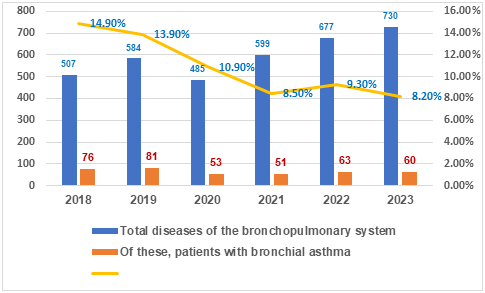 | Figure 1. Number of patients admitted with asthma over the past 6 years |
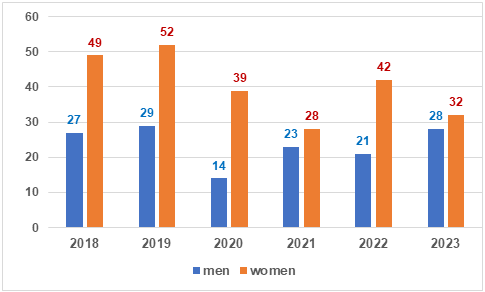 | Figure 2. Ratio of men and women among patients with bronchial asthma |
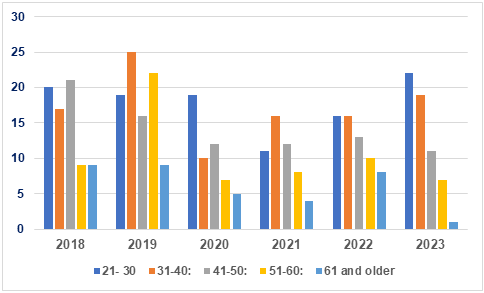 | Figure 3. Ratio of patients with bronchial asthma by age |
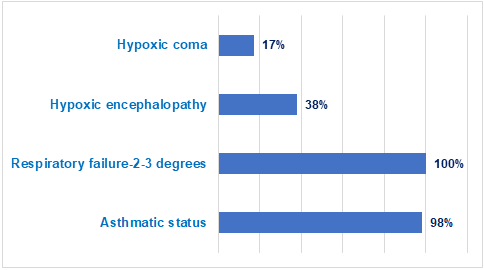 | Figure 4. Severity of the condition of patients with asthma upon admission |
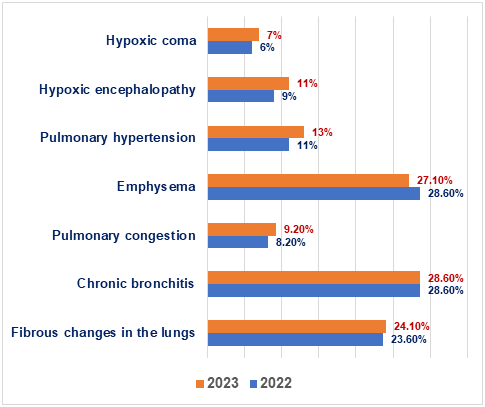 | Figure 5. X-ray changes in the bronchopulmonary system of patients with bronchial asthma |
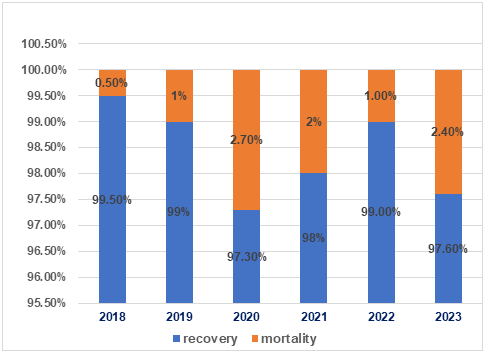 | Figure 6. Outcome of bronchial asthma |
4. Conclusions
- Thus, the analysis showed that the clinical picture in patients with bronchial asthma, despite the decrease in the number of hospitalized patients, is more complicated by changes in radiological and laboratory parameters. Cases of recurrent asthmatic status within a year and severe asthma with a fatal outcome have become more frequent.Consequently, these patients with bronchial asthma need additional monitoring by a general practitioner or pulmonologist, timely correction of asthma therapy and achieving control over the disease. It is necessary to inform patients about the importance of regularly taking medications for the treatment of bronchial asthma and adhering to the necessary regimen. Such as: vaccination, use of personal protective equipment in the cold season, isolation during an increase in the incidence of coronavirus infection and limiting contact with COVID-19 patients in order to avoid infection with the virus.