
-
Paper Information
- Previous Paper
- Paper Submission
-
Journal Information
- About This Journal
- Editorial Board
- Current Issue
- Archive
- Author Guidelines
- Contact Us
American Journal of Medicine and Medical Sciences
p-ISSN: 2165-901X e-ISSN: 2165-9036
2025; 15(8): 2833-2834
doi:10.5923/j.ajmms.20251508.88
Received: Aug. 6, 2025; Accepted: Aug. 24, 2025; Published: Aug. 30, 2025

Comparative Assessment of Cutaneous Microcirculation After Traditional Blepharoplasty and Cold Plasma Dermablation Using B-Flow Ultrasound Imaging
 Abstract
 Reference
 Full-Text PDF
 Full-text HTML
Kasimova M. S.1, Iminova M. M.2
1Professor of the Department of Ophthalmology, Center for the Development of Professional Qualifications of Medical Workers, Uzbekistan
2PhD, Ophthalmologist, Republican Clinical Ophthalmology Hospital, Uzbekistan
Copyright © 2025 The Author(s). Published by Scientific & Academic Publishing.
This work is licensed under the Creative Commons Attribution International License (CC BY).
http://creativecommons.org/licenses/by/4.0/

Dermatochalasis of the upper and lower eyelids is a common age-related condition that impairs both appearance and function. While surgical blepharoplasty is widely regarded as the standard treatment, interest in non-invasive methods such as cold plasma dermablation is growing due to their lower complication rates and faster recovery. Despite advancements in technique, the role of cutaneous microcirculation in postoperative healing remains insufficiently studied. This research aimed to compare skin perfusion outcomes following surgical blepharoplasty and cold plasma treatment using B-Flow ultrasound imaging, a non-Doppler-based modality that provides real-time, high-resolution visualization of superficial blood flow. A total of 1 cm² areas on the upper and lower eyelids were examined on postoperative Days 3, 10, and 30. Quantitative assessment included the number of visible capillaries, perfusion uniformity, and presence of hypoperfusion zones. The results demonstrated faster vascular recovery and fewer perfusion deficits in patients treated with cold plasma, particularly in the early postoperative period. By Day 30, both groups showed comparable microcirculatory status. The study concludes that cold plasma dermablation may better preserve early skin perfusion, supporting improved healing dynamics. B-Flow imaging proved to be a reliable tool for monitoring cutaneous vascular status and may enhance clinical decision-making in periocular aesthetic procedures.
Keywords: Dermablation, Eyelids, Dermatochalas, Non-invasive approaches
Cite this paper: Kasimova M. S., Iminova M. M., Comparative Assessment of Cutaneous Microcirculation After Traditional Blepharoplasty and Cold Plasma Dermablation Using B-Flow Ultrasound Imaging, American Journal of Medicine and Medical Sciences, Vol. 15 No. 8, 2025, pp. 2833-2834. doi: 10.5923/j.ajmms.20251508.88.
1. Introduction
- Age-related changes in the periorbital region include dermatochalasis, tissue ptosis, and redistribution of subcutaneous fat. Surgical blepharoplasty remains the gold standard for correction, yet non-invasive approaches such as cold plasma dermablation have gained popularity due to their lower invasiveness and reduced downtime [3,5].Regardless of the technique used, skin microcirculation is a critical determinant of tissue healing and postoperative outcomes. Poor perfusion may lead to edema, delayed wound healing, or tissue necrosis [4].B-Flow ultrasound offers high-resolution visualization of real-time blood flow in superficial vessels without Doppler-related artifacts. It is particularly effective in evaluating low-flow, small-diameter vessels in the skin, making it a valuable tool for postoperative monitoring in aesthetic procedures [1,2].Traditional Blepharoplasty. This surgical method involves the excision of excess skin, repositioning or removal of orbital fat pads, and partial resection of the orbicularis oculi muscle if needed. While it ensures long-lasting results, it is associated with higher tissue trauma, hematomas, and a longer recovery period [5].Cold Plasma Dermablation. A non-surgical alternative based on ionized gas application (cold plasma), which induces controlled epidermal ablation and dermal remodeling. It is recommended for mild to moderate dermatochalasis and offers a faster recovery. However, it may require repeated sessions for lasting aesthetic effects [3].
2. Materials and Methods
- Method for Microcirculation Assessment (B-Flow Imaging)Principle of Operation. B-Flow technology suppresses stationary tissue signals while capturing echoes from moving erythrocytes, producing grayscale images of blood flow without aliasing or blooming artifacts. Unlike Doppler methods, it provides angle-independent and artifact-free vascular imaging. Ultrasound Protocol: • Equipment: GE Logiq E9 with ML6-15 linear transducer• Examination timeline: Day 3, Day 10, and Day 30 post-procedure• Target zones: Central upper and lower eyelids (1 cm² area)• Evaluated parameters: number of visible capillaries, perfusion uniformity, areas of hypoperfusion
3. Results and Discussion
|
|
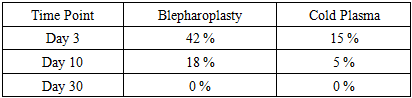
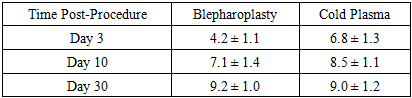
 Interpretation: Hypoperfusion zones are more frequent following surgical intervention, particularly in patients with thick skin or extensive excision. Cold plasma procedures exhibit significantly fewer perfusion deficits.The B-Flow findings demonstrate that cutaneous microcirculation recovers faster after cold plasma dermablation compared to traditional surgery. This correlates with clinical observations of less edema, earlier normalization of skin color, and milder discomfort in plasma-treated patients.However, by Day 30, perfusion metrics in both groups become comparable, indicating that early postoperative differences are transient and not necessarily predictive of long-term outcomes.B-Flow proved advantageous over Doppler techniques by detecting slow-flow capillaries without the limitations of color or angle dependency, especially valuable in the periorbital region with its superficial vascular architecture.
4. Conclusions
- • B-Flow is a reliable and informative modality for assessing postprocedural microcirculation in aesthetic eyelid interventions.• Cold plasma dermablation preserves superficial skin perfusion more effectively in the early stages of healing.• Surgical blepharoplasty is associated with temporary perfusion decline but normalizes by one month post-op.• Routine use of B-Flow may enhance postoperative monitoring, allow early detection of complications, and guide personalized recovery protocols.