
-
Paper Information
- Next Paper
- Previous Paper
- Paper Submission
-
Journal Information
- About This Journal
- Editorial Board
- Current Issue
- Archive
- Author Guidelines
- Contact Us
American Journal of Medicine and Medical Sciences
p-ISSN: 2165-901X e-ISSN: 2165-9036
2025; 15(8): 2779-2781
doi:10.5923/j.ajmms.20251508.76
Received: Aug. 9, 2025; Accepted: Aug. 25, 2025; Published: Aug. 30, 2025

Sensitization Patterns in Respiratory Allergy
 Abstract
 Reference
 Full-Text PDF
 Full-text HTML
Ikramova Shakhnoza Abdurasulovna
Bukhara State Medical Institute, Bukhara, Uzbekistan
Correspondence to: Ikramova Shakhnoza Abdurasulovna, Bukhara State Medical Institute, Bukhara, Uzbekistan.
Copyright © 2025 The Author(s). Published by Scientific & Academic Publishing.
This work is licensed under the Creative Commons Attribution International License (CC BY).
http://creativecommons.org/licenses/by/4.0/

This study aimed to determine the prevalence of sensitization to key inhalant allergens and to assess the degree of immune response in patients with clinical signs of allergic rhinitis and/or bronchial asthma. The analysis revealed a predominance of sensitization to Der p 1/Der p 2 (house dust mites), Art v 1/Art v 3 (mugwort), the fungal allergen Alt a 1, as well as epithelial allergens of cats (Fel d 1) and dogs (Can f 1). The largest proportion of patients exhibited a high degree of sensitization according to the RAST scale, highlighting the severity of allergic inflammation and the need for early diagnosis and individualized therapy.
Keywords: Allergic rhinitis, Bronchial asthma, Sensitization, Inhalant allergens, House dust mites (Der p 1, Der p 2), Mugwort pollen (Art v 1, Art v 3), Fungal allergens (Alt a 1), Cat epithelial allergen (Fel d 1), Dog epithelial allergen (Can f 1), Immune response, RAST scale, Individualized therapy
Cite this paper: Ikramova Shakhnoza Abdurasulovna, Sensitization Patterns in Respiratory Allergy, American Journal of Medicine and Medical Sciences, Vol. 15 No. 8, 2025, pp. 2779-2781. doi: 10.5923/j.ajmms.20251508.76.
Article Outline
1. Introduction
- Sensitization to inhaled allergens plays a crucial and central role in the development and progression of allergic respiratory diseases, impacting millions worldwide. This process, where the immune system becomes overly reactive to otherwise harmless substances in the air, fundamentally underlies conditions like allergic rhinitis (hay fever), asthma, and allergic bronchitis [1]. Understanding an individual’s specific allergic sensitization profile - which allergens they react to – and the magnitude of their immune response to those allergens is absolutely vital. This detailed assessment allows clinicians to accurately determine the severity of the respiratory illness, ranging from mild, occasional symptoms to debilitating, chronic conditions, and consequently, to tailor a highly effective treatment strategy. Such strategy might encompass a variety of approaches, including avoidance measures, medication to control symptoms, and, crucially, allergen-specific immunotherapy (ASIT), also known as allergy shots. ASIT works by gradually desensitizing the patient to the specific allergen, ultimately reducing the allergic response over time [2].Adding to the complexity and concern, the worsening global environmental situation is contributing to a significant rise in the prevalence of sensitization to some of the most impactful inhaled allergens [3,4]. These include house dust mites, microscopic creatures that thrive in warm, humid environments and whose fecal matter is a potent allergen; pollen from various trees, grasses, and weeds, released seasonally and triggering widespread allergic reactions; fungal spores, which can be found both indoors and outdoors and are particularly problematic for individuals with mold allergies; and allergens derived from the epithelium (dead skin cells, saliva, and dander) of domestic animals like cats and dogs, which can persist in the environment long after the animal has left [5]. The increasing urbanization, climate change, and indoor air pollution all contribute to higher allergen concentrations and prolonged exposure, further exacerbating the problem of allergic respiratory diseases and highlighting the importance of ongoing research and preventative measures.
2. Purpose of the Research
- To determine the prevalence of sensitization to major inhalant allergens and assess the degree of immune response in patients with respiratory manifestations of allergy in order to optimize approaches to the diagnosis and treatment of allergic respiratory diseases.
3. Materials and Methods
- Patients with clinical signs of bronchial asthma and allergic rhinitis were examined. All participants underwent specific IgE testing to major inhalant allergens using the RAST method. The results were evaluated according to the degree of sensitization: low (RAST 1), moderate (RAST 2–3), and high (RAST 4–6).
4. Results and Discussion
- The most frequent and significant positive reactions observed in our study were directed towards components of house dust mites, specifically Der p 1 and Der p 2. A substantial 119 patients demonstrated sensitization to these allergens, highlighting their dominance within the spectrum of inhalant allergies. These mites, common inhabitants of homes and bedding, release these proteins into the environment, triggering allergic responses in susceptible individuals. Der p 1, in particular, is a major allergen responsible for many symptoms associated with house dust mite allergy, including rhinitis (hay fever), asthma, and eczema. Der p 2 also contributes significantly to the allergic burden, often exhibiting cross-reactivity with other allergens.Following house dust mite allergens, the pollen components of Artemisia (Art v 1 and v 3) ranked second in terms of sensitization frequency, affecting 99 patients. *Artemisia* species, such as mugwort and wormwood, are prevalent weeds, and their pollen is a significant springtime allergen in many regions. Art v 1 and v 3 are key allergenic proteins within Artemisia pollen, known to cause respiratory symptoms and allergic reactions upon inhalation. The widespread distribution of these plants contributes to the high prevalence of Artemisia pollen allergy.Subsequently, fungal allergens, specifically Alt a 1, were identified as sensitizing agents in 70 individuals. Alt a 1 is a major allergen produced by Alternaria alternata, a common mold found both indoors and outdoors. Exposure to Alternaria spores can occur year-round, but levels often peak during late summer and fall. Sensitization to Alt a 1 is frequently associated with respiratory symptoms, particularly asthma and allergic rhinitis.Sensitization to feline epithelial proteins, primarily Fel d 1, was detected in 65 patients, while sensitization to canine components, specifically Can f 1, was observed in 54 patients. Fel d 1 is the major allergen produced by cats, found in their saliva, skin, and urine. It adheres to fur and dander, becoming airborne and triggering allergic reactions in sensitive individuals. Similarly, Can f 1 is a major allergen produced by dogs, also found in their saliva, skin, and dander. These animal allergens are persistent in the environment, even after the animal has left a room, making avoidance challenging for allergic individuals (Figure 1).
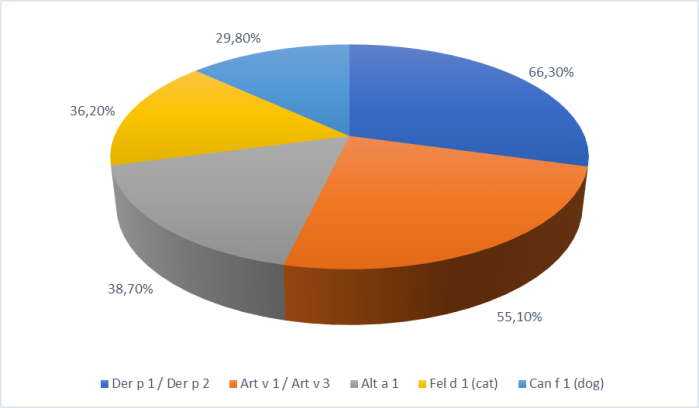 | Figure 1. Frequency of Sensitization to Major Inhalant Allergenic Components |
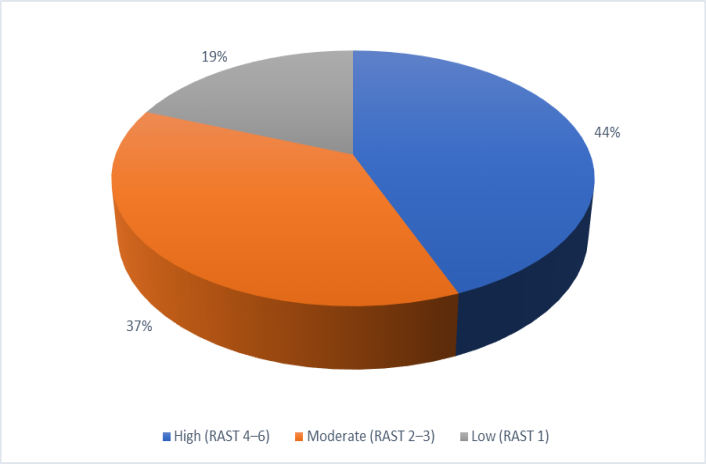 | Figure 2. Severity of Allergen Sensitization According to RAST Scores |
5. Conclusions
- Sensitization to components of house dust mites and pollen allergens overwhelmingly dominates the structure of allergic respiratory diseases. A significant majority, exceeding 80% of patients examined, have demonstrated a moderate to high degree of sensitization to these allergens, highlighting the critical importance of early and accurate diagnosis, followed by a carefully individualized therapeutic approach. This individualized strategy should incorporate various interventions, including allergen-specific immunotherapy (ASIT), often referred to as allergy shots, which gradually desensitizes the immune system to specific allergens, and a range of preventative measures aimed at reducing allergen exposure. For example, preventative steps might include using hypoallergenic bedding encasements to minimize dust mite exposure, employing HEPA filters in air purifiers, regularly vacuuming with a HEPA-filtered vacuum cleaner, and monitoring pollen counts to limit outdoor activity during peak pollen seasons. The prevalence of this widespread sensitization underscores the need for increased public awareness regarding allergen avoidance and the availability of effective treatment options like ASIT to manage and potentially reduce the severity of allergic respiratory conditions.