
-
Paper Information
- Next Paper
- Previous Paper
- Paper Submission
-
Journal Information
- About This Journal
- Editorial Board
- Current Issue
- Archive
- Author Guidelines
- Contact Us
American Journal of Medicine and Medical Sciences
p-ISSN: 2165-901X e-ISSN: 2165-9036
2025; 15(8): 2756-2759
doi:10.5923/j.ajmms.20251508.71
Received: Aug. 7, 2025; Accepted: Aug. 23, 2025; Published: Aug. 30, 2025

Study of the Relationship Between Biochemical and Immunological Parameters of Blood in Pregnant Women with Mitral Stenosis
 Abstract
 Reference
 Full-Text PDF
 Full-text HTML
Tuksanova D. I.1, Tukhtaeva M. A.2
1Bukhara State Medical Institute, Bukhara, Uzbekistan
2Bukhara Branch of the Republican Specialized Scientific and Practical Medical Center for Mother and Child Health, Bukhara, Uzbekistan
Correspondence to: Tuksanova D. I., Bukhara State Medical Institute, Bukhara, Uzbekistan.
| Email: |  |
Copyright © 2025 The Author(s). Published by Scientific & Academic Publishing.
This work is licensed under the Creative Commons Attribution International License (CC BY).
http://creativecommons.org/licenses/by/4.0/

The article presents the results of an analysis of the relationship between biochemical and immunological blood parameters in 110 pregnant women with mitral stenosis. The level of inflammation, renal function, hemostatic system, and cytokine content were evaluated. Statistically significant correlations were found between increased levels of C-reactive protein, D-dimer, and fibrinogen and concentrations of proinflammatory cytokines IL-8 and TNF-α. The data obtained allow us to consider these parameters as potential markers of the risk of complicated pregnancy in this group of patients.
Keywords: Mitral stenosis, Pregnancy, Biochemistry, Cytokines, Inflammation, Hemostasis
Cite this paper: Tuksanova D. I., Tukhtaeva M. A., Study of the Relationship Between Biochemical and Immunological Parameters of Blood in Pregnant Women with Mitral Stenosis, American Journal of Medicine and Medical Sciences, Vol. 15 No. 8, 2025, pp. 2756-2759. doi: 10.5923/j.ajmms.20251508.71.
1. Introduction
- Mitral stenosis (MS) is one of the most common acquired heart defects in women of reproductive age, mainly of rheumatic origin. During pregnancy, when the cardiovascular system undergoes significant physiological changes (an increase in the volume of circulating blood, heart rate, BCC, MOC), even compensated mitral stenosis can cause decompensation of cardiac activity [4,9].Early detection of signs of impaired heart adaptation in pregnant women with mitral stenosis can significantly improve the prognosis due to timely correction of therapy and determination of labor management tactics [7,11].Cardiohemodynamic changes during pregnancyFrom the beginning of the first trimester, physiological changes are observed aimed at providing increased metabolic needs of the mother and fetus. Plasma volume increases by 40-50%, heart rate increases by 10-15 beats / min, and cardiac output increases. In women with MS, compensatory mechanisms are limited, which predisposes to the development of congestive heart failure, especially in the II-III trimesters [1,6,10].Diagnostic approaches and markers of cardiac adaptationTraditional methods for assessing cardiac function include echocardiography (chamber size, ejection fraction, pulmonary artery pressure), ECG, and clinical follow-up. However, they often detect changes already at the stage of functional disorders. In recent years, attention has been paid to cytokines-markers of systemic inflammation and cardiac stress [2,3].Cytokine biomarkers: role and prospectsTNF-α is a key pro-inflammatory cytokine that causes endothelial dysfunction and myocardial remodeling.IL-8 is a chemokine involved in neutrophil activation and vascular endothelial damage.IL-2-reflects T-cell activity and immune stress.IL-10 is an anti-inflammatory cytokine important for limiting the cytotoxic effects of inflammation.Several studies have shown that an increase in TNF-α and IL-8 with a decrease in IL-10 in pregnant women with MS correlates with a deterioration in hemodynamics, an increase in pulmonary artery pressure, and an increase in the size of the left atrium [5,8,12].Purpose of the study. to study the relationship between biochemical and immunological blood parameters in pregnant women with mitral stenosis in order to identify possible predictors of a complicated gestational process.
2. Materials and Methods of Research
- In accordance with the goals and objectives of the work, 110 pregnant women were examined. The research program will be implemented jointly with the Department of Obstetrics and Gynecology No. 2 of the Bukhara State Medical Institute on the basis of the Bukhara Perinatal Center, Bukhara City Maternity Complex. The median age was 28.4±4.7 years.Traditional laboratory clinical and biochemical diagnostic methods are performed - a general blood test, rheumatic test, CRP, determination of creatinine and urea in the blood, OR and hemostasis parameters-fibrinogen, PTI, D-dimer, INR and APVT. Immunological studies - IL-8, IL-2, IL-10, TNF-a. Functional studies included ultrasound and Doppler imaging to determine maternal hemodynamics, local blood flow in the uterine, umbilical and medial arteries of the fetus, and ECHO-cardiography parameters.In-depth studies were conducted in 110 pregnant women. Group I consisted of 40 healthy pregnant women with physiological pregnancy, group II consisted of 35 pregnant women with mitral foramen stenosis in the late period of pregnancy, group III consisted of 35 women in whom this pathology is detected in the early stages of pregnancy, the risk is assessed, timely therapeutic antirheumatic and cardiotonic drug therapy is used.To study the main indicators of biochemical studies, blood serum samples were taken from patients, and the functional activity of the heart and placenta was determined using ultrasound and Doppler research methods.Optimal threshold values of biomarkers associated with the risk of adaptation disorders are:• TNF-α > 10 pg / ml• IL-8 > 30 pg / ml• IL-10 < 12 pg / ml• IL-2 > 18 pg / ml
3. Results
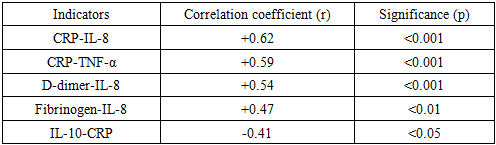
- A correlation was found between the level of TNF-α and the degree of left atrial hypertrophy (r=0.72, p<0.001).These studies demonstrate the possibility of using the cytokine profile as a predictor of early disruption of the adaptive mechanisms of the myocardium in pregnancy complicated by mitral stenosis. An increase in pro-inflammatory markers and a decrease in anti-inflammatory IL-10 correlate with a deterioration in hemodynamic parameters and a decrease in the functional reserve of the heart. Timely detection of these changes in the first trimester in women at risk allows us to apply targeted therapy and improve the prognosis.
|

|

|

|

|
4. Conclusions
- Thus, the revealed changes and established relationships between the indicators emphasize the importance of a comprehensive assessment of both biochemical and immunological parameters in monitoring the condition of pregnant women with mitral stenosis. The use of prognostic cytokine biomarkers-IL-2, IL-8, IL-10, and TNF-α-makes it possible to assess the risk of impaired myocardial adaptation in pregnant women with mitral stenosis already in the first trimester of pregnancy. Their use in dynamics, along with instrumental methods, makes it possible to prescribe timely pathogenetically sound therapy, increase the safety of pregnancy and minimize the development of complications for both the mother and the fetus.