American Journal of Medicine and Medical Sciences

p-ISSN: 2165-901X    e-ISSN: 2165-9036

2025;  15(8): 2745-2748

doi:10.5923/j.ajmms.20251508.68

Received: Aug. 2, 2025; Accepted: Aug. 21, 2025; Published: Aug. 30, 2025

 

Clinical and Immunological Changes in Young Children with Community-Acquired Pneumonia Complicated by Infectious-Toxic Shock

Aliev A. L.1, Quziyev D. V.2, Yuldoshev S. V.3

1Tashkent Medical University, Uzbekistan

2Assistant of the Department of Propaedeutics of Children's Diseases and Outpatient Pediatrics, Andijan State Medical Institute, Uzbekistan

3Student of Andijan State Medical Institute the Faculty of Pediatrics, Uzbekistan

Copyright © 2025 The Author(s). Published by Scientific & Academic Publishing.

This work is licensed under the Creative Commons Attribution International License (CC BY).
http://creativecommons.org/licenses/by/4.0/

Abstract

The study included 63 children with a confirmed diagnosis of pneumonia (main group – 42 children under one year of age with complicated pneumonia; comparison group – 21 children under one year of age with uncomplicated pneumonia). Twenty-two practically healthy children constituted the control group. The concentrations of IL-10 and TNF-α in blood serum were determined by solid-phase enzyme-linked immunosorbent assay (ELISA) using test systems manufactured by AO “Vector-Best” (Novosibirsk, Russia). Hypersecretion of the studied cytokines was established in patients of both groups. TNF-α contributes to the body’s fight against infection, which was observed in the group of children with uncomplicated pneumonia. Excessive production of TNF-α in children with complicated pneumonia may lead to negative effects, such as increased vascular permeability, which can cause pulmonary edema and hemorrhages. In addition, an elevated level of IL-10 in both complicated and uncomplicated pneumonia in the examined children is likely part of a complex immune response aimed at regulating inflammation and limiting tissue damage.

Keywords: Immunity, Pneumonia, Children under one year of age, Cytokines, Serum, Imbalance

Cite this paper: Aliev A. L., Quziyev D. V., Yuldoshev S. V., Clinical and Immunological Changes in Young Children with Community-Acquired Pneumonia Complicated by Infectious-Toxic Shock, American Journal of Medicine and Medical Sciences, Vol. 15 No. 8, 2025, pp. 2745-2748. doi: 10.5923/j.ajmms.20251508.68.

1. Introduction

Pneumonia (PN) is a severe infectious and inflammatory disease, accounting for 80% of pulmonary pathology, with high mortality among children, especially preterm and newborn infants. In recent years, cases of pneumonia with extremely severe and “fulminant” progression have increasingly been registered in newborns, and despite the use of modern antibacterial therapy, a high mortality rate persists (6.1–11). Therefore, the study of the etiological structure, clinical features, course, and treatment of pneumonia in children under current conditions is of great theoretical and practical significance.
A key role in regulating the immune response of the body to the invasion of pathogenic flora belongs to cytokines, which stimulate a local protective inflammatory reaction with the production of inflammatory mediators. In the case of their hyperproduction, a cascade systemic inflammatory response develops, up to infectious-toxic shock, sepsis, enhanced procoagulant activity, and multiple organ dysfunction [4,9,19].
The course of pneumonia depends on the concentration and ratio of pro- and anti-inflammatory cytokines. Their elevated levels may correspond to a severe course of pneumonia [1,2,7].
Despite numerous studies and research, the immune response, including the cytokine profile in children under one year of age with complicated pneumonia, remains insufficiently explored, and this process has yet to be fully clarified. At the same time, the nature of immune disturbances at different stages of the inflammatory process has not been studied comprehensively and is interpreted ambiguously. Therefore, the study of cytokines is of particular interest, since they regulate the intensity and duration of the immune response, as well as the nature of the inflammatory process, ensuring both positive and negative immunoregulation.
Based on the above, the aim of this study was to clarify and investigate certain key pro- and anti-inflammatory mediators of the immune response in children under one year of age with different courses of pneumonia.

2. Materials and Methods

This study included 63 children with a confirmed diagnosis of pneumonia, among whom 42 infants under one year of age with complicated pneumonia, admitted to the intensive care unit, comprised the main group, while 21 infants under one year of age with uncomplicated pneumonia comprised the comparison group. Twenty-two practically healthy children formed the control group. The study involved children aged 3 to 12 months.
Immunological examinations of the children were carried out at a multidisciplinary pediatric medical institution in the Andijan region.
The concentration of the pro-inflammatory tumor necrosis factor alpha (TNF-α) and the anti-inflammatory interleukin-10 (IL-10) in peripheral blood serum was determined by solid-phase enzyme-linked immunosorbent assay (ELISA) using test systems produced by AO “VECTOR-BEST” (Novosibirsk, Russia). Quantitative evaluation of the results was performed by constructing a calibration curve that reflects the dependence of optical density on concentration for the standard antigen, allowing comparison with the studied samples.
Statistical processing of the obtained data was carried out using the computer program Statistica 6.0. The data were analyzed using standard approaches, and the results are presented as the sample mean (M) and standard error of the mean (m); the median (Me), characterizing the central tendency; and the upper and lower quartiles, characterizing the spread of values in 50% of the respondents (Q1–Q3), where Q1 is the 25th percentile, Me is the 50th percentile, and Q3 is the 75th percentile. The significance of differences in mean values (P) between the compared indicators was assessed using Student’s t-test.

3. Results and Discussion

One of the leading causes of complicated and prolonged pneumonia at present is the alteration of the body’s immunological reactivity [5]. The immune response in complicated pneumonia in children under one year of age represents a complex research problem.
As is known, the organization of the immune system undergoes age-related changes. Critical periods of development of immunobiological reactivity (milestones) represent stages during which the impact of antigens may trigger a disproportionate or even paradoxical immune response. This response may either be insufficient for effective protection (hypo- or anergic) or excessive (hyperergic). The selected group of children (from 3 to 12 months) in the present study corresponds to the second critical period of immune system development.
Literature data indicate a multitude of factors that make the study of immune response in complicated pneumonia in children under one year particularly difficult. Firstly, in this age group, immunological mechanisms are still in the process of formation, and their function may differ significantly from the immune response in adults or older children. Secondly, pneumonia may be caused by various pathogens, such as bacteria, viruses, or fungi, which further complicates the study of immune response.
In pulmonary diseases, cytokines are involved in the infectious-inflammatory process at the level of both immune mechanisms themselves and the effector component, largely determining the direction, severity, and outcome of the pathological process [8].
In the context of pneumonia, cytokines perform several key functions—they act as mediators of inflammation, regulators of the immune response, agents of recruitment and activation of immune cells, growth and regeneration factors, and immune regulators.
It should be noted that initially all children participating in the immunological studies were divided into groups of 3 to 6 months and 6 to 12 months. However, in the course of the research, the results obtained did not show significant differences; therefore, all children in the main and comparison groups were subsequently combined accordingly into the above-mentioned groupings of 3 to 12 months.
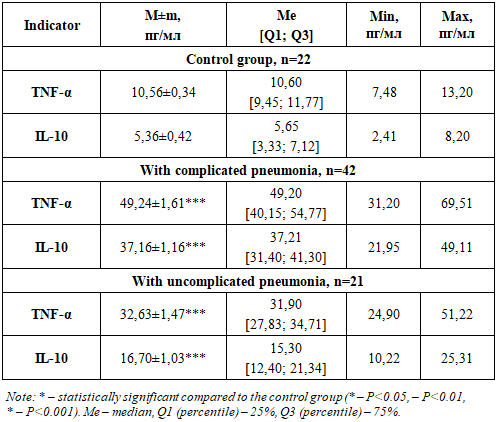
The obtained results are presented in Table 1 below.
Table 1. Serum cytokine levels in examined children with pneumonia
     
Tumor necrosis factor alpha (TNF-α) is a pro-inflammatory cytokine with a wide range of activity. The biological effects of TNF-α depend on its concentration. The main producers of TNF-α are monocytes and macrophages. It is also secreted by neutrophils, endothelial and epithelial cells, eosinophils, mast cells, B- and T-lymphocytes when they are involved in the inflammatory process [12].
TNF-α is a powerful pleiotropic pro-inflammatory cytokine, produced mainly by activated macrophages, lymphocytes, and endothelial cells [11]. A high level of circulating TNF-α is associated with toxic shock induced by endotoxins [14].
Analysis of serum TNF-α levels presented in Table 1 revealed a significantly increased concentration of cachexin in all groups of children with pneumonia compared to the control values. Thus, synthesis in the group of infants with uncomplicated pneumonia was increased threefold, with an average value of 32.63 ± 1.47 pg/ml (P<0.001). In the group of children with complicated pneumonia, it was increased by nearly 3.7 times, averaging 49.24 ± 1.61 pg/ml (P<0.001), whereas in the group of practically healthy infants, this indicator was 10.56 ± 0.34 pg/ml.
The results obtained indicate the functional duality of TNF-α. In an acute situation such as pneumonia, local production of TNF-α has a beneficial effect, which consists in promoting increased expression of adhesion molecules on the surface of vascular endothelial cells. This, in turn, facilitates the migration of immune cells, such as neutrophils and macrophages, to the sites of infection. Thus, TNF-α contributes to the body’s defense against infection, which was observed in the group of children with uncomplicated pneumonia. However, systemic or prolonged elevation of TNF-α levels can be harmful. Excessive TNF-α production may lead to negative effects, such as increased vascular permeability, which can cause pulmonary edema and hemorrhages. This may result in the development of a shock-like state, which, in turn, may worsen the patient’s condition — as observed in our study in infants with complicated pneumonia.
Anti-inflammatory cytokines play an important role in regulating the inflammatory response in pneumonia, helping to balance the immune response and preventing excessive inflammation, which can lead to tissue damage and complications. They act in concert with pro-inflammatory cytokines to maintain balance and limit pathological inflammation. In the context of pneumonia in both children and adults, the proper functioning and balance of anti-inflammatory and pro-inflammatory cytokines are of great importance for successful infection resolution and minimizing harm to the body.
Interleukin-10 (IL-10) — the main sources of IL-10 are T-helper cells, monocytes, macrophages, and dendritic cells. However, many types of immune effector cells are also capable of producing IL-10 in specific contexts, including B cells, cytotoxic T cells, NK cells, mast cells, and granulocytes such as neutrophils and eosinophils [16, 17, 18]. In addition, non-immune effector types, such as epithelial cells and keratinocytes, can also produce IL-10 in response to infection or tissue damage, as well as tumor cells [15].
IL-10 is considered one of the most potent anti-inflammatory cytokines, preventing excessive inflammatory reactions that may contribute to reduced tissue damage. Therefore, the next stage of the immunological study was to investigate the serum concentration of this cytokine in a comparative aspect in the examined children with pneumonia — with and without complications. The obtained results are presented in Table 1.
The assessment of IL-10 levels in the peripheral blood serum of the examined infants with pneumonia revealed significant values compared to children in the control group. Thus, the level of the studied anti-inflammatory cytokine in the group of children with uncomplicated pneumonia was increased 3.1-fold, with an average value of 16.70 ± 1.03 pg/ml (P<0.001). In the group of infants with complicated pneumonia, it was increased 3.5-fold, with an average value of 37.16 ± 1.16 pg/ml (P<0.001), compared to the control indicators of 5.36 ± 0.42 pg/ml.
According to the mechanism, the increase in IL-10 levels in pneumonia in all examined children may be explained by several factors related to the immune response to infection and inflammation. These include modulation of the inflammatory response — suppressing the production of pro-inflammatory cytokines and preventing tissue damage; limitation of the immune response — inhibiting the activation of immune cells, thereby preventing the spread of inflammation in the lungs and other organs; tissue remodeling — supporting regenerative processes and participating in the restoration of damaged tissues; and maintenance of immune homeostasis.
In conclusion, we assume that the increase in IL-10 levels in pneumonia, both complicated and uncomplicated, in the examined children represents part of a complex immune response aimed at controlling inflammation and limiting tissue damage. It is likely that this may be one of the compensatory mechanisms allowing the body to cope with infection and restore normal condition after the disease.

4. Conclusions

Understanding the immune response in complicated pneumonia in children under one year of age is of great importance for developing effective methods of treatment and prevention. This requires further research, including clinical studies, analysis of immunological mechanisms and molecular pathways, as well as the use of modern biotechnological approaches.

References

[1]  Abaturov A.E., Nikulina A.A. Development of the immune response in pneumonia caused by Pseudomonas aeruginosa. Family Medicine. 2016; (6). URI: http://repo.dma.dp.ua/id/eprint/1340 (accessed: 16.01.2017).
[2]  Bugrym N.V. Features of cellular and humoral immunity in newborns who experienced severe asphyxia: Abstract of the dissertation … Candidate of Medical Sciences. Voronezh, 2011. 145 p.
[3]  Geppe N.A., Rozinova N.N., Volkov I.K., Mizernitsky Yu.L. Working classification of the main clinical forms of bronchopulmonary diseases in children. Practical Medicine. 2010; (6): 93–97.
[4]  Zinina E.P., Tsarenko S.V., Logunov D.Yu., Tukhvatulin A.I., Babayants A.V., Avramov A.A. The role of pro-inflammatory and anti-inflammatory cytokines in bacterial pneumonia. Bulletin of Intensive Care. 2021; (1). URL: https://intensive-care.ru/en/the-role-of-proinflammatoryand-anti-inflammatory-cytokines-in-bacterial-pneumonia-review. DOI: 10.21320/1818-474X-2021-1-77-89.
[5]  Karaulov A.V. Immunology of community-acquired pneumonia. In: Pneumonia. Eds. A.G. Chuchalin, A.I. Sinopalnikov, N.E. Chernekhovskaya. Moscow: Economics and Informatics; 2002. p. 67–93.
[6]  Karimjonov I.A., Gozieva A.S., Togaev M.K. Community-acquired pneumonia in children (literature review). Eurasian Journal of Medical and Natural Sciences. 2023; (Part): 34–41.
[7]  Kasokhov T.B., Tsoraeva Z.A., Merdenova Z.S., Tsoraeva L.K., Shlyaykher A.N., Kasokhova V.V., Mazur A.I. Indicators of immune status in premature newborns with infectious and inflammatory diseases. Modern Problems of Science and Education. 2016; (2). URL: https://science-education.ru/ru/article/view?id=24370 (accessed: 22.03.2022).
[8]  Markelova E.V. Cytokine system in patients with acute lung injuries and clinical-immunological justification of therapy with leukinferon: Abstract of the dissertation … Doctor of Medical Sciences. Vladivostok, 2012. 49 p.
[9]  Ragimova N.D. Comprehensive assessment of the condition of premature infants with perinatal infection. Modern Problems of Science and Education. 2019; (4). URL: https://science-education.ru/ru/article/view?id=28998 (accessed: 26.01.2022).
[10]  Tselkin E.V., Lavreneva D.S., Krivitskaya L.V. Pneumonia in children of the first year of life. International Scientific Journal “Bulletin of Science”. 2023; 1(58): 297–302.
[11]  Shabalov N.P., Sofronova L.N. Neonatology. Moscow: GEOTAR-Media, 2020. 346 p. Volodina N.N. Neonatology – National Guidelines. Moscow: GEOTAR-Media, 2008. 749 p.
[12]  Yarilin A.A. [Immunology textbook]. Moscow: GEOTAR-Media, 2010. 749 p.
[13]  Bhatia M., Moochhala S. Role of inflammatory mediators in the pathophysiology of acute respiratory distress syndrome. J Pathol. 2004; 202(2): 145–156. doi:10.1002/path.1491. [PubMed] [CrossRef] [Google Scholar]
[14]  Bradley J.R. TNF-mediated inflammatory disease. J Pathol. 2008; 214(2): 149–160. doi:10.1002/path.2287. [PubMed] [CrossRef] [Google Scholar]
[15]  Jung M., Sabat R., Krätzschmar J., Seidel H., Wolk K., Schönbein C., Schutt S., Friedrich M., Docke W.D., Asadullah K., Volk H.D., Grutz G. Expression profiling of IL-10-regulated genes in human monocytes and peripheral blood mononuclear cells from psoriatic patients during IL-10 therapy. Eur J Immunol. 2004; 34(2): 481–493. [PubMed] [Google Scholar]
[16]  Maloy K.J., Powrie F. Regulatory T cells in the control of immune pathology. Nature Immunol. 2001; 2: 816–822. [PubMed] [Google Scholar]
[17]  Maynard C.L. Contrasting roles for all-trans retinoic acid in TGF-β-mediated induction of Foxp3 and IL-10 genes in developing regulatory T cells. J Exp Med. 2009; 206: 343–357. [PMC free article] [PubMed] [Google Scholar]
[18]  Ouyang W., Rutz S., Crellin N.K., Valdez P.A., Hymowitz S.G. Regulation and functions of the IL-10 family of cytokines in inflammation and disease. Annu Rev Immunol. 2011; 29: 71–109. doi:10.1146/annurev-immunol-031210-101312. [PubMed] [Google Scholar]
[19]  Rita de C.C.M. de B., Norma L.S., Leuridan C.T., Carlos F.L., Jaílson de B.C., Giselia A.P. da S. The balance between the serum levels of IL-6 and IL-10 cytokines discriminates mild and severe acute pneumonia. BMC Pulmonary Medicine. 2016; 16: 170.