
-
Paper Information
- Previous Paper
- Paper Submission
-
Journal Information
- About This Journal
- Editorial Board
- Current Issue
- Archive
- Author Guidelines
- Contact Us
American Journal of Medicine and Medical Sciences
p-ISSN: 2165-901X e-ISSN: 2165-9036
2025; 15(8): 2713-2715
doi:10.5923/j.ajmms.20251508.61
Received: Aug. 6, 2025; Accepted: Aug. 23, 2025; Published: Aug. 26, 2025

Application of Test Systems in Diagnosis and Monitoring of Brucellosis Infection in Donors Blood
 Abstract
 Reference
 Full-Text PDF
 Full-text HTML
Shokhista Bobojonova1, A’lonur Saidov2, Lobar Samatova1, Yulduz Saburova1, Sobirjon Jumamurodov1
1Tashkent Medical Academy, Uzbekistan
2Republican Blood Transfusion Center, Uzbekistan
Copyright © 2025 The Author(s). Published by Scientific & Academic Publishing.
This work is licensed under the Creative Commons Attribution International License (CC BY).
http://creativecommons.org/licenses/by/4.0/

Based on analysis of comparative data on peculiarities of brucellosis progression, an assertion can be made that in the latest decade brucellosis in people has been less symptomatic which impedes its diagnostics. In such cases laboratory methods of studying this infection are utterly important. This confirms the importance of improving and developing new, more sensitive and specific means of diagnostics, especially those for rapid testing and instrumental account of test results. A diagnostic test system has been developed for detection of brucellosis pathogens in indirect IFA and PCR in the course of study of human biological material, and the conditions for its application have been optimized. The results are presented to demonstrate that the test system is fairly specific and sensitive, which allows proposing it for routine diagnostics of brucellosis as a complementary or alternative test method.
Keywords: Donor blood, Brucellosis infection, Heddelson reaction, Wright reaction, IFA, PCR
Cite this paper: Shokhista Bobojonova, A’lonur Saidov, Lobar Samatova, Yulduz Saburova, Sobirjon Jumamurodov, Application of Test Systems in Diagnosis and Monitoring of Brucellosis Infection in Donors Blood, American Journal of Medicine and Medical Sciences, Vol. 15 No. 8, 2025, pp. 2713-2715. doi: 10.5923/j.ajmms.20251508.61.
1. Introduction
- Blood transmitted infection is the commonest cause of complications after blood transfusion. The etiological agents can be virus, bacteria or protozoa. These organisms can cause clinical sickness in recipient, can persist in him as carrier state or can cause asymptomatic infection in him. Every blood bank follows screening analyses to prevent such infections but the infective agents escape detection due to window period – a period where in the infective agent’s presence cannot be detected, though it is present in donor’s blood. [1]Among the donors who have applied to the blood transfusion center of the Republic of Uzbekistan, the incidence of brucellosis infection improving inspection methods and comparing them.
2. Material and Methods
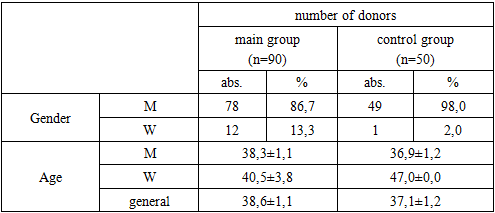
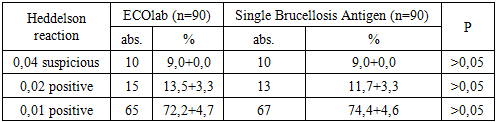
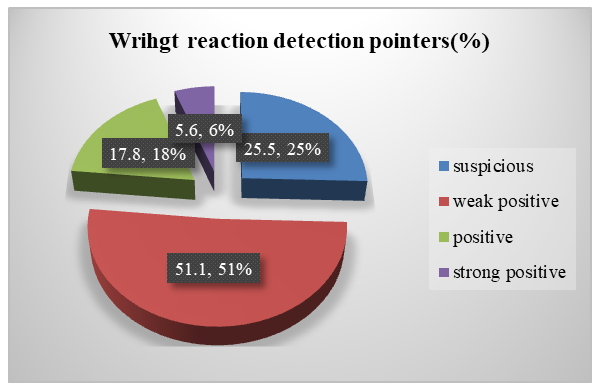
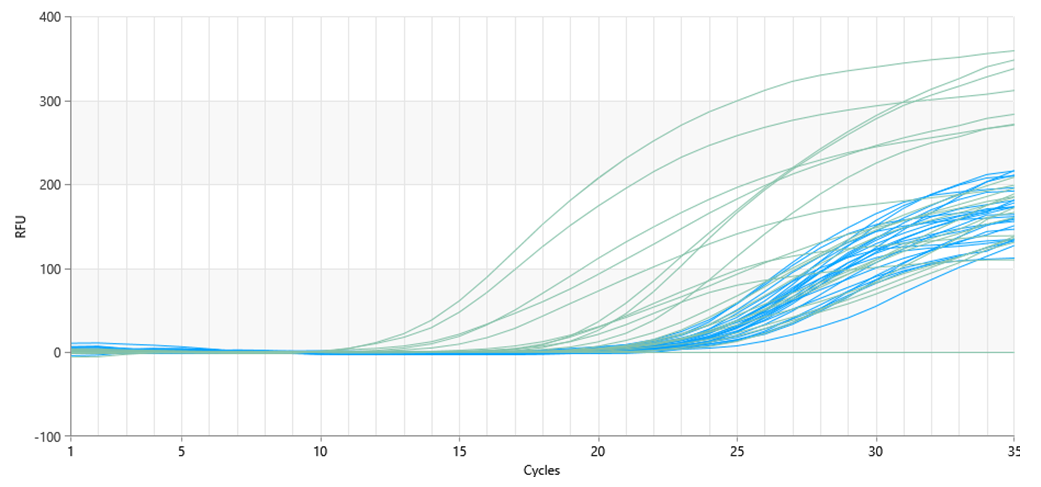
- For this study, out of 128,158 donors who donated voluntary blood to the Republican blood transfusion center of the Ministry of health of the Republic of Uzbekistan in 2021-2024, 90 donors of blood serum were isolated, which at the first stage gave a positive result to the Heddelson agglutination reaction. The blood of 90 donors with isolated positive results is the Wright's agglutination reaction (Ecolab), Immunoferment method (Brucella-IgM-IFA-BEST and Brucella-IgG-IFA-BEST) and PCR ("Amplicense Brucella spp.- FL") with research was conducted using diagnostic systems. Based on the results of our study, the distribution of donors (n=90) with positive brucellosis infection by age and gender was 18–60 years. Of these, the male donors 78 (86,7%), (38,3+1,1) and woman donors 12 (13,3%), (40,5+3,8) were organized. (1-table)
|
|
 | Figure 1 |
 | Figure 2 |
|

 | Figure 3 |
3. Results and Discussions
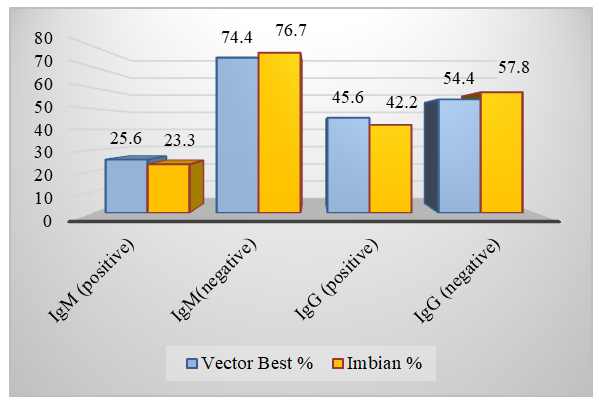
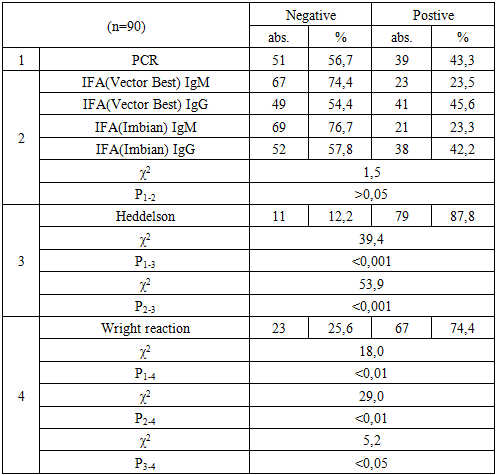
- In our study, testing of brucellosis infection in the blood of donors by the IFA method showed almost the same results when tested using the Vector best and Imbian reagents. [5]Results of PCR testing of brucellosis infection in donor blood (abs/%) (4-Table).
|

|
4. Conclusions
- The use of IFA and PCR methods in the diagnosis and monitoring of Brussels infections in the blood of donors plays a key role in ensuring transfusion safety. Regular screening of blood donors using these methods reduces the risk of infection and helps protect the health of blood recipients.Thus, the use of IFA and PCR methods in the diagnosis and monitoring of brucellosis infection in donor blood is a necessary element of modern tranfusiology, ensuring a high level of safety and effectiveness of transfusion processes.