Matkurbanov Khamdambek Ilhambekovich1, Mukhtorov Davronbek Zuhurovich2, Umirov Safar Ergashovich3
1Assistant of the Department of Infectious Diseases, Epidemiology and Phthisiology Urgench Branch of the Tashkent Medical Academy, Urgench, Uzbekistan
2Associate Professor, Republican Specialized Scientific and Practical Medical Center of Phthisiology and Pulmonology, Tashkent, Uzbekistan
3Associate Professor, Center for the Professional Development of Medical Personnel, Tashkent, Uzbekistan
Correspondence to: Matkurbanov Khamdambek Ilhambekovich, Assistant of the Department of Infectious Diseases, Epidemiology and Phthisiology Urgench Branch of the Tashkent Medical Academy, Urgench, Uzbekistan.
| Email: |  |
Copyright © 2025 The Author(s). Published by Scientific & Academic Publishing.
This work is licensed under the Creative Commons Attribution International License (CC BY).
http://creativecommons.org/licenses/by/4.0/

Abstract
Tuberculosis is one of the urgent public health problems due to its medical and socio-economic importance and the scale of the epidemic process. Tuberculosis (TB) continues to pose a major public health threat worldwide, with significant geographical variations in disease incidence across different territorial units. This study investigates the spatial distribution patterns of tuberculosis and examines the multifaceted relationships between territorial characteristics and TB occurrence rates. The research analyzes epidemiological data from various geographical regions, incorporating demographic, environmental, and socioeconomic variables to understand territorial disparities in tuberculosis incidence. The analysis reveals substantial territorial heterogeneity in TB distribution, with pronounced clustering in specific geographical areas. Urban territories, particularly overcrowded settlements and informal housing areas, demonstrate significantly higher incidence rates compared to rural regions. Key territorial determinants include population density, housing conditions, air quality, humidity levels, and accessibility to healthcare facilities. Migration patterns between territories emerge as critical factors influencing disease transmission dynamics, with mobile populations serving as vectors for cross-territorial TB spread.
Keywords:
Tuberculosis, Morbidity, Damage, Death dynamics, Territorial distribution, Rapidity
Cite this paper: Matkurbanov Khamdambek Ilhambekovich, Mukhtorov Davronbek Zuhurovich, Umirov Safar Ergashovich, Some Aspects of the Territorial Incidence of Tuberculosis, American Journal of Medicine and Medical Sciences, Vol. 15 No. 8, 2025, pp. 2616-2620. doi: 10.5923/j.ajmms.20251508.42.
1. Introduction
Due to its medical and socio-economic importance and the scale of the epidemic process, tuberculosis (TB) still maintains its position as one of the most urgent public health problems in most countries [2,4]. As a result of the socio-economic reforms that are consistently implemented in Uzbekistan, significant positive changes are observed in the health care system, in particular, in the provision of phthisiatric medical care to the population [2]. At the same time, it should be noted that, as a multifactorial phenomenon, the incidence of tuberculosis and its spread among the population depend on biological, demographic, socio-economic, and environmental determinants [3]. In particular, in recent years, the aggravation of the environmental problem in the Aral region has been shown to be one of the serious threats that have a negative impact on the health of the population [1]. Accordingly, it is recommended to study cases of tuberculosis on a regional scale and implement a complex of treatment and preventive measures based on the results obtained.Purpose of the researchThe purpose of the study is to analyze and evaluate the dynamic distribution of new cases of tuberculosis and the extent of its spread.
2. Materials and Methods
On the basis of the official statistical data of the Khorezm regional branch of the Republican specialized scientific and practical medical center of phthisiology and pulmonology, the dynamics of tuberculosis incidence during 2005-2022 were analyzed. Based on the data from 2010-2021, the distribution and intensity of TB infection in the administrative regions of the region were studied. Also, in order to assess the impact of the ecological situation in the Aral Bay region, the indicators of TB incidence in the Khorezm region and Kashkadarya region, which are far from the direct influence of the natural ecological degradation center, during 2013-2021, were analyzed. Epidemiological and statistical methods were used in the study. Statistical analysis of materials was carried out using the Microsoft Office 2013 suite of applications. p<0.05 was accepted as the criterion of statistical significance of the difference between indicators.
3. Results and Discussion
In the Khorezm region, the dynamics of new cases of tuberculosis (incidence), morbidity, and TB-related deaths during the last 18 years (2005-2022) were analyzed (Fig. 1). 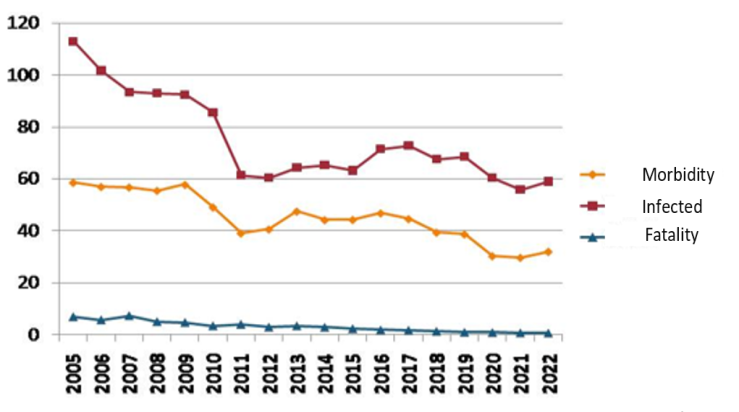 | Figure 1. Dynamics of tuberculosis incidence, incidence, and mortality rates in Khorezm region per 100,000 inhabitants, 2005-2022 |
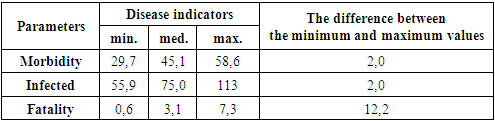
The results of the analysis of the long-term dynamics of primary tuberculosis infection show that the incidence rate in Khorezm region during 2005–2022 fluctuated from 29.7 (2021) to 58.6 (2005) per 100,000 populations, and the average rate was 45.1. In 2022, the rate of tuberculosis in the region decreased by 1.8 times compared to 2005, that is, by 45.4%; the average annual rate of decrease is 2.5%. The median morbidity rate is 44.5 (30.3-57.8). The prevalence rate of the disease was 54.6 in 2022, compared to 100.0 in 2005. Tuberculosis was recorded in 0.045% of the total population of the region during 2005–2022, including 0.06% in 2005 and 0.03% in 2022. Median: 0.04 (0.03-0.06). Compared to the general average rate of morbidity, the indicators of 2005–2010, 2013, and 2016 were 1.03–1.3 times higher; on the contrary, they were 1.01–1.5 times lower during 2011–2012, 2014–2015, and 2017–2022.The rate of tuberculosis infection in the Khorezm region during 2005–2022 fluctuated from 49.5 (2021) to 113.0 (2005) per 100,000 inhabitants, and the average rate is 75.0. In 2022, the rate of tuberculosis infection in the region decreased by 1.9 times compared to 2005, that is, by 47.8%; the average annual rate of decrease is 2.7%. The median of the damage index is 68.1 (59.0-101.8). The prevalence of injury was 52.2 in 2022 compared to 100.0 in 2005. Tuberculosis infection was recorded in 0.07% of the total population of the region during 2005–2022, including 0.1% in 2005 and 0.06% in 2022. Median: 0.07 (0.06-0.1). It was found that the indicators during 2005–2010 were 1.1–1.9 times higher than the general average damage indicator, and on the contrary, they were 1.0–1.3 times lower during 2011–2022.In the Khorezm region, the death rate related to tuberculosis during 2005–2022 fluctuated from 0.6 (2022) to 7.3 (2007) per 100,000 inhabitants, and the average rate is 3.1. The death rate related to tuberculosis in the region has decreased by 11.5 times in 2022 compared to 2005, i.e., by 91.3%; the average annual rate of decrease is 5.1%. The median mortality rate is 2.85 (0.7–6.9). The probability of death was 8.7 in 2022, compared to 100.0 in 2005. Tuberculosis-related deaths were recorded on average in 0.003% of the total population of the region during 2005–2022, including 0.007% in 2005 and 0.0006% in 2022. Median: 0.003 (0.0007–0.007). It was found that the indicators during 2005–2011 and 2013 were 1.1–2.4 times higher than the general average death rate, while they were 1.1–5.2 times lower during 2012 and 2014–2022.The analysis of the main epidemiological parameters carried out shows that compared to 2005, the incidence of tuberculosis in 2022 has decreased by 1.8 times, the incidence rate by 1.9 times, and the death rate by 11.5 times (r<0.001). The difference between the scale of fluctuations in dynamics, that is, between the minimum and maximum indicators of the intensity of these epidemiological parameters, is 2.0, respectively; it is 2.0 and 12.2 times (Table 1).Table 1. The scale of fluctuations in the dynamics of tuberculosis epidemiological parameters in the Khorezm region per 100,000 inhabitants, 2005–2022
 |
| |
|
In our opinion, the fact that the death rate related to tuberculosis has decreased more statistically than other indicators during the analyzed period should be evaluated as a direct positive result of the efficiency of medical services provided to patients in recent years. That is, the conditions determining the incidence of TB and its spread among the population decreased by two times during 2005–2022, and the effectiveness of treatment for the disease and medical and social assistance provided to patients changed more than 10 times in a positive direction.Based on this point of view, first of all, it is necessary to evaluate the regional and interregional distribution of tuberculosis. For this purpose, the dynamics of morbidity during 2010–2022 were analyzed by the administrative regions of the Khorezm region (Fig. 2).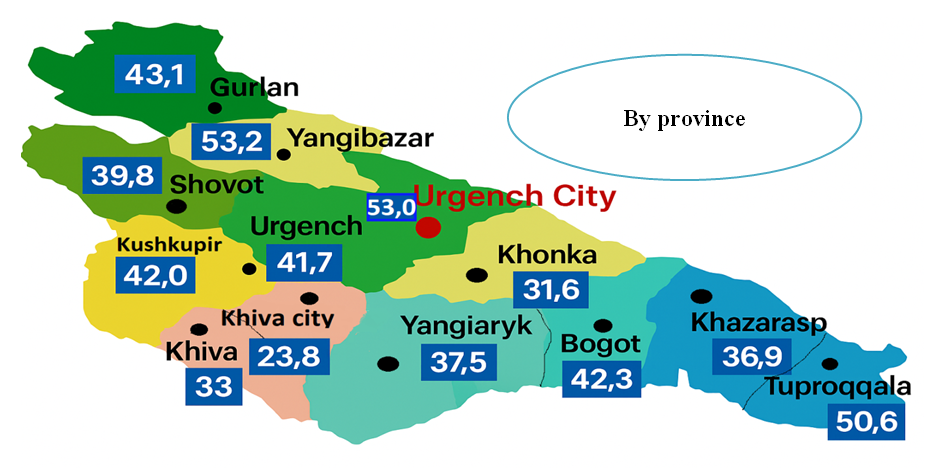 | Figure 2. The average rate of tuberculosis infection in the administrative regions of Khorezm region during 2010-2022, per 100,000 inhabitants |
Tuberculosis incidence in 2022 will be 40.5 per 10,000 people. 7 administrative support for secondary morbidity of the region: Tuprokkala (50.6), Bogot (42.3), Gurlan (43.1), Koshkopir (42.0), Urganch (41.7), Yangibozor (53.2), districts, and the city of Urganch (53.0); on the contrary, 6 administrative support: Hazorasp (36.9), Khanka (31.6), Khiva (34.0), Shavot (39.8), and Yangariq (37.5) in the districts and in the city of Khiva (23.8) to low auxiliary boats.Among the administrative regions of the region, during the analyzed years, the highest average rate of tuberculosis was recorded in Yangibozor district (53.2), which is 1.3 times higher than the regional average (40.5). On the contrary, the lowest average indicator of the same period—1.7 times lower than the regional indicator—was observed in the city of Khiva (23.8) (r<0.05). Differences in the level of TB incidence among administrative regions of the province can be explained by the socio-economic and demographic characteristics of each region and differences in the quality of medical care provided to the population.In order to make a comparative assessment of the impact of the ecological situation on the incidence of TB in the Aral Bay region, the indicators of the Khorezm and Kashkadarya regions during 2013–2021 were analyzed. In the Khorezm region, the rate of morbidity during 2013–2021 fluctuated from 29.7 (2021) to 47.5 (2013) per 100,000 populations, and the average rate was 40.7 (Fig. 3).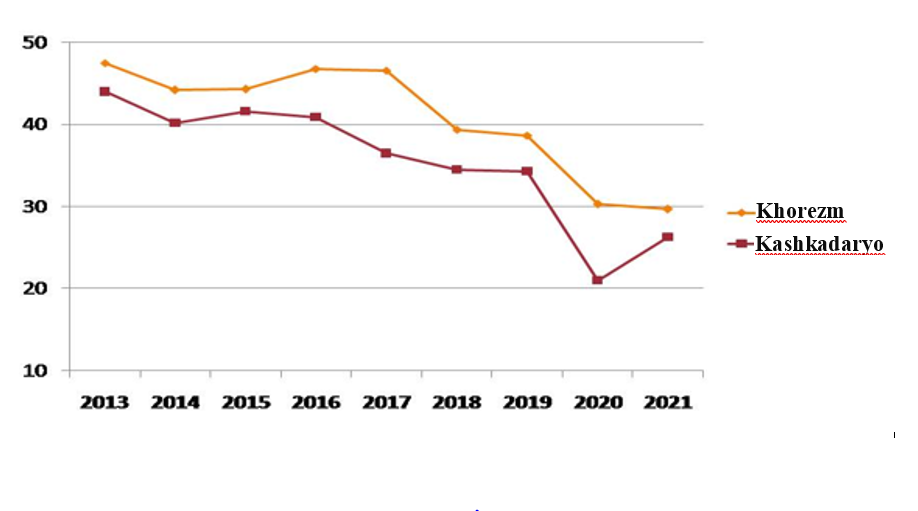 | Figure 3. Dynamics of tuberculosis incidence in Khorezm and Kashkadarya regions, per 100,000 inhabitants, 2013-2021 |
In Khorezm, the incidence rate of tuberculosis in 2021 decreased by 1.6 times, that is, by 37.5%, compared to 2013. The average annual rate of decline is 4.2%. The median morbidity rate is 44.2 (30.3–46.8). During this period, the rate of primary tuberculosis infection in the Kashkadarya region fluctuated from 21.0 (2020) to 44.0 (2013) per 100,000 inhabitants, and the average rate was 35.5. The incidence rate in 2021 decreased by 1.7 times compared to 2013, i.e., by 40.2%; the average annual rate of decrease is 4.5%. The median morbidity rate is 36.5 (26.3–41.6%). It can be seen that in 2013–2021, the average rate of TB incidence in the Khorezm region, which is located directly in the Aral Bay region, is 1.1 times higher (p > 0.05), and the rate of decline in incidence is 1.1 times lower than in the Kashkadarya region, which is far from this region. (p>0.05). At the same time, it should be noted that the difference between the indicators of TB incidence among regions is not statistically significant. This situation is determined by the fact that the probability of contracting TB and the speed of the epidemic process are multifactorial phenomena; that is, if the influence of ecological risk factors related to the construction of the island is the priority in the territory of the Khorezm region, some risk factors specific to this region also show their influence in the territory of the Kashkadarya region.
4. Conclusions
The average rate of tuberculosis incidence in the Khorezm region during 2005–2022 was 45.1 per 100,000 populations, and in 2022 it decreased by 45.4% compared to 2005; the average annual rate of decrease is 2.5%. The average TB incidence rate was 75.0, a 47.8% decrease in 2022 compared to 2005, with an average annual rate of decline of 2.7%. The TB-related death rate averaged 3.1 in 2022, a 91.3% decrease from 2005, with an average annual rate of decline of 5.1%. Thus, compared to 2005, in the Khorezm region, the incidence of tuberculosis in 2022 decreased by 1.8 times, the rate of infection by 1.9 times, and the death rate by 11.5 times (r<0.001). Recognizing the tendency of tuberculosis incidence in the Khorezm region to decrease over many years, it should be noted that this process is slow. This situation shows that, first of all, it is necessary to analyze the conditions and risk factors underlying the causes that determine the rate of tuberculosis incidence, to evaluate the cause-effect relationship between the level of morbidity and risk factors, and, according to the results, to correct the entire set of measures aimed at the problem. The fact that the death rate related to TB, compared to other indicators, is clearly statistically significantly reduced, in our opinion, should be evaluated as a direct positive product of the efficiency of medical services provided to patients in recent years.Among the administrative regions of the region, the highest average rate of tuberculosis incidence in 2010–2022 was recorded in Yangibozor district (53.2), and this indicator is 1.3 times higher than the regional average (40.5) for these years. On the contrary, the lowest average indicator of the same period—1.7 times lower than the regional indicator—was observed in the city of Khiva (23.8) (r<0.05). In 2013–2021, the average rate of TB incidence in the Khorezm region, located in the Aral Bay region, was 1.1 times higher than in the Kashkadarya region, and the rate of decline was 1.1 times lower (p > 0.05). It is recommended to use the information obtained as a result of the research in the development of TB treatment and prevention programs.
References
| [1] | Asilbekova Kh.S.: National Report on the State of the Environment: Uzbekistan // Tashkent, December 2023, pp. 155. |
| [2] | Parpieva N.N., Abulkasimov S.P., Mukhtarov Sh.N.: Adverse side effects when using bedaquiline in the treatment regimen of patients with MDR TB. "Young Scientist." No. 10.1 (196.1) March 2, 2018. pp. 31-33. |
| [3] | Savilov Yu.D.: Manifestations of Infectious Pathology in Conditions of Environmental Pollution // Bulletin of the East Siberian Scientific Center of the Siberian Branch of the Russian Academy of Medical Sciences. - 2007. - No. 2 (54). -pp. 82-89. |
| [4] | Fazilova Sh. M., Khusainov A. Sh., Karimov F. M. Breast cancer and the causes of its occurrence // Current scientific research in the modern world. - 2017. - No. 4-6. - pp. 134-136. |
| [5] | Shukurlaev K. Sh., Kurbaniyazova R. K., Fazilova Sh. M. Side effects of non-steroidal anti-inflammatory drugs. Sources of Knowledge // Sources of Knowledge. - 2015. - No. 7. - P. 12. |
| [6] | Zulayho E., Mirkhamidovna F.S. Clinical and laboratory aspects in multiple myeloma (literature review) // Journal of Interdisciplinary Innovations and Scientific Research in Uzbekistan. - 2023. - Vol. 2. - No. 20. - pp. 203-206. |
| [7] | Ilkhamovna K.G., Mirkhamidovna F.S.: Features of the liver state in acute leukemia (literature review) // Pedagog. - 2023. - Vol. 6. - No. 6. - pp. 285-290. |
| [8] | Mirkhamidovna F.S., Soburovna M.D.: The range of functional mutations and their contribution to the formation of blast cells and the development of leukemia (literature review) // Finland international scientific journal of education, social science & humanities. - 2023. - Vol. 11. - No. 6. - pp. 450-458. |
| [9] | Mirkhamidovna F.S., Soburovna M.D., Bakhadirovna A.S.: In the Dynamics of the Development of Hemolytic Deficiency Induced with Phenylhydrazine of the new product "Reomannisol." - 2022. |


 Abstract
 Reference
 Full-Text PDF
 Full-text HTML