
-
Paper Information
- Next Paper
- Previous Paper
- Paper Submission
-
Journal Information
- About This Journal
- Editorial Board
- Current Issue
- Archive
- Author Guidelines
- Contact Us
American Journal of Medicine and Medical Sciences
p-ISSN: 2165-901X e-ISSN: 2165-9036
2025; 15(8): 2493-2495
doi:10.5923/j.ajmms.20251508.14
Received: Jul. 2, 2025; Accepted: Jul. 26, 2025; Published: Aug. 4, 2025

Analysis of Differential Characteristics of Clinical-Functional Changes in Early and Prodromal Stages of Parkinson's Disease
 Abstract
 Reference
 Full-Text PDF
 Full-text HTML
Khaydarova Dildora Kodirovna1, Safarov Komiljon Kamolovich2
1Doctor of Medical Sciences, Professor Department of Neurology, Tashkent State Medical University, Uzbekistan
2Independent Researcher, Department of Neurology, Bukhara State Medical Institute, Uzbekistan
Copyright © 2025 The Author(s). Published by Scientific & Academic Publishing.
This work is licensed under the Creative Commons Attribution International License (CC BY).
http://creativecommons.org/licenses/by/4.0/

While instrumental methods for preclinical diagnosis of Parkinson's disease (positron emission tomography (PET), single-photon emission computed tomography, and functional magnetic resonance imaging (MRI) spectroscopy) help identify and visualize functional deficiency of specific neurons in the substantia nigra of the brain, their high cost and need for specialized equipment limit the possibility of early detection of risk groups among the healthy population, even in developed countries. Therefore, identifying specific, highly sensitive, economically effective, and easily applicable biomarkers for Parkinson's disease is a crucial task for early diagnosis and treatment of this condition.
Keywords: Positron emission tomography, Functional magnetic resonance imaging, Parkinson's disease
Cite this paper: Khaydarova Dildora Kodirovna, Safarov Komiljon Kamolovich, Analysis of Differential Characteristics of Clinical-Functional Changes in Early and Prodromal Stages of Parkinson's Disease, American Journal of Medicine and Medical Sciences, Vol. 15 No. 8, 2025, pp. 2493-2495. doi: 10.5923/j.ajmms.20251508.14.
1. Introduction
- Parkinson's disease (PD) is a progressive degenerative disease of the central nervous system and is considered the second most common neurodegenerative disease among the population over 65 years of age worldwide. According to the World Health Organization, more than 8.5 million people worldwide suffer from this disease [1,5]. In the Republic of Uzbekistan, the incidence rates of Parkinson's disease are increasing year by year due to the acceleration of the population aging process. As of 2023, 150-180 cases per 100,000 population were recorded in our republic, which is 2.3 times higher than 10 years ago [2,6]. Early diagnosis of Parkinson's disease is one of the most complex problems in modern neurology. Traditionally, the disease is diagnosed when motor symptoms appear, but by this time, 50-70% of dopamine neurons have already been destroyed. This significantly limits the effectiveness of early intervention and treatment [3,7]. The prodromal stage is a period that occurs 5-20 years before the appearance of motor symptoms, during which various non-motor symptoms manifest. Early detection and proper analysis of these symptoms are of great importance in developing strategies for early diagnosis and treatment of the disease [4,8].
2. Methodology
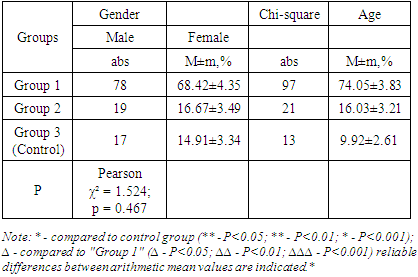
- This scientific work was conducted by the Department of Neurology of Bukhara State Medical Institute at the Bukhara District Medical Association. A total of 216 patients were studied to achieve the goals and objectives of the research. All patients were divided into 2 groups. A total of 246 individuals were involved in the study, divided into the following groups:• Group I – 176 patients in the clinical stage of Parkinson's disease;• Group II – 40 individuals with prodromal symptoms belonging to the high-risk group (clinically PD not formally diagnosed, but having characteristic features);• Group III – 30 age- and sex-matched, functionally healthy control subjects.Inclusion Criteria:• Patient consent to participate in the study• Presence of parkinsonism syndrome• Availability of MRI resultsExclusion Criteria:• Acute course of comorbid diseases• Taking neuroleptics• Presence of kidney or heart failure in decompensation stageDemographic CharacteristicsGroup 1 included 175 patients, of which 78 (68.42±4.35%) were men and 97 (74.05±3.83%) were women. Although the number of women was relatively higher in the gender distribution, this difference was not statistically significant according to chi-square analysis (χ²=2.063; p=0.151).Group 2 included 19 men (16.67±3.49%) and 21 women (16.03±3.21%), with proportional and non-significant gender composition differences (χ²=0.100; p=0.752).Group 3 (control group) included 17 men (14.91±3.34%) and 13 women (9.92±2.61%). This group also showed no statistically significant gender distribution differences (χ²=0.533; p=0.465).The Pearson χ² analysis result (χ²=1.524; p=0.467) for overall gender distribution confirms that gender balance was maintained among the study groups.Age analysis showed: Group 1 had an average age of 60.22±0.69 years, Group 2 had 58.78±1.17 years, and Group 3 had 59.67±1.28 years. Patient ages were nearly identical across all groups and statistically non-significant (Table 1).
|
3. Results
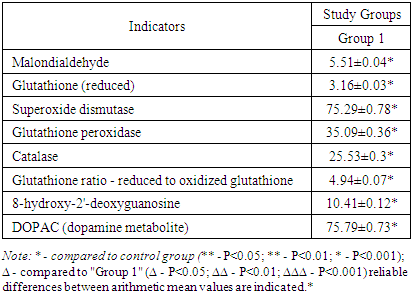
- At the center of neurodegenerative processes in Parkinson's disease is oxidative stress, namely the imbalance between free radicals and antioxidant defense mechanisms. Therefore, assessing redox balance has decisive scientific and clinical significance for deep understanding of the metabolic foundations of this pathological process, proper determination of therapeutic strategies, and evaluation of treatment effectiveness.The main biochemical indicators of redox balance in the study groups were analyzed before treatment (Table 2). This analysis allowed assessment of oxidative stress levels and the functional state of the antioxidant defense system.
|
4. Conclusions
- Thus, in the prodromal stage of Parkinson's disease, cognitive functions, smell sensation, REM sleep disorders, SCOPA-AUT indicators, and autonomic disorders identified through Ewing tests were statistically significantly detected (p < 0.05), which is significant for early diagnosis of the disease and important in determining screening methods. Oxidative stress indicators - malondialdehyde and 8-oxoguanosine levels were decreased, while glutathione and antioxidant enzyme (catalase, GPx) levels were increased (p < 0.001). This condition demonstrates the role of redox imbalance in the pathogenetic mechanism of the disease and shows its correlation with clinical symptoms.