
-
Paper Information
- Next Paper
- Previous Paper
- Paper Submission
-
Journal Information
- About This Journal
- Editorial Board
- Current Issue
- Archive
- Author Guidelines
- Contact Us
American Journal of Medicine and Medical Sciences
p-ISSN: 2165-901X e-ISSN: 2165-9036
2025; 15(8): 2486-2489
doi:10.5923/j.ajmms.20251508.12
Received: Jun. 22, 2025; Accepted: Jul. 16, 2025; Published: Aug. 4, 2025

Risk Factors for the Development of Chronic Kidney Disease in Adolescents
 Abstract
 Reference
 Full-Text PDF
 Full-text HTML
Olimova Gulkhayo Shamser qizi, Akhmedova Nilufar Sharipovna
Bukhara State Medical Institute, Bukhara, Uzbekistan
Copyright © 2025 The Author(s). Published by Scientific & Academic Publishing.
This work is licensed under the Creative Commons Attribution International License (CC BY).
http://creativecommons.org/licenses/by/4.0/

Among adolescents, chronic kidney disease (CKD) is one of the leading causes of mortality and disability. Our research highlights key factors significantly associated with the progression of CKD. These include untreated chronic inflammatory foci (caries, tonsillitis, otitis media), harmful habits (smoking in boys, excessive consumption of energy drinks in both sexes), obesity, a history of allergic diathesis and rickets, low birth indicators (prematurity, low birth weight), anemia, and blood pressure irregularities. Identification of these risk factors allows for the early detection of nephropathy in adolescents.
Keywords: Adolescence, Chronic kidney disease, Risk factors, Glomerular filtration rate (GFR)
Cite this paper: Olimova Gulkhayo Shamser qizi, Akhmedova Nilufar Sharipovna, Risk Factors for the Development of Chronic Kidney Disease in Adolescents, American Journal of Medicine and Medical Sciences, Vol. 15 No. 8, 2025, pp. 2486-2489. doi: 10.5923/j.ajmms.20251508.12.
1. Introduction
- Chronic kidney disease (CKD) is a progressively widespread condition affecting all segments of the population. While extensive data exist for adult and pediatric populations, information on its prevalence and impact among adolescents remains limited.Nephropathies in adolescence represent a critical challenge in nephrology. Early diagnosis and treatment are crucial in preventing progression to chronic renal failure, disability, or the need for renal replacement therapy at a young age. CKD in adolescents is increasingly recognized as a medical and social issue, often associated with early-onset nephropathies, congenital abnormalities, metabolic disorders, and environmental stressors [1,3].Adolescence (11–16 years) is characterized by physiological growth, hormonal changes, and heightened susceptibility to modifiable risk factors. Therefore, identifying contributing factors to nephropathy during this period is vital for prevention and early intervention.Globally, the prevalence of CKD in children and adolescents is estimated at 15–74 cases per million, though rising obesity and metabolic syndrome rates suggest an upward trend. Early-stage nephropathy is frequently asymptomatic, potentially leading to accelerated renal function decline in adulthood [4].Risk Factors. Genetic and Congenital Factors: Congenital anomalies of the kidney and urinary tract (CAKUT) are among the most common causes of nephropathy in children. Genetic mutations such as APOL1 (especially in individuals of African descent), NPHS1, and NPHS2 are associated with early glomerular injury and nephrotic syndromes.Metabolic and Cardiovascular Factors: Obesity, metabolic syndrome, and type 2 diabetes are on the rise among adolescents, often linked to hyperfiltration and proteinuria. Hypertension, even pre-hypertensive states, particularly in obese individuals, is a risk for early renal damage [2,7].Infections and Autoimmune Disorders: Post-streptococcal glomerulonephritis, lupus nephritis, and Henoch–Schönlein purpura are among the inflammatory causes of CKD. Recurrent urinary tract infections, especially in girls, can lead to reflux nephropathy and tissue damage.Lifestyle and Environmental Factors: High-salt diets, sugary drinks, and sedentary lifestyles contribute to obesity-related nephropathy. Tobacco, NSAIDs, heavy metals, and substance abuse are nephrotoxic and increase CKD risk.Socioeconomic and Psychosocial Factors: Limited access to healthcare, poor health literacy, and delayed diagnosis exacerbate CKD progression. Mental health disorders, poor nutrition, and substance dependency further increase risk [5,6].Objective of the Study.To assess the prevalence of CKD among adolescents and analyze the significance of associated risk factors contributing to nephropathy development.
2. Materials and Methods
- A total of 791 adolescents from urban and rural areas of Bukhara region were surveyed. An initial questionnaire identified potential CKD risk factors and clinical symptoms. Based on the results, 380 adolescents were selected for further investigation.Subsequent assessments included serum creatinine and cystatin C levels to calculate glomerular filtration rate (GFR), urinary microalbumin analysis, lipid spectrum, calcium and potassium levels, and complete blood count. GFR was calculated using the Schwartz formula.Statistical analysis was conducted using Microsoft Excel with Student's t-test and Pearson correlation. The study adhered to evidence-based medicine principles.
3. Results and Discussion
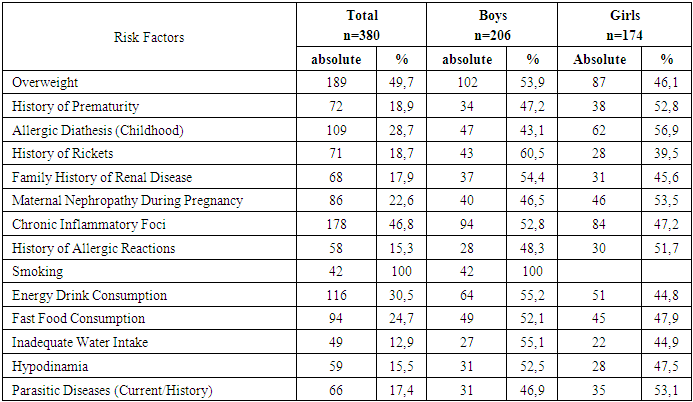
- Out of the 380 adolescents, 54.2% (n=206) were male and 45.8% (n=174) female. Risk factors for CKD were identified through questionnaires and analyzed by gender.Using a questionnaire, the level of occurrence of risk factors that cause CKD in all adolescents was studied and their occurrence frequency was analyzed in terms of gender (Table 1).
|
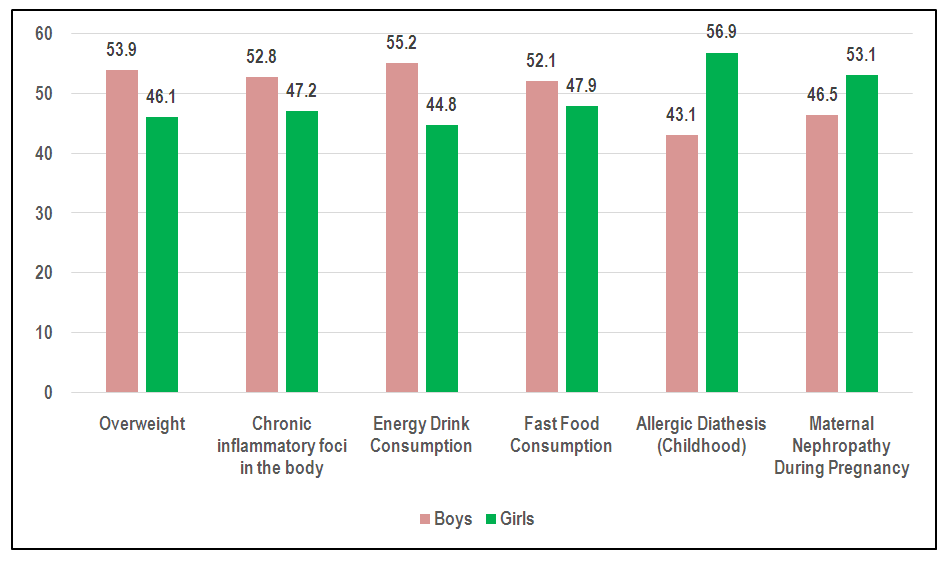 | Figure 1. Gender Distribution of Risk Factors Contributing to Nephropathy in Adolescents |
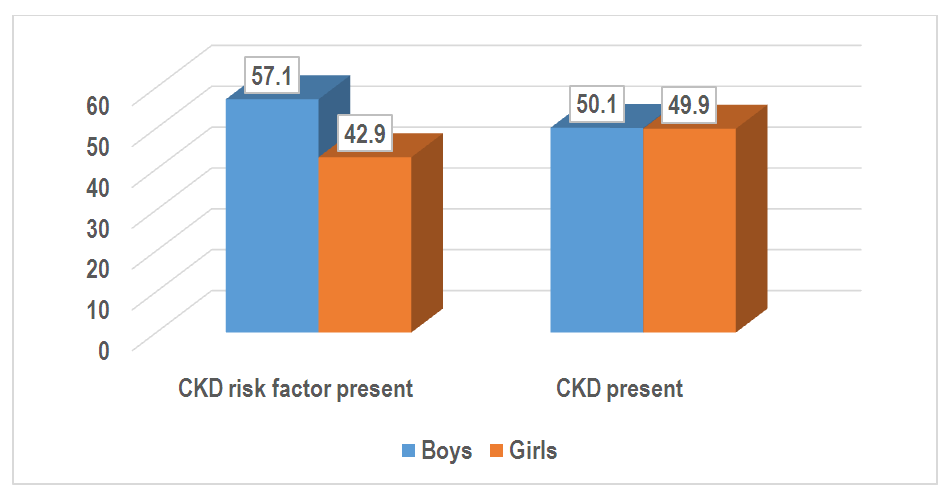 | Figure 2. Analysis of study groups by gender |
4. Conclusions
- Based on the analysis in the study, it can be concluded that the most significant risk factors for the development of SBC in adolescents include: undiagnosed and untreated chronic inflammatory foci (in our study: dental caries, tonsillitis, and otitis media), harmful habits (smoking among boys and the abuse of energy drinks in both genders), excess body weight, and a history of allergic diathesis. Nephropathy in adolescents is a multifactorial and complex clinical condition with various contributing risks. Comprehensive screening programs, lifestyle modification strategies, and targeted monitoring of at-risk groups are crucial in preventing CKD. Future research should focus on long-term cohort studies and early diagnostic markers based on biomarkers.