Mamasoliyev Z. N.1, Rustamjonov A. B.2
1Associate Professor, Department of Ophthalmology, Doctor of Science, Andijan State Medical Institute, Uzbekistan
2Assistant of the Department of Ophthalmology, Andijan State Medical Institute, Uzbekistan
Copyright © 2025 The Author(s). Published by Scientific & Academic Publishing.
This work is licensed under the Creative Commons Attribution International License (CC BY).
http://creativecommons.org/licenses/by/4.0/

Abstract
The authors substantiate the algorithms developed as a result of scientific research on the development and recommendation for practical activity of optimization algorithms based on predicting the treatment and prevention of acute glaucoma attacks in valley conditions, and their significance. The authors conclude that the introduction of the developed algorithms into practice and their use in measures for the timely diagnosis, control, and prevention of glaucoma: 1) the level of early detection and elimination of an acute glaucoma attack reaches more than 50%; 2) blindness and other ophthalmological complications caused by glaucoma attacks also decrease at least in every second patient (reaching 50%); 3) losses from the acute course of glaucoma (of socio-economic significance) are halved; 4) the risks from medications used in the context of glaucoma and its attacks are almost completely eliminated, reaching 100.0%.
Keywords:
Glaucoma, Acute attack, Treatment, Prevention, Algorithm
Cite this paper: Mamasoliyev Z. N., Rustamjonov A. B., Development and Recommendation for Practical Activity of Optimizational Algorithms Based on the Forecasting of the Treatment and Prevention of the Acute Attack of Glaucoma in Valley Conditions, American Journal of Medicine and Medical Sciences, Vol. 15 No. 8, 2025, pp. 2470-2474. doi: 10.5923/j.ajmms.20251508.09.
1. Introduction
In recent years, there has been an increase in clinical guidelines dedicated to the prevention of chronic diseases and their complications. These guidelines serve as a convenient "reference" encompassing modern data, defining scientific and practical directions, widely introducing preventive concepts within specialties, and improving clinical practice by at least 80% [6,1,2]. Such directions and recommendations in glaucomatology are very rare or have not been developed at all for certain regions and populations. In preventive glaucomatology, studying the issues of optimizing the prevalence, clinical course, and treatment and prevention of acute glaucoma attacks is considered one of the urgent scientific topics.For example, in the population with a comorbid background, in particular with glaucoma, the modification of lifestyle taking into account cardiovascular diseases (CVD) has a medical, economic, and social effect. Similar results were achieved and conclusions were drawn in non-communicable chronic diseases [3,4,5,11,7].In glaucoma and GCC with cardiocomorbidity, this practical and scientifically significant issue has not been fully resolved and has not been specifically studied in individual populations and regions.The main factors recommended by the international community for lifestyle modification against the background of cardiocomorbidity, for example [9,10] at least 150-300 minutes of average training load per week or 75-150 minutes. Intense aerobic exertion; maintaining maximum physical activity per week if it is not possible to perform this exercise; maximizing the reduction of sitting position duration throughout the week; conducting exercises with the addition of aerobic exertion; prescribing and using a Mediterranean diet; reducing excess body weight until arterial pressure normalizes; reducing alcohol consumption up to 100 g per week; giving up smoking [8].The development of these basic principles of preventive medicine in ophthalmology, particularly in the case of glaucoma and AGA, represents a pressing problem and scientific issue.Because, despite the constant development of fundamental and clinical glaucomatology, glaucoma continues to remain one of the main health problems and the main cause of irreversible blindness worldwide [12].
2. Material and Method
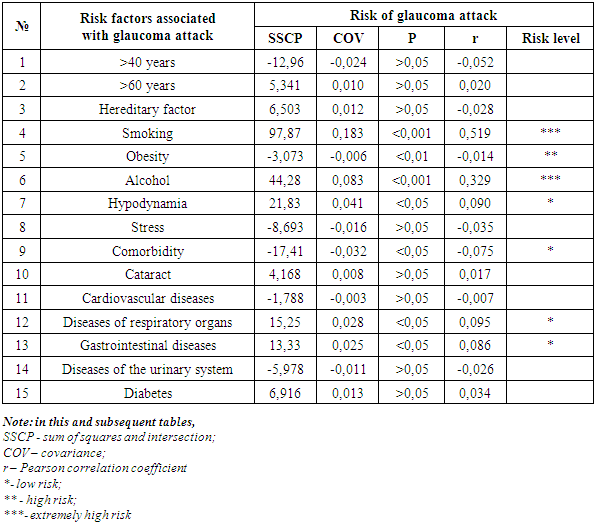
The relative risk of the occurrence of an acute glaucoma attack depending on risk factors in the valley population and the gender characteristics of the algorithm for its prediction were studied and evaluated. The development of algorithms for the prevention of primary and secondary glaucoma is an important theoretical and scientific activity, especially in various regions. The dissertation research on such a scientific topic was specifically devoted to the acute glaucoma attack and was not carried out in the regions of Uzbekistan, in particular, on the example of the valley. Such a study was conducted for the first time, and in this dissertation work, an algorithm for calculating the relative risk and prognosis of the occurrence of an acute glaucoma attack depending on risk factors in the valley population was developed. The gender characteristics of the forecasting of this algorithm, using the example of women of the valley, are presented in Table 1 and presented with a numerical interpretation.Table 1. Algorithm for assessing the relative risk of developing an acute glaucoma attack in relation to risk factors in the female population of Andijan
 |
| |
|
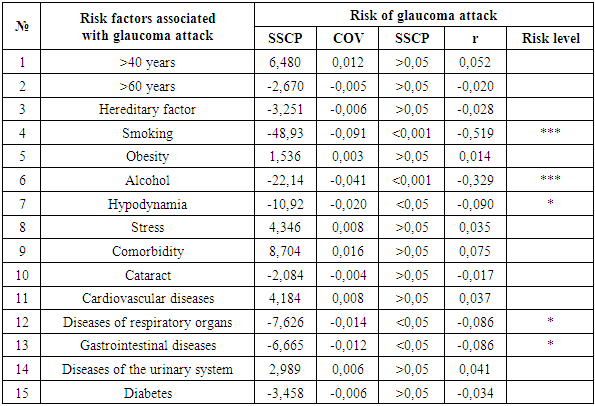
In the population of women of the valley, 15 risk factors directly related to the acute glaucoma attack - low, high, and extremely high risk of developing an acute glaucoma attack - were identified and confirmed. These are ≥ 40 age factor > 60 age factor, hereditary factor, smoking, obesity, alcohol consumption, hypodynamia, stress, comarbidity, cardiovascular diseases (CVD), respiratory diseases (RD), gastrointestinal diseases (GD), urinary system diseases (UIS), and diabetes mellitus (DM2). Under the influence of the age factor >40 and >60 years, the risk of AGA development increases insignificantly (P>0.05).In this case, in the female population, a factor (P>0.05), stress factor (P>0.05), cataract (P>0.05), CVD (P>0.05), DUS (P>0.05), and D2 (P>0.05) are confirmed as risk factor that significantly increase the risk of seizures.In women with glaucoma, smoking (r= 0.5/9; P<0.001) and alcohol consumption (r= 0.329; P<0.001) are factors associated with 8 high levels of AGA. A high risk for AGA is directly related to obesity as a risk factor (P>0.01). Lower risk levels for AGA are associated with hypodynamia (r= 0.090; P<0.05), comorbidity (P>0.05), DRO (r= 0.095; P<0.05), and GD (r= 0.086; P<0.05).Table 2 presents an algorithm for assessing/predicting the relative risk of developing AGA in relation to risk factors in the male population of Andijan.Table 2. Algorithm for assessing the relative risk of developing an acute glaucoma attack in relation to risk factors in the male population of Andijan
 |
| |
|
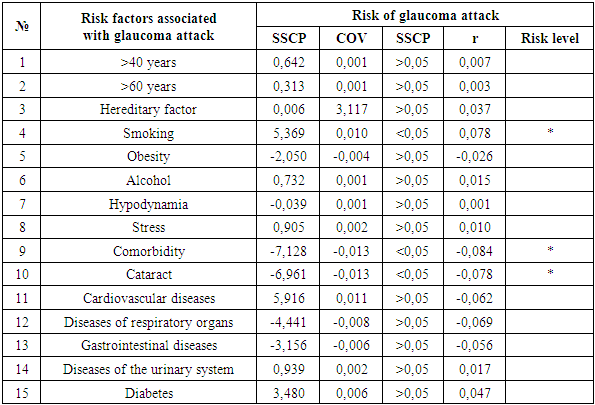
The 8th highest risk of an acute course of glaucoma in the male population is associated with smoking (P<0.001) and alcohol consumption (P<0.001). A low risk level is predicted in hypodynamia (P>0.05), DRO (P>0.05), and GD (P>0.05). Insignificant risk is predicted under the influence of 15 other risk factors: > 40 years and > 60 years, hereditary factors, obesity, stress, comarbidity, cataracts, CVD, DUS and D2."Implementing preventive measures as a barrier" against 2 to 8 strong and 3 strongly negative factors completely eliminates AGA (primary glaucoma prevention) or slows it down to an unknown degree (secondary glaucoma prevention).Table 3 shows that in relation to the following factors: > 40 years and > 60 years, hereditary factors, smoking, obesity, alcohol consumption, hypodynamia, stress, comorbidity, cataracts, CVD, DRO, GD, DUS and D2, the degree of AGA risk of varying severity arises in the rural population.Table 3. Algorithm for assessing the relative risk of developing an acute glaucoma attack in relation to risk factors in the rural population of Andijan
 |
| |
|
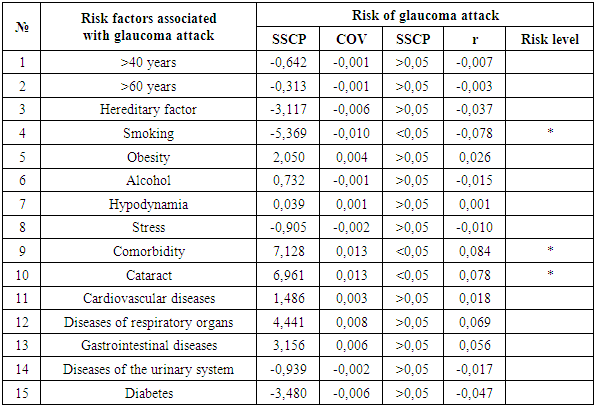
In particular, the rural population shows a low risk of developing and is predicted to have a lower incidence of acute glaucoma attacks associated with smoking (P>0.05), comorbidities, and cataracts.In hypodynamia, DRO and GD, there is also an insignificant risk of occurrence and/or prognosis of AGA.Depending on the remaining risk factors, in the rural population, a subtly expressed low risk of glaucoma arises, manifesting as an acute glaucoma attack. It is noteworthy that there is a large number of factors that increase the risk of AGA in the rural population.In the urban population of Andijan (Table 4), smoking (P<0.05; p= -0.078), comarbidity (P<0.05; p= -0.084), and cataract (P<0.05; p= -0.078) are confirmed as risk factors for a significant but low-degree glaucoma attack.Table 4. Algorithm for assessing the relative risk of developing an acute glaucoma attack in relation to risk factors in the urban population of Andijan
 |
| |
|
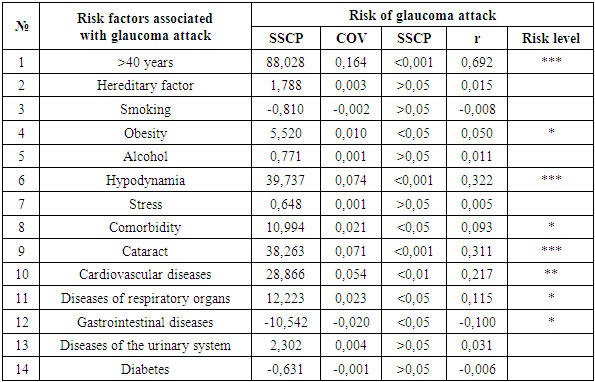
Among the remaining 12 risk factors, an insignificant degree of risk leads to the occurrence of an acute glaucoma attack.The following tables 5-6 show algorithms for assessing/predicting the relative risk of developing an acute glaucoma attack in relation to risk factors in the population aged <60 and ≥60 years.Table 5. Algorithm for assessing the relative risk of developing an acute glaucoma attack in relation to risk factors in the population of Andijan <60 years old
 |
| |
|
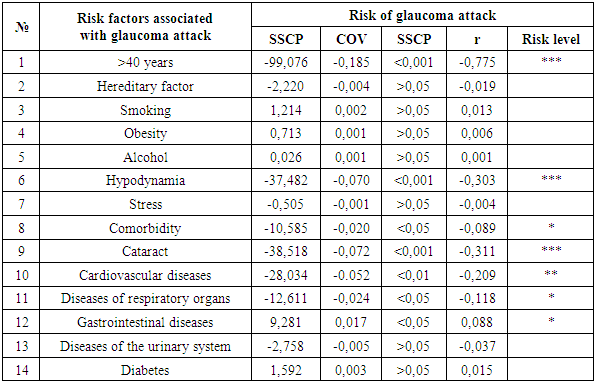
Table 6. Algorithm for assessing the relative risk of developing an acute glaucoma attack in relation to risk factors in the population of Andijan ≥60 years old
 |
| |
|
A very high risk of AGA occurrence is associated with or predicted by hypodynamia (P<0.001; p=0.322) and cataracts (P<0.001; p=0.311).A high level of AGA risk is confirmed/prognosed depending on CVD [P<0.01; p=0.217].Low level of risk. In the origin of AGA DRO (P<0.05; p=0.115), GD (P<0.05), comorbidity (P<0.05; p=0.093) and obesity (P<0.05; p=0.050) were associated.In other risk factors, such a risk is predicted insignificantly. In the development and recommendation for practical activities of optimization algorithms based on the prediction of the treatment and prevention of acute glaucoma attacks in the population aged ≥60 years, the leading or main important risk factor is hypodynamia (under the influence of this factor, an extremely high risk of AGA occurrence is confirmed; P<0.001), cataract (extremely high risk; P<0.01), CVD (poses a high risk; P<0.01), comorbidity (creates a low risk; P<0.05), DRO (creates a low risk level; P<0.05) and GD (creates a low risk level; P<0.05).
3. Conclusions
The implementation of the developed algorithms and their use in measures for the timely diagnosis, control and prevention of glaucoma: 1) the level of early detection and elimination of an acute glaucoma attack - reaches more than 50%; 2) blindness and other ophthalmological complications caused by glaucoma attacks also decrease at least in every second patient (reaching 50%); 3) losses from the acute course of glaucoma (of socio-economic significance) are reduced by half; 4) the risks from medications used in the context of glaucoma and its attacks are almost completely eliminated, reaching 100.0%.
References
| [1] | American Diabetes Association Professional Practice Committee. Diabetes Care. January 1, 2022; 45 (Suppl. 1). |
| [2] | Byrne R.A., Rossello X., Coughlan J>J> et al. ESC Scientific Document Group. 20232 ESC Guidelines for the management of acute coronary syndromes. Eur. Heart J. 2023 Aug 25: ehad 191. |
| [3] | Collet, J. P., and Thiele, H. Barbato E. et al. ESC Scientific Document Group. 2020 ESC Guidelines for the management of acute coronary syndromes in patients presenting without persistent ST-segment elevation. Eur. Heart J. 2021 Apr 7; 42 (14): 1289-1367. |
| [4] | Kleindorfer D.O., Z. Towfighi A., Chaturvedi S. et al. Guidline for the Prevention of Stroke in Patients with Stroke and Transient Ischemic Attack: A Guidline From the American Heart Association/American Stroke Association. Stroke. 2021 Jul; 52 (7): e364-e467. |
| [5] | Lyon A.R., Lopez-Fernandez T., Couch L.S. et al. ESC Scientific Document Group. 2022 ESC Guidelines on Cardio-Oncology developed in collaboration with the European Hematology Association (EHA)? The European Society for Therapeutic Radiology and Oncology (ESTRO) and the International Cardio - Oncology Society (IC-OS). EUR. Heart J. Cardiovasc. Image. 2022 Sep 10; 23 (10): e333-e465. |
| [6] | Mansouri K, Tanna AP, De Moraes CG, Camp AS, Weinreb RB. Review of the measurement and management of 24-hour intraocular forceps in patients with glaucoma. Surv Ophthalmol. 2020; 65 (2): 172-184. https://doi.org/10.1016/JSURVOPHTHAL.2019.09.004. |
| [7] | McDonagh T.H., Metra M., Adamo M. et al. ESC Scientific Document Group. 2023 Focused Update of the 2021 ESC Guidelines for the diagnosis and treatment of acute and chronic heart failure. EUR. Heart J. 2023 Oct 1.; 44 (37): 3627-3639. |
| [8] | Napalkov D.A., Sokolova A.A. Zhilenkov V. Prevention of cardiovascular diseases in tables and diagrams// Moscow 2024 B-18-24. |
| [9] | Pearson G.J., Thanassoulis G., Anderson T.J. et al. Canadian Cardiovascular Society Guidelines for the Management of Dyslipidemia for the Prevention of Cardiovascular Disease in Adults. Can J. Cardiol. 2021 Aug.; 37 (8) 1129 - 1150. doi:10.1016/j.cjca.2021.03.016. Epub 2021 Mar 26. PMID: 33781847. |
| [10] | Rabi M.D., Doreen M. et al. Hypertension Canada's 2020 Comprehensive Guidelines for the Prevention, Diagnosis, Risk Assessment, and Treatment of Hypertension in Adults and Children. Can. J. Cardiol 2020; 36 (5): 596-624. |
| [11] | Shukla, A.G., De Moraes, C.G., Chioffi, G.A., et al. The Relationship Between Intraocular Pressure and Rates of Central Versus Peripheral Visual Field Progression. J. Glaucoma. 2020; 29 (6): 437-439. https://doi.org/10.1097/IJG.0000000000001494. |
| [12] | World Health Organization. Blindness and visual impairments. Link active as of 07.04.22. https://www.who.int/ru/news-room/fact-sheets/detail/blindless-and-visual-impairment. |


 Abstract
 Reference
 Full-Text PDF
 Full-text HTML