
-
Paper Information
- Next Paper
- Previous Paper
- Paper Submission
-
Journal Information
- About This Journal
- Editorial Board
- Current Issue
- Archive
- Author Guidelines
- Contact Us
American Journal of Medicine and Medical Sciences
p-ISSN: 2165-901X e-ISSN: 2165-9036
2025; 15(8): 2460-2463
doi:10.5923/j.ajmms.20251508.07
Received: Jun. 16, 2025; Accepted: Jul. 20, 2025; Published: Aug. 2, 2025

Hygienic Assessment of the Dynamics of Suspended Particulate Concentrations in the Ambient Аir
 Abstract
 Reference
 Full-Text PDF
 Full-text HTML
Azimova Madinabonu Bakhrom kizi, Ataniyazova Raushan Aminovna
Research Institute of Sanitation, Hygiene and Occupational Diseases, Tashkent, Uzbekistan
Copyright © 2025 The Author(s). Published by Scientific & Academic Publishing.
This work is licensed under the Creative Commons Attribution International License (CC BY).
http://creativecommons.org/licenses/by/4.0/

Objective: The aim of this study is to conduct a hygienic assessment of the dynamics of dust concentrations in the ambient air of Bukhara city based on state monitoring data. Materials and Methods: The study utilized official data from the Hydrometeorological Service Center for the years 2017–2021. Annual and monthly average concentrations of dust were compared with the hygienic standard – the maximum allowable annual average concentration (MAC = 0.075 mg/m³), established by SanPiN RUz №0053-23. Statistical analysis was carried out using methods of variance analysis with visual presentation of the results. Results and Discussion: A consistent exceedance of sanitary norms for suspended particulate matter in the ambient air was identified throughout the entire study period. The highest average concentrations were recorded during the spring and summer months, reaching 0.28 mg/m³ (in May and August), which is 3.7 times higher than the MAC. The analysis revealed distinct seasonal fluctuations, which, in our opinion, are associated with climatic conditions and other dust-generating processes. Conclusions: The obtained data indicate a stable and background level of dust pollution in the ambient air of Bukhara city, which necessitates strengthened hygienic control and preventive measures, especially during periods of high environmental stress.
Keywords: Ambient air, Suspended particulate matter, Dust, Hygienic assessment
Cite this paper: Azimova Madinabonu Bakhrom kizi, Ataniyazova Raushan Aminovna, Hygienic Assessment of the Dynamics of Suspended Particulate Concentrations in the Ambient Аir, American Journal of Medicine and Medical Sciences, Vol. 15 No. 8, 2025, pp. 2460-2463. doi: 10.5923/j.ajmms.20251508.07.
1. Introduction
- Ambient аir pollution is one of the most significant risk factors for public health and a major global environmental problem of the modern era. Numerous studies have shown that long-term exposure to polluted air contributes to an increased incidence of respiratory diseases, allergic reactions, immune system disorders, and oncological pathologies [4,6].In recent years, particular attention has been paid to assessing the levels of suspended particulates and their impact on the health of vulnerable populations, including children. Studies have demonstrated that dust particles containing toxic and allergenic components exert immunomodulatory and damaging effects on the respiratory tract [6], and contribute to the development of acute allergic conditions in children [5].The issue of air pollution and its link to childhood morbidity has been explored in a number of regional and international studies. For example, it was found that high concentrations of air pollutants correlate with increased rates of childhood illnesses [7]. Similar findings are reported in foreign studies examining the effects of dust pollutants and polycyclic aromatic hydrocarbons (PAHs) on children’s health in urban settings and areas of electronic waste processing [8,9,10]. Occupational exposure to pollutants, particularly in industrial environments, is also of great importance. Research on biomarkers of dust-induced lung diseases allows for an objective assessment of the risks associated with inhalation exposure to pollutants [3].In the national context, the analysis of pollutant emissions into the atmosphere, their sources, and trends over the years provides a scientific basis for the development of sanitary and epidemiological measures [1,2].Moreover, a crucial area of hygienic research is the comprehensive assessment of environmental burden on the population and the analysis of the temporal characteristics of pollutants, such as polycyclic aromatic hydrocarbons in street dust [9], or trace elements in areas with intensive electronic waste processing [10].Thus, the existing evidence base highlights the necessity of regular atmospheric air monitoring and hygienic assessment of its quality. The present study is aimed at analyzing air pollution in the city of Bukhara based on government monitoring data to determine hygienic risks and identify priority pollutants.Objective of the Study: The aim of the study was to conduct a hygienic assessment of the dynamics of suspended particulate concentrations in the ambient air of Bukhara city over a five-year observation period, based on data from state monitoring. The focus was on identifying seasonal and annual fluctuations, assessing compliance with sanitary standards, and determining potential health risks to the population.
2. Materials and Methods
- This study utilized official data from the Center of Hydrometeorological Service for the period from 2017 to 2021. The hygienic assessment was carried out by comparing actual concentrations with the maximum allowable concentrations established in the Sanitary Rules and Norms of the Republic of Uzbekistan №0053-23 (SanPiN №0053-23). The analysis included the calculation of average, minimum, and maximum concentration values for each year of observation, as well as the determination of the extent to which the normative levels were exceeded. The temporal dynamics of pollution levels were evaluated, taking into account seasonal and annual variations.Statistical analysis of the data was performed using methods of variational statistics. The obtained results were visualized in the form of tables and graphs reflecting long-term trends in atmospheric air pollution levels in the studied region.
3. Results and Discussion
- In the context of anthropogenic environmental transformation, increasing urbanization, and changing climatic conditions, both average and extreme levels of suspended particulate matter in the air have been rising. This trend enhances the hygienic and medico-social significance of the problem.Figure 1 presents the dynamics of average, minimum, and maximum annual concentrations of suspended particulate matter in the ambient air of Bukhara city over the period from 2017 to 2021.
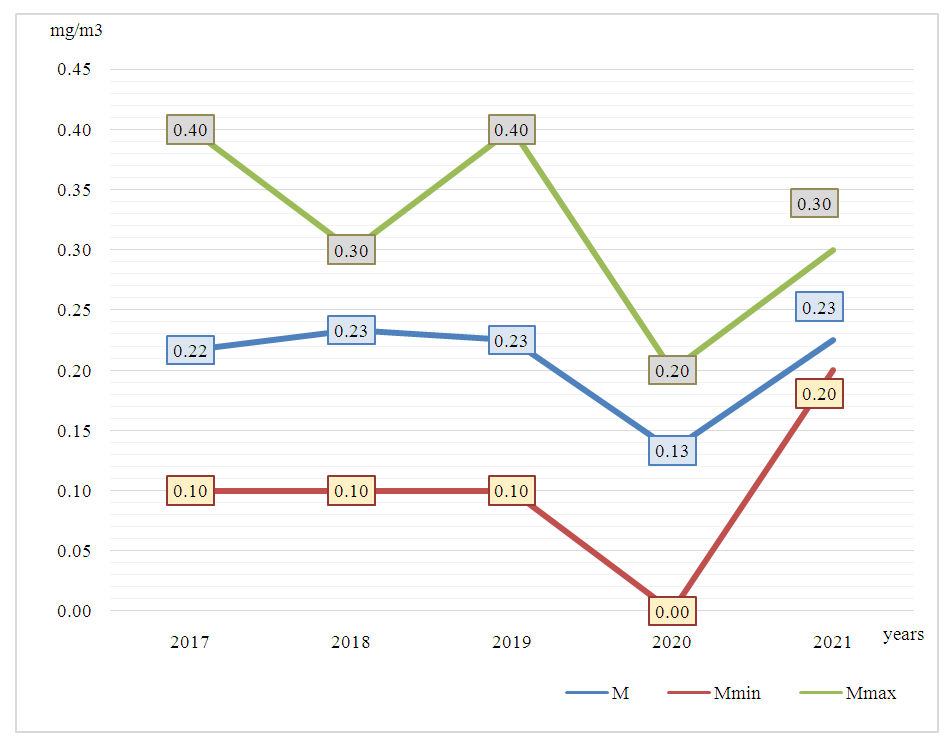 | Figure 1. Dynamics of average, minimum, and maximum annual concentrations of suspended particulate matter in ambient air of Bukhara city for the period 2017–2021, mg/m³ |
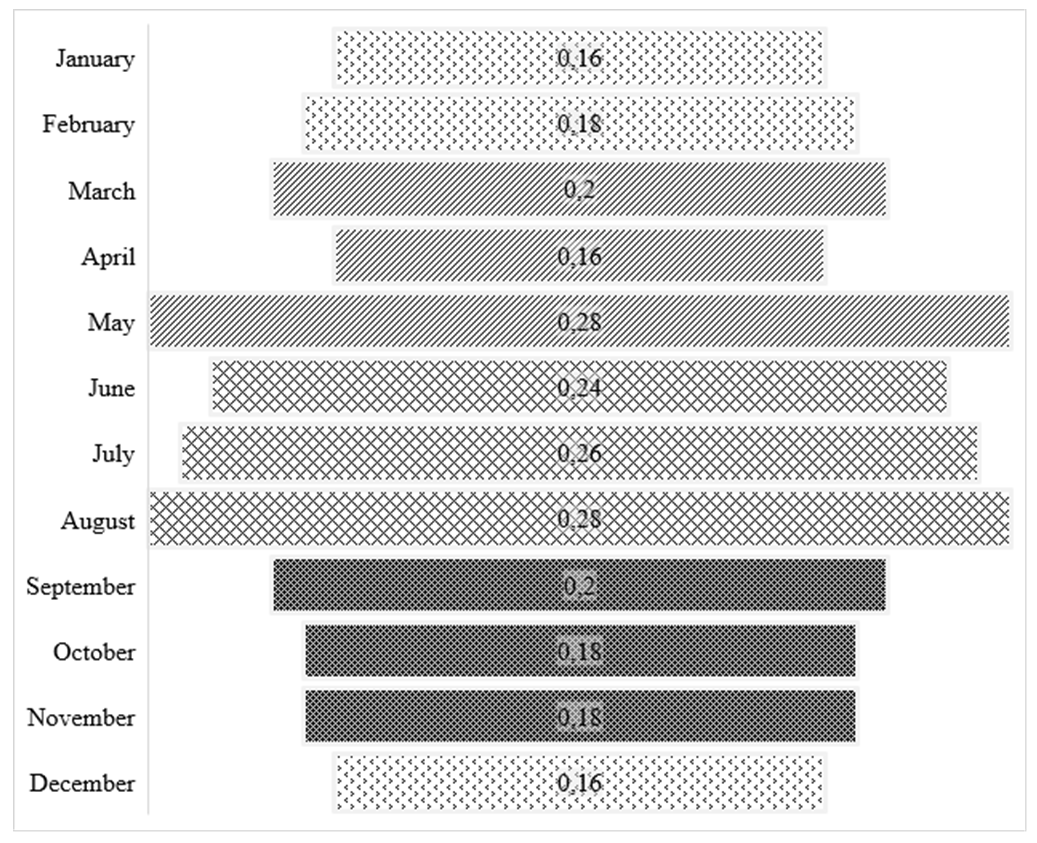 | Figure 2. Average annual values of monthly mean concentrations of suspended particulate matter in the atmospheric air of Bukhara city during the period 2017–2021, mg/m³ |
4. Conclusions
- The observed dynamics highlight the importance of continuous hygienic monitoring of ambient air quality and the need for preventive measures aimed at reducing the impact of dust pollution, particularly during periods of its highest increase.