American Journal of Medicine and Medical Sciences

p-ISSN: 2165-901X    e-ISSN: 2165-9036

2025;  15(7): 2156-2163

doi:10.5923/j.ajmms.20251507.15

Received: May 14, 2025; Accepted: Jun. 12, 2025; Published: Jul. 10, 2025

 

Stability Properties of Escherichia coli - to Form an External Quality Assessment Panel

Seyfullaeva Bagdagul Skenderbekovna1, Abdukhalilova Gulnara Kudratullaevna Abdukhalilova2

1Junior Researcher and the Basic Doctoral Student, Republican Specialized Scientific and Practical Medical Center for Epidemiology Microbiology of Infections and Parasitic Diseases Tashkent, Uzbekistan

2Doctor of Medical Sciences, Republican Specialised Scientific and Practical Medical Centre of Epidemiology, Microbiology of Infectious and Parasitic Diseases Tashkent, Uzbekistan and Tashkent Medical Academy

Correspondence to: Seyfullaeva Bagdagul Skenderbekovna, Junior Researcher and the Basic Doctoral Student, Republican Specialized Scientific and Practical Medical Center for Epidemiology Microbiology of Infections and Parasitic Diseases Tashkent, Uzbekistan.

Email:

Copyright © 2025 The Author(s). Published by Scientific & Academic Publishing.

This work is licensed under the Creative Commons Attribution International License (CC BY).
http://creativecommons.org/licenses/by/4.0/

Abstract

External quality assessment (EQA) is a commonly used tool to track the performance of laboratory tests. Medical laboratories play a central role in health care. Many laboratories are taking a more focused and stringent approach to quality system management. Clinical laboratory analysis techniques are of great help to clinical doctors in making medical decisions, so they must be reliable and accurate. Unfortunately, no laboratory tests or devices are reliable, and errors can occur in the pre-analysis, analytical and Post-analysis stages of the test. Evaluation of potential error-causing conditions is an important part of laboratory testing to detect and prevent errors in time before the patient is harmed.

Keywords: External quality assessment, Panel, Quality of laboratory testing, BD Phoenix, Antibiotic resistance

Cite this paper: Seyfullaeva Bagdagul Skenderbekovna, Abdukhalilova Gulnara Kudratullaevna Abdukhalilova, Stability Properties of Escherichia coli - to Form an External Quality Assessment Panel, American Journal of Medicine and Medical Sciences, Vol. 15 No. 7, 2025, pp. 2156-2163. doi: 10.5923/j.ajmms.20251507.15.

1. Introduction

In modern medicine, clinical laboratory data comprise a very large portion of patient care. More than half of a doctor’s decisions are thought to be influenced by laboratory data. [24] Nearly 94% of electronic medical record requests in one large medical center that monitors information flow were for laboratory testing. [23] Poor quality laboratory tests have significant financial, health, and social impacts, and quality improvement is very beneficial for the future. [22] It is estimated that 70-80% of clinical decisions are made based on information provided by laboratories. [9] Therefore, it is necessary to develop reliable quality assurance tools to assess laboratory performance, [21] a very important factor in the care of patients, their treatment and epidemiological control was considered, [8] especially during epidemics, medical laboratory diagnostics formed the main diagnostic of infectious diseases. [7]
Infectious diseases and related deaths continue to pose a serious threat to the health and lives of people around the world. [6] Urinary tract infection (UTI) is the most common worldwide and has now become a health problem. [20] UTI is one of the most common bacterial infections seen in primary care and thus one of the most common indications for which antibiotics are precribed. [19] UTI are widespread bacterial infections that affect 150 million people worldwide every year. [5] The etiological structure of UTI pathogens is dominated by uropathogenic Escherichia coli (UPEC), which causes up to 90% of out-of-hospital and up to 50% of hospital cases of UTI. [4] The most common among women compared to men is approximately 90% of all UTI in young women are caused by E. coli which is a gram-negative. [18] Data show that a single episode of cystitis during life activity in women with a prevalence of UTI develops at the age of 20%, 18-20 years, and its prevalence increases over time. To form an idea of the state of antibiotic resistance of uropatogens, it is usually E. coli. resistance data is analyzed. [3] Escherichia coli (E. coli) and Klebsiella pneumoniae (K. pneumoniae) are among the most important gram-negative pathogens in the hospital setting, accounting for around one fifth of all pathogens causing healthcare-associated infections in the USA. [17]
The use of antibacterial drugs (ABD) is considered as one of the effective ways to treat UTI. The effectiveness of such therapy depends on the sensitivity of the pathogen to the ABD used. [4] One of the most important stages of research in any laboratory, including bacteriological Laboratories, is due to the fact that a thorough and reliable work is carried out on timely analysis techniques, and it is important to organize and qualitatively conduct all the stages of laboratory research before analysis (Preanalytical), analytical and Post-analysis. [2] The quality of laboratory diagnostics depends on the reception and supply of pathological material carried out in microbiological laboratories –the preanalytic stage, as well as the analytical stage, which consists of cultural studies. [1]
External quality assessment (EQA) is a commonly used tool to track the performance of laboratory tests. [16] External quality assessment-from time to time by an external organization, the laboratory is carried out by checking the results. Any well-organized quality external assessment system is designed to compare the results of the analysis between laboratories in order to harmonize the results of the laboratory. [2] This is best performed using EQA, with the aim being the reduction of incorrect results to a minimum. [15] EQA is nowadays available to some degree in all developed healthcare systems and is a averages to improving the quality of laboratory performance. [14] Participation in EQA may be voluntary, although a prerequisite for accreditation, or may be mandatory, for licensing, [13] however, in our country there is no system for conducting EQA for bacteriological laboratories. In this regard, we will consider the most stable E.coli for creating a EQA panel, we aimed to identify coli strains.

2. Materials and Methods

The research work was carried out in accordance with the cooperation agreement between SDS and the of Republican Specialized Scientific and Practical Medical Center for Epidemiology, Microbiology of Infectious and Parasitic Diseases (RSSPMCEMIPD) within the framework of the project № 5 NU2HGH000089-04-00 “Expansion of the epidemiological control network to combat the problem of resistance to antimicrobial drugs in the Republic of Uzbekistan”. Pure cultures brought to the RSSPMCEMIPD Antimicrobial Resistance Center (ARC) were surged and planted in nutrient media produced by «HiMedia» and put on the 35°±1 thermostat. Morphological, tinctorial, cultural and biochemical characteristics of overgrown colonnades were studied. The interpretation of antimicrobial drug sensitivity levels and test results was conducted in two different ways: the disc-diffusion method was interpreted based on the European Committee's methodical guide to antimicrobial drug sensitivity (Europen Committee on Antimicrobial suspension Testing (EUCAST 2023-y)). Nutrient media Himedia (India) and antimicrobial discs produced by Liofilchem (Italy) were used.
A dispenser instrument was used when placing disks on the surface of the Muller Hinton feed medium. The advantage of this tool is that the antibiotics being administered fall at the same distance, and their sterility is fully ensured, absorbed from time. All strains were found to have levels of sensitivity to downstream antibiotics: Ampicillin AMP 10, Amoxicillin clavulanic acid AUG 10- 20, Ciprofloxacin CIP 5, Levofloxacin LEV 5, Amicacin AK 30, Gentamicin CN 10, Meropenem MRP10, Imipenem IMI 10, Ceftriaxone CRO 30, Ceftazidime CAZ 10, Cefepime FEP 30, Piperacillin-tazobactam TZP 36.
In recent years, isolated culture identification (ID) and antimicrobial susceptibility testing (AST) systems detection have been compiled and automated. The effectiveness of this method, mainly bacteriology, is aimed at freeing specialists from manual work in a long process of identification and reducing the period of diagnosis of infectious diseases as well.
Phoenix identification system (ID). We studied our study in parallel with the BD Phoenix (USA) bacteriological Analyzer using panels NID (REF) -448008 when ID and NMIC-600 (REF) -449055 when determining AST levels. The Phoenix ID method uses modified conventional, fluorogenic, and chromogenic substrates. Research-use-only combination panels for both identification and susceptibility testing were used for this comparison. The ID side contains 45 wells with dried biochemical substrates and 2 fluorescent control wells. The ID broth was inoculated with bacterial colonies adjusted to a 0.5 McFarland standard by using a CrystalSpec nephelometer (BD Diagnostics), according to the manufacturer's recommendations.
Phoenix system antimicrobial susceptibility testing. The AST side of the combination panel contains up to 84 wells with dried antimicrobial panels and 1growth control well.
The assay is a broth-based microdilution test. The system uses a redox indicator for the detection of organism growth in the presence of an antimicrobial agent. The previously described (25 μl) of the standardized ID broth suspension was transferred to the AST broth, yielding a final concentration of approximately 5 × 10⁵ CFU/ml. Quality control was performed according to the manufacturer’s recommendations.
The specimen was logged and loaded into the instrument within the specified timeline of 30 min. [11-12] The reference strain NCTC (national Collection of Type Cultures) Escherichia coli 12241 was used. The obtained sensitivity results were processed using the WHONET and Microsoft Excel programs.
In Lyophilization, or freeze drying, there is a water is frozen, followed by its removal from the sample, initially by sublimation (primary drying) and then by desorption (secondary drying). In this process, the moisture content of the product is reduced to such a low level that does not support biological growth or chemical reactions which gives the stability to the formulation.[10] Benchtop Freeze Dryer was carried out on the INFITEK LYO60B-1s apparatus, which included several stages. The LYO60B-1s sublimation dryer operates at excessively low temperatures (-60 degrees C) and vacuum is used to remove moisture from microorganisms. Lyophilization was carried out in smooth-mouthed penicillin vials of 10 ml. Lyophilization process: in the first step, biomaterials are frozen at a temperature of minus 60 degrees C. In the second stage, the initial drying is carried out, at which time the Frozen Free Moisture is sublimated under the influence of vacuum and heat. The third stage is the final drying of the product, in the process of which the remaining moisture is removed. The lyophilization process takes 18-22 hours. Principle of the process through the basis of formulation, freezing, primary drying and secondary drying. Lyophilized formulation not only has the advantage of better stability, but also provide easy handling that is shipping and storage. [10]

3. Results

To form the EQA panel, the stability of antimicrobial sensitivity properties of 40 E.coli strains and one control strain E.coli NCTC 12241 were studied. All strains were identification as E.coli. To study the stability of the sensitivity properties of E.coli strains to antimicrobial drugs, at the initial stage, strains stored in frozen form at a temperature of minus 80 degrees C were studied. Each strain was tested five times (in1 month, in 2 months, in 4 months, in 6 months and after 1 year) before freeze-drying, as well as one month, 3 and 6 months after freeze-drying. The results of the AST were analyzed by the stability of sensitivity properties-resistance of strains to antimicrobial drugs.
In most clinical microbiology laboratories, the disc-diffusion method is the primary method for determining antimicrobial susceptibility. The composition of the antibiotic panel is flexible and allows the clinical laboratory to easily modify the panel according to its needs. This method has its disadvantages, such as the competence of the employee and the variability of results, labor costs associated with manual measurements and manual documentation of test data.
The first step of the analysis to compare the stability of the sensitivity-resistance results of E.coli strains, was to calculate the values of the average values of the range of lysis of strains, in mm, against antimicrobials (Table 1).
Table 1. Average lysis range of E. coli strains, in mm, to antimicrobial agents
     
In this analysis, the results of different antibiotics on E. coli after 1 month, 2 months, 4 months, 6 months, 1 year the start of the experiment are discussed. The focus is on the average values of the bacterial growth suppression zone, the standard error of the average and the 95% confidence interval (CI), which shows the range of possible values of the average with 95% probability. Analysis of these results showed that the antibiotic Ampicillin AMP10 (95% - 0-0.1) Amikacin AK30 (95% - 0.1-0.3), Piperacillin-tazobactam TZP 36 (95% - 0.1-0.3) confidence interval shows moderate spread of values but their upper limit remains low compared to other drugs. This suggests that bacterial resistance to this antibiotic is high. To Amoxicillin clavulanic acid AUG 10-20 (95% - 1.6-4.1) the zone of suppression is significantly higher than Ampicillin 10, indicating greater efficacy. However, the standard error is higher, indicating possible variations in efficacy across samples. For Ciprofloxacin CIP 5 (95% - 0.3-0.7), Levofloxacin LEV 5 (95% - 0.2-0.6), Ceftriaxone CRO 30 (95% - 0.5-1.2) and Gentamicin CEN 10 (95% - 0.2-0.4), the confidence interval is quite wide, indicating significant variation in results. Meropenem MRP10 (95% - 0.6-1.7) and Imipenem IMI10 (95% - 0.6-1.6) showed the most effective antibiotic in this study. The narrow confidence interval indicates the stability of the data.
Thus, each antibiotic shows different trends of suppression zone variation depending on storage time: the most stable antibiotics-suppression zone is practically unchanged (e.g. Ampicillin AMP10, Amikacin AK30, Piperacillin-tazobactam TZP 36). Antibiotics with fluctuations-suppression zone values change at different storage times (e.g. Ceftazidime CAZ 10, Ciprofloxacin CIP 5, Levofloxacin LEV 5). This may indicate the influence of external factors or gradual adaptation of bacteria and antibiotics with a drop in efficacy - significant decrease in the suppression zone (e.g. Imipenem IMI 10, Ceftriaxone CRO 30).
The narrowest confidence intervals are for Amikacin AK30 and Meropenem MRP10, which indicates high stability. Cefepime FEP 30 and Ceftazidime CRO 10 have wide confidence intervals, which may indicate a high variability of the result. Antibiotics with wide confidence intervals require additional studies to confirm their stability.
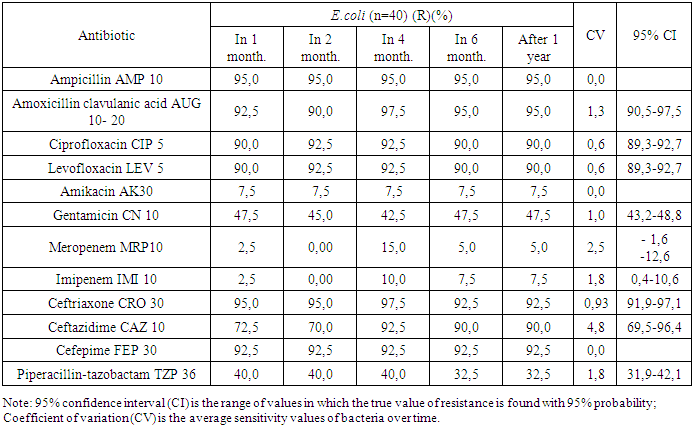
Next, we performed analysis of variance (ANOVA) to test whether there were statistically significant differences between groups of data representing changes in E. coli strain resistance as a function of storage time and analysis with 95% confidence interval determination (Table 2).
Table 2. Data analysis of antimicrobial susceptibility test data of E. coli strains for stability properties - by disk-diffusion method
     
ANOVA analysis of variance showed that F-statistic: 0.0249 and p-value: 0.9988 or p-value > 0.05, this averages that there is no statistically significant difference in stability during long term storage, that is, E. coli resistance to antimicrobials remains stable during the storage period. According to the table we can see that most of the antimicrobials show stability (no significant variation). Meropenem MRP10 (95% - - 1.6 -12.6) and Imipenem IMI 10 (95% - 0.4-10.6) show slight variations but they remain within random variations. Ceftazidime CAZ 10 (95% - 69.5-96.4) and Piperacillin-tazobactam TZP 36 (95% - 31.9-42.1) show a slight decrease in resistance but without statistical significance.
When grouping antimicrobial agents according to the stability of resistance of E. coli strains, we found that Ampicillin AMP 10, Ciprofloxacin CIP 5, Levofloxacin LEV 5, Cefepime FEP 30, Amikacin AK30 showed absolute stability: E. coli resistance to them did not change during the entire storage period. Insignificant changes (but without statistical significance) showed Amoxicillin clavulanic acid AUG 10- 20, Gentamicin CN 10, Ceftriaxone CRO 30, Ceftazidime CAZ 10, Piperacillin-tazobactam TZP 36. The resistance of E. coli to these drugs fluctuates, but without sharp spikes. Meropenem MRP10 (95% - - - 1.6-12.6), Imipenem IMI 10 (95% - 0.4-10.6) were found to be the most variable antimicrobials, they show the highest fluctuations but ANOVA showed that the changes are not statistically significant.
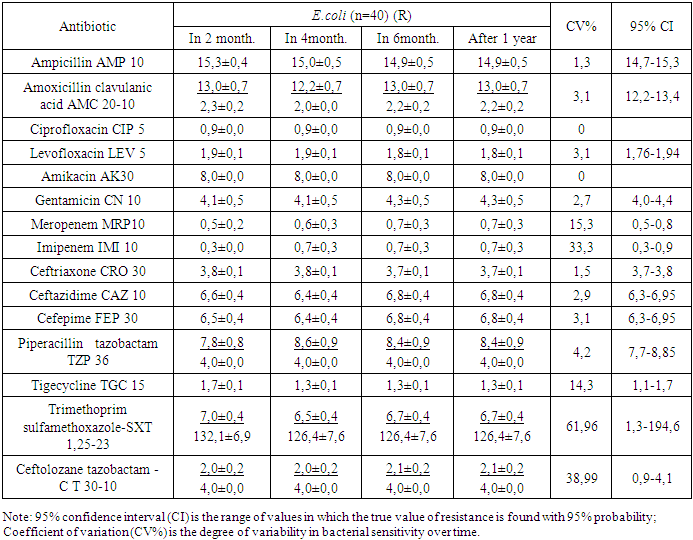
Because the antimicrobial susceptibility data of strains supplied by the disk-diffusion method differed, we performed parallel AST on the NMIC-600 (REF)-449055 panel of a BD Phoenix bacteriological analyzer. Automated microbiology systems were designed, for rapid, reliable and accurate bacterial ID and AST for most clinically encountered species.
To evaluate the changes in the minimum inhibitory concentration (MIC, mg/L) of the antimicrobials during storage time and to identify the degree of stability of E. coli sensitivity, the following key parameters were presented for each antibiotic: Average value MIC - reflects the minimum inhibitory concentration of the antibiotic over time; 95% confidence interval (CI) - shows the range within which the true MIC value is 95% likely to lie and coefficient of variation (CV%) - reflects the degree of variability in sensitivity. The higher the CV%, the greater the variation in MIC (Table 3). Interpreting the results of the analysis we found that the completely stable antimicrobials (CV% = 0%) include Ciprofloxacin CIP 5 (0.9 mg/L, CV% = 0%) and Amikacin AK30 (8.0 mg/L, CV% = 0%). The MIC of these antibiotics did not change throughout the storage time and E. coli strains show complete stability of sensitivity to these antibiotics. Antibiotics with low variability (CV% < 2%) included Ampicillin AMP 10 (15.03 mg/L, CV% = 1.26%) and Ceftriaxone CRO 30 (3.75 mg/L, CV% = 1.33%). Minor variations in MIC were detected, but overall sensitivity remains stable. Possible causes of variation: natural variations in storage conditions. Antimicrobials with moderate variability (CV% = 3-4%) included Levofloxacin LEV 5 (1.85 mg/L, CV% = 3.12%) and Amoxicillin-clavulanic acid AMC 20-10 (12.80 mg/L, CV% = 3.13%). Bacterial sensitivity varied slightly but not critically. The 95% confidence interval is narrow, indicating good predictability of variation. And antibiotics with high variability (CV% > 5%) which include Trimethoprim-sulfamethoxazole SXT 1,25-23 (126.4 mg/L, CV% = high) and Meropenem MRP10 (0.7 mg/L, CV% high).
Table 3. Average minimum inhibitory concentration (MIC) of E. coli, in mg/l, to antimicrobial agents
     
Thus, the most stable sensitivity parameters were Ciprofloxacin CIP 5, Amikacin AK30, Ampicillin AMP 10, Ceftriaxone CRO 30, moderate variability was observed for Levofloxacin LEV 5 and Amoxicillin-clavulanic acid AMC 20-10 and high variability was observed for Meropenem MRP10 and Trimethoprim-sulfamethoxazole SXT 1,25-23, which requires additional control.
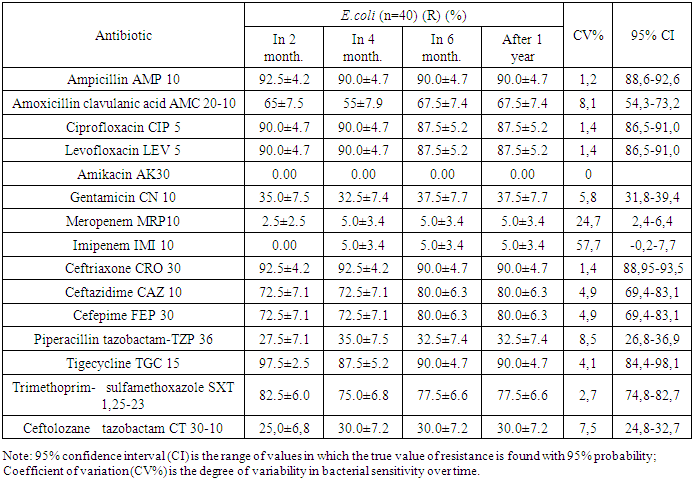
Analyzing the data, coefficient of variation (CV%) (Table 4), that is, the degree of variability of bacterial sensitivity over the storage period showed that of the fifteen antimicrobials offered by the manufacturer in the panel, three antimicrobials showed high stability (CV% < 2%), these were Ampicillin (Average: 90. 6%, CV% = 1.19%), Ciprofloxacin (Average: 88.75%, CV% = 1.41%) and Levofloxacin (Average: 88.75%, CV% = 1.41%). These antibiotics show minimal changes in E. coli sensitivity over time. The narrow 95% confidence interval confirms the stability of the measurements and E. coli maintains sensitivity to these antibiotics at the same level.
Table 4. Analysis of antimicrobial susceptibility test data of E.coli strains for stability properties using NMIC-600 BD Phoenix panel
     
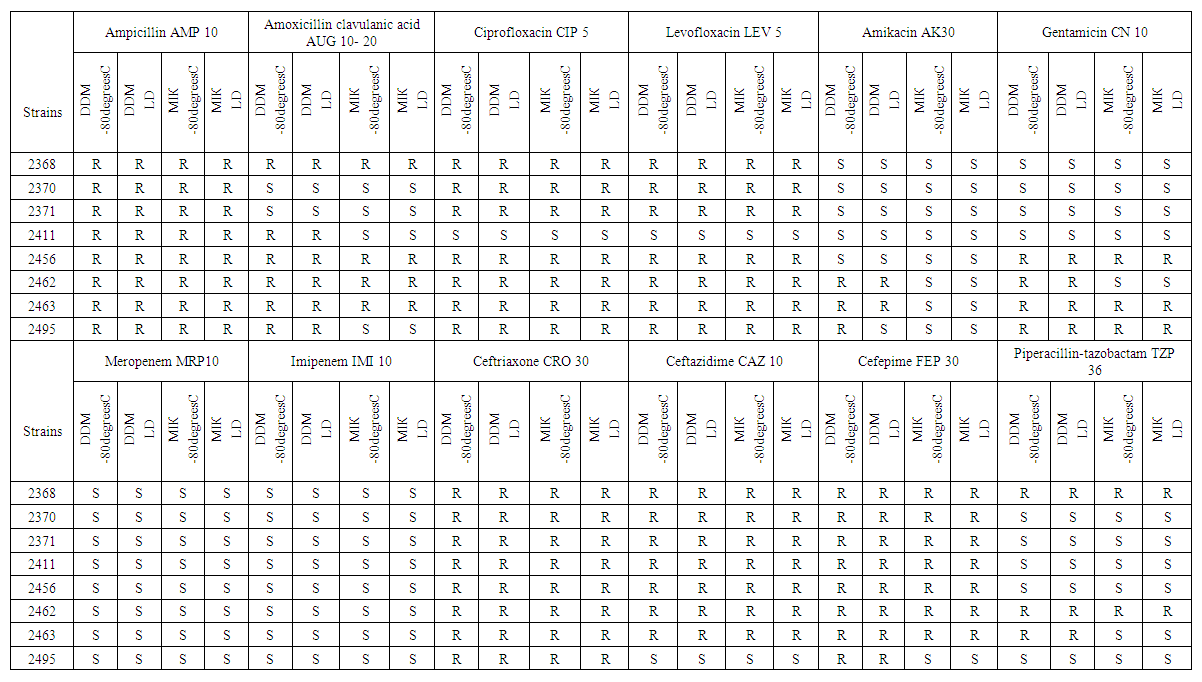
Two antimicrobials showed moderate variability (CV% = 5-10%), they are Amoxicillin (Average: 63.75%, CV% = 8.08%) and Clavulanic acid (Average: 63.75%, CV% = 8.08%). The variability of sensitivity is higher than the previous group, also it may be due to the effect of storage conditions or adaptation of bacteria and 95% CI (54.28% – 73.22%) indicates significant variation in values. The remaining antimicrobials were categorized as antibiotics with high variability (CV% > 10%). High variability may indicate instability of E. coli resistance. Further monitoring and verification of storage conditions is required. Having analyzed the stability of sensitivity - resistance of E. coli strains, by two methods, we selected E. coli 8 strains for lyophilic drying and further study of their stability. After lyophilic drying we tested the strains three times (after one month, 3 months and 6 months) for stability of sensitivity - resistance properties (Table 5). Analyzing the obtained data, we selected four strains that did not change their properties during the entire period of the study to create a panel of EQA.
Table 5. Sensitivity-resistance stability indices of E. coli strains during storage by two methods

4. Conclusions

Stability of microbial strains is the ability of bacteria or fungi to retain their biological properties (resistance, virulence, morphology, metabolic activity) during long-term storage or cultivation. The main factors affecting stability are genetic stability, that is the presence of plasmids and mutations can lead to changes in antibiotic resistance and some strains can lose or gain resistance depending on storage conditions. Storage methods also affect the stability of properties, such as cryopreservation (-80 degrees C, liquid nitrogen) or lyophilization (drying) maximizes the stability of the properties of microorganisms. Studies on the stability of E. coli strains showed that not all strains retain their properties during storage, only 15.0% of E. coli strains retained their properties and were selected to create a panel.

References

[1]  Borisova O.Yu. et al. /// External quality control of bacteriologic investigation in the isolation of Corynebacterium diphtheriae. /// Clinical Laboratory Diagnostics. 2021; 66(8).
[2]  Oradova A.Sh., Kamzina E.K., Bekenova A.A. /// Quality control in clinical diagnostic laboratory /// Bulletin of Kaz NMU, №1- 2014 p 294-295.
[3]  Rafalsky V. /// Antibiotic resistance of pathogens of uncomplicated urinary tract infections in the Russian Federation // Bulletin of Urology Urology Herald 2018; pp 50-56.
[4]  Kazantsev A.V., Proskuryakova M.V., Kazakova E.S., Osina N.A., Shvidenko I.G., Mikerov A.N. /// Antibiotic resistance of uropathogenic Escherichia coli isolated from patients with urinary tract infections in the urologic inpatient unit of the clinical hospital of Saratov// Problems of especially dangerous infections. 2022; 3 PP 82-89.
[5]  Slukin P.V. Astashkin E.I., Aslanian E.M., Ershova M.G., Poletaeva E.D., Svetoch E.A., Shepelin A.P., Fursova N.K. /// Characterization of virulent strains of Escherichia coli isolated from patients with urological infection // Journal of Microbiology, Epidemiology and Immunobiology. 2021; 98(6) pp 671-684.
[6]  Domotenko L. V., Morozova T. P., Shepelin A. P., Mironov A. Yu // effectiveness of quality control of bacteriologic transport media // russian clinical laboratory diagnostics. 2021; pp 374-378.
[7]  Meshkov D.O., Cherkasov S.N. /// Recommendations of the World Health Organization for the evaluation of medical laboratories /// Vestnik medical institute REAVIZ. 2020. No. 2 pp 148-152.
[8]  Zolotarev P.N., Liang O.V., Kochetov A.G. Formation of the concept” medical laboratory technique ” on the basis of legal and specialized documentation of the Russian Federation // Medical alma mater. - 2014. - № 3 (33). - С. 21-25.
[9]  Nikolaev N.S., Nazarova V.V., Dobrovolskaya N.Y., Orlova A.V., Pchelova N.N/// Quality management in clinical diagnostic laboratory in the conditions of FGBU “Federal Center of Traumatology, Orthopedics and Endoprosthesis” of the Ministry of Health of Russia (Cheboksary) Clinical Laboratory Diagnostics, № 10, 2014 pp 59-64.
[10]  Naveen Kamboj, Sadanand Maurya, Sonia Kamboj, Gaurav kumar Singh /// Lyophilization process - an overview /// Subscribe to Pharmatutor Alerts by Email /// kamboj.naveen21@gmail.com.
[11]  Karen C, Carroll., Brian D., Glanz, Anita P. Borek., Chad Burger., Hasan S. Bhally., Susan Henciak and Diane Flayhart /// Evaluation of the BD Phoenix Automated Microbiology System for Identification and Antimicrobial Susceptibility Testing of Enterobacteriaceae /// Journal of clinical microbiology, Oct. 2006, p. 3506–3509.
[12]  Karen C. Carroll., Anita P. Borek., Chad Burger., Brian Glanz., Hasan Bhally., Susan Henciak and Diane C., Flayhart /// Evaluation of the BD Phoenix Automated Microbiology System for Identification and Antimicrobial Susceptibility Testing of Staphylococci and Enterococci /// Journal of Clinical Microbiology., June 2006, pages. 2072–2077.
[13]  Barbara De la Salle, Piet Meijer, Annette Thomas, Ana-Maria Simundic /// Special issue on External Quality Assessment in Laboratory Medicine – current challenges and future trends /// Biochemia Medica 2017; 27(1): 19–22.
[14]  James D, Ames D, Lopez B, Still R, Simpson W, Twomey P. External Quality Assessment: Best Practice. J Clin Pathol. 2014; 67: 651–5.
[15]  William Graham Wood/// Problems and Practical Solutions in the External Quality Control of Point of Care Devices with Respect to the Measurement of Blood Glucose /// Journal of diabetes science and technology., Volume 1, Issue 2, March 2007.
[16]  Hyeongsu Kim, Sollip Kim,Yeo-Min Yun, Tae-Hyun Um, Jeonghyun Chang, Kun Sei Lee, Sail Chun, Kyu-Dong Cho and Tae-Hwa Han /// Status of Quality Control for Laboratory Tests of Medical Institutions in Korea: Analysis of 10 Years of Data on External Quality Assessment Participation /// Healthcare journal 27 March 2020.
[17]  Alexia Cusini, David Herren, Lukas Bütikofer, Catherine Plüss-Suard, Andreas Kronenberg and Jonas Marschall/// Intra-hospital differences in antibiotic use correlate with antimicrobial resistance rate in Escherichia coli and Klebsiella pneumoniae: a retrospective observational study /// Cusini et al. Antimicrobial Resistance and Infection Control (2018).
[18]  Maryam Raeispour, Reza Ranjbar /// Antibiotic resistance, virulence factors and genotyping of Uropathogenic Escherichia coli strains /// Raeispour and Ranjbar Antimicrobial Resistance and Infection Control (2018) 7: 118.
[19]  Anja Klingeberg, Ines Noll, Niklas Willrich, Marcel Feig, Dagmar Emrich, Edith Zill, Annegret Krenz-Weinreich, Wiltrud Kalka-Moll, Klaus Oberdorfer, Guido Schmiemann, Tim Eckmanns /// Antibiotic-Resistant E. coli in Uncomplicated Community-Acquired Urinary Tract Infection /// Deutsches Ärzteblatt International /// 2018; 113: 494–500.
[20]  Na Wang, Minghua Zhan, Teng Wang, Jinlu Liu, Caiqing Li, Baoliang Li, Xuying Han, Huiying Li, Shuting Liu, Jing Cao, Xinran Zhong, Chunmei Lei, Wei Zhang, Zhihua Zhang /// Long Term Characteristics of Clinical Distribution and Resistance Trends of Carbapenem-Resistant and Extended-Spectrum β-Lactamase Klebsiella pneumoniae Infections: 2014–2022 /// Infection and Drug Resistance 2023: 16 1279–1295.
[21]  Laura Sciacovelli, Andrea Padoan, Ada Aita, Daniela Basso and Mario Plebani /// Quality indicators in laboratory medicine: state-of-the-art, quality specifications and future strategies /// Clin Chem Lab Med 2023; 61(4): 688–695.
[22]  World Health Organization . WHO Manual for Organizing a National External Quality Assessment Programme for Health Laboratories and Other Testing Sites. WHO Press; Geneva, Switzerland: 2016. [Google Scholar].
[23]  Hyeongsu Kim, Sollip Kim,Yeo-Min Yun, Tae-Hyun Um, Jeonghyun Chang, Kun Sei Lee, Sail Chun, Kyu-Dong Cho and Tae-Hwa Han /// Status of Quality Control for Laboratory Tests of Medical Institutions in Korea: Analysis of 10 Years of Data on External Quality Assessment Participation /// Healthcare journal 27 March 2020.
[24]  Kim J.Y., Dzik W.H., Dighe A.S., Lewandrowski K.B. Utilization management in a large urban academic medical center: A 10-year experience. Am. J. Clin. Pathol. 2011; 135: 108–118.