American Journal of Medicine and Medical Sciences

p-ISSN: 2165-901X    e-ISSN: 2165-9036

2025;  15(7): 2110-2113

doi:10.5923/j.ajmms.20251507.05

Received: May 10, 2025; Accepted: Jun. 2, 2025; Published: Jul. 3, 2025

 

High Prognostic Risk MDS: Comparative Evaluation of Treatment Efficacy

Zulhumor Dzhumabaevna Yunusova

2nd Clinical Department of Hematology, Republican Specialized Scientific-Practical Medical Center of Hematology (RSSPMCH) MoH RUz, Tashkent, Uzbekistan

Correspondence to: Zulhumor Dzhumabaevna Yunusova, 2nd Clinical Department of Hematology, Republican Specialized Scientific-Practical Medical Center of Hematology (RSSPMCH) MoH RUz, Tashkent, Uzbekistan.

Email:

Copyright © 2025 The Author(s). Published by Scientific & Academic Publishing.

This work is licensed under the Creative Commons Attribution International License (CC BY).
http://creativecommons.org/licenses/by/4.0/

Abstract

Objective: To comparatively evaluate the effectiveness of using Cytarabine and Azacitidine in patients with high prognostic risk MDS. Material and Methods. The study was based on voluntary participation of 68 adult patients with myelodysplastic syndrome (MDS) (median age 51.0±1.7 years). Patients were selected at admission to the Republican Specialized Scientific and Practical Medical Center of Hematology (RSSPMCH, Tashkent) from 2014 to 2024. Conclusion. More promising as the most effective method of treating patients with high prognostic risk MDS is the use of Azacitidine.

Keywords: Myelodysplastic syndrome, High prognostic risk, Chemotherapy, Azacitidine, Cytarabine

Cite this paper: Zulhumor Dzhumabaevna Yunusova, High Prognostic Risk MDS: Comparative Evaluation of Treatment Efficacy, American Journal of Medicine and Medical Sciences, Vol. 15 No. 7, 2025, pp. 2110-2113. doi: 10.5923/j.ajmms.20251507.05.

1. Introduction

Myelodysplastic syndrome (MDS) is an unexplored tumor disease of the hematopoietic system that develops at any age, including children. MDS mainly affects the elderly population [1,4,9,13]. According to WHO statistics, MDS is diagnosed in 86% of cases in people aged 60 years and older [2,3,8]. Along with this, the estimated incidence of MDS increases significantly with age: in the fourth decade of life from 0.7 per 100,000 adults, and after 70 years of age to 10.8-36.3 per 100,000 adults [3,9]. The risk of developing the disease increases fivefold between the ages of 60 and 80 years [3]. As the elderly population grows, world statistics estimate that by 2025 there will be 1.2 billion people over 60 years of age, and therefore there will be an increase in the incidence of MDS in the general population [1,3].
Patients diagnosed with MDS experience a deterioration in quality of life, jeopardizing the ability of elderly patients to independently perform activities of daily living [5,7,11,14]. Depending on the severity of MDS and the degree of cytopenia, patients present with excessive fatigue, night sweats, bone pain, fever, weight loss, recurrent infections, and hemorrhagic events in the form of bruising, bleeding, and skin rashes [6,10,12,15]. There are data showing the effect of different treatment methods on the course of MDS [16,18,19,21]. Some foreign studies have shown the effect of treatment with erythropoiesis-stimulating drugs and granulocyte colony-stimulating factor on the quality of life of MDS patients before and after treatment [17,20,24,28]. Treatment options for patients with MDS are very limited, and there are many factors that increase the likelihood that they will not receive active treatment for MDS [22,23].
Age-related comorbidities, functional impairment, poor tolerability, ineffectiveness of available treatments, and patient preference may influence whether a physician recommends active treatment for a patient [25,27]. Results of large studies regarding the treatment of patients with MDS showed that 27% of high-risk patients with newly diagnosed disease and 24-49% of high-risk patients with established disease received only maintenance replacement therapy [26]. Meanwhile, although the main goal of currently available therapies is to eliminate cytopenia, there is currently conflicting data regarding the use of drugs of the pyrimidine nucleoside cytidine analogs azacytidine (Aza) in the treatment of patients with MDS.
Thus, the choice of therapy has a crucial role in improving the quality of life of patients with MDS of high prognostic risk. Timely correct choice of therapy for patients with MDS will contribute to the reduction of complications of the disease, reduce the incidence of MDS transformation into acute leukemia, improve the relapse-free overall survival and quality of life of patients.
Aim of the study. To conduct a comparative evaluation of the efficacy of cytarabine and azacitidine in patients with high prognostic risk myelodysplastic syndrome (MDS).

2. Main Body

2.1. Material and Methods of Study

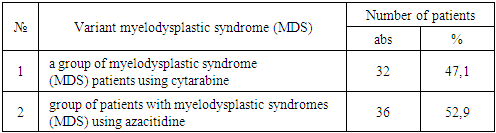
The study was based on voluntary participation of 68 (1st main group) adult patients with MDS aged 18 to 85 years, with an age median of 51.0±1.7 years. Patients were selected upon admission to the Republican Specialized Scientific and Practical Medical Center of Hematology (RSNPMCH, Tashkent) from 2014 to 2024. The diagnosis was established taking into account clinical manifestations, changes in the clinical blood count, myelogram, taking into account diagnostic standards (Oster H. S., Mittelman M., 2024). Based on the results of the analyses performed in patients with MDS, all subjects were categorized into groups based on the method of treatment (Table 1).
Table 1. Distribution of patients with MDS depending on the method of treatment
     
Analysis of sex differences in the group of patients showed a greater number of men (37/54.4%) than women (31/45.6%), with their ratio corresponding to 1.2 (male): 1 (female).
As a control comparison (group 4) were conditionally healthy adults (n=102) without hematologic and other neoplasia in the history. among whom the number of men was equal to 57 (55.9%) and women 45 (44.1%), their median age was 48.7±2.3 years.
MDS patients underwent investigations that included clinical (objective and subjective methods), laboratory (OAC, myelogram), cytogenetic (standard cytogenetic study - SCI) and statistical methods.
For statistical processing of the obtained numerical data we used calculations with Excel and Stathistisa programs, and the established differences between the studied indicators were considered to be reliably significant at p≤0.05.

2.2. Results of the Study

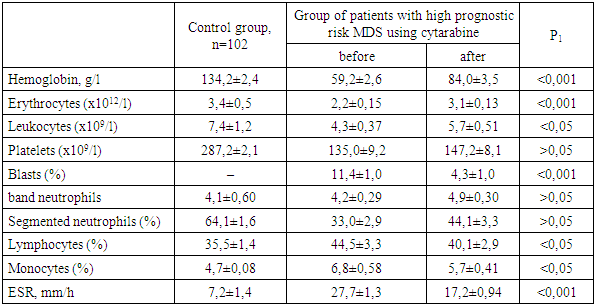
We carried out a comparative analysis of the effectiveness of the conducted treatment methods with cytarabine (n=32) and azacitidine (n=36) according to the studied indicators of the general blood analysis and myelogram (Table 2).
Table 2. Quantitative analysis of hematological parameters in groups of patients with high prognostic risk MDS (n=32) after treatment with “Cytarabine” (M±m)
     
Comparing hemoglobin indices in comparison with the level before treatment, there was a statistically significant increase in its concentration by 1.4 times (84.0±3.5 g/l vs. 59.2±2.6 g/l; p<0.001), along with which there was also an increase in the number of erythrocytes by 1.4 times (3.1±0.13 x 10¹²/l vs. 2.2±0.15 x 10¹²/l; p<0.001). Moreover, in the group of patients with MDS after cytarabine application a 1.9-fold decrease in leukocyte count was observed (5.7±0.51 x 10⁹/l vs. 10.8±4.5 x 10⁹/l; p>0.05). On the platelet side, a statistically significant 2.2-fold increase was found after treatment (147.2±8.1 x 10⁹/l vs. 68.0±10.8 x10⁹/l; p<0.001).
Positive dynamics was also observed with respect to blast cells, the number of which after treatment significantly decreased 2.6-fold (4.3±1.0% vs. 11.4±1.0%; p<0.001). At the same time, after treatment, although insignificant, but still there was an increase in the number of mature neutrophils by 1.33 times (44.1±3.3% vs. 33.0±2.9%; p>0.05).
Meanwhile, on the side of lymphocytic cells, there was a decrease to the upper limit of their norm (40.1±2.9% vs. 44.5±3.3%; p<0.05), while the number of monocytes decreased to 5.7±0.41% (p>0.05) and ESR to 17.2±0.94 mm/h.
Analyzing the dynamics of myelogram parameters in a group of patients with high prognostic risk MDS (n=32) after treatment with Cytarabine, a significant decrease in the median of blast cells by 2.1 times was revealed (from 15.0±0.58% to 7.2±0.56%; p<0.001).
Along with this, there was a decrease in the content of lymphocytes by 1.4 times (from 17.2±1.0% to 12.4±0.65%; p<0.05), monocytes - by 1.5 times (from 2.1±0.11% to 1.4±0.09%; p<0.05), erythroblasts - by 1.4 times (from 3.83±0.2% to 2.8±0.17%; p<0.05). Moreover, in this group of patients there was an insignificant, but still an increase in the field of view of the number of megakaryocytes from 7.3±0.29 to 7.7±0.36 (p>0.05), due to an increase in the number of platelet-containing forms (from 4.0±0.19 to 4.7±0.23; p>0.05).
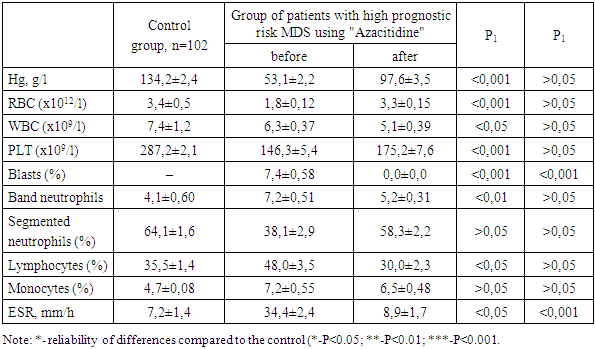
When assessing the effectiveness of treatment using “Azatitidine” (n=36) according to the studied indicators of the general blood test, a more significant recovery of indicators was found than in the group of patients after using “Cytarabine” (Table 3).
Table 3. Quantitative analysis of hematological parameters of the OAC in groups of patients with high prognostic risk of MDS (n=36) after treatment with "Azacitidine" (M±m)
     
In particular, this was manifested in a more significant increase in the hemoglobin level compared to its concentration in the group after the use of cytarabine. The hemoglobin concentration statistically significantly increased in relation to its indicator before treatment by 1.8 times (97.6±3.5 g/l versus 53.1±2.2 g/l; p<0.001), along with which an increase in the number of erythrocytes was also observed by 1.8 times (3.3±0.15 x10¹²/l versus 1.8±0.12 x10¹²/l; p<0.001) (Table 3). The leukocyte count among this group of patients decreased 2.1-fold (5.1±0.39 x10⁹/L versus 10.8±4.5 x10⁹/L; P>0.05). Simultaneously, platelet counts statistically significantly increased 2.6-fold after treatment (175.2±7.6 x10⁹/L versus 68.0±10.8 x10⁹/L; P<0.001).
The number of blast cells after treatment with "Azacitidine" was not detected in the peripheral blood (0.0% versus 11.4±1.0%; p<0.001), which confirmed the greater effectiveness of this drug compared to "Cytarabine", after treatment with which blast cells continued to be detected in the peripheral blood.
In parallel, after treatment, a more significant increase in the number of mature neutrophils by 1.5 times (58.3±2.2% versus 38.1±2.9%; p>0.05) and a decrease in lymphocyte cells by 1.6 times (30.0±2.3% versus 48.0±3.5%; p<0.05) were also observed, while the number of monocytes decreased from 7.2±0.55% to 6.5±0.48% (p>0.05), and ESR from 34.4±2.4 mm/h to 8.9±1.7 mm/h (p<0.05).
Comparing the dynamics of myelogram parameters in a group of patients with high prognostic risk MDS (n=36) after treatment with Azacitidine, a significant decrease in the median content of blast cells in the bone marrow by 3.4 times was revealed (from 15.1±0.52% to 4.5±0.22%; p<0.001). In this group, there was also a more pronounced decrease in the content of lymphocyte cells by 4.0 times (from 22.1±1.2% to 5.5±0.34%; p<0.001), monocytes by 2.0 times (from 2.9±0.13% to 1.4±0.09%; p<0.001), erythroblasts by 1.8 times (from 3.86±0.2% to 2.1±0.17%; p<0.05).
At the same time, in this group of patients, a more significant increase in the field of view of the number of megakaryocytes was observed than in the previous group, from 6.3±0.29 to 8.5±0.33 (p<0.05), also due to an increase in the number of platelet-containing forms (from 2.8±0.19 to 5.5±0.24; p>0.05).

3. Conclusions

The results of the analysis of the dynamics of peripheral blood parameters and myelogram in patients with MDS showed a variety of hematological disorders characterized by erythrocytopenia and thrombocytopenia, accompanied by a decrease in the number of mature neutrophils and simultaneous lymphocytosis.
Comparison of treatment methods for patients revealed a decrease in blast cells and an increase in the number of erythrocytes, platelets, and neutrophils with the use of Cytarabine and Azacitidine. In addition, among patients with high-risk MDS, the release of blast cells into the peripheral blood was maintained with the use of Cytarabine due to the excess of the permissible values of blast cells in the myelogram after treatment with Cytarabine. At the same time, the use of Azacitidine treatment courses in patients with high-risk MDS resulted in a more pronounced recovery of blood and myelogram parameters with a decrease in blast cells to normal values in the bone marrow.
Thus, from the above results, it can be concluded that the use of "Cytarabine" and "Azacitidine" in patients with high prognostic risk MDS is observed to have positive dynamics in terms of peripheral blood and myelogram indices. However, the preservation of the increased number of blast cells, both in the general blood test and in the myelogram, as well as less pronounced recovery of other indices against the background of the use of "Cytarabine", compared with the effectiveness of changing similar indices after the use of "Azacitidine", which indicates its lower effectiveness. Consequently, the use of "Azacitidine" is more promising as the most effective method of treating patients with high prognostic risk MDS.

References

[1]  Gritsayev S.V. Myelodysplastic syndromes of low risk // Clinical Oncohematology. 2021. № 4.
[2]  Gritsayev SV, Yunusova ZD, Baimatova NA, Babadjanova SH, Zhakhonov AH, Kostroma AI, Zhernyakova AA Complex-pathogenetic approach in the correction of iron deficiency in patients with low-risk myelodysplastic syndrome // Eurasian Herald of Pediatrics. - 2019; 1 (1): 8-12.
[3]  Lipilkin P.V., Kulaeva E.D., Zeltser A.N., Mordanov S.V., Shatokhin Yu.V. Myelodysplastic syndrome: epidemiology and epigenetic disorders. Medical Bulletin of the South of Russia. 2022; 13(2): 179-190.
[4]  Bazinet A., Bravo G. M. New approaches to myelodysplastic syndrome treatment // Current treatment options in oncology. – 2022. – Т. 23. – №. 5. – С. 668-687.
[5]  Bewersdorf J. P., Zeidan A. M. Risk-adapted, individualized treatment strategies of myelodysplastic syndromes (MDS) and chronic myelomonocytic leukemia (CMML) //Cancers. – 2021. – Т. 13. – №. 7. – С. 1610.
[6]  Carraway H. E., Saygin C. Therapy for lower-risk MDS // Hematology 2014, the American Society of Hematology Education Program Book. – 2020. – Т. 2020. – №. 1. – С. 426-433.
[7]  Dotson J. L., Lebowicz Y. Myelodysplastic syndrome. – 2018.
[8]  Fenaux P. et al. Myelodysplastic syndromes: ESMO Clinical Practice Guidelines for diagnosis, treatment and follow-up // Annals of Oncology. – 2021. – Т. 32. – №. 2. – С. 142-156.
[9]  Fenaux P., Platzbecker U., Ades L. How we manage adults with myelodysplastic syndrome //British journal of haematology. – 2020. – Т. 189. – №. 6. – С. 1016-1027.
[10]  Garcia Manero G. Myelodysplastic syndromes: 2023 update on diagnosis, risk stratification, and management // American journal of hematology. – 2023. – Т. 98. – №. 8. – С. 1307-1325.
[11]  Garcia‐Manero G., Chien K. S., Montalban‐Bravo G. Myelodysplastic syndromes: 2021 update on diagnosis, risk stratification and management // American journal of hematology. – 2020. – Т. 95. – №. 11. – С. 1399-1420.
[12]  Hasserjian R. P. Myelodysplastic syndrome updated // Pathobiology. – 2019. – Т. 86. – №. 1. – С. 7-13.
[13]  Hellström-Lindberg E., Tobiasson M., Greenberg P. Myelodysplastic syndromes: moving towards personalized management // Haematologica. – 2020. – Т. 105. – №. 7. – С. 1765.
[14]  Jiang L, Luo Y, Zhu S, Wang L, Ma L, Zhang H, et al. Mutation Status and Burden can Improve Prognostic Prediction of Patients With Lower-Risk Myelodysplastic Syndromes. Cancer Sci (2020) 111(2): 580–91.
[15]  Li H. et al. Myelodysplastic syndromes // Nature reviews Disease primers. – 2022. – Т. 8. – №. 1. – С. 74.
[16]  Montalban‐Bravo G., Garcia‐Manero G. Myelodysplastic syndromes: 2018 update on diagnosis, risk‐stratification and management // American journal of hematology. – 2018. – Т. 93. – №. 1. – С. 129-147.
[17]  Nazha A, Komrokji R, Meggendorfer M, Jia X, Radakovich N, Shreve J, et al. Personalized Prediction Model to Risk Stratify Patients With Myelodysplastic Syndromes. J Clin Oncol (2021) 39(33): 3737–46.
[18]  Oster H. S., Mittelman M. How we diagnose Myelodysplastic syndromes // Frontiers in Oncology. – 2024. – Т. 14. – С. 1415101.
[19]  Palacios-Berraquero M. L., Alfonso-Piérola A. Current therapy of the patients with MDS: walking towards personalized therapy // Journal of clinical medicine. – 2021. – Т. 10. – №. 10. – С. 2107.
[20]  Platzbecker U, Fenaux P, Adès L, Giagounidis A, Santini V, van de Loosdrecht AA, et al. Proposals for Revised IWG 2018 Hematological Response Criteria in Patients With MDS Included in Clinical Trials. Blood (2019) 133(10): 1020–30.
[21]  Platzbecker U. Treatment of MDS // Blood, The Journal of the American Society of Hematology. – 2019. – Т. 133. – №. 10. – С. 1096-1107.
[22]  Santini V. How I treat MDS after hypomethylating agent failure // Blood, The Journal of the American Society of Hematology. – 2019. – Т. 133. – №. 6. – С. 521-529.
[23]  Saygin C., Carraway H. E. Current and emerging strategies for management of myelodysplastic syndromes // Blood reviews. – 2021. – Т. 48. – С. 100791.
[24]  Sekeres M. A., Taylor J. Diagnosis and treatment of myelodysplastic syndrome
[25]  Steensma D. P. Myelodysplastic syndromes current treatment algorithm 2018 //Blood cancer journal. – 2018. – Т. 8. – №. 5. – С. 47.s: a review // Jama. – 2022. – Т. 328. – №. 9. – С. 872-880.
[26]  Tanaka T. N., Bejar R. MDS overlap disorders and diagnostic boundaries // Blood, The Journal of the American Society of Hematology. – 2019. – Т. 133. – №. 10. – С. 1086-1095.
[27]  Weinberg O. K., Hasserjian R. P. The current approach to the diagnosis of myelodysplastic syndromes☆ // Seminars in hematology. – WB Saunders, 2019. – Т. 56. – №. 1. – С. 15-21.
[28]  Zeidan A. M. et al. Epidemiology of myelodysplastic syndromes: why characterizing the beast is a prerequisite to taming it // Blood reviews. – 2019. – Т. 34. – С. 1-15.