
-
Paper Information
- Paper Submission
-
Journal Information
- About This Journal
- Editorial Board
- Current Issue
- Archive
- Author Guidelines
- Contact Us
American Journal of Medicine and Medical Sciences
p-ISSN: 2165-901X e-ISSN: 2165-9036
2025; 15(5): 1384-1386
doi:10.5923/j.ajmms.20251505.14
Received: Apr. 14, 2025; Accepted: May 3, 2025; Published: May 8, 2025

Determination of Accumulation of Titanium Dioxide and Aluminum in the Food Dyes E171 and E173 in the Brain under Experimental Conditions
 Abstract
 Reference
 Full-Text PDF
 Full-text HTML
Zaripova Oysara Olimjon Qizi 1, Abdullaeva Muslima Axadovna 2
1Bukhara State Medical Institute named after Abu Ali ibn Sina, Uzbekistan
2DCs, Bukhara State Medical Institute named after Abu Ali ibn Sina, Uzbekistan
Correspondence to: Zaripova Oysara Olimjon Qizi , Bukhara State Medical Institute named after Abu Ali ibn Sina, Uzbekistan.
| Email: |  |
Copyright © 2012 Scientific & Academic Publishing. All Rights Reserved.
This work is licensed under the Creative Commons Attribution International License (CC BY).
http://creativecommons.org/licenses/by/4.0/

Introduction: Today, the lifestyle of mankind, the increase in living conditions, social welfare, the improvement of working conditions, and the increase in annual income require the development of all sectors of society. In particular, in the manufacturing industry, the quality of the product and its appearance, uniqueness, color, packaging, and long-term storage are highly valued by consumers, in addition to the shelf life. Methods: We will study the extent to which titanium and aluminum accumulate in the brain, and how this accumulation is related to changes in the brain. 1. Control group; 2. Group that received E171; 3. Group that received E173; 4. The group that received E171 and E173. Results: The result obtained in the above experimental groups, compared with the control group, revealed differences in titanium: an average of 3.63/0.28 μg/g, 13 times more, and aluminum: an average of 4.21/0.53 μg/g, 8 times more. In addition, in the group given aluminum and titanium at the same time, compared with the control group, it was found that: titanium increased by 3.7/0.28 μg/g, 13.2 times, and aluminum increased by 4.5/0.53 μg/g, 8.5 times. Conclusion: Around the worldl it is known that the brain has a natural blood-brain barrier, and the peculiarity of this barrier is its selective permeability. Accordingly, various toxic substances, poisonous products and many types of drugs circulating in the blood cannot pass through this barrier.
Keywords: E171, Titanium dioxide, Nanomaterials, E173, Aluminum, Natural brain barrier, Cumulation
Cite this paper: Zaripova Oysara Olimjon Qizi , Abdullaeva Muslima Axadovna , Determination of Accumulation of Titanium Dioxide and Aluminum in the Food Dyes E171 and E173 in the Brain under Experimental Conditions, American Journal of Medicine and Medical Sciences, Vol. 15 No. 5, 2025, pp. 1384-1386. doi: 10.5923/j.ajmms.20251505.14.
1. Introduction
- Titanium dioxide (TiO2) is actively used not only in the food industry, but also in the pharmaceutical industry, in the production of personal hygiene products, and cosmetics as a bleaching agent. Titanium dioxide is a water-insoluble substance with low toxicity [2].In the body, titanium accumulates in the form of proteins. Enterally administered titanium dioxide interacts with the aggressive environment of the stomach significantly affecting the properties of proteins and enzymes changes.In a laboratory study, chronic (90 days) enteral administration of titanium dioxide (TiO2) to rats resulted in spleen damage, thrombocytopenia, lymphopenia, decreased hemoglobin levels, and decreased immunoglobulin levels [4].In another laboratory study, administration of titanium dioxide at a dose of 10 mg/kg resulted in severe liver damage, nephron apoptosis, and impaired immunoregulation.When titanium dioxide (TiO2) was administered enterally at a dose of 100 mg/kg for 10 days, it was found that CD4 lymphocytes increased in all areas of the intestine, and the secretion of cytokines IL-4, IL-12, IL-23, and TNF increased mainly in the colon wall [5].Many studies have been devoted to the effects of titanium dioxide (TiO2) on the body, especially on the lungs, and the changes that occur in it. In this, solutions were sought to the questions related to the entry of small-sized titanium dioxide through the respiratory tract in the workplace and the development of pathological processes. Experiments conducted on rats with high doses of titanium dioxide for two years showed that tumors developed in the lungs of the rats, which indicated the carcinogenic properties of titanium dioxide [6].Fine-particle titanium dioxide, which enters the body through the intratracheal route, damages the cellular structure of alveolar macrophages and leads to impaired function. In addition, it reduces the chemotoxic properties of alveolar macrophages. Small amounts of titanium dioxide ((TiO2) increase the phagocytic properties of macrophages, while large amounts reduce this property. With an increase in the amount of fine-particle titanium dioxide, the production of NO and TNF increased, since more pro-inflammatory mediators were synthesized under the influence of fine-particle titanium dioxide than with conventional titanium dioxide. [7] Small amounts of titanium dioxide increased the sensitivity of the upper respiratory tract by twofold, and the number of cells responsible for inflammation increased by up to threefold. Histological examination revealed edema, epithelial destruction, and inflammation [8]. Free titanium dioxide (TiO2) causes denaturation of cytoplasmic proteins [9].E173 Aluminum is one of the most common elements on Earth, ranking third after oxygen and silicon. Aluminum compounds occur in nature in a variety of forms. Aluminum compounds are part of more than 280 minerals and are actively used in various fields of human activity. Despite the widespread use of aluminum compounds, their negative consequences remain one of the most important and necessary problems of modern medicine. In particular, its complications related to the brain are the cause of much discussion. There is still much debate about whether Alzheimer's disease, autism, Parkinson's disease, multiple sclerosis, and similar profound changes in the brain are caused by aluminum and its compounds. [11] Aluminum in drinking water, inhalation and food products despite entering in large quantities through mucous membranes in small quantities reabsorption occurs. Aluminum is not essential for the human body and metabolic processes [13]. This element has a strong toxic effect on the body and the brain. The many ways in which aluminum enters the body and its widespread use further emphasize its toxic properties. [11,12,13]. This toxic effect is especially pronounced in Alzheimer's disease, autism, progressive sclerosis, and other brain dysfunctions. The attention of international scientific journals has been focused on aluminum and the above-mentioned neurological diseases [12].The main part of aluminum enters the body through water, food dyes and used in packaging, preparation, and storage of food products enters through the details. Unprocessed food products the amount of aluminum in its composition is less than 5-7 mg/g. Aluminum entering the body with water is 0.3%, and with food - 0.1%. The daily intake of aluminum is 15 mg / day [14].E171 and E173 are used as food dyes and give the product a white color. The fact that these dyes can change the analeptic properties of the product is very useful for entrepreneurs. But there is another side to the matter. All food additives, including food dyes that give color, can cause various pathological reactions in the body. processes are developing [6].This article aims to demonstrate the effects and accumulation of the bleaching dyes E171 and E173 (when taken in large quantities) on the brain. The active substances of these dyes are: titanium dioxide (171) and aluminum (E173). The effects of titanium dioxide and aluminum substances on the nervous system, including the brain, have been proven in numerous experiments. For example, titanium dioxide powder was given to experimental rats for a long time and changes in the brain were observed. When the EEG of the rat brain was performed, it was observed that active epileptic foci appeared in the brain and the rats became very aggressive. [1], [2], [3]. Aluminum is believed to be one of the main causes of neurodegenerative diseases: Alzheimer's disease, Parkinson's disease, autism [4], [5].
2. Methodology
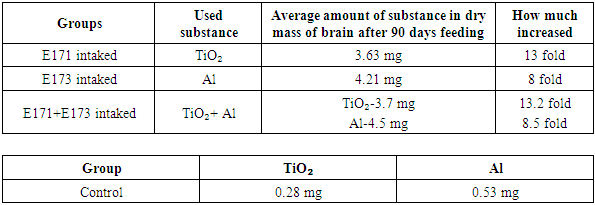
- We will study the extent to which titanium and aluminum accumulate in the brain, and how this accumulation is related to changes in the brain. White, inbred rats selected for the experiment will be divided into 4 groups:1. Control group2. Group that received E1713. Group that received E1734. The group that received E171 and E173The above group of rats was given enteral titanium dioxide and aluminum in the form of powder.The standard for determining the mass amounts of macro- and microelements in the researched samples is carried out in relation to samples with known amounts of elements.Instrumental neutron activation analysis It was shown that for 90 days, laboratory white rats were fed with food dyes E171 (TiO2 titanium dioxide) and E173 (Al, aluminum) and the following results were obtained. The rats that received food dyes as an experiment were divided into 3 groups:Group I E171 (titanium dioxide) was given 500 mg/kg orally per day for 90 days as an experiment. Our instrumental neutron activation analysis revealed that the test sample contained an average of 3.63 mg of titanium dioxide in the dry mass of the brain trace amount of titanium was detected. In the brains of rats selected for control, this amount was 0.28 mg.Group II was also given 500 mg/kg of food dye E173 (Al – aluminum) to laboratory white rats for 90 days as an experiment. In our instrumental neutron activation analysis, the test sample contained an average of 4.21 mg of aluminum in the dry mass of the brain. Element aluminum (Al) was detected in the amount of 0.53 mg/kg in the control group rats.Group III E171 (titanium dioxide) 500 mg/kg and 500 mg/kg of E173 (Al – aluminum) food dyes orally for 90 days as an experiment. Our instrumental neutron activation analysis showed that the study sample contained an average of 3.7 μg / g of titanium (TiO2) and 4.5 μg/g of in the dry mass of the brain traces of aluminum (Al) elements were detected. of 3.7 μg / g of titanium (TiO2) and 4.5 μg/g of titanium (TiO2) in the dry mass of the brain traces of aluminum (Al) elements were detected.
|
3. Results
- The result obtained in the above experimental groups, compared with the control group, revealed differences in titanium: an average of 3.63/0.28 μg/g, 13 times more, and aluminum: an average of 4.21/0.53 μg/g, 8 times more. In addition, in the group given aluminum and titanium at the same time, compared with the control group, it was found that: titanium increased by 3.7/0.28 μg/g, 13.2 times, and aluminum increased by 4.5/0.53 μg/g, 8.5 times.
4. Conclusions
- Around the worldl it is known that the brain has a natural blood-brain barrier, and the peculiarity of this barrier is its selective permeability. Accordingly, various toxic substances, poisonous products and many types of drugs circulating in the blood cannot pass through this barrier. However, there are exceptions, and there are 3 types of entry mechanisms for substances that have the property of crossing the barrier: 1) slow diffusion 2) active transport mechanism 3) endocytosis. The ability of the two food dyes titanium dioxide and aluminum shown in the experiment to cross the brain barrier has been proven in many experiments. If aluminum crosses the barrier by binding to proteins through the active transport pathway, then the physical properties of titanium dioxide help it in this way. Small particles (nanoparticles) of size 5-100 nm can easily pass through the brain barrier and show the property of accumulation. However, the question of how titanium enters the brain is a matter of much debate among scientists. During the 90 days of possible entry, it is shown that the active substances in the enterally administered dyes (E171 and E173): aluminum and titanium, accumulate in the brain to a high degree, and changes in the brain may be associated with the degree of this accumulation.