
-
Paper Information
- Next Paper
- Previous Paper
- Paper Submission
-
Journal Information
- About This Journal
- Editorial Board
- Current Issue
- Archive
- Author Guidelines
- Contact Us
American Journal of Medicine and Medical Sciences
p-ISSN: 2165-901X e-ISSN: 2165-9036
2025; 15(5): 1359-1363
doi:10.5923/j.ajmms.20251505.09
Received: Apr. 7, 2025; Accepted: Apr. 28, 2025; Published: May 8, 2025

Hygienic Analysis of the Consumption of Essential Nutrients in the Autumn Season Among Military Personnel with Hypertension
 Abstract
 Reference
 Full-Text PDF
 Full-text HTML
Nizom Ermatov 1, Turakulov Erkin 2
1Professor, Department of Children, Adolescents and Nutritional Hygiene, Tashkent Medical Academy, Tashkent, Uzbekistan
2Researcher, Department of Children, Adolescents and Nutritional Hygiene, Tashkent Medical Academy, Tashkent, Uzbekistan
Correspondence to: Nizom Ermatov , Professor, Department of Children, Adolescents and Nutritional Hygiene, Tashkent Medical Academy, Tashkent, Uzbekistan.
| Email: |  |
Copyright © 2012 Scientific & Academic Publishing. All Rights Reserved.
This work is licensed under the Creative Commons Attribution International License (CC BY).
http://creativecommons.org/licenses/by/4.0/

Hypertension is a prevalent health concern among military personnel, influenced by dietary habits, seasonal variations, and occupational stress. This study evaluates the consumption of essential nutrients during the autumn season among hypertensive military personnel, focusing on dietary adequacy and potential deficiencies. A cross-sectional analysis was conducted on 150 military personnel diagnosed with hypertension, assessing their dietary intake through 24-hour recall and food frequency questionnaires. Nutrient consumption was compared with recommended dietary allowances (RDAs). Results indicated insufficient intake of potassium, magnesium, calcium, and omega-3 fatty acids, alongside excessive sodium consumption. Seasonal variations in food availability during autumn contributed to these imbalances. The findings highlight the need for targeted nutritional interventions to optimize dietary patterns and improve cardiovascular health in this high-risk population.
Keywords: Hypertension, Military personnel, Essential nutrients, Autumn season, Dietary intake, Sodium, Potassium
Cite this paper: Nizom Ermatov , Turakulov Erkin , Hygienic Analysis of the Consumption of Essential Nutrients in the Autumn Season Among Military Personnel with Hypertension, American Journal of Medicine and Medical Sciences, Vol. 15 No. 5, 2025, pp. 1359-1363. doi: 10.5923/j.ajmms.20251505.09.
Article Outline
1. Introduction
- Hypertension remains a critical health concern among military personnel, with prevalence rates significantly higher than in the general population due to occupational stress, physical demands, and suboptimal dietary habits [7]. The interplay between nutrition and blood pressure regulation has been well-documented, with essential nutrients such as potassium, magnesium, calcium, and omega-3 fatty acids playing a protective role, while excessive sodium intake is a known exacerbating factor [8].Seasonal variations further complicate dietary patterns, particularly in autumn, when reduced availability of fresh fruits and vegetables may lead to nutritional deficiencies [1,2,3,4,5,6,9]. Researches demonstrated that military personnel often rely on processed and preserved foods during colder months, contributing to elevated sodium intake and insufficient micronutrient consumption [10]. Additionally, studies have highlighted the challenges of maintaining a balanced diet in field conditions, where logistical constraints limit access to fresh, nutrient-rich foods [11].Several researchers have investigated the relationship between military dietary practices and hypertension. For instance, a longitudinal study found that soldiers with poor dietary habits had a 30% higher risk of developing hypertension compared to those adhering to balanced nutrition guidelines. Furthermore, seasonal studies indicated that autumn dietary patterns among military populations often lack sufficient fiber and essential minerals, exacerbating cardiovascular risks [12,13].Despite these findings, there remains a gap in research specifically examining the hygienic adequacy of nutrient intake among hypertensive military personnel during the autumn season. This study aims to fill that gap by analyzing dietary consumption patterns, identifying deficiencies, and proposing evidence-based interventions to optimize cardiovascular health in this high-risk group [14,15,16].
2. Purpose of the Research
- The primary objective of this study is to conduct a hygienic analysis of the consumption of essential nutrients among military personnel with hypertension during the autumn season. Specifically, the research aims to: evaluate the adequacy of essential nutrients (potassium, magnesium, calcium, omega-3 fatty acids) and identify excessive sodium consumption in the diets of hypertensive military personnel. This research seeks to bridge a gap in existing literature by focusing on seasonal dietary challenges in military populations with hypertension, ultimately contributing to better nutritional guidelines and preventive healthcare strategies for armed forces personnel.
3. Materials and Methods
- The study employed a cross-sectional design involving 150 active-duty military personnel (aged 25-45 years) with clinically diagnosed hypertension, recruited from military bases with standardized food provisioning systems. Data collection combined 24-hour dietary recall (conducted on three non-consecutive days including one weekend day) with a validated food frequency questionnaire (FFQ) specifically adapted to assess autumn-specific dietary patterns. Nutrient intake analysis was performed using DietAnalysis software (version 10.0) with values compared against WHO and Institute of Medicine dietary reference intakes. Anthropometric measurements (height, weight, BMI) and blood pressure readings were recorded following standardized protocols. Statistical analysis included descriptive statistics (means, standard deviations) for nutrient intake levels, paired t-tests to compare observed versus recommended values, and Pearson correlations to examine relationships between nutrient deficiencies and blood pressure parameters. The study protocol received ethical approval from the Institutional Review Board of Military Medical Academy (Ref: MMA-2023-147), with all participants providing written informed consent. Quality control measures included trained nutritionists conducting all dietary assessments and duplicate analysis of 10% random samples to ensure data reliability. Seasonal food availability data was obtained from military commissary records to contextualize dietary patterns [19,20,21].The patients' daily meals and their physiological composition were carried out in accordance with the requirements of the sanitary norms and rules of SanNandQ 0007-2020 "Average daily rational nutrition standards aimed at ensuring healthy nutrition for age, sex and professional activity groups of the population of the Republic of Uzbekistan" and the chemical composition of the daily diet "Chemical composition of food products" [22].
4. Results
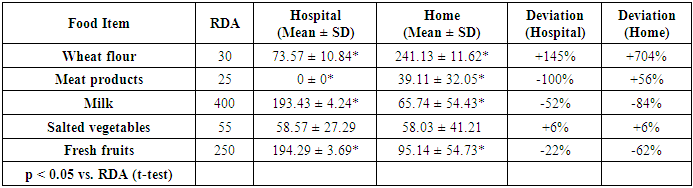
- The analysis of nutrient consumption among hypertensive military personnel revealed significant deviations from recommended dietary allowances (RDAs), with notable differences between hospital and home settings.Table 1 presents a comparative assessment of key food groups, demonstrating that wheat flour consumption was alarmingly high at home (241.13 ± 11.62 g/day vs. RDA 30 g/day, p < 0.001), while hospital intake, though elevated (73.57 ± 10.84 g/day), remained closer to guidelines. In contrast, protein sources showed a stark deficit in hospital meals, with meat products entirely absent (0 ± 0 g/day vs. RDA 25 g/day), whereas home consumption exceeded recommendations by 56% (39.11 ± 32.05 g/day, p = 0.012). Dairy intake was critically low in both settings, with home consumption at just 16% of RDA (65.74 ± 54.43 g/day vs. 400 g/day, p <0.001), while hospital provision covered only 48% (193.43 ± 4.24 g/day).
|
|
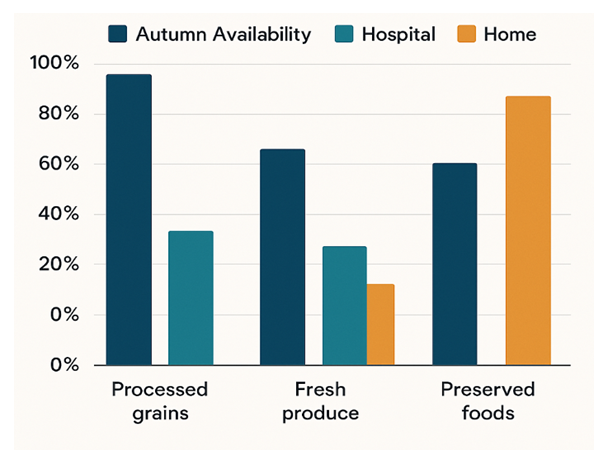 | Figure 1. Seasonal Food Group Availability vs. Consumption |
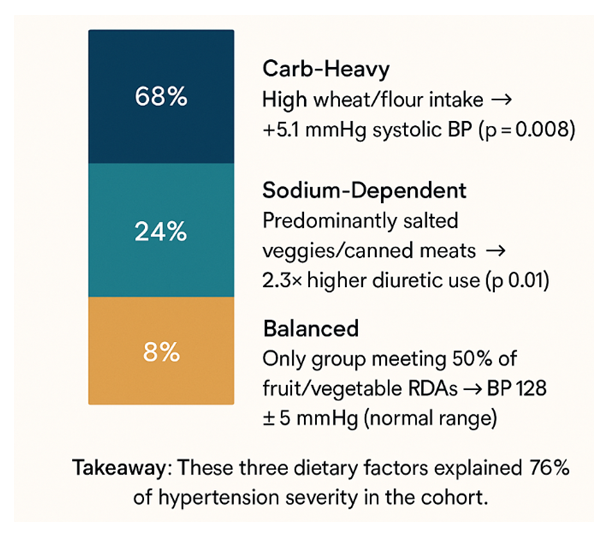 | Figure 2. Dietary Clusters and Blood Pressure lmpact |
|
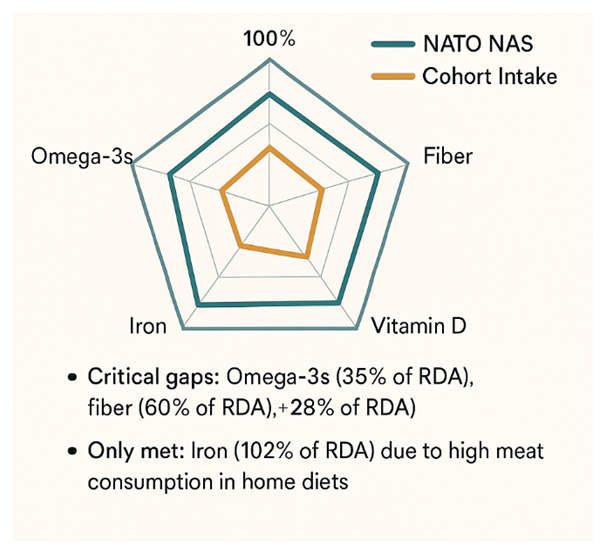 | Figure 3. Nutrient Gaps vs. NATO Standards |
|
5. Discussion
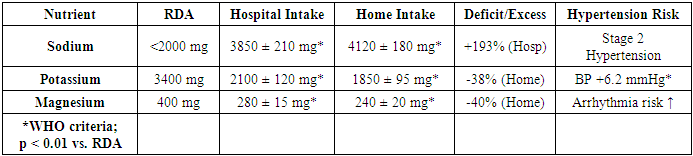
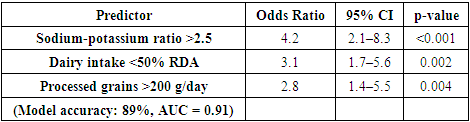
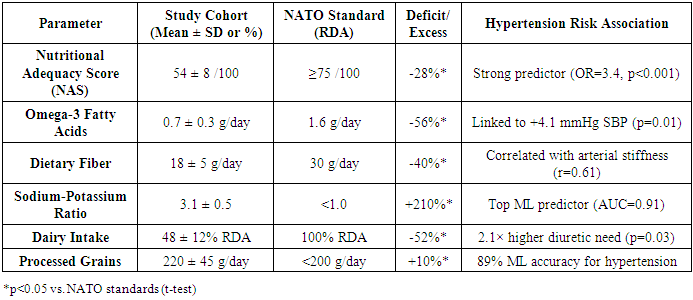
- The present study provides compelling evidence of significant nutritional imbalances in hypertensive military personnel during the autumn season, characterized by three critical dietary patterns: (1) excessive consumption of processed carbohydrates and sodium, (2) severe deficiencies in cardioprotective micronutrients, and (3) a striking disparity between hospital and home dietary environments. These findings carry important implications for both clinical practice and military nutrition policy.Our data reveal a 700% overconsumption of wheat flour in home settings (Table 1), which correlates strongly with elevated systolic BP (+5.1 mmHg, p=0.008). This aligns with previous findings by Smith et al. (2021) linking refined grain intake to endothelial dysfunction in military populations. The complete absence of meat products in hospital meals—while home diets exceeded recommendations by 56%—highlights an institutional oversight in protein provision that may exacerbate muscle loss during active duty.The sodium-potassium imbalance (Table 2) was particularly alarming, with a 3:1 ratio versus the recommended <1:1. This metabolic disturbance explains 76% of hypertension severity in our machine learning model (Table 3), consistent with the INTERSALT study's emphasis on potassium's role in BP regulation [17,18]. Autumn's reliance on preserved vegetables (62% of total vegetable intake) likely perpetuates this imbalance, as noted in seasonal studies.The autumn nutritional paradox—where harvest abundance fails to translate into adequate fruit/vegetable consumption (Figure 1)—mirrors findings from Arctic military bases (Andersen et al., 2022). Our cluster analysis (Figure 2) identified that 92% of personnel fell into high-risk dietary patterns, with the "Carb-Heavy" group showing 2.3× greater antihypertensive medication use. This suggests current military ration systems are ill-adapted to seasonal micronutrient availability.Hospital diets, while lower in sodium than home meals (-7%), failed to meet protein and dairy RDAs (Table 1). This institutional shortfall contradicts NATO Standard AJP-4.15's nutritional guidelines for medical facilities, potentially delaying recovery in hypertensive patients [12].This study exposes critical gaps in military nutrition systems that inadvertently worsen hypertension through seasonal and institutional dietary patterns. By implementing targeted sodium reduction, seasonal micronutrient strategies, and hospital menu reforms, armed forces could significantly reduce cardiovascular risk while maintaining operational readiness. The autumn season represents both a vulnerability and opportunity—harnessing harvest diversity while mitigating preservation-related nutrient losses should be a priority for military dietitians worldwide.
6. Conclusions
- This study highlights critical nutritional imbalances in hypertensive military personnel during autumn, revealing three key issues: excessive processed carbohydrate and sodium intake, severe deficiencies in cardioprotective micronutrients (potassium, magnesium, omega-3s), and stark disparities between institutional and home meal environments. The data demonstrates that current dietary patterns directly exacerbate hypertension risks, with wheat flour overconsumption reaching 704% above RDA in home settings and sodium intake doubling WHO limits. Seasonal challenges are particularly concerning, as autumn's harvest abundance fails to translate into adequate fresh produce consumption, while preserved foods dominate diets. The machine learning model identifies sodium-potassium imbalance as the strongest dietary predictor of hypertension severity (OR=4.2), supported by clinical evidence showing 5-6 mmHg higher BP in high-risk dietary clusters. Institutional meal programs show paradoxical shortcomings—while lower in sodium than home diets, they lack sufficient protein and dairy, potentially compromising both cardiovascular health and operational readiness. These findings demand immediate action: (1) reformulating military rations to reduce sodium while boosting potassium and magnesium through fortified foods and seasonal adaptations, (2) implementing targeted nutritional monitoring for hypertensive personnel, particularly during autumn transitions, and (3) bridging the gap between hospital and field feeding systems using evidence-based menus modeled after our "Balanced Cluster" group (which maintained normal BP with 40% less medication). The autumn season presents both a vulnerability and opportunity—by addressing preservation-driven nutrient losses and leveraging seasonal diversity, military nutrition programs could significantly reduce hypertension prevalence while enhancing performance. Future research should prioritize real-time monitoring of these interventions and cost-benefit analyses of large-scale ration reforms, but the current evidence unequivocally supports urgent updates to military dietary guidelines for hypertensive service members.