
-
Paper Information
- Paper Submission
-
Journal Information
- About This Journal
- Editorial Board
- Current Issue
- Archive
- Author Guidelines
- Contact Us
American Journal of Medicine and Medical Sciences
p-ISSN: 2165-901X e-ISSN: 2165-9036
2025; 15(4): 1306-1308
doi:10.5923/j.ajmms.20251504.96
Received: Mar. 18, 2025; Accepted: Apr. 20, 2025; Published: Apr. 30, 2025

Improvement of Anesthetic Protection in Simultaneous Operations on Abdominal and Pelvic Organs
 Abstract
 Reference
 Full-Text PDF
 Full-text HTML
Kurbanov Navruzbek Zayniddinovich , Pardaev Shukur Kuliyevich , Sharipov Isroil Latobovich
Department of Anesthesiology, Resuscitation and Emergency Medicine of the Samarkand State Medical University, Samarkand, Uzbekistan
Correspondence to: Kurbanov Navruzbek Zayniddinovich , Department of Anesthesiology, Resuscitation and Emergency Medicine of the Samarkand State Medical University, Samarkand, Uzbekistan.
| Email: |  |
Copyright © 2012 Scientific & Academic Publishing. All Rights Reserved.
This work is licensed under the Creative Commons Attribution International License (CC BY).
http://creativecommons.org/licenses/by/4.0/

The consideration of reliable means of anesthesia when performing one-stage operations on the abdominal and pelvic organs is one of the most important links in the treatment of surgical patients. Study of surgical stress severity, regional anesthesia method application, hypnotic component, influence of artificial lung ventilation, anesthesia in surgery, general anesthesia, and opioids on cognitive and psychomotor functions; provision of positive effect when epidural anesthesia is used in combination with general anesthesia.
Keywords: Surgical stress, Complications, Sedative component, Anesthetics, Anesthesia, Epidural analgesia
Cite this paper: Kurbanov Navruzbek Zayniddinovich , Pardaev Shukur Kuliyevich , Sharipov Isroil Latobovich , Improvement of Anesthetic Protection in Simultaneous Operations on Abdominal and Pelvic Organs, American Journal of Medicine and Medical Sciences, Vol. 15 No. 4, 2025, pp. 1306-1308. doi: 10.5923/j.ajmms.20251504.96.
1. Introduction
- Co-morbidities are increasing rapidly due to the increase in the average life expectancy of the population, the impact of environmental damage and damage to the diagnosis. Recently, pathogenetic support has allowed us to find new things in the combination of diseases of different organs and systems that are interrelated. In 2021, the World Health Organization published statistics, according to which there are diseases related to production. At the same time, only 1.5-6% of low-income people are undergoing intervention at this stage, depending on their actual participation in order to provide necessary medical care to patients and participate in maximum medical, social and economic support. effect. At the same time, the paucity of cases is explained by various reasons: incomplete examination of postoperative diseases, surgical intervention and the strength of surgery in the abdominal cavity and small pelvis is explained by the unpreparedness of surgical psychologists.Main part: Evaluation of the effectiveness of anesthesiological approach in simultaneous operations of various abdominal and pelvic organs.
2. Material and Inspection Methods
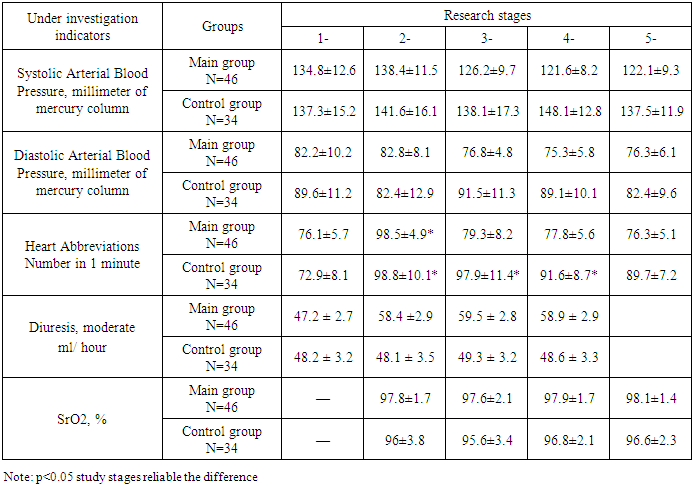
- For examination, 80 surgical patients who underwent simultaneous abdominal surgery were studied. Their age ranged from 35 to 72 years (average 54.6 +- 6.6): men - 35-43.75%, women - 45-56.25%. Patients were divided according to the nature of simultaneous surgery as follows: hernigastrectomy and cholecystectomy - 29 patients, liver echinococcectomy and cholecystectomy - 16, hemiolaparotomy and cholecystectomy - 18 patients, hermiolaparotomy and hysterectomy - 17 patients. Patients in the main group (46 patients) underwent multicomponent general and epidural anesthesia (EA) in combination. Epidural puncture and catheterization were performed 30-40 minutes after standard premedication based on general rules. The puncture site was selected taking into account the organs to be operated on. Local isobaric anesthetic longocaine (Ukraine) was used at the rate of 0.5%-1.5 mg/kg. Total intravenous anesthesia was performed on the background of PV to 34 patients in the control group in similar procedures. As a general anesthetic, ketamine 5-6 mg/kg/h, thiopental sodium 3-5 mg/kg/h, NLA drugs and myorelaxant arduan in doses of 0.04-0.06 mg/kg/h were used – 12 - 01, Japan).) (MPR6 - 03 - "Triton" Russia) was evaluated by hemodynamic indicators, and in the postoperative period using a visual analog scale (VASH).
|
3. Conclusions
- Combined anesthesia (It is wax A anesthesia +E pidural A anesthesia ) during traumatic simultaneous operations of thae abdominal cavity and small pelvic organs ensures a smooth intraoperative period, significantly reduces the consumption of narcotic analgesics and general anesthetics, and allows the patient to wake up earlier. came Postoperative epidural analgesia activated the patient earlier, activated breathing and bowel movements, reduced intensive care unit and intensive care unit days, which means cost-effectiveness.