
-
Paper Information
- Paper Submission
-
Journal Information
- About This Journal
- Editorial Board
- Current Issue
- Archive
- Author Guidelines
- Contact Us
American Journal of Medicine and Medical Sciences
p-ISSN: 2165-901X e-ISSN: 2165-9036
2025; 15(2): 330-333
doi:10.5923/j.ajmms.20251502.14
Received: Jan. 20, 2025; Accepted: Feb. 10, 2025; Published: Feb. 13, 2025

Evaluation of the Influence of Toll-Like Receptor Gene Polymorphisms (TLR4 (-728 GC) and TLR4 (-2272 AG)) on the Development and Course of Chronic Liver Diseases
 Abstract
 Reference
 Full-Text PDF
 Full-text HTML
Sadikjon Babayevich Sadikov1, Ravshanbek Babajonovich Abdullaev1, Dilfuza Saburovna Matkarimova2, Kodirzhon Tukhtaboevich Boboev3
1Urganch Branch of Tashkent Medical Academy, Department of Internal Medicine, Rehabilitation and Folk Medicine, Urganch City
2Department of Hematology, Transfusiology and Laboratory Science, Tashkent Medical Academy MoH RUz, Tashkent, Uzbekistan
3Laboratory of Medical Genetics, Republican Specialized Scientific-Practical Medical Center of Hematology MoH RUz, Tashkent, Uzbekistan
Correspondence to: Sadikjon Babayevich Sadikov, Urganch Branch of Tashkent Medical Academy, Department of Internal Medicine, Rehabilitation and Folk Medicine, Urganch City.
| Email: |  |
Copyright © 2025 The Author(s). Published by Scientific & Academic Publishing.
This work is licensed under the Creative Commons Attribution International License (CC BY).
http://creativecommons.org/licenses/by/4.0/

To study the degree of participation of polymorphic variants of TLR4 (-728 GC) and TLR4 (-2272 AG) Toll-like receptor genes in the risk of chronic liver disease development and severity of its course. The study included 162 adults (median age 53.3±1.4 years), among whom 82 were patients with CLD (1st main group: - 38 with chronic viral hepatitis (CH) and 44 with liver cirrhosis (LC)) who were under treatment in the therapy department of Khorezm Regional Multidisciplinary Medical Center (KRMMC) in the period from 2020 to 2023 and 80 - conditionally healthy volunteers (mean age 51.8±1.7 years). SNP genotyping of TLR4 (-728 GC) and TLR4 (-2272 AG) genes was performed. DNA was extracted from whole blood using the DNA-Sorb-B reagent kit (Russia). Genotyping was performed by PCR using a universal reagent kit (Litech, Russia) according to the manufacturer's instructions. The statistical software package “OpenEpi 2009, Version 9.2” was used for mathematical calculations of the obtained results. The distribution of observed and expected frequencies of genotypes of the studied polymorphic gene was compared according to Hardy-Weinberg equilibrium (HWE) (P>0.05), comparative analysis of SNPs of TLR4 (-728 GC) and TLR4 (-2272 AG) genes between groups of patients and healthy individuals (case-control) was performed by calculation of χ2 criterion, reliability (P), odds of development (OR) and confidence interval (95% Cl). Detected differences were considered reliable at P ≤0.05. Differences in the distribution of SNPs of TLR4 (-728 GC) and TLR4 (-2272 AG) genes that did not reach a statistically significant level between the groups of patients with CLD and healthy controls confirm the absence of their independent functional involvement in the risk of CLD (CH and CLD) development and their course aggravation.
Keywords: Chronic liver disease, Chronic hepatitis, Cirrhosis, Toll-like receptors, TLR4 (-728 GC), TLR4 (-2272 AG), Risk of development, Severity of course
Cite this paper: Sadikjon Babayevich Sadikov, Ravshanbek Babajonovich Abdullaev, Dilfuza Saburovna Matkarimova, Kodirzhon Tukhtaboevich Boboev, Evaluation of the Influence of Toll-Like Receptor Gene Polymorphisms (TLR4 (-728 GC) and TLR4 (-2272 AG)) on the Development and Course of Chronic Liver Diseases, American Journal of Medicine and Medical Sciences, Vol. 15 No. 2, 2025, pp. 330-333. doi: 10.5923/j.ajmms.20251502.14.
Article Outline
1. Introduction
- Chronic liver diseases (CLD) among diseases of the organs of the hepatobiliary system, represent one of the important problems of both medical and social significance [11]. The medical and social significance of the problem is determined by the progressive tendency to increase the incidence of CLD among the active population worldwide, associated with both the increasing prevalence of hepatotropic infections and the negative impact of the environment [1]. According to WHO, there are more than 2 billion people with chronic liver diseases of various etiologies in the world. At the same time, annual fatal outcomes from complicated course of CLD reach more than 300 000 cases [5].Prolonged exposure to the causative factor of CLD is characterized by a progressive course of the disease leading to rapid development of disability of patients [7]. At the same time, the persisting activity of inflammatory process in the liver creates the basis for the development of diffuse pathological process, accompanied by disruption of liver architectonics and formation of liver cirrhosis (LC) in the final stage, often leading to cancerous transformation of liver tissue [9].The causes and mechanism of development of chronic liver diseases are diverse, with hepatotropic viral agents being the most common among the causes [9]. The mechanism of formation remaining complex and not completely clear suggests the involvement of genetic factors, among which polymorphic genes of Toll-like receptors are of special interest. Toll-like receptors are one of the leading signaling systems that actively regulate innate and adaptive immunity and are active in pathogen ligand recognition [2,10].Studies evaluating the role of Toll-like receptor (TLR) gene polymorphisms in chronic liver disease have been reported in the literature [4,8]. However, while some researchers report the influence of different polymorphic variants of TLR genes on the susceptibility of the organism to hepatotropic viruses and the progression of liver disease [6], other authors provide data that genetic variants in the TLR3 gene may have a protective effect on the development of chronic viral hepatitis (CH), liver cirrhosis (LC) and hepatocellular carcinoma (HCC) [3].At the same time, there are no data on studying the degree of participation of single nucleotide polymorphisms of TLR4 (-728 GC) and TLR4 (-2272 AG) genes in CLD in the Republic of Uzbekistan, which served as a basis for the present study.
2. Main Body
2.1. The Purpose of Our Research
- To study the degree of participation of polymorphic variants of TLR4 (-728 GC) and TLR4 (-2272 AG) Toll-like receptor genes in the risk of chronic liver diseases development and severity of their course.
2.2. Material and Methods of Study
- The study included 162 adults (median age 53.3±1.4 years), among whom 82 were patients with chronic liver disease (CLD) (main group): - 38 with chronic viral hepatitis (CH) (1st main group) and 44 with liver cirrhosis (LC) (2nd main group), who were under treatment in the therapy department of the Khorezm Regional Multidisciplinary Medical Center (KRMMC) in the period from 2020 to 2023 and 80 – conditionally healthy volunteers (mean age 51.8±1.7 years). The diagnosis was made based on the standards of CLD diagnostics taking into account clinical, laboratory (biochemical blood tests, PCR analysis for viral hepatitis markers (HBsAg, anti-HCV, anti-HDV)) and instrumental (ultrasound, liver fibroscanning) data.SNP genotyping of TLR4 (-728 GC) and TLR4 (-2272 AG) genes was performed. DNA was extracted from whole blood using the DNA-Sorb-B reagent kit (Russia). Genotyping was performed by PCR using a universal reagent kit (“Litech”, Russia), according to the manufacturer's instructions, with amplification reaction (amplification with DNA pre-denaturation was performed at 93°C for 1 minute; 35 cycles of denaturation at 93°C for 10 seconds; primer annealing at 64°C for 10 seconds; elongation process at 72°C for 20 seconds; DNA synthesis at 72°C for 1 minute). The method was adapted for testing with a Rotor-Gene 6000 (Corbett Research, Australia).The statistical software package “OpenEpi 2009, Version 9.2” was used for mathematical calculations of the obtained results. The distribution of observed and expected genotype frequencies of the studied polymorphic gene was compared according to the Hardy-Weinberg equilibrium (HWE) (P>0.05), comparative analysis of SNPs of TLR4 (-728 GC) and TLR4 (-2272 AG) genes between the groups of patients and healthy controls (case-control) was performed by calculating the χ2 criterion, reliability (P), odds of development (OR) and confidence interval (95% Cl). Detected differences were considered reliable at P≤0.05.
2.3. Results of the Study
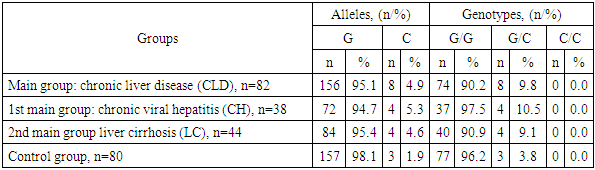
- The pattern of distribution of observed (No) and expected (No) genotype frequencies for TLR4 (-728 GC) and TLR4 (-2272 AG) polymorphic genes did not deviate from Hardy-Weienberg equilibrium (HWE, p>0.05).The functional evaluation of TLR4 polymorphic gene (-728 GC) in relation to the risk of chronic liver disease (CHD and CLD) in the main group of patients when compared with healthy controls revealed no statistically significant differences in the frequencies of impaired allele and genotype, among which in the group with chronic liver disease the C allele was unreliably more frequent in 2.7 times (4.9% vs. 1.9%; χ2=2.2; P=0.2; OR=2.7; 95%CI: 0.73-9.81), and the G/C genotype 2.8 times (9.8% vs. 3.8%; χ2=2.3; P=0.2; OR=2.8; 95%CI:0.74-10.35).In turn, this was the basis for confirming the lack of independent functional significance of the studied gene in the risk of CLD (see Table 1).
|
|
3. Conclusions
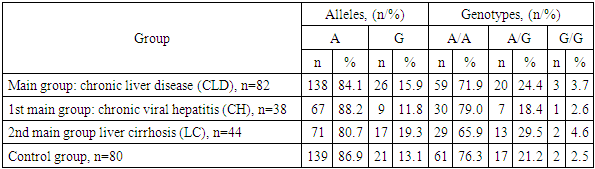
- Thus, structural and functional analysis of SNPs of TLR4 (-728 GC) and TLR4 gene (-2272 AG) genes in chronic liver diseases (CLD) (chronic hepatitis (CH) and liver cirrhosis (LC)) in comparison with healthy parameters allowed to determine the absence of their independent participation in the formation of chronic liver diseases (CLD) despite the more frequent occurrence of impaired alleles and genotypes for the studied genes among patients. In the main group in relation to the healthy group the differences in frequencies of allele C and genotype G/C by SNP of TLR4 gene (-728 GC) were statistically unreliably increased in 2.7 (χ2=2.2; P=0.2) and 2.8 (χ2=2.3; P=0. 2) times, in CH by 2.9 (χ2=2.1; P=0.2) and 2.8 (χ2=1.8; P=0.2) times, and, in cirrhosis of the liver (LC) by 2.5 (χ2=1.5; P=0.3) and 2.6 (χ2=1.5; P=0.3) times, respectively, with respect to similar values among healthy controls.Comparing the distribution features of alleles and genotypes of SNPs of the TLR4 gene (-2272 AG) in the patient group of patients in relation to a sample of healthy controls in the differences in the main group with chronic liver disease (CLD) (G – χ2=0.5; P=0.5; OR=1.2; A/G - χ2=0.2; P=0.7; OR=1.2 and G/G - χ2=0. 2; P=0.7; OR=1.5), in the group with chronic hepatitis (CH) (G - χ2=0.1; P=0.8; OR=0.9; A/G - χ2=0.1; P=0.8; OR=0.8) and G/G - χ2<3.84; P=0.98; OR=1.1) and in the group with liver cirrhosis (LC) (G – χ2=1.7; P=0.2; OR=1.6; A/G - χ2=1.1; P=0.3; OR=1.6; and G/G – χ2=0.4; P=0.6; OR=1.9) also did not reach statistically significant levels.In this regard, the differences in the distribution of SNPs of TLR4 (-728 GC) and TLR4 (-2272 AG) genes that did not reach statistically significant level between the groups of patients with chronic liver diseases (CLD) and healthy controls confirm the absence of their independent functional involvement in the risk of chronic liver diseases (CLD) (chronic hepatitis (CH) and liver cirrhosis (LC)) and in the aggravation of their course.It is proposed to conduct further research in the field of searching for SNPs of other genes that could have statistically significant significance in the development of chronic liver diseases, as well as to study their gene-gene interactions.