Rahmatov A. A.
Bukhara State Medical Institute, Bukhara, Uzbekistan
Correspondence to: Rahmatov A. A., Bukhara State Medical Institute, Bukhara, Uzbekistan.
Copyright © 2025 The Author(s). Published by Scientific & Academic Publishing.
This work is licensed under the Creative Commons Attribution International License (CC BY).
http://creativecommons.org/licenses/by/4.0/

Abstract
The immunograms of 93 sick children with chronic purulent otitis media on the background of chronic hepatitis (39 mesotympanitis and 54 epitympanitis) were studied. A comparative analysis of immunogram indices was carried out depending on the severity of inflammatory changes and the inclusion of imunofan in the therapy regimen. The results of the work showed that in sick children with chronic purulent otitis media against the background of chronic hepatitis, the immunogram reflects the peculiarities of the course of the inflammatory process. Chronic inflammatory process in the temporal bone and surgical trauma sharply suppress cellular and humoral immunity, which prompts the use of immunocorrectors in the scheme of postoperative treatment. The inclusion of imunofan in the therapy scheme allowed to completely normalize the immunogram indices in patients with epitympanitis and to improve the clinical course of the postoperative period.
Keywords:
Chronic hepatitis, Immunogram, Cellular and humoral immunity, Imunofan, Chronic otitis media
Cite this paper: Rahmatov A. A., Immunological Aspects of Diagnosis and Treatment of Sick Children with Chronic Purulent Medium Otititis on the Background of Chronic Hepatitis В, American Journal of Medicine and Medical Sciences, Vol. 5 No. 1, 2025, pp. 149-152. doi: 10.5923/j.ajmms.20251501.28.
1. Introduction
The modern literature provides a lot of data on the relationship between the development of a viral infection and pronounced changes in the immune system, which are classified as secondary immunodeficiency states [5,6,12]. An increase in the number of chronic inflammatory diseases of the middle ear against the background of chronic hepatitis and a change in their clinical course [1,9,13] dictates the need for an in-depth study of the mechanisms of development of this pathology and the development of pathogenetic effects on the chronic inflammatory process. It is known that one of the reasons for the formation of chronic purulent otitis media on the background of chronic hepatitis is a change in general and local immunity [3,7,14]. The main indicators of cellular and humoral immunity are combined by the concept of "immunogram" [4,5,10,11]. Imunofan is used to correct immunological disorders as part of the combination therapy of a number of diseases [2,8,15]. However, information about the use of imunofan in otorhinolaryngology, including in the treatment of epithympanitis, is not found in the literature. Objective: to study the immunogram parameters in patients with chronic purulent otitis media and to evaluate the effectiveness of standard and combined therapy with the use of imunofan.
2. Materials and Methods
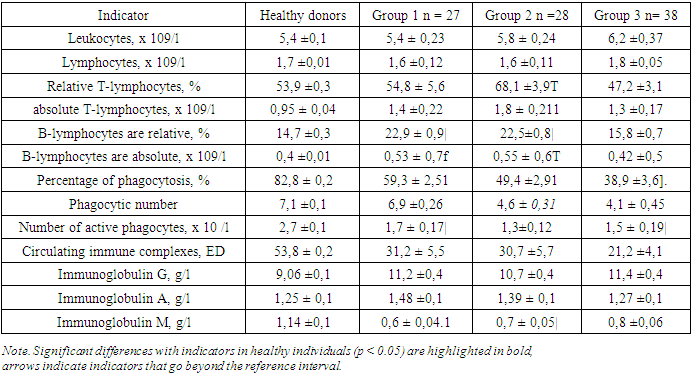
On the first day of hospitalization, the immunograms of 93 patients with chronic purulent otitis media (51 boys, 42 girls) were examined. All examined patients, depending on the activity of the inflammatory process, were divided into three groups. The first group consisted of 27 patients with mesotimpanitis (code H66.1 according to the International Classification of Diseases) who received only conservative therapy. The second group consisted of 28 patients with epithympanitis (code 66.2), who simultaneously underwent sanitizing and functional operations on the middle ear. The third group included 38 patients with epithympanitis who, due to the vastness of pathological changes (a significant amount of destructive destruction, large cholesteatoma, labyrinth fistula, sub- and epidural abscesses, facial nerve paresis), underwent only a sanitizing operation.Upon discharge from the hospital, the immunogram was analyzed in 54 patients with epithympanitis, of which two groups were formed. The control group included 26 patients who underwent standard therapy in the postoperative period (antibiotics, hyposensitizing drugs, symptomatic and local therapy), the main group consisted of 28 patients who, upon discharge from the hospital, had an immunogram analyzed in 54 patients with epithympanitis, of which two groups were formed. The control group included 26 patients who received standard therapy in the postoperative period (antibiotics, hyposensitizing drugs, symptomatic and local therapy), the main group consisted of 28 patients who received standard postoperative treatment enhanced by intramuscular administration of imunofan 1 ml every other day for 10 days (5 injections). The material was processed using a set of descriptive statistics parameters implemented in the Microsoft Excel analysis package for Windows XP. The differences in relative and absolute values were determined using the critical values of the Student's criterion (t). The differences at t > T critical were considered reliable, corresponding to the significance level p < 0.05.The results of the study of immunograms of patients with chronic purulent otitis media indicated significant changes in the key links of both cellular and humoral immunity. In clinical groups, there is an increasing suppression of all links of immunity with an increase in the severity of the inflammatory process (Table 1). In the cellular immunity of patients of the first clinical group, although there is a decrease in the number and functional activity of phagocytes, significant differences in indicators are determined only by the number of active phagocytes - 1.7 ± 0.17 x 10⁹ / l (p < 0.05 to the indicators of healthy donors). In patients of the second group, the inhibition of cellular immunity increases, the percentage of phagocytosis decreases to 49.4 ± 2.9% (p < 0.05), the phagocytic number to 4,610,31 (p < 0.05), the number of active phagocytes - up to 1.3 ± 0.12 x 10⁹ / l (p < 0.05). In the third clinical group, the percentage of phagocytosis and the number of active phagocytes in none of the patients reached the lower limit of the reference interval, and the average figures were significantly lower than the average values of similar indicators in the first and second groups. The percentage of phagocytosis in the third group decreased to 38.9 In 3.6% (p < 0.05), the phagocytic number - to 4.1+0.45 (p 0.01), the number of active phagocytes– to 1.51 0.19 x 10% (p < 0.01) (Table 1). The deepest depletion of the cellular link of immunity was found in patients with a long-term destructive cholesteatomic process in the temporal bone and a relapse of epithympanitis after a previously performed sanitizing operation.Table 1. Average immunogram values in patients with chronic purulent otitis media, depending on the severity of the inflammatory process
 |
| |
|
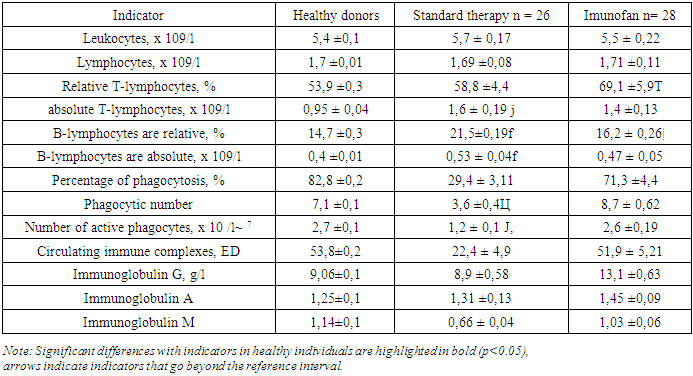
The average numbers of leukocytes in all clinical groups were recorded within the acceptable reference interval, increasing from the first group to the third, reaching significant differences in the latter with indicators in healthy donors - 6.2 ± 0.37 x 10⁹/l (p < 0.05). In patients of the first and second groups, the intensity of humoral immunity was noted, expressed in an increase in the number of T- and B-lymphocytes, especially noticeable in young patients. In the third group, there was no adequate immunological response to the chronic process. Despite the predominance of patients with pronounced inflammatory changes in the temporal bone, including recurrent and complicated, the absolute and relative numbers of T- and B-lymphocytes were within acceptable reference numbers (Table 1).The increasing immunosuppression is also seen by other indicators of humoral immunity. In all clinical groups, both in general and throughout the sample, there is a decrease in the titer of circulating immune complexes. In the first group, their figures were 3 ± 5.5 units, in the second they decreased to 30.7 ± 5.7 units, in the third - to 21.2 ± 4.1 units. Similarly, immunoglobulin A titers decreased: from 1.48 ± 0.1 g/l in the first group, to 1.39 ± 0.1 g/l in the second and 1.27 ± 0.1 g/l in the third (Table 1).The results of comparing the indicators of cellular and humoral immunity in clinical ipynnax revealed an increasing immunodeficiency in patients with chronic purulent otitis media, depending on the severity of inflammatory changes. This circumstance encourages the inclusion in the treatment regimen, especially severe destructive cholesteatomic, recurrent and complicated epithympanitis, immunocorrecting drugs.Analysis of the results of the immunogram before discharge showed significant changes in the cellular and humoral immunity in patients with chronic purulent otitis media after sanitizing surgical treatment. Such a condition after surgical treatment is described by many authors as "immunological paralysis". Thus, a sharp decrease in phagocytic activity was noted in patients of the control group. The percentage of phagocytosis in them was 29.4 ± 3.1% (p < 0.05 to the indicators of healthy donors), the phagocytic number was 3.6 ± 0.41, the number of active phagocytes was 1.2 ± 0.1 x 10⁹/l (reference interval 2.5 - 2.9 x 10⁹/l, p < 0.05) (Table 2). The data obtained confirm the fact of the immunosuppressive effect of surgical trauma and indicate the low immunocorrective effectiveness of traditional therapy prescribed in the postoperative period.Table 2. Average immunogram values in patients with epithympanitis before discharge from the hospital, depending on the use of Immunophane
 |
| |
|
It was noted that in most patients who received only 29.4 standard therapy, absolute and relative numbers of T- and B-lymphocytes were higher than in healthy donors, which affected the average indicators. Relative T-lymphocytes were 58.8±4.4%, absalum-1.6±0.19 x 10⁹/L, B-lymphocytes -21.5±0.19% and 0.53± 0.04 x 10⁹ /l. At the same time, a sharp decrease in the functional activity of cells was noted. Low indicators of circulating immune complexes were noted -22.4+ 4.9 units (p 0.05 to the indicators of healthy donors), immunoglobulin G-8.9+0.58g/l, immunoglobulin A-1.21+0.13 g/l and mmunoglobulin M-0.66+0.04g/l (Table 2). The inclusion of imunofan in the scheme of postoperative treatment of patients with chronic purulent otitis media allowed to normalize most indicators of cellular and humoral immunity by the time of discharge from the hospital. The percentage of phagocytosis in this group of patients was 71.3 ± 4.4% (p < 0.05 to control), the phagocytic number was 8.7 ± 0.62 (p < 0.05 to control), the number of active phagocytes was 2.6 ± 0.19 x 10⁹/l (p < 0.05 to control). The absolute and relative numbers of T- and B-lymphocytes, although determined at the level of the maximum figures of the reference interval, did not significantly differ from those in patients who received standard therapy (Table 2).The use of imunofana activated the functional activity of immunocytes. On average, all the compiled documents of humoral immunity are determined at the level of the highest granites of the reference interval and are significant from the indications in large ones treated according to the traditional scheme (p < 0.05). Thus, the average levels of circulating immune complexes increased to 51.9 ± 5.21, immunoglobulin G - to 13.1 ± 0.63 g/l, immunoglobulin A - to 1.55 ± 0.09 g/l, immunoglobulin M - to 1.03 ± 0.06 g/ l (Table 2).Combined imunofan therapy of postoperative patients with epithympanitis significantly reduced the percentage of patients with a high degree of immunological insufficiency. By the time of discharge from the hospital in 82.6% of patients who received only standard therapy, at least 5 immunogram indicators exceeded the limits of the reference interval. The administration of imunofan allowed to reduce the proportion of patients with such immunological disorders to 14.8% (p < 0.05).The beneficial effect of using imunofan in the postoperative period in patients with epithympanitis is noticeable not only in the restoration of immunological, but also in positive changes in the clinical status of patients. In most patients, by the time they were discharged from the hospital (8-12 days), exudation from the postoperative cavity was scanty, areas of epidermization began to appear.Thus, in patients with chronic purulent otitis media, the immunogram reflects the features of the course of the inflammatory process, which must be taken into account in the diagnosis and treatment regimen. Chronic inflammatory process in the temporal bone and surgical trauma sharply inhibits cellular and humoral immunity, which prompts the use of immunocorrectors in the scheme after surgical treatment. The inclusion of Immunophane in the therapy regimen made it possible to completely normalize the immunogram indicators in children with epithympanitis and improve the clinical course of the postoperative period.
References
| [1] | Vlasova G. V., Egorov L. V., Yu A. Kotov Features of general and local immunological reactivity in children with chronic otitis media // Cytokines and inflammation. - 2015. – Р. 4. -Р. 54-56. |
| [2] | Karaulov A.V., Sokurenko S. I. Imunofan: immediate and long-term results of treatment of patients with chronic bronchitis // Medical Market. 1 2012. - No. 34. - Р.21-24. |
| [3] | Lantsov A. A., Khmelnitskaya N. M., Endaltseva E. B. Local immunity and treatment of patients with chronic purulent otitis media // News of otorhinolaryngology and logoptology. - 2013. - No. 1. -Р. 3-7. |
| [4] | Lebedev K. A., Ponyakina I. D. Immunogram in clinical practice. - M.: Nauka, 2014. -P. 1224. |
| [5] | Lolor-ml G., Fischer D. Adelman Clinical immunology and allergology. edited by G. Lolor-ml.; trans. from English I. M.: Praktika, 2015. -Р. 1 806. |
| [6] | Pinegin P. V., Andronova T. M., Karsonova M. I. Modern ideas about immunoprophylaxis and immunotherapy of surgical infections // Anesthesiology and resuscitation. - 2012. - No. 3. - Р. 61-67. |
| [7] | Pogosov V. S., Polyakova S. D. Effectiveness of combined immunocorrection in the treatment of patients with chronic epithympanitis// Bulletin of Otorhinolaryngology - 2017. - No. 5. -Р. 12-15. |
| [8] | Pokrovsky V. I. Imunofan - regulatory peptide in the therapy of infectious and non-communicable diseases. - M.: Praminko, 2018. - P. - 119. |
| [9] | Polyakova S. D. Dependence of the effectiveness of immunocorrection on blood groups in patients with chronic purulent otitis media // Bulletin of otorhinolaryngology. - 2018. - No. 5. - Р. 18-19. |
| [10] | Narzulaev N.U., Khamidova N.K., Mirzayeva M.R. Clinical and immunological study of the effect of various types of therapy on the course of allergic rhinitis in children with hymenolepidosis // Annals of the Romanian Society of Cell Biology 2021. pp. 1900-1908. |
| [11] | Narzullaev N.U., Mirzayeva M.R. Immunological features of infectious diseases etiology of mononucleosis caused by Epstein-Barr virus in children // International Journal of Pharmaceutical Research 2021, pp. 2667-2671. |
| [12] | Narzullaev N.U., Rakhmatov A.A. Cytokine profile in children with acute inflammation of the middle earth on the background of chronic active hepatitis // Tibbietda yangi kun. No. 2 (34). Tashkent 2021, pp. 15-17. |
| [13] | Jonas M.M., Blok J.M., Huber B.A. et al. Treatment of children with chronic hepatitis B virus infection in the United States: patient selection and thiacerapy options. Hepatology 2018. -Р. 2192-2205. |
| [14] | Pawlowska M., Halota W., Swukalska E., Wozniakowska - Gesica. Kups. HBV DNA suppression during en tecavir treatment in previously treated children wich chronic hepatitis. Microbiol Infect. Dis. (2017) 31. -Р. 571-574. |
| [15] | Treatment results of chronic hepatitis B in children retrospective study. The Turkish journae of pediatrics. 2014. –Р. 360-366. |


 Abstract
 Reference
 Full-Text PDF
 Full-text HTML