
-
Paper Information
- Next Paper
- Previous Paper
- Paper Submission
-
Journal Information
- About This Journal
- Editorial Board
- Current Issue
- Archive
- Author Guidelines
- Contact Us
American Journal of Medicine and Medical Sciences
p-ISSN: 2165-901X e-ISSN: 2165-9036
2024; 14(12): 3442-3444
doi:10.5923/j.ajmms.20241412.78
Received: Dec. 16, 2024; Accepted: Dec. 29, 2024; Published: Dec. 31, 2024

Results of Studies of the State of the Autonomic Nervous System in Patients with Glossodynia
 Abstract
 Reference
 Full-Text PDF
 Full-text HTML
Rizayev Elyor Alimdzhonovich1, Khasanov Fozil Kozimzhonovich2
1MD, Professor, Tashkent State Dental Institute, Uzbekistan
2Samarkand State Medical University, Uzbekistan
Copyright © 2024 The Author(s). Published by Scientific & Academic Publishing.
This work is licensed under the Creative Commons Attribution International License (CC BY).
http://creativecommons.org/licenses/by/4.0/

Clinical manifestations of glossina are inconstant, varied and changeable. Possible: pain in the oral mucosa, changes in taste, xerostomia, etc., the intensity of which often increases at the end of each day. Various studies prove that patients with glossina have non-specific health complaints, including headaches, pain in the TMJ, dizziness, musculoskeletal disorders, irritable bowel syndrome, dermatological and mental disorders. It is believed that the clinical course of glossina depends on the characteristics of autonomic regulation. Improving the effectiveness of treatment for patients with glossina based on the study of changes in local hemodynamics of the tongue, autonomic dysfunctions and psych emotional state, as well as the development of a method for correcting disorders identified in the context of complex treatment.
Keywords: Autonomic dysfunctions and psych emotional, Complex treatment, Effectiveness of treatment
Cite this paper: Rizayev Elyor Alimdzhonovich, Khasanov Fozil Kozimzhonovich, Results of Studies of the State of the Autonomic Nervous System in Patients with Glossodynia, American Journal of Medicine and Medical Sciences, Vol. 14 No. 12, 2024, pp. 3442-3444. doi: 10.5923/j.ajmms.20241412.78.
1. Introduction
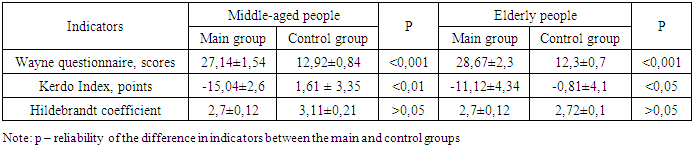
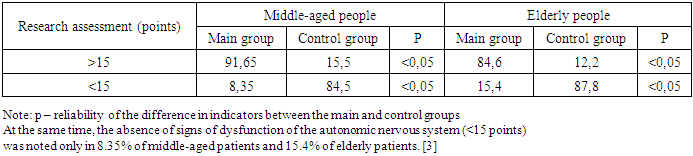
- In accordance with the purpose and objectives of the study, 45 patients with glossina aged 45-64 years who applied to the Department of Therapeutic Dentistry of the Samarkand State Medical University in 2022-2024 were examined. The examined patients were divided into 2 groups according to the WHO age classification: middle-aged (45-59 years old - 27 people) and elderly (60-74 years old - 18 people). There were 6 men (13.3%), 39 women (86.7%). Glossina was diagnosed according to the diagnostic criteria of ICD-11. [1]The presence of autonomic dysfunction was examined using the "Questionnaire for identifying signs of autonomic changes. According to this questionnaire, the total number of points in healthy individuals should not exceed 15. Exceeding this number indicates the presence of vegetative dysfunction. To assess the initial vegetative tone, the Kerdo vegetative index (KVI) was calculated:VIK = (1 - dBP/p) x 100,where dBP is diastolic pressure, p is pulse rate.In complete vegetative equilibrium (eutonia) in the cardiovascular system, VIC=0. The obtained numerical value VIC>0 indicates sympathicotonia, and the value VIC<0 indicates vagotonia. To analyze intersystem cardiorespiratory relationships, the Hildebrandt coefficient (the ratio of the heart rate to the respiratory rate per 1 minute) was calculated. The obtained coefficient between 2.8 and 4.9 indicates normal intersystem relationships, the index ≤ 2.7 indicates discoordination of the vegetative support of the respiratory and cardiac systems according to the vagotonic type, the index ≥ 5.0 - according to the sympathectomy type. [2]The results of the assessment of the presence of signs of dysfunction of the autonomic nervous system and the degree of its severity are presented in Table 1. The obtained results of the questionnaire indicate a significant violation of the regulatory functions of homeostasis and home kinesis in patients with glossina. Thus, signs of dysfunction of the autonomic nervous system in elderly patients were established in 91.4% of cases, in middle-aged people - in 84.2% with a reliability level in relation to the control group of 95%.
2. Materials and Methods
|
|
3. Results and Discussion
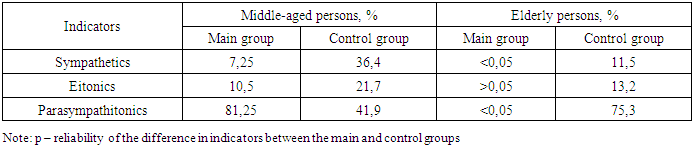
- Determination of the numerical values of the Vein questionnaire in points also confirmed changes in the regulation of vital processes in patients with glossina. The average statistical value of the vegetative test in middle-aged patients was 27.14±1.54 points, in elderly patients - 28.67±2.3 points (versus 12.92±0.84 and 12.3±0.7 points, respectively, in the control groups (p<0.001).Vegetative tone determines the activity of the body, with the help of which the function of all organs is regulated in order to maintain life and balance under external influences [4]. A study of the direction of the functions of the autonomic nervous system using the Kerdo index revealed parasympathetic symptoms in 81.25% of middle-aged patients and in 75.3% of elderly patients (p<0.05).
|
|
4. Conclusions
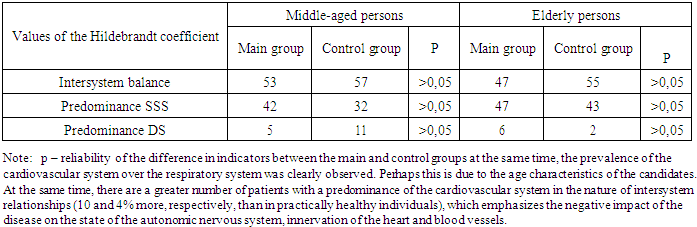
- Thus, significant signs of autonomic dysfunction were found in patients with glossina, which indicates that this disease is accompanied by disorders of the autonomic regulation of vital processes.The established shift in tone towards the predominance of parasympathetic functions in patients with glossina reflects the age-related characteristics of central hemodynamics and the negative impact of the disease on circulatory factors.The calculated Hildebrandt coefficient confirmed the discoordination of the autonomic support of the cardiac and respiratory systems according to the vagotonic type and the predominance of parasympathetic influences on the heart over the respiratory tract.